

Exotic and Collector Car Transport: How the Industry's Best Operators Actually Work
Most auto transport carriers have never loaded a $400,000 exotic. They've moved a lot of cars — but mid-engine exotics, race-prepped track cars, and ultra-low-clearance hypercars involve loading protocols, equipment requirements, and handling standards that fall entirely outside standard carrier operations.
This isn't a criticism of standard carriers. They're optimized for high volume, standard-height production vehicles. Exotic car transport is a different discipline, and the checklist that separates qualified specialists from well-intentioned generalists is more specific than most owners realize.
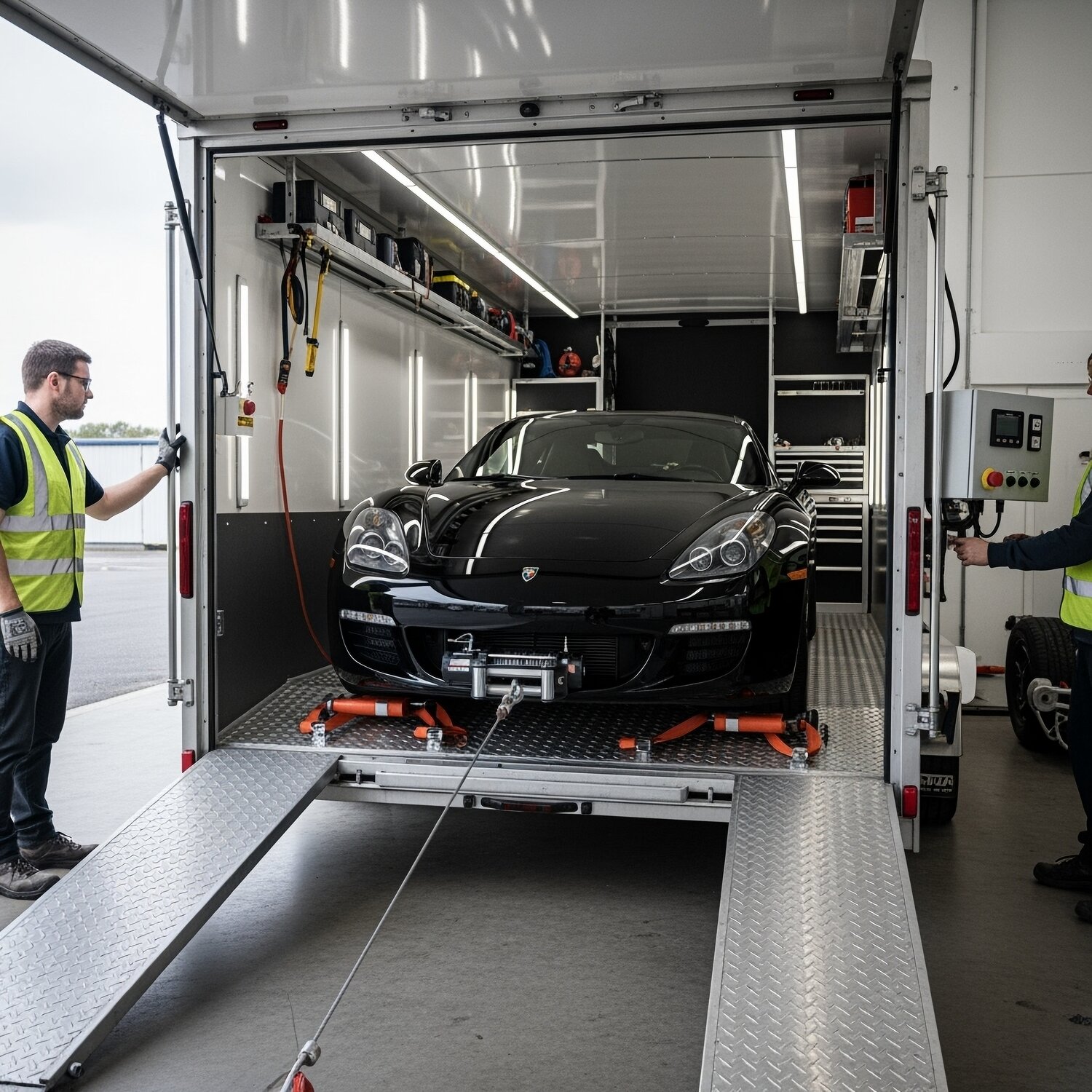
Why Exotics and Collector Cars Are Different to Transport
The challenges are primarily physical. Most exotics have ground clearance between 3.5 and 5 inches — significantly lower than the 5.5–7 inch clearance on a standard sedan. Many have:
- Carbon fiber body panels that don't absorb contact the way steel panels do — any impact is structural, not cosmetic
- Carbon-ceramic brake rotors that require soft-tie restraint systems to avoid stress fractures from hard-contact wheel chocking
- Active aerodynamic components (spoilers, diffusers, air intakes) that can be damaged by improper tie-down placement
- Mid-engine or rear-engine layouts that change weight distribution during loading
- Custom or bespoke paint finishes from specialty manufacturers that cannot be matched if damaged
Standard carrier operations aren't designed around any of these variables. Open carriers, wheel-contact tie-down systems, and standard ramp loading are correct for the vehicles they're designed to handle. They're not correct for an exotic.
Equipment: The Non-Negotiables
Enclosed Trailer, Hard-Sided
An exotic or collector car should travel in an enclosed, hard-sided trailer. Soft-sided enclosed trailers offer weather protection but limited protection from physical contact or highway debris. Hard-sided trailers provide full environmental isolation. For the full range of luxury car transport options — from single-car dedicated trailers to multi-vehicle enclosed loads — equipment specification is the starting point for any serious evaluation.
Trailer checklist:
- Air-ride suspension — reduces road vibration transmission to the vehicle, critical for older exotics or vehicles with original suspension components
- Climate-stable interior — prevents thermal stress on sensitive materials and finishes
- Full hard-sided enclosure — no ventilation gaps that allow road debris entry
Hydraulic Lift Gate Loading
Non-negotiable for any vehicle with less than 4.5 inches of ground clearance. Ramp loading requires the vehicle to transition between ramp angle and flat trailer surface — a point where the undercarriage is at maximum extension. For a McLaren 720S at 4.3 inches of clearance, ramp loading without a hydraulic liftgate is a liability event.
Soft-Tie Restraint Systems
Hard-tie systems — wheel straps, chains, rigid chocks — secure the vehicle through direct contact with the wheel or undercarriage. For a standard production vehicle, this is fine. For a vehicle with carbon-ceramic brakes, aftermarket lightweight wheels, or low-profile tires, hard-tie contact can cause:
- Stress fractures in carbon-ceramic rotor faces from lateral chocking pressure
- Rim damage from strap contact on lightweight forged or carbon fiber wheels
- Tire sidewall deformation under extended transport pressure
Soft ties connect to the vehicle's manufacturer-designated tie-down points — the same points used for factory transport — without hard contact on brake or wheel surfaces. This is the correct specification for exotic and collector car transport.
Carrier Vetting: What to Actually Verify
The auto transport carrier market has low barriers to entry. The FMCSA's motor carrier database allows anyone to look up a carrier's operating authority, safety rating, and insurance.
Before booking any carrier for an exotic or collector vehicle:
- Verify MC number and DOT number are active at safer.fmcsa.dot.gov
- Confirm cargo insurance coverage limits — federal minimums don't reflect the value of a high-end exotic
- Ask for the Certificate of Insurance, not just a verbal confirmation
- Request references specifically from exotic or collector car owners, not general auto transport reviews
- Confirm you're contracting directly with the carrier, not a broker who will subcontract to an unverified hauler
Insurance: What You Actually Need
Standard cargo insurance minimums under FMCSA regulations do not scale with vehicle value. A carrier legally operating with $100,000 in cargo coverage is not adequately insured for a $500,000 Bugatti.
For collector vehicles specifically, Hagerty notes that agreed-value policies — which pay the full stated value in a total loss rather than depreciated market value — are the industry standard for serious collectors. Verify whether your personal collector car policy includes in-transit coverage, and confirm the carrier's coverage limits before shipping.
RPM Moves offers supplemental coverage up to $500,000 per vehicle on luxury car transport and exotic car shipments — an additional layer above and beyond standard carrier cargo insurance.
Pre-Shipment Documentation
Document the vehicle's condition before it loads. This is non-negotiable.
Photograph in full daylight — all four corners, both sides, front, rear, roof, undercarriage if accessible, interior, and odometer reading. Any pre-existing damage should be photographed specifically and confirmed on the carrier's condition report before you sign.
The pickup condition report is a legal document. A legitimate luxury car transport operation will provide digital, timestamped condition documentation meeting AIAG standards — the same inspection framework used by major OEMs and luxury manufacturers. Read it, verify it, and sign only when it accurately reflects the vehicle's condition.

The Questions That Separate Specialists From Generalists
Before committing to any carrier for an exotic or collector vehicle, these questions should have specific answers:
- What is your trailer specification — air-ride suspension, hard-sided, liftgate standard?
- What soft-tie restraint systems do you use, and how are tie-down points determined for my vehicle?
- What cargo coverage limit applies to my shipment, and is declared-value coverage available?
- What is your driver's documented experience with this category of vehicle?
- Who is my direct contact during transit, and what is your protocol if there's an issue?
A carrier who can answer all five specifically handles exotics correctly. A carrier who responds with general quality language does not.
We're not the right choice for every move. We're the right choice when what you're moving actually matters.
Request a luxury car transport quote → and speak with a DCAT transport specialist about your vehicle's specific requirements.