

Quick answer: Fleet reassignment logistics is the coordinated movement of vehicles between drivers, roles, or locations when an assignment ends. It covers recovery from the outgoing driver, inspection and reconditioning, and redeployment to the next driver or site. Done well, the vehicle changes hands without sitting idle. Done poorly, every driver change strands a capital asset in a parking lot earning nothing.
What fleet reassignment logistics means
Fleet reassignment is what happens to a vehicle when the person or purpose it was assigned to changes. A driver leaves, a territory is restructured, or a vehicle is reallocated to a busier region. The car still belongs to the fleet, but it now has to get from where it was to where it is next needed, in condition to be handed to someone else.
The logistics are the connective tissue between assignments: recovering the vehicle, documenting and reconditioning it, and moving it to its next driver or location. It is routine work that most programs handle reactively, which is exactly why it so often causes downtime.
Why reassignment is constant, not occasional
Fleet managers tend to treat reassignment as an exception. At scale it is a continuous process driven by ordinary workforce churn.
The driver supply makes this permanent. The American Trucking Associations projects a shortage of more than 160,000 drivers by 2030, and high turnover is a defining feature of the current labor market. Every departure and replacement is a reassignment event. The scale is significant: NAFA member fleet professionals manage more than 3.5 million vehicles across North America, including 1.1 million trucks (NAFA). Across a population that size, vehicles are changing hands constantly, and each handoff is a small logistics problem waiting to become downtime.
Seasonal and demand-driven shifts add to it. Vehicles move to match where work is, a pattern we explore in our guide to seasonal fleet repositioning around peak demand. The common thread is that reassignment is not a rare event to manage once. It is a recurring flow to systematize.
The operational disruption reassignment threatens
The cost of poor reassignment is idle capital and stranded productivity. A fleet vehicle is an expensive asset that only earns when it is assigned and working.
When a reassignment stalls, the vehicle sits. A car recovered from a departed driver but not yet inspected, reconditioned, and moved to its next assignment is pure cost, depreciating in a lot while the role it should fill goes uncovered. The incoming driver waits, the territory goes unserved, and a temporary rental often fills the gap at premium cost. Multiply that by the turnover rate across a large fleet and the downtime adds up to real money. Measuring this idle time is part of tracking the right fleet transport KPIs.
The reassignment workflow
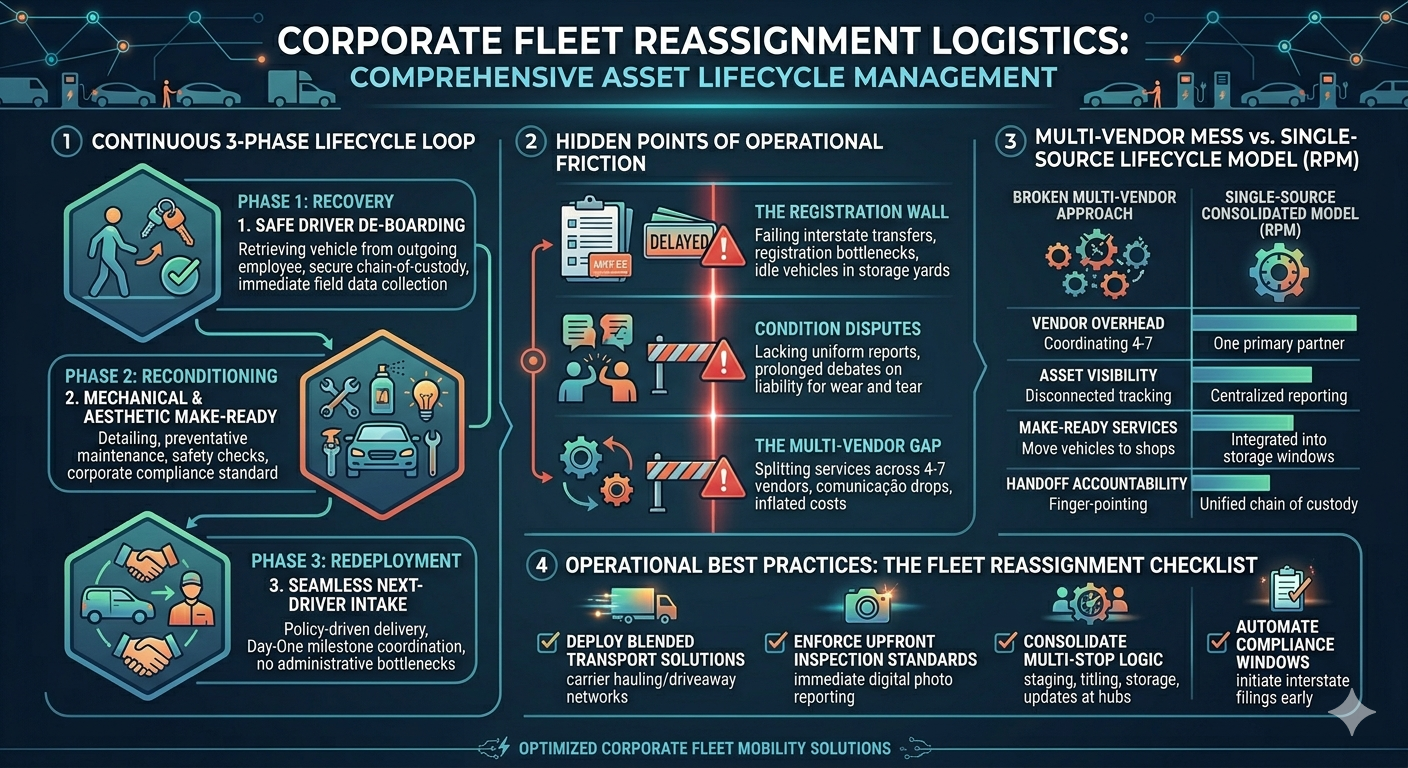
A reassignment that does not disrupt operations runs through four steps in sequence, each prepared before it is needed.
Recovery
The vehicle is collected from the outgoing driver or location. The timing matters: recovering promptly after an assignment ends prevents the vehicle from sitting unaccounted for, and a documented handoff protects the fleet against disputes over condition.
Inspection and condition documentation
The vehicle's condition is recorded at recovery. This establishes what reconditioning is needed and creates a defensible record of how it was returned, which matters when an outgoing driver's handling is in question.
Reconditioning and preparation
The vehicle is cleaned, serviced, and brought to handoff standard. Deferred maintenance is addressed here rather than passed to the next driver, who would otherwise inherit a problem and lose trust in the program.
Redeployment
The vehicle is transported to its next driver or site. This is where transport method, distance, and timing intersect, and where coordination with the next assignment's start date determines whether there is any gap at all.
What triggers reassignment, and what each requires
Different triggers create different logistics needs. Recognizing the trigger early sets up the right response.
TriggerWhat it requiresDisruption risk
Driver turnover
Prompt recovery, reconditioning, redeployment
High if reactive
Territory or role change
Relocation to a new region, possible re-registration
Medium
Demand rebalancing
Moving units to higher-need locations
Medium
Vehicle lifecycle stage change
Transition toward remarketing or replacement
Low if planned
Facility consolidation
Bulk relocation between sites
High if uncoordinated
Territory changes often carry a registration consequence when the vehicle crosses state lines, which links reassignment to the title and registration work that governs when a relocated vehicle can legally operate. Bulk moves tied to facility changes are effectively a relocation project, covered in our guide to multi-state fleet relocation.
How to move vehicles without operational disruption
The difference between a smooth reassignment and a costly one is whether the steps run in parallel and ahead of need, rather than in sequence after the fact.
- Trigger the process early. Start recovery and redeployment planning when a departure is known, not after the vehicle is already parked.
- Standardize condition documentation. A consistent recovery inspection protects the fleet and speeds reconditioning decisions.
- Pre-position against known demand. Move vehicles toward where the next assignment is likely before the assignment is confirmed, where the pattern is predictable.
- Run reconditioning and transport in parallel. Schedule the next move while the vehicle is being prepared, so it ships the moment it is ready.
- Use holding deliberately. When timing between assignments cannot be closed, secure storage keeps the vehicle protected and accounted for rather than exposed in an ad hoc lot.
Storage is the underrated piece. A short, planned hold in secure fleet vehicle storage between assignments is far better than leaving a vehicle in an unsecured location, and it keeps the asset ready to deploy. When a vehicle reaches the end of its service rather than a new assignment, the same recovery discipline feeds directly into remarketing logistics. For corporate programs managing frequent moves, a dedicated corporate fleet relocation program can run recovery, reconditioning, and redeployment as one coordinated flow.
Measuring reassignment performance
A reassignment process improves only when it is measured. The right metrics expose where vehicles sit and what that idle time costs.
- Reassignment cycle time. The days from an assignment ending to the vehicle being back in service. This is the headline number, and shortening it directly recovers earning days.
- Idle days per event. How long the vehicle sits unproductive at each stage, which isolates whether the delay is in recovery, reconditioning, or transport.
- Cost per reassignment. The fully loaded cost of recovery, reconditioning, transport, and any interim rental, which makes the case for investing in a faster process.
- Rental substitution rate. How often a premium rental fills a gap that a faster reassignment would have closed.
These belong in the same dashboard as the broader fleet transport KPIs. A program that cannot report cycle time and idle days is managing reassignment blind, and blind processes default to slow. Supply-chain measurement frameworks from CSCMP offer useful structure for building these metrics into a program.
Building a standing reassignment program
The fleets that handle reassignment without disruption treat it as a standing program, not a series of one-off scrambles.
A standing program defines the triggers in advance, so a known driver departure automatically starts recovery planning rather than waiting for someone to notice the vehicle is idle. It centralizes coordination, so recovery, reconditioning, and transport are managed as one flow instead of separate handoffs that each introduce delay. And it pre-arranges the vendors and capacity needed, so the process does not stall waiting for a transport slot or a reconditioning bay. The same coordinated discipline that governs a multi-state fleet relocation applies at the single-vehicle level, so the entire recovery-to-redeployment cycle can be absorbed into one coordinated program. The result is that reassignment stops being a source of downtime and becomes a routine, measured operation. Federal freight and operations data from the Bureau of Transportation Statistics provide external benchmarks for vehicle movement at scale.
The bottom line
Reassignment is not an occasional chore. With driver turnover high and millions of fleet vehicles in service, it is a constant flow that quietly determines how much of a fleet is actually working at any moment. The disruption it causes is avoidable. Trigger the process early, document condition consistently, pre-position against demand, and run reconditioning and transport in parallel, and a vehicle changes hands without ever sitting idle. To systematize reassignment across your fleet, request a fleet consultation. Industry benchmarks and best practices are published by NAFA Fleet Management Association.
Frequently asked questions
What is fleet reassignment logistics?
It is the coordinated movement of a vehicle between drivers, roles, or locations when an assignment ends. It covers recovering the vehicle from the outgoing driver, inspecting and reconditioning it, and redeploying it to the next driver or site so it returns to work without sitting idle.
Why does driver turnover make reassignment a constant process?
Every driver departure and replacement is a reassignment event. With the American Trucking Associations projecting a shortage of more than 160,000 drivers by 2030 and high turnover across the labor market, vehicles change hands continuously, making reassignment a recurring flow rather than an occasional task.
How do fleets avoid downtime during reassignment?
Start recovery and redeployment planning when a departure is known, document condition consistently, pre-position vehicles against predictable demand, and run reconditioning and transport in parallel. Planned secure storage covers any timing gap that cannot be closed, keeping the vehicle protected and ready.
What role does storage play between assignments?
When the next assignment does not start the moment a vehicle is ready, secure storage keeps it protected and accounted for instead of exposed in an ad hoc lot. A short, planned hold preserves the asset's condition and keeps it ready to deploy on short notice.