

Quick answer: Decommissioning a fleet vehicle is a compliance sequence, not a disposal event. Before the unit leaves, company identity and data have to come off, and afterwards plates, registration and insurance have to be unwound in an order that varies by state. Getting the order wrong leaves the company liable for a vehicle it no longer owns.
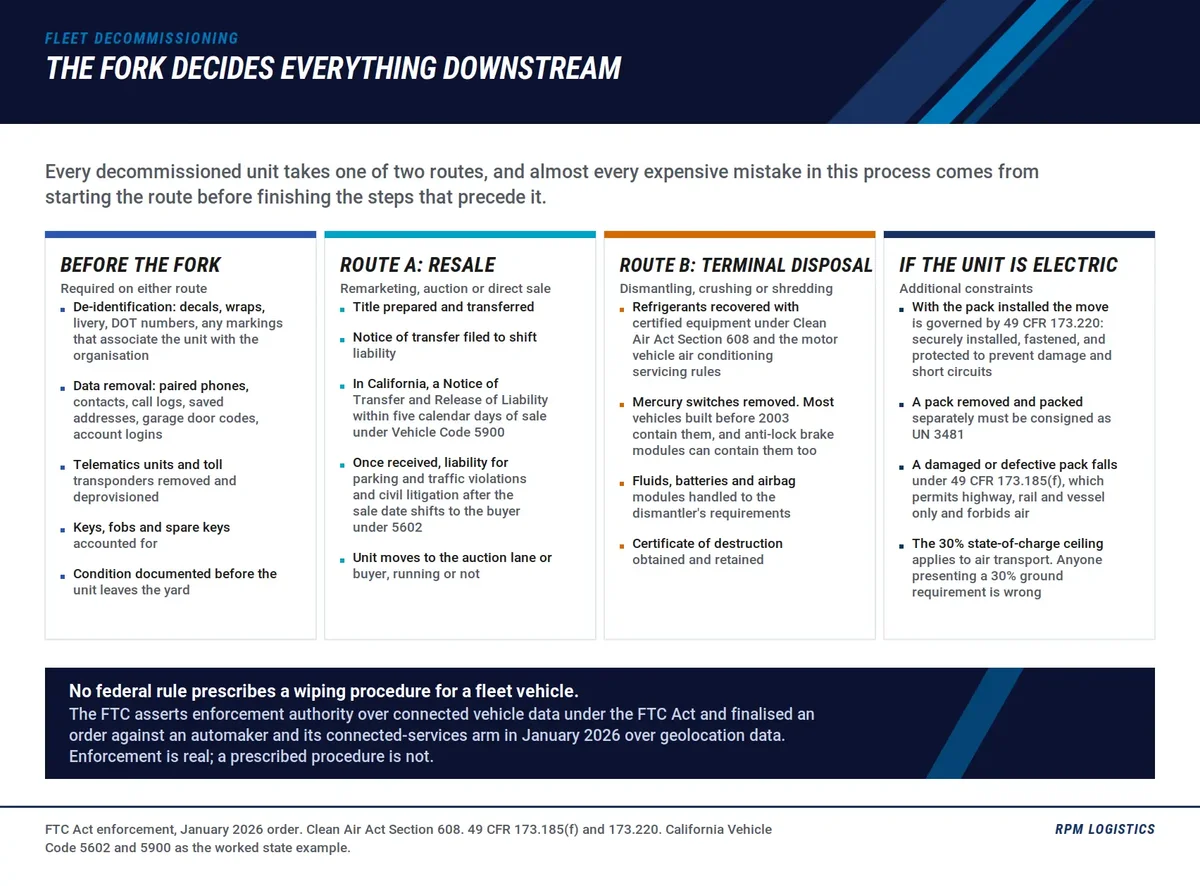
Resale and terminal disposal diverge early, and the de-identification and data steps happen before the fork, not after it.
Most published guidance on retiring fleet vehicles is about recovering value: which channel, what the unit is worth, how fast it sells. That is the remarketing question, and it is well covered.
This is the other half. What has to physically come off the vehicle, what data has to be destroyed, what paperwork has to be cancelled rather than transferred, and who is responsible for the asset between its last operational day and its final disposition. Our guide to remarketing logistics covers the resale pipeline. This covers everything that has to be true before a unit enters it, and everything that has to happen when it never will.
The fork: resale or terminal disposal
Every decommissioning decision starts at the same fork, and the two paths have almost nothing in common operationally.
A unit going to resale enters the remarketing pipeline: auction, dealer-direct, wholesale, employee sale. Its title transfers. It needs to look and function like a saleable vehicle.
A unit going to terminal disposal never re-enters commerce as a vehicle. It goes to a dismantler, a scrap processor, or parts recovery. Its title is cancelled or branded rather than transferred, and the rules that attach are environmental rather than commercial.
The decision is arithmetic, and it turns on a comparison most fleets do not run: the unit's realistic wholesale recovery against the cost of getting it to a sale channel. A non-running unit several hundred miles from the nearest lane, requiring winch loading, may be worth less than the move. That is the case for terminal disposal even when the vehicle would technically sell.
Our coverage of auction lane strategy handles the arithmetic on the resale side. What follows applies to both paths unless stated.
What comes off before the vehicle leaves
This is the part almost nobody publishes, and the part with the most residual liability attached.
De-identification
Company livery on a vehicle you no longer control is a reputational and legal exposure. A van with your decals still on it, being driven badly by its third owner, is your van as far as anyone watching is concerned.
The procedural standards that exist are governmental rather than commercial. Municipal fleet policy typically requires removal of all agency markings and decals before disposal, and at least one national police service specifies grinding off reflective markings on vehicles headed for destruction, which is a useful benchmark for how thorough "removed" is meant to be.
What to strip: decals and vinyl wraps, magnetic signage, painted livery where applicable, DOT and MC numbering, unit numbers, and any door or tailgate lettering. Vehicles that carried regulated markings need those handled deliberately rather than left to the buyer.
Plan the time. De-identification is a queue like any other shop process, and waits of up to four weeks have been reported in fleet trade coverage, which is long enough to matter against a depreciation curve.
Data removal, which is the newer problem
A modern fleet vehicle holds more operational and personal data than most fleets account for. There is no federal rule requiring you to wipe it, and that is precisely the exposure: the obligation is contractual, reputational, and increasingly a matter of state privacy law rather than a checklist item someone hands you.
The Federal Trade Commission has asserted enforcement authority over connected vehicle data under the FTC Act, stating that firms do not have free license to monetise people's information beyond what is needed to provide the requested product or service, and has advised consumers to clear personal data before selling a car (FTC). Enforcement is real: the Commission finalised an order against a major automaker and its connected-services arm in January 2026 over geolocation data.
What to remove or destroy:
- Telematics units. Physically remove, and confirm the account is deprovisioned rather than just unassigned.
- Dashcams and their storage. The device and the card.
- Paired phone data in the infotainment head unit. Contacts, call logs, saved destinations and home addresses. A factory reset is the minimum and is almost universally skipped.
- Connected-services accounts. Remote start, location, and any OEM app pairing tied to a driver.
- Fuel cards. Deactivate at the provider, not just retrieve the card.
- Toll transponders. Remove, destroy, and report the serial number to the issuing authority. A transponder that keeps billing after disposal is a live account in your name.
- Maintenance and CMMS records. Archive rather than delete, since retention obligations may outlast the asset.
Unwinding the paperwork, and why order matters
There is no federal plate surrender or registration cancellation requirement. Titling and registration are state functions, and the states do not agree. A national fleet retiring assets across thirty states is running several incompatible models at once.
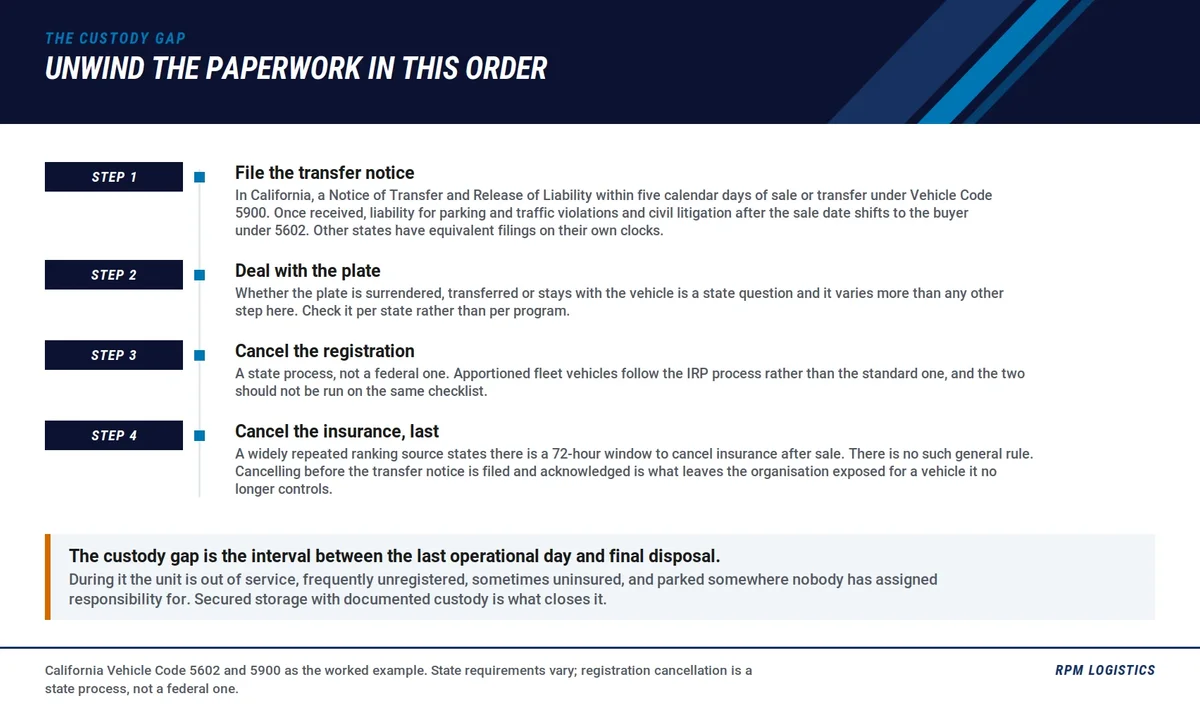
Cancelling insurance before the transfer notice is filed is the sequence that creates the gap.
Three models are worth knowing because they cover most of the field.
Surrender-gated. Florida's procedure instructs that where an owner intends to cancel insurance on a vehicle with a valid plate and decal, they should surrender the plate and decal first, and on disposal must surrender the plate or file the relevant form. Non-compliance leaves the registrant responsible for unauthorised use of the plate, with exposure to a financial responsibility suspension. Nevada is explicit in the same direction: cancel the registration before dropping insurance.
Fleet registration deletion. Apportioned fleet vehicles are their own process. New York requires surrender of the apportioned plates and the cab card to the International Registration Bureau with the vehicle marked for deletion on the relevant schedules. Miss it and the fee for the entire year is still charged. This is the case most guidance ignores entirely, and it is the one that applies to commercial fleets.
Notice-based liability release. California works differently. The obligation is to file a Notice of Transfer and Release of Liability within five calendar days of sale or transfer under Vehicle Code § 5900. Once received, liability for parking and traffic violations and civil litigation after the sale date shifts to the buyer under § 5602.
The operating rule that falls out of this: do not cancel insurance as the first step. In two of the three models that sequence leaves you exposed. Build the unwind around the state's requirement, not around the accounting calendar.
One widely repeated claim deserves correction. A ranking source states there is a 72-hour window to cancel insurance after sale. No authority supports that as a general rule, and it contradicts the guidance from the states that address the sequence, which put plate surrender first with no such clock.
The custody gap
Between a vehicle's last operational day and its final disposition sits a period nobody owns, and it is where decommissioning programmes actually fail.
The unit is no longer assigned, so no driver is accountable. It may be parked at a site with no fleet presence. Its plates may still be current, its insurance may still be active, and its telematics may still be reporting. If it is stolen, damaged or driven in that window, the question of who is responsible has no clean answer.
The most instructive evidence here is an audit rather than a vendor page: a national police service reviewing its own decommissioning found that vehicle files did not contain evidence the process had been carried out to its own standards. If an organisation with that level of procedural discipline cannot evidence it, a commercial fleet running the same process informally certainly cannot.
What closes the gap:
- A defined out-of-service date recorded in the fleet system, which starts the clock on everything else.
- A named custodian for the period between out-of-service and disposal. A site is not a person.
- Keys secured centrally on the out-of-service date, not left in a drawer at a location.
- Condition documented at the out-of-service date, so damage occurring afterwards is attributable. See condition reporting standards.
- Secured storage rather than an operational lot. Units awaiting disposal sitting among working vehicles get used. RPM Logistics operates more than 70 storage locations across the United States and Canada.
- Insurance held until disposal is complete, not until the vehicle stops being driven.
Comparing the disposal routes
Five routes exist and most fleets evaluate two. The table below scores them on the dimensions that matter operationally rather than on recovery alone, because a route that recovers slightly more while leaving liability attached is not the better answer.
Route | Recovery | Speed | Residual liability | Custody burden |
|---|---|---|---|---|
Physical auction | Market rate, variable by lane | Tied to sale calendar | Clean once title transfers | High: transport to lane, storage, condition reporting |
Digital auction | Comparable, wider buyer pool | Faster listing, slower settlement | Clean once title transfers | Moderate: unit often stays put until sold |
Dealer direct | Below auction, predictable | Fastest | Clean, single counterparty | Low |
Employee sale | Often above wholesale | Variable | Highest. An ongoing relationship with the buyer complicates post-sale disputes | Low, but documentation discipline matters more |
Recycler or dismantler | Scrap or parts value only | Fast | Clean, and title is cancelled rather than transferred | Low, but environmental handling applies |
Two things the table makes visible. Employee sales carry the highest residual liability precisely because the counterparty is still in the building, which is why the de-identification and data-removal steps matter more on that route, not less. And the recycler route is the only one where the title is extinguished rather than passed along, which removes a category of future exposure entirely.
Charitable donation is a sixth route some fleets use. Treat it as a resale route for operational purposes, since the title transfers and the same de-identification and data obligations apply.
Environmental requirements on terminal disposal
Where a unit goes to a dismantler or scrap processor, a defined set of components has to be removed and handled before crushing or shredding. The EPA specifies the sequence:
- Batteries first. Removed before other work, stacked no more than two high, separated by cardboard or plywood, stored dry.
- Refrigerants recovered with certified equipment, under Clean Air Act Section 608 and the motor vehicle air conditioning servicing rules.
- Waste fuel drained in a ventilated area with a suction system rated for fuel, into labelled separate containers. Not with plastic hand pumps, because of static ignition risk.
- Mercury convenience switches removed from hood, trunk and vanity mirror assemblies. Most vehicles built before 2003 contain them, and anti-lock brake modules can contain them too.
- Waste fluids drained. Engine, transmission, power steering, differential and brake fluids may be combined, but antifreeze and washer fluid must be stored separately.
- Lead from wheel weights and battery cable ends kept separate.
There is also one genuinely federal reporting obligation that almost no fleet guidance mentions. Under the Anti Car Theft Act, reporting to the National Motor Vehicle Title Information System has been mandatory since March 31, 2009 for any business or individual handling five or more junk, salvage or total-loss vehicles annually, at a frequency of not less than monthly. A fleet disposing of units at any scale should confirm whether it falls inside that definition or whether its disposal partner does.
Electric units change the disposal move
The category treats EV retirement as a residual value question. The more immediate issue is that a decommissioned pack is regulated material, and moving it is a different shipment than moving the car.
EPA states that end-of-life lithium-ion batteries are likely to be hazardous waste on ignitability and reactivity grounds, that they can be managed as universal waste under 40 CFR Part 273, and that batteries removed at a dealership, auto shop or scrap yard are not household hazardous waste. It further confirms that DOT regulations for shipping lithium batteries apply, and that damaged batteries must comply with 49 CFR § 173.185(f).
The operational distinction that matters:
- Pack still installed in the vehicle. The move is governed by 49 CFR § 173.220, which requires the battery to be securely installed and fastened, and protected to prevent damage and short circuits.
- Pack removed and shipped separately. The classification changes. Section 173.220 provides that a battery removed from the vehicle and packed separately must be consigned as UN 3481, lithium ion batteries packed with equipment.
- Pack damaged or defective. Under § 173.185(f), it may move by highway, rail or vessel only and is forbidden by air, requires non-metallic inner packaging with non-combustible, electrically non-conductive and absorbent cushioning, and the outer package must be marked "Damaged/defective lithium ion battery" in characters at least 12 mm high.
One correction worth making: the 30% state-of-charge ceiling applies to air transport. Ground transport carries no general state-of-charge limit. Proposals to extend it more broadly have been introduced but are not law, and anyone presenting a 30% ground requirement is wrong. Our lithium battery transport compliance guide covers the full picture, and shipping damaged and defective batteries covers the pathway for a pack that has failed.
Moving units that no longer drive
A meaningful share of decommissioned vehicles are not roadworthy, and the disposal move is the last one they make. Non-running units need winch loading, dollies where the steering is seized, and equipment suited to a vehicle that may not brake or steer. Our guide to damage recovery logistics covers handling for non-drivable units.
Tell the carrier the truth about the unit's state at booking. A crew arriving with a standard transporter for something that needs a winch is a wasted trip that somebody pays for, and at disposal-stage values that cost is a large fraction of what the unit is worth.
Frequently asked questions
Do I have to surrender the plate before cancelling insurance on a retired fleet vehicle?
In several states, yes, and doing it the other way round creates exposure. Florida's procedure instructs surrendering the plate and decal before cancelling insurance, and warns that the registrant remains responsible for unauthorised use of a plate not surrendered. Nevada instructs cancelling registration before dropping insurance. California instead requires a Notice of Transfer and Release of Liability within five days of transfer. There is no federal rule, so the sequence has to follow the state.
Who is liable for a fleet vehicle between its last operational day and final disposal?
Whoever the fleet has named, and most fleets have named nobody. The unit is unassigned, often parked at a site with no fleet presence, frequently still plated and insured. Close the gap with a recorded out-of-service date, a named custodian, keys secured centrally, condition documented at that date, and secured storage rather than an operational lot.
What has to come off a vehicle before it leaves the fleet?
Decals, vinyl wraps, magnetic signage, painted livery, unit numbers and any regulated markings, plus telematics units, dashcams and their storage, paired phone data in the infotainment head unit, connected-services accounts, fuel cards deactivated at the provider, and toll transponders removed, destroyed and reported by serial number.
Is there a federal rule requiring fleet vehicle data to be wiped?
No, and that is the exposure. The FTC asserts enforcement authority over connected vehicle data under the FTC Act and finalised an order against an automaker and its connected-services arm in January 2026, but no rule prescribes a wiping procedure for a fleet vehicle. The obligation is contractual, reputational and a matter of state privacy law.
Does an EV battery have to be removed before a decommissioned electric vehicle is transported?
Not necessarily, and removing it changes the shipment. With the pack installed, the move is governed by 49 CFR 173.220 and the battery must be securely installed and protected against damage and short circuits. Once removed and packed separately, it must be consigned as UN 3481. A damaged or defective pack falls under 49 CFR 173.185(f), which permits highway, rail and vessel only and forbids air transport.
What has to be removed before a vehicle is crushed or shredded?
EPA requires batteries removed first, refrigerants recovered with certified equipment under Clean Air Act Section 608, waste fuel drained with a suction system rated for fuel, mercury convenience switches removed from hood, trunk and vanity mirror assemblies and from anti-lock brake modules, waste fluids drained with antifreeze and washer fluid stored separately, and lead from wheel weights and battery cable ends kept separate.
What is the difference between vehicle disposal and vehicle remarketing?
Remarketing is the resale pipeline: channel selection, reconditioning, sale and title transfer. Disposal in the terminal sense means the unit never re-enters commerce as a vehicle, so the title is cancelled or branded rather than transferred and the applicable rules are environmental. The decision between them is arithmetic, comparing realistic recovery against the cost of getting the unit to a sale channel.
Is registration cancellation a federal requirement or does it vary by state?
Entirely state-level. Titling and registration are state functions and no federal rule governs plate surrender or registration cancellation. States use at least three different models: surrender-gated, fleet registration deletion for apportioned vehicles, and notice-based liability release.
Do apportioned fleet vehicles follow the same process?
No. Apportioned vehicles require surrender of the apportioned plates and cab card to the state's International Registration Bureau with the vehicle marked for deletion on the relevant schedules. Failing to do it can leave the registration fee charged for the full year.
Retiring assets without retaining the liability
RPM Logistics moves fleet vehicles across all 50 states and Canada, including non-running units, with documented custody at every transfer and secured storage between out-of-service and disposal. If your retirement waves are leaving units parked and unaccounted for, talk to our team.