

Quick answer: A collector car transport quote is usually a bid, not a price. Most are issued by brokers who then post the load to carriers at a lower number, and the difference is the broker's margin. The federal 110% protection people cite applies to household goods moves, not to a car shipped on its own, and there is no minimum cargo insurance a car hauler must carry.
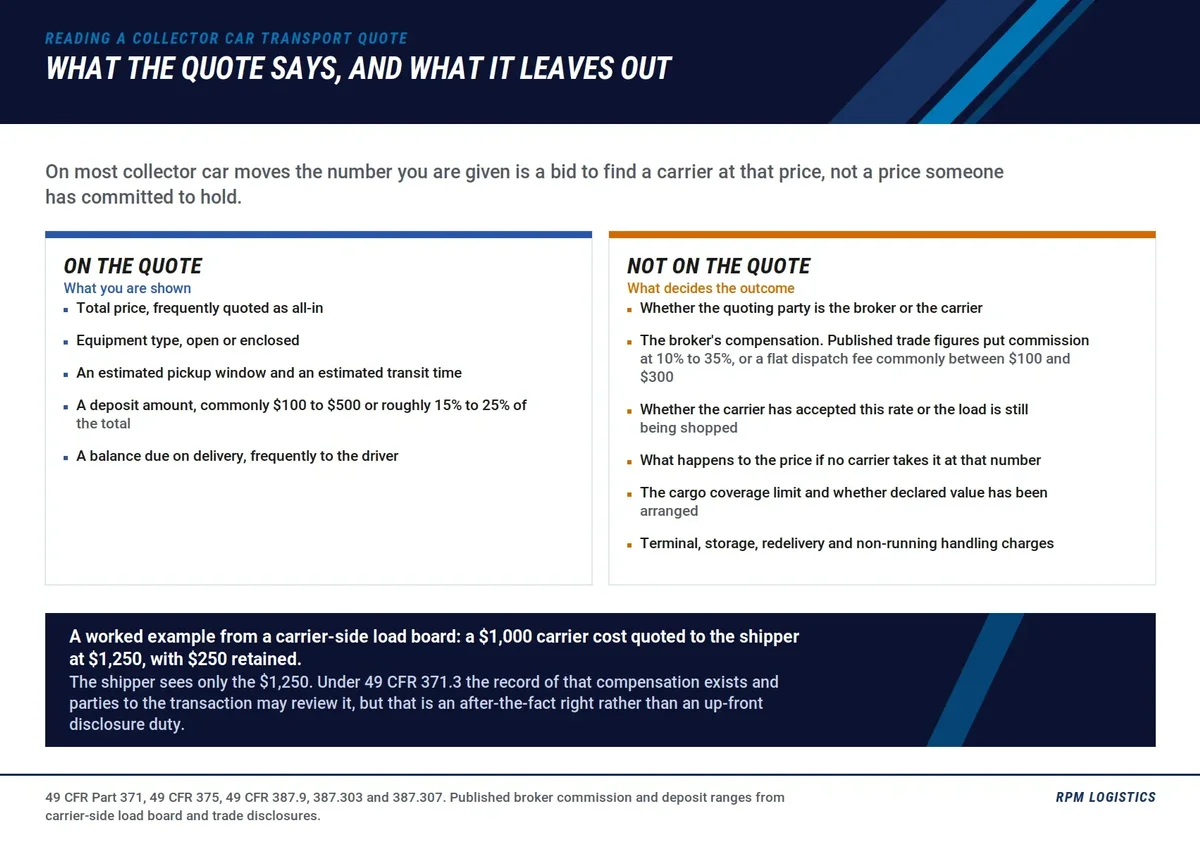
A quote is usually a bid. What is missing from it is the part that decides whether the number holds.
Our complete classic car transport guide covers what a move costs and what drives the price. This is the other half: what the quote document actually is, who produced it, what the line items mean, and what is missing from it.
That distinction matters because the number is often the least informative thing on the page.
A quote is usually a bid
Here is the mechanism most of the industry does not explain, because most of the industry is the party it describes.
When you request a quote, you are usually talking to a broker, not to the company whose truck will carry the car. The broker quotes you a number. If you accept, the load is posted to a dispatch board where carriers see it at a lower number, the difference being the broker's margin. A carrier accepts it, or does not.
Published trade figures put broker commission in the range of 10% to 35%, or a flat dispatch fee commonly between $100 and $300. A worked example from a carrier-side load board: a $1,000 carrier cost quoted to the shipper at $1,250, with $250 retained. The shipper sees only the $1,250.
The consequence is the part worth internalising. If no carrier takes the load at the posted rate, the quote does not hold. At that point the broker either reduces its margin to make the load attractive, or comes back to you with a revised price. A quote that was never accepted by a carrier was never a commitment to move your car.
None of this makes brokers illegitimate. A good broker has relationships with enclosed specialists you would never find, and on a niche lane that access is worth paying for. The problem is not the model. The problem is a quote that presents a bid as a price.
Binding and non-binding: the protection that does not apply
Search for "binding versus non-binding auto transport quote" and most of what you find is about household goods moves, because that is where the terms are regulated. Applying it to a car is a mistake.
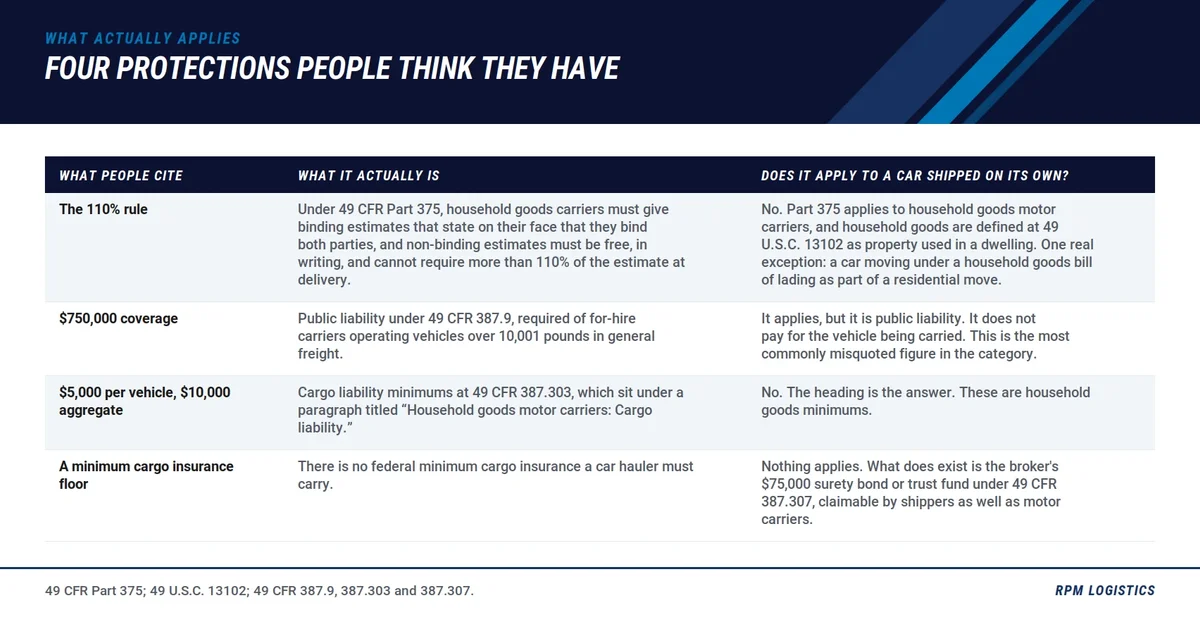
Each of these is real. None of them does what it is commonly said to do on a car shipped on its own.
Under 49 CFR Part 375, household goods carriers must give binding estimates that state on their face that they bind both parties, and non-binding estimates must be free, in writing, and cannot require you to pay more than 110% of the estimate at delivery. That 110% rule is the protection people think they have.
It does not reach a car shipped on its own. Part 375 applies to household goods motor carriers transporting household goods, and household goods are defined in 49 U.S.C. § 13102 as property used or to be used in a dwelling. A collector car moving by itself is not that.
So in standalone vehicle transport, "binding quote" is borrowed vocabulary with no regulatory content behind it. Whether a number is binding depends entirely on what your contract says. If the document does not state that the price is firm and under what conditions, assume it is not.
One real exception: if your car is moving under a household goods bill of lading as part of a residential move, Part 375 does apply. Same car, different paperwork, different rights.
Broker or carrier: how to tell, and why it changes the document
Establish which you are dealing with before you compare anything, because the two quotes are structurally different.
An asset-based carrier quotes you the price for its own truck, its own driver and its own insurance. What you are quoted is what the move costs the company performing it.
A broker quotes you a retail price containing a margin, then finds a carrier. You are not told the carrier's number, and under current rules you do not have to be.
The disclosure rules are narrower than people assume. Under 49 CFR § 371.3, a broker must keep a record of each transaction including the amount of compensation received for the brokerage service and the name of the payer, retain it for three years, and allow each party to the transaction to review it. That is an after-the-fact review right, not an up-front disclosure duty. Nothing requires a broker to tell you the carrier's share before you book.
FMCSA has a rulemaking underway that would tighten this, requiring electronic records provided within 48 hours and limiting contractual waiver of the review right. The notice of proposed rulemaking published in November 2024 and its comment period closed in March 2025; trade reporting indicates a supplemental proposal went to the Office of Management and Budget in late August 2026. It is not a rule, and it is aimed at carrier and broker relationships rather than retail shipments. Do not expect it to change what you see on a quote.
Questions that settle it in one exchange: Is the truck yours? What is your MC number, and is it broker authority or carrier authority? Who will physically move the car? Our guide to DOT compliance for automotive carriers covers how to check the answer. If the load is re-tendered without disclosure, that is a separate problem covered in what double brokering does to your liability chain.
Reading the quote line by line
A quote that cannot be broken into these components is not a quote, it is a number.
- Base transport charge. The line rate for the move as described. Confirm whether it assumes open or enclosed, because a quote that does not say is quoting open.
- Fuel treatment. Either included in the base, or a separate surcharge that floats. A base rate with a floating surcharge and a firm-looking total is the commonest source of an invoice that does not match a quote.
- Service level. Standard, expedited, or guaranteed pickup window. These are different products and should be priced separately rather than implied.
- Equipment. Lift gate, low-angle ramps, single-car exclusive versus multi-car. On a low or non-running collector car this is not optional and should appear explicitly.
- Cargo coverage and declared value. The limit applying to your vehicle, stated in dollars. See below.
- Pickup and delivery terms. Door-to-door or terminal, and what happens when a street cannot take a transporter.
- Deposit and balance. How much, when taken, and what is refundable.
- Validity period. How long the quoted number stands.
- Accessorial schedule. The one almost nobody attaches. See the next section.
What is not on the quote
These are the charges that turn a quote into a different invoice. None of them is improper. What is improper is not disclosing them.
- Inoperable or winch fee. If the car does not run, drive, steer or brake, it needs different handling. Declare it at quote. A car discovered to be inoperable at pickup is a rate change at the worst possible moment, and our guide to non-running vehicle recovery covers what the handling actually involves.
- Lift gate. Distinct from a winch fee and required for low-clearance cars that cannot take a ramp angle.
- Shuttle. Where a transporter cannot legally or physically reach the address, a smaller truck bridges the gap. Common on narrow residential streets and gated properties, rarely quoted upfront.
- Failed pickup or dry run. The truck arrives and the car is not available, not ready, or not as described. Someone pays for that trip.
- Storage. When delivery cannot be accepted on arrival, per day.
- Redelivery. A second attempt after a failed delivery.
- Top load. A guaranteed upper-deck position on an open carrier, which some collector owners specify.
- Oversize or modified vehicle. Lifted, widened, non-standard track or wheelbase, or fitted aero that changes the footprint.
- Remote area or seasonal access. Where the origin or destination is genuinely hard to serve.
The single most useful request you can make: ask for the accessorial schedule in writing before booking. A company that has one and will send it is telling you something. A company that says charges are handled case by case is telling you something else.
Declared value, and the cargo insurance floor that does not exist
This is the most consequential misunderstanding in the category.
There is no federal minimum cargo insurance requirement for auto transport carriers. The cargo liability minimums at 49 CFR § 387.303 sit under a paragraph titled "Household goods motor carriers: Cargo liability," at $5,000 per vehicle and $10,000 in the aggregate. Those figures apply to household goods carriers. They are not a floor for a car hauler, and they would be irrelevant to a collector car anyway.
The $750,000 figure that circulates is public liability under 49 CFR § 387.9. That covers injury and damage to third parties. It does not pay for the car on the trailer.
So the cargo limit on a transporter is a commercial decision by that company, and the only fact is the certificate of insurance. Three things to do with that:
- Ask for the COI, not a statement. "Fully insured" is not a limit. You want the number and the carrier's name on the certificate.
- Check the limit against the car, not the load. A policy limit that covers a full deck of ordinary vehicles may be well below one collector car's value.
- Understand what declaring a higher value does. On some quotes it raises the price because supplemental coverage is purchased against it. On others it does nothing except appear on the paperwork. Ask which, because a declared value that buys no coverage is decoration.
Where supplemental coverage is offered, published pricing runs on the order of a small percentage of declared value. Your own collector policy may also respond in transit, and the valuation basis on it decides what gets paid. See agreed value versus actual cash value.
Deposits and payment
No federal rule governs deposits in vehicle transport. Practice is consistent enough to describe.
A deposit is commonly $100 to $500, or roughly 15% to 25% of the total, with the balance due on delivery, frequently to the driver. Whether it is credited against the total or charged on top varies, so confirm which.
The question that matters more than the amount is when the deposit is taken. A deposit taken at quote, before any carrier has accepted the load, is money paid for a bid. A deposit taken on carrier assignment is money paid against a confirmed move. Ask which trigger applies, and what happens to it if no carrier is found.
On cancellation, expect a deposit to be refundable before carrier assignment and partially or wholly non-refundable after, because at that point a truck has committed capacity. Get the terms in writing rather than relying on a phone assurance.
What to ask before you accept
- Are you a broker or an asset-based carrier, and what authority do you hold?
- Is this price firm, and what conditions would change it?
- How long is the quote valid?
- Send me the accessorial schedule.
- What is the cargo coverage limit, and can I see the certificate?
- What does declaring a higher value actually buy?
- When is the deposit taken, and what happens to it if no carrier accepts the load?
- Is enclosed equipment confirmed, and is a lift gate included?
- Who physically moves the car, and may the load be re-tendered?
- What is the condition documentation standard at pickup and delivery?
On that last one, the documentation standard is what decides a damage claim months later. Our guidance on insurance-grade condition reporting sets out what good looks like.
If the quote turns out to be a bait
Deliberately low estimates followed by demands for more money are a recognised complaint category. FMCSA's consumer complaint process accepts complaints against auto transporters as well as movers and brokers, including this pattern. Filing matters because the complaint record is what regulators act on.
There is also a financial remedy most people never hear about. Under 49 CFR § 387.307, a property broker must maintain a $75,000 surety bond or trust fund, and it is claimable by shippers as well as motor carriers. If a broker takes your money and the move does not happen, that bond is the route to recovery. It is worth asking for the bond details in advance, and it is absent from essentially every consumer-facing page on this subject.
The Better Business Bureau has published scam alerts on vehicle shipping quoting practices, with the usual advice: be wary of unusually low quotes, avoid paying deposits by digital wallet or wire, and use a credit card where possible.
Frequently asked questions
Is an auto transport quote binding?
Usually not, and there is no regulation making it so for a car shipped on its own. The binding and non-binding estimate rules in 49 CFR Part 375, including the 110% limit at delivery, apply to household goods moves. A standalone vehicle move is governed by the contract, so if the document does not state the price is firm and under what conditions, assume it is not.
Why do auto transport quotes differ so much between companies?
Partly because they are quoting different things, open versus enclosed and different service levels, and partly because most quotes come from brokers pricing a retail number over an expected carrier cost. A low quote can reflect an efficient lane or an optimistic bid that no carrier will accept.
What is the broker fee, and will I be told what it is?
Published trade figures put broker commission at roughly 10% to 35%, or a flat dispatch fee commonly between $100 and $300. Under 49 CFR 371.3 a broker must record the compensation received and allow parties to the transaction to review that record, but that is an after-the-fact right rather than an up-front disclosure duty. Nothing currently requires a broker to tell you the carrier's share before you book.
How long is a car shipping quote valid?
It varies by company and should be stated on the document. Where a quote carries a floating fuel surcharge, the validity of the total is shorter than the validity of the base rate, which is a common source of an invoice that does not match the quote.
Do I have to pay a deposit to book car transport?
Commonly yes, typically $100 to $500 or roughly 15% to 25% of the total, with the balance due on delivery. The more important question is when it is taken. A deposit taken at quote is money paid before any carrier has accepted the load; one taken on carrier assignment is paid against a confirmed move.
What fees are not included in an auto transport quote?
Commonly omitted charges include inoperable or winch fees, lift gate, shuttle service where a transporter cannot reach the address, failed pickup or dry run, storage, redelivery, top load, and oversize or modified vehicle fees. Ask for the accessorial schedule in writing before booking.
How much cargo insurance must a car hauler carry?
There is no federal minimum. The cargo liability figures in 49 CFR 387.303 apply to household goods motor carriers. The $750,000 figure often cited is public liability under 49 CFR 387.9 and does not pay for the vehicle being carried. Cargo coverage is a commercial decision by the carrier, so ask for the certificate of insurance and check the limit against your car's value.
Does declaring a higher value change the quote?
Sometimes. On some quotes a higher declared value triggers supplemental coverage that is priced into the total. On others it appears on the paperwork and buys nothing. Ask which applies, because a declared value that does not correspond to coverage is not protection.
What can I do if a broker takes my deposit and the car never moves?
Property brokers must maintain a $75,000 surety bond or trust fund under 49 CFR 387.307, and it is claimable by shippers as well as motor carriers. You can also file a complaint with FMCSA, which accepts complaints against auto transporters including deliberately low estimates followed by demands for more money.
Quoting the move, not bidding on it
RPM Logistics moves collector vehicles in enclosed equipment across all 50 states and Canada through a contracted carrier network, with documented custody at each transfer and coverage confirmed in writing before dispatch. If you have a quote in front of you and want it read properly, talk to our team.