

Quick answer: Double brokering is when a party that accepted a load re-tenders it to someone else without the shipper's knowledge or authorization. It is unlawful when the re-tendering party is not registered as a broker or conceals the arrangement. Federal penalties reach $13,676 per violation, and liability extends personally to officers and directors.
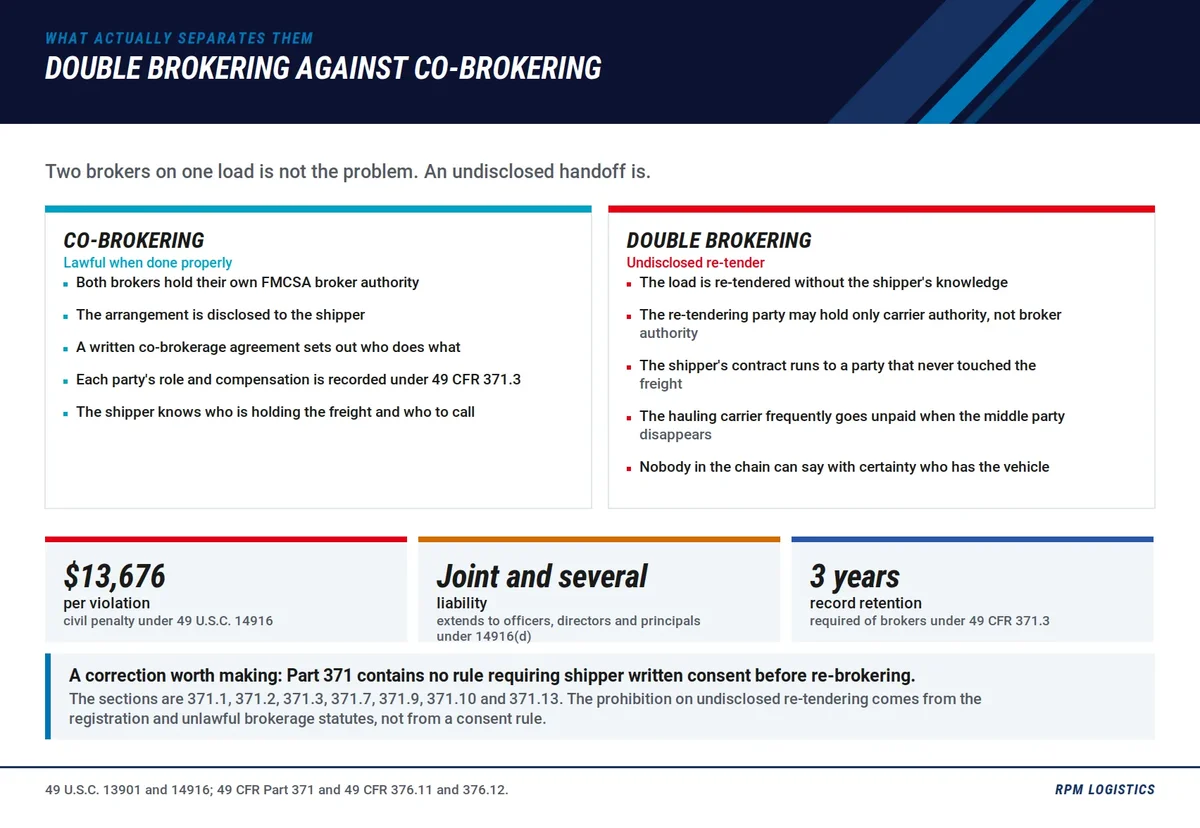
The difference is disclosure and consent, not the number of intermediaries.
Double brokering occurs when a motor carrier or broker accepts a shipment and then hands it to a different party to actually move, without disclosing that arrangement to the shipper who tendered it. The shipper believes its freight is with the company it vetted and contracted. In reality the load is with an unknown third party that the shipper never approved, never insured against, and in many cases cannot identify from its own paperwork.
The practice sits on a spectrum. At one end is a carrier that gets overcommitted and quietly re-brokers a load to keep a customer happy. At the other end is organized freight fraud, where re-tendering is the mechanism used to take possession of cargo and disappear. Both create the same structural problem for the shipper: the party holding the freight is not the party on the contract.
The scale is not incidental. Verisk CargoNet estimated $725 million in US and Canadian cargo theft losses across 2025, up 60% year over year, on 2,646 confirmed incidents (Verisk CargoNet, January 2026). Separately, Highway's Freight Fraud Index reported that ownership-change fraud, in which criminals acquire dormant motor carrier businesses with clean histories rather than registering new ones, appeared in 25.6% of reported thefts in the second quarter of 2026, up from 23.0% in the first quarter. Undisclosed re-tendering is the mechanism that makes an acquired identity useful.
This guide covers what the law actually says, what changed in 2026, what the penalties really are, and who ends up paying when a double-brokered load is damaged or stolen. That last question is the one most published material skips, and for anyone shipping vehicles it is the one that matters most.
Double brokering versus co-brokering
The distinction is disclosure and authority, not the number of parties involved.
Co-brokering is a disclosed arrangement in which two properly registered brokers work a load together with the shipper's knowledge and consent. It is lawful and common. Double brokering is the undisclosed version, and it is frequently combined with a second defect: the party re-tendering the load does not hold broker authority at all, because it registered as a motor carrier.
That second defect is where most of the legal exposure originates. A motor carrier is registered to haul freight. A broker is registered to arrange for others to haul freight. These are separate registrations with separate financial security requirements, and FMCSA issues a distinct registration number for each authority type. A carrier that arranges transportation it does not perform is providing brokerage service without broker authority, whatever it calls the transaction internally.
Is double brokering illegal?
Undisclosed re-tendering by a party without broker authority is unlawful under federal law. The relevant provisions are specific, and most published guidance on this topic does not cite them.
The registration requirement
Under 49 U.S.C. § 13901(a), a person may provide transportation as a motor carrier or service as a broker only if registered to provide that specific transportation or service. Section 13901(b) requires FMCSA to issue a distinct registration number for each authority type, with an indicator identifying whether the registrant is a carrier, a broker, or a freight forwarder.
Section 13901(c) is the provision that speaks most directly to double brokering, and it is cited almost nowhere. It requires that for each agreement to provide transportation or service for which registration is required, the registrant must specify in writing the authority under which it is providing that transportation or service. A carrier that accepts a load as a carrier and then arranges for another party to haul it has not specified the authority it is actually operating under, because it is not operating under the authority it claimed.
Unlawful brokerage activities
49 U.S.C. § 14916 is the core enforcement provision. Brokerage services are lawful only if the party is registered under and in compliance with § 13904 and has satisfied the financial security requirements of § 13906. Two features of § 14916 deserve attention:
- Section 14916(c) makes anyone who knowingly authorizes, consents to, or permits a violation liable to the United States for a civil penalty and liable to the injured party for all valid claims, without regard to amount. There is no cap on the private claim.
- Section 14916(d) makes that liability joint and several and extends it to individual officers, directors, and principals. It pierces the corporate entity. An LLC does not insulate the people who ran the scheme.
The broker regulations
49 CFR Part 371 governs broker conduct. Section 371.2 defines a broker as a person who, for compensation, arranges or offers to arrange the transportation of property by an authorized motor carrier. Section 371.3 requires records of each transaction, retained for three years, showing the consignor, the carrier, compensation, and charges. Section 371.7 addresses misrepresentation and prohibits a broker from performing brokerage service in any name other than the one in which its registration was issued, or holding itself out as a carrier.
A note of correction, because it circulates widely: some published guidance claims that Part 371 contains a provision prohibiting brokers from re-brokering loads without the shipper's written consent. No such provision exists in Part 371. The sections are 371.1, 371.2, 371.3, 371.7, 371.9, 371.10, and 371.13, followed by the household goods subpart. The prohibition on undisclosed re-tendering comes from the registration and unlawful brokerage statutes, not from a consent rule in Part 371. Getting this right matters if you are relying on it in a contract dispute.
The equipment leasing rule
49 CFR § 376.11 permits an authorized carrier to perform transportation in equipment it does not own only under a written lease meeting the requirements of § 376.12. Under § 376.12(c), the lessee carrier must have exclusive possession, control, and use of the equipment for the duration of the lease, and must assume complete responsibility for its operation. This is the provision that defeats the common defense that a re-tendered load was merely an equipment arrangement. If there is no compliant lease and no exclusive control, it was not a lease.
What the penalties actually are
Nearly every published guide on this topic quotes $10,000 per violation. That figure comes from the statutory text of § 14916(c)(1) and has not been adjusted. Federal civil penalties are inflation-adjusted annually, and the operative enforcement figures live in 49 CFR Part 386, Appendix B.
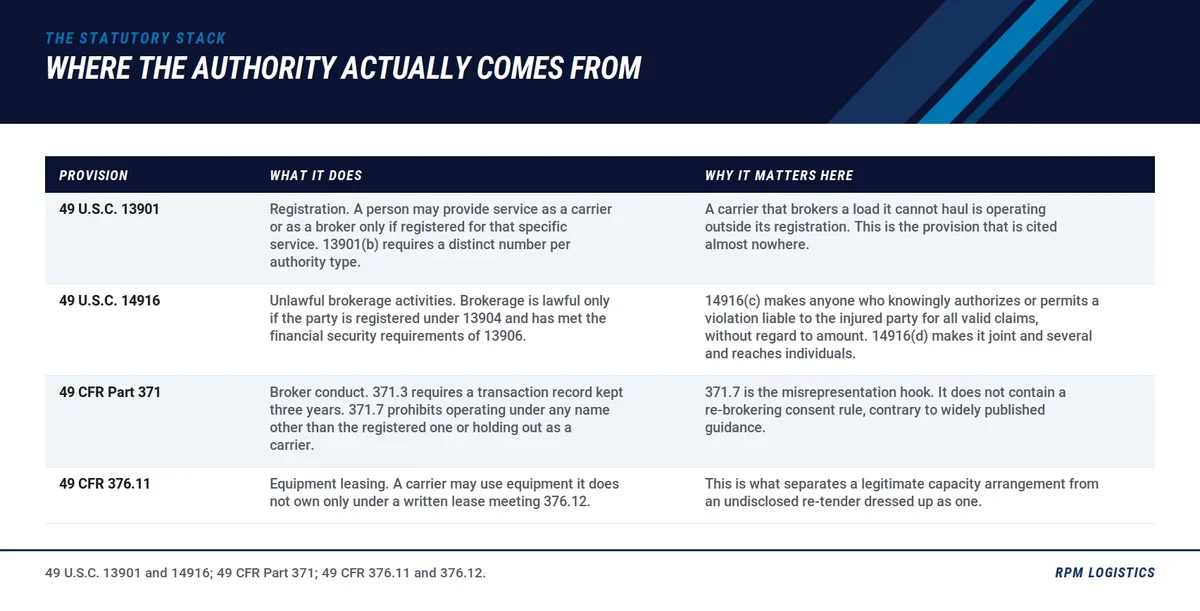
Four provisions do the work. Most published guidance cites only one of them.
Violation | Current civil penalty |
|---|---|
Operating without required registration under § 13901 | Minimum $13,676 per violation |
Knowing violation of § 13904 registration or § 13906 financial security | Up to $13,676 per violation |
Surety or financial institution violation of broker financial security rules | $12,882 per violation, plus three-year ineligibility |
These are the numbers FMCSA enforces against. The private liability under § 14916(c)(2) is separate and uncapped, and under § 14916(d) it reaches individuals personally.
What changed in 2026
This is where most competing material is out of date. The three developments below are all 2026 and none of them appear in the pages currently ranking for this topic.
The Broker and Freight Forwarder Financial Responsibility Rule is now in force
The compliance date was January 16, 2026. The rule substantially tightens the financial security regime that § 14916 ties lawful brokerage to. Under 49 CFR § 387.307:
- A broker must maintain a surety bond or trust fund of $75,000.
- Trust fund assets are restricted to cash, irrevocable letters of credit from a federally insured depository institution, and Treasury bonds, and must be liquidable within 7 calendar days. This ends the practice of funding trusts with illiquid or affiliated assets.
- A surety or financial institution must notify FMCSA in writing within 2 business days when the instrument drops below $75,000 because of payments.
- FMCSA then gives written notice that authority will be suspended within 7 business days of service unless the broker restores the full amount or resolves pending claims.
- A provider that violates these requirements loses the ability to file instruments as evidence of financial responsibility for three years. That penalty runs against the surety or financial institution, not the broker. Trade summaries frequently get this backwards.
Note the two different seven-day periods. Assets must be liquidable within seven calendar days. Suspension follows seven business days from service of notice. They are different tests measuring different things.
Practically, this matters for double brokering because it raises the cost of maintaining the broker authority that a legitimate operation needs and a fraudulent one has to fake. It also makes financial security status a more meaningful vetting signal than it was.
Broker transparency is still a proposal
FMCSA's broker transparency rulemaking would amend § 371.3 to require brokers to keep transaction records electronically and provide them within 48 hours of a request, eliminate the distinction between brokerage and non-brokerage service, and itemize all charges and payments connected to a shipment. The notice of proposed rulemaking published November 20, 2024, and the reopened comment period closed March 20, 2025.
It has not been finalized. Trade press reported in late August 2026 that FMCSA sent the rulemaking to the Office of Management and Budget as a supplemental notice of proposed rulemaking rather than a final rule, indicating the proposal changed materially after comments (CCJ). If that reporting is accurate, a final rule remains at least one further comment cycle away. Treat any vendor claim that broker transparency is now law as incorrect.
No federal freight fraud legislation has passed
Several bills get cited as though they were enacted. As of September 2026, none has become law and only one has passed either chamber.
- S. 337, Household Goods Shipping Consumer Protection Act. Reported without amendment in February 2026 and placed on the Senate legislative calendar. It has not received a floor vote. It would restore FMCSA authority to assess civil penalties for unauthorized brokerage.
- H.R. 880, the House companion, has had no action since February 2025.
- H.R. 2853, Combating Organized Retail Crime Act of 2025, passed the House 348 to 60 in May 2026 and was referred to Senate Judiciary. It is the only bill in this group to clear a chamber.
- S. 3950 and H.R. 8267, the SAFER Transport Act, were both referred to committee and have seen no further action.
Bill status is verifiable through govinfo.gov. Trade headlines announcing that a bill "gained approval" or "hit the Senate floor" have in several cases described a committee report or calendar placement, not passage.
Who pays when a double-brokered load is damaged or stolen
This is the question with real money attached, and it is absent from essentially all competing coverage. The answer turns on the Carmack Amendment.
Under 49 U.S.C. § 14706, a motor carrier must issue a receipt or bill of lading for property it receives, and both the receiving carrier and the delivering carrier are liable for actual loss or injury to the property, including loss caused by another carrier over whose line the property moved. The statute sets minimum periods of at least nine months to file a claim and two years to bring suit after a formal denial. Liability can be limited by a released-rate declaration or written agreement for non-household goods.
Carmack liability attaches to carriers, not brokers. That single fact is what makes a double-brokered load dangerous in a way a normal load is not.
Consider a shipper that tenders a consignment of vehicles to a company it believes is the carrier. That company re-brokers the load. The result:
- The shipper's contractual counterparty is functionally acting as a broker, and brokers do not carry Carmack liability.
- The entity that actually took possession of the vehicles is a carrier the shipper never vetted, never approved, and often cannot identify, because the bill of lading names the wrong party.
- The receiving-carrier and delivering-carrier structure that § 14706(a)(1) depends on has been broken at the origin. The named receiving carrier did not receive the freight.
- Cargo insurance may not respond, because the policy covers the named carrier's operations and the freight was never in that carrier's custody.
For finished vehicles the exposure is concentrated. Damage claims are the dominant loss category in vehicle transport, and the entire claims process depends on knowing who held the unit and when. Our guidance on transport damage claims and photo condition reports and on insurance-grade condition reporting both assume a documented chain of custody. A double-brokered move destroys that assumption at the first handoff.
How to tell a load has been double brokered
Most detection happens at the dock, which is late but not useless. The signals below are the ones that hold up.
- The driver or equipment does not match the carrier on the rate confirmation. Different DOT number on the door, different company name on the tractor, a driver who does not recognize the carrier of record. This is the clearest single indicator.
- A same-day carrier substitution. Late reassignment is the standard cover for a re-tender, and it is also the standard setup for a fictitious pickup.
- The booking party holds carrier authority but no broker authority. Check the authority type in the FMCSA record before tendering. A carrier arranging transportation it will not perform is the core defect.
- Rate confirmation and bill of lading name different parties. Compare them at pickup rather than at invoice.
- Payment or invoicing comes from a third company. Often the first sign in an otherwise uneventful move.
- The carrier resists giving driver and equipment details in advance. A legitimate carrier knows who is covering the load.
Verification before booking is more effective than detection at the gate. Operating authority status, authority type, financial security filings, and safety record are all checkable in advance. Our guide to DOT compliance for automotive carriers covers what those records show and, just as importantly, what they do not.
Why finished vehicles raise the stakes
Vehicle freight is a poor fit for the assumptions underneath casual re-brokering. Units are individually identifiable, high in value, and subject to condition disputes that can surface weeks after delivery. A consignment that changes hands without documentation creates three problems at once: an unknown party has custody, the condition record has a gap, and the liability chain has a break in it.
Auction and dealer movements carry additional exposure because the freight is often released from third-party locations where the releasing party is not the shipper. Our coverage of auction vehicle transport and high-value dealer inventory transport addresses those handoffs directly.
The structural answer is to reduce the number of parties who can re-tender in the first place. A transport program built on a contracted carrier network with continuous vetting has fewer opportunities for an undisclosed handoff than one that sources load by load from open boards. That is a procurement decision more than a security one, which is why it belongs in transport strategy rather than in an incident response plan.
Frequently asked questions
Is double brokering illegal?
Undisclosed re-tendering by a party that lacks broker authority violates federal law, principally 49 U.S.C. §§ 13901 and 14916. Disclosed co-brokering between properly registered brokers with the shipper's consent is lawful.
What is a double-brokered load?
A double-brokered load is a shipment that the party the shipper contracted with handed to a different party to actually transport, without disclosing the arrangement or obtaining authorization.
What is the difference between double brokering and co-brokering?
Co-brokering is disclosed and authorized, between parties that both hold broker authority. Double brokering is undisclosed, and the re-tendering party often holds only carrier authority rather than broker authority.
What are the penalties for double brokering?
Federal civil penalties reach $13,676 per violation for operating without required registration or for knowing violations of broker registration and financial security requirements. Private liability to the injured party is uncapped, and under 49 U.S.C. § 14916(d) it is joint and several and extends personally to officers, directors, and principals.
Who is responsible for damages on a double-brokered load?
Carmack Amendment liability under 49 U.S.C. § 14706 attaches to carriers, not brokers. When a load is double brokered, the shipper's counterparty was acting as a broker without Carmack liability, and the carrier that actually held the freight was never vetted or named on the bill of lading. Recovery becomes substantially harder, and cargo insurance may not respond because the freight was never in the named carrier's custody.
How do you detect double brokering?
Compare the driver, tractor, trailer, and DOT number at pickup against the carrier named on the rate confirmation. Verify authority type before booking, since a carrier arranging transportation it will not perform is the core defect. Treat same-day carrier substitutions and third-party invoicing as warning signs.
Did the FMCSA broker transparency rule take effect?
No. The notice of proposed rulemaking published in November 2024 and the comment period closed in March 2025. Trade press reported in August 2026 that FMCSA advanced it to OMB as a supplemental proposed rule rather than a final rule. It remains a proposal.
Will I get paid if I unknowingly hauled a double-brokered load?
Payment is uncertain and often contested. The party that tendered the load may lack the financial security to pay, and the original shipper may have already paid its contracted counterparty. Verify who holds the load before accepting it rather than pursuing collection afterward.
Moving vehicles without an undisclosed handoff
RPM Logistics moves finished vehicles across all 50 states and Canada through a contracted carrier network rather than open load boards. Carriers are screened at onboarding, motor vehicle records are monitored continuously, and custody is documented at each transfer. If you want to review how your current program handles carrier authority verification and chain of custody, talk to our team.