

Quick answer: Expedited transport buys one of four different things depending on the provider, and only one of them actually compresses long-haul transit. The mechanism is federal hours-of-service rules: a solo driver is capped at 11 driving hours, so a second driver roughly doubles daily range. Everything else accelerates pickup, not the trip.
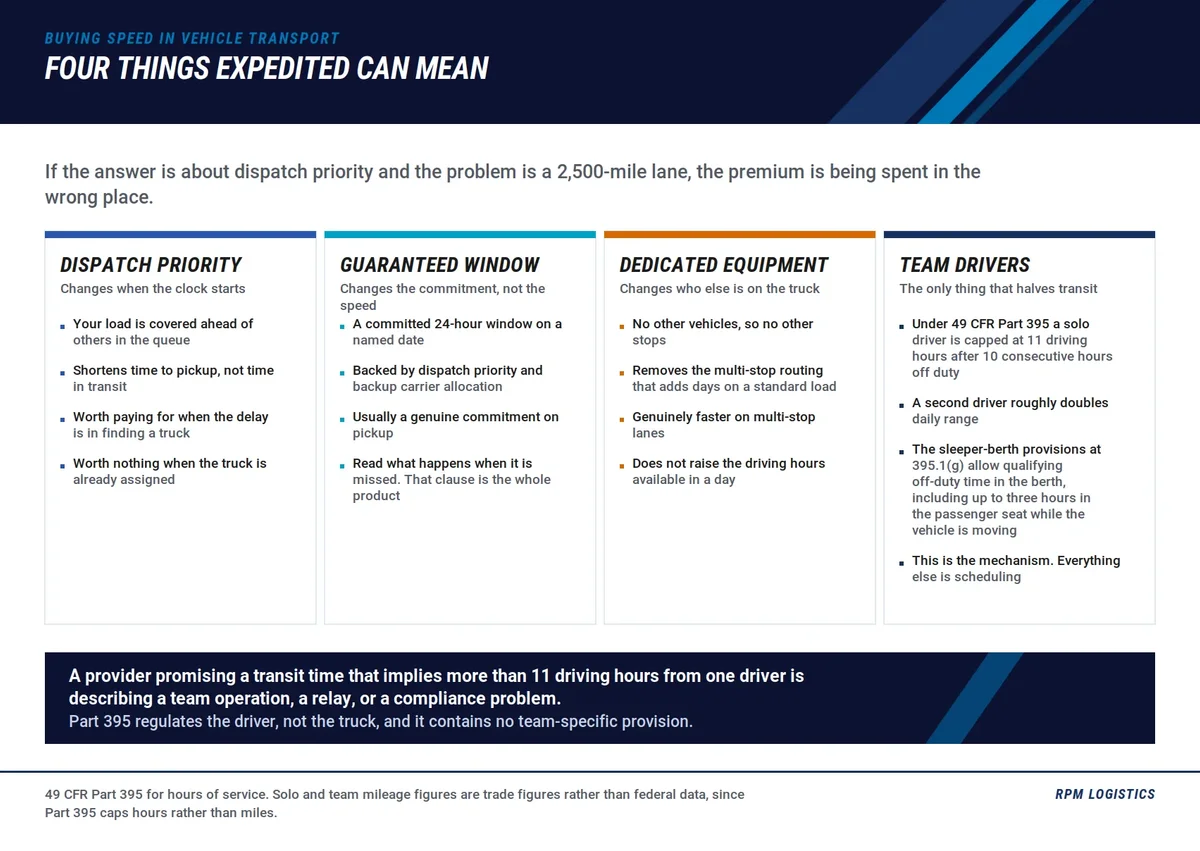
Only one of the four changes transit time. The other three change when the clock starts or who else is on the truck.
"Expedited" is used to mean at least four incompatible things in vehicle transport, and providers do not agree on which. That makes the buying decision harder than it needs to be, because the premium is quoted against a service whose definition changes by vendor.
This sets out what each tier actually delivers, the regulation that governs how fast a truck can go, when the premium is justified against the cost of the delay, and the cases where expedited buys nothing at all.
Four things "expedited" can mean
In ascending order of what it actually costs and what it actually does:
Tier | What you are buying | Effect on pickup | Effect on transit |
|---|---|---|---|
Priority dispatch | Queue position. Your load is presented to carriers ahead of others, often for a flat order fee. | Faster | None |
Reduced-stop | Fewer units on the trailer, so fewer intermediate deliveries ahead of yours. | Faster | Modest |
Exclusive use or dedicated | The trailer carries only your units. No consolidation, no cross-dock. | Faster | Meaningful |
Team-driven exclusive use | Dedicated equipment plus two drivers. | Faster | Roughly halves long-haul transit |
The distinction that costs buyers money is between the first tier and the last. A provider selling priority dispatch is selling a better place in a queue. That is a real service and it genuinely accelerates pickup, but it does not make the truck go faster, and on a long lane the truck is where the days are.
The honest providers say so. At least one states plainly that expedited service does not automatically mean a dedicated truck or a guaranteed delivery date. Most do not draw the distinction at all.
Ask which tier you are buying. If the answer is about dispatch priority and the problem is a 2,500-mile lane, the premium is being spent in the wrong place.
The mechanism: why two drivers is the only thing that halves transit
The reason expedited costs what it costs on long lanes is not fuel or scarcity. It is federal hours-of-service regulation, and almost nothing published in this category explains it.
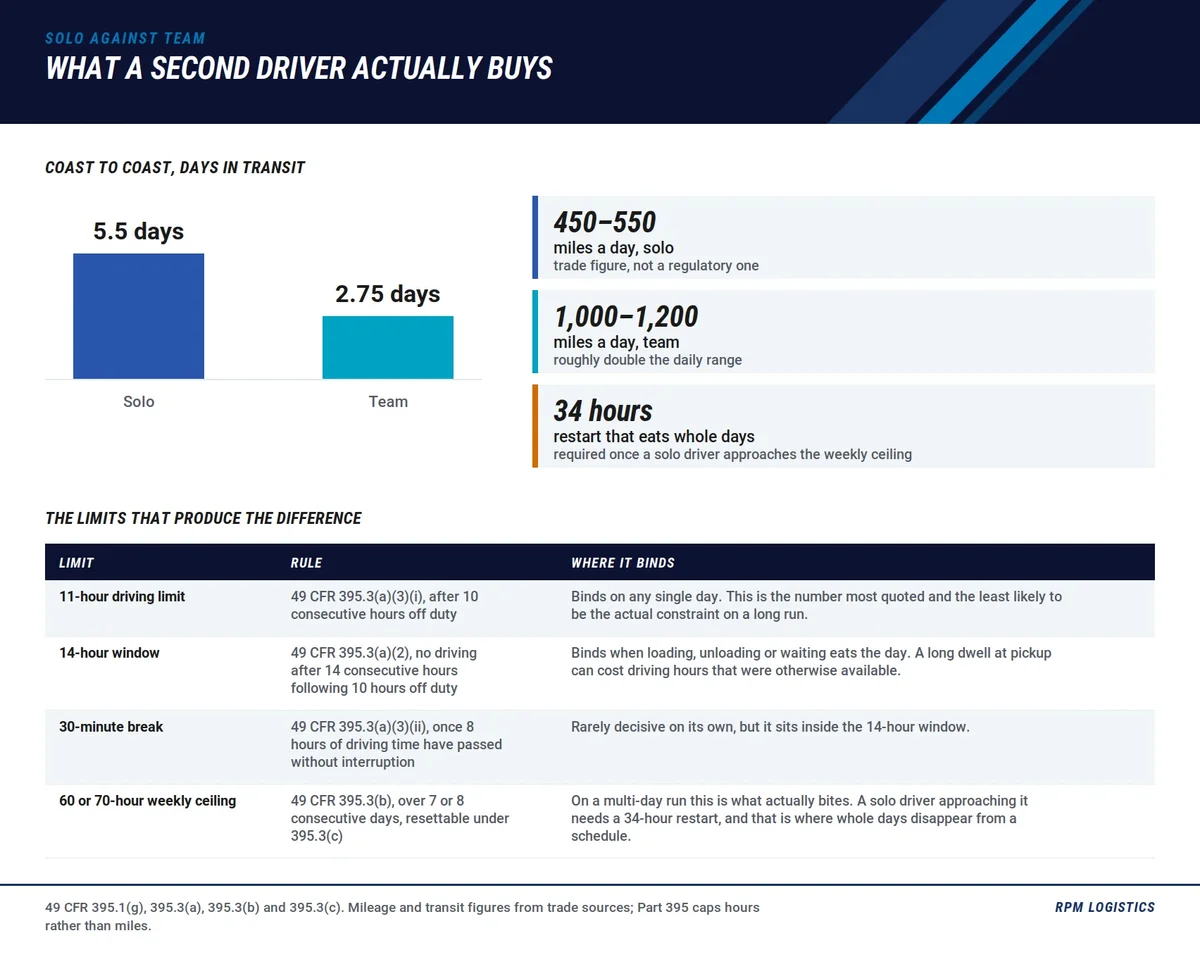
Trade figures, not federal ones. Part 395 caps hours, not miles.
Under 49 CFR Part 395, a property-carrying driver is subject to:
- An 11-hour driving limit after 10 consecutive hours off duty, under § 395.3(a)(3)(i).
- A 14-hour window. No driving after a period of 14 consecutive hours following 10 hours off duty, under § 395.3(a)(2). The clock runs whether the driver is moving or not.
- A 30-minute break required once 8 hours of driving time have passed without an interruption, under § 395.3(a)(3)(ii).
- A weekly ceiling of 60 hours in 7 consecutive days, or 70 hours in 8, under § 395.3(b), resettable by 34 or more consecutive hours off duty under § 395.3(c).
Part 395 regulates the driver, not the truck, and it contains no team-specific provision. Each driver in a two-person operation runs an independent set of clocks. The sleeper-berth provisions at § 395.1(g) allow qualifying off-duty time to be accumulated in the berth, including a combination of sleeper time and up to three hours in the passenger seat while the vehicle is moving. The resting driver accrues rest while the truck keeps rolling. That is the entire mechanism.
What it produces in practice, from trade sources rather than federal data: a solo driver covers roughly 450 to 550 miles a day and a team 1,000 to 1,200; coast to coast runs about 5 to 6 days solo against 2.5 to 3 days team. Those are industry figures, not regulatory ones. Part 395 caps hours, not miles.
The constraint people miss is the weekly one. On a multi-day run it is the 60 or 70-hour ceiling that bites, not the daily 11. A solo driver approaching the weekly limit needs a 34-hour restart, and that is where whole days disappear from a schedule. No page in this category mentions it.
This also explains what expedited cannot do. It cannot exceed the hours a driver is permitted to work. A provider promising a transit time that implies more than 11 driving hours from one driver is describing a team operation, a relay, or a compliance problem.
What a "guaranteed" window actually guarantees
Here is the finding that should change how these are bought.
Reviewing the vehicle transport providers ranking on guaranteed delivery terms, not one states a remedy for a missed window. No refund, no credit, no penalty, no liquidated damages. Every guarantee is paired with an unbounded force majeure carve-out, and the stated recourse where any is offered at all is that someone will notify you.
So the word is doing two very different jobs:
- Guaranteed pickup is usually real and narrow. It means a committed 24-hour window on a named date, backed by dispatch priority and backup carrier allocation. It is a genuine operational commitment.
- Guaranteed delivery is, as commonly sold, a service level with no teeth. It expresses intent and priority. It is not a warranty and it carries no consequence.
For a B2B buyer this distinction is the whole decision. If a unit has to be somewhere by a contractual date, what you need is not a guarantee in the marketing sense but a stated remedy in the contract. Ask the question directly: what happens, in money, if the window is missed? A provider with an answer is selling something different from a provider without one.
The related question is who bears the risk of the carve-outs. Weather, road closures, mechanical failure and hours-of-service limits are legitimate excusing conditions. An agreement in which every plausible cause of delay is excused has allocated all the risk to the shipper while charging a premium for certainty.
When the premium is justified
The calculation is simple and almost nobody publishes it: compare the premium against the cost of the delay it removes. Not against the standard rate.
Our analysis of what transport delays cost dealerships sets out the per-day figures on the retail side. The same logic applies upstream. The test is: what does one more day cost, and how many days does this actually save?
That second half is where expedited purchases go wrong. A premium paid for priority dispatch on a lane where the constraint is transit saves close to zero days. A premium paid for a team operation on a 2,500-mile lane saves two or three. Same word, different product, very different answer.
Cases where the premium usually clears:
- A unit with a customer attached and a delivery commitment. Highest cost of delay in the category, and the one place where a missed date has a named person behind it.
- Model year changeover. Value decays on a cliff rather than a slope. Days before the cutoff are worth far more than days after.
- A contractual in-service date with penalties. If late delivery triggers a financial consequence, the premium is being compared against that consequence, not against the standard rate.
- A dealer inventory gap on a fast-turning configuration. Lost sales rather than carrying cost.
- Launch, press and event vehicles. The date is immovable and the unit is useless after it.
- Warranty, recall and campaign units where the vehicle is out of service until it arrives.
- Auction deadlines, where missing a sale date pushes to the next cycle with depreciation in between.
Cases where it usually does not:
- Stock units into adequate inventory. Nothing is waiting, and carrying cost accrues either way.
- Short lanes. Under roughly a day's driving, a team buys nothing, because a solo driver completes it inside one shift.
- Where the constraint is upstream. See below.
- Where the receiving site cannot take delivery sooner. Arriving early at a location that is not ready converts a transport premium into yard dwell.
What expedited cannot fix
This is the question a provider selling a surcharge has no incentive to answer, and it is the most important one.
Expedited compresses the transport leg. It does nothing to the stages on either side of it, and in finished vehicle logistics those stages are frequently where the days actually are.
- Port and compound dwell. A unit sitting in a yard awaiting processing is not waiting on a truck. Buying a faster truck changes nothing about when it becomes available. See compound management and yard operations.
- Processing and pre-delivery inspection. Throughput is a facility constraint.
- Accessory installation and upfit. A shop slot is a shop slot.
- Customs and documentation. Paperwork errors are not solved by speed.
- Release authorisation. A unit that has not been released cannot be dispatched at any service level.
- Readiness at the destination. Arrival is not deployment, and the tasks after delivery have their own clock.
The diagnostic question before buying expedited: where is the delay actually occurring? If the answer is anywhere other than the transport leg, the premium buys nothing. Our guide to finished vehicle logistics lead times breaks door-to-door time into its stages, which is the right way to locate the constraint before spending against it.
Practical constraints on buying it
Three things that are true of expedited capacity and are rarely stated.
It is not instantly available. Team-driven exclusive-use equipment is a limited pool and it is committed in advance. Expedited booked the same day is priority dispatch by another name, because the dedicated equipment is already allocated.
Enclosed and expedited compete for the same scarce equipment. On high-value units needing both, expect less availability and a longer booking lead time, not more.
Driveaway is sometimes the faster answer. For a single drivable unit on a short-to-mid lane, a professional driver can beat a scheduled transporter, because there is no consolidation and no waiting for a load to fill. It carries mileage and exposure consequences, which our comparison of driveaway and haulaway covers, but it belongs in the consideration set rather than being ruled out by default.
What to put in the agreement
If speed is being bought for a reason that has a date attached, the agreement should say so in terms that survive a dispute. Six clauses worth insisting on:
- Which tier is being supplied, named explicitly. Priority dispatch, reduced-stop, exclusive use or team-driven exclusive use. Not the word "expedited" on its own.
- The committed window, stated as pickup, delivery, or both, with the date and the width of the window.
- The remedy if it is missed, in money. A credit, a refund of the premium, or liquidated damages. Without this the guarantee is a statement of intent.
- The excusing conditions, enumerated and bounded. Weather, road closure and mechanical failure are legitimate. A clause excusing anything outside the carrier's reasonable control has excused everything.
- Notification obligations, expressed in hours from the carrier becoming aware, not from the delay being resolved.
- Whether the load may be re-tendered. Expedited service sourced from a party that will not perform the move reintroduces exactly the uncertainty the premium was meant to remove.
Carrier compliance status is worth confirming alongside this, since hours-of-service performance is a matter of record. FMCSA publishes the underlying rules, and our guide to DOT compliance for automotive carriers covers what a carrier's record shows.
Frequently asked questions
What is the difference between expedited and standard vehicle transport?
It depends on which tier you buy. Priority dispatch accelerates pickup but not transit. Reduced-stop service puts fewer units on the trailer. Exclusive use dedicates the trailer to your units. Team-driven exclusive use adds a second driver and is the only tier that materially compresses long-haul transit. Providers use the word "expedited" for all four.
Will the truck actually drive faster if I pay for expedited?
No. A truck moves at the same speed regardless of what was paid. Transit compresses only when the equipment stops less, which on a long lane means a second driver. Under 49 CFR Part 395 a solo driver is limited to 11 driving hours within a 14-hour window after 10 hours off duty, so the vehicle is stationary for the reset. A team runs two independent clocks, and the sleeper-berth provisions let the resting driver accrue off-duty time while the truck is moving.
How much time does a team driver actually save?
Trade figures put a solo driver at roughly 450 to 550 miles a day against 1,000 to 1,200 for a team, and coast-to-coast at about 5 to 6 days solo against 2.5 to 3 days team. These are industry figures rather than regulatory ones, since Part 395 caps hours rather than miles. On multi-day runs the binding constraint is often the 60 or 70-hour weekly ceiling, which forces a 34-hour restart.
Can a vehicle transport company really guarantee a delivery date?
Guaranteed pickup is usually a genuine commitment to a 24-hour window on a named date. Guaranteed delivery, as commonly sold, is a service level rather than a warranty. Across the providers ranking on guaranteed delivery terms, not one states a remedy for a missed window, and every guarantee is paired with broad force majeure carve-outs.
What happens if a guaranteed window is missed?
Usually nothing contractual, which is the point worth checking before booking. Ask what the remedy is in money if the window is missed, and read which causes of delay are excused. An agreement excusing every plausible cause has allocated the risk to the shipper while charging for certainty.
When is expedited vehicle transport worth the premium?
Compare the premium against the cost of the delay it removes, not against the standard rate, and be honest about how many days it actually saves. It usually clears for units with a customer attached, model year changeover deadlines, contractual in-service dates carrying penalties, inventory gaps on fast-turning configurations, launch and event vehicles, and auction deadlines.
When is expedited not worth paying for?
Stock units moving into adequate inventory, short lanes a solo driver completes in one shift, situations where the receiving site cannot accept delivery any sooner, and any case where the delay is occurring outside the transport leg.
What can expedited transport not fix?
Anything outside the transport leg: port and compound dwell, processing and pre-delivery inspection throughput, accessory installation and upfit slots, customs and documentation, release authorisation, and readiness at the destination. Locate where the delay is actually occurring before spending against it.
How far in advance does expedited need to be booked?
Further than most buyers expect. Team-driven exclusive-use equipment is a limited pool committed in advance, so same-day expedited is generally priority dispatch rather than dedicated capacity. Enclosed and expedited compete for the same scarce equipment, so units needing both require more lead time, not less.
Buying speed where it exists
RPM Logistics moves finished vehicles across all 50 states and Canada, including dedicated and team-driven capacity where a lane genuinely requires it. If you want help locating whether the delay is in the transport leg before you pay a premium against it, talk to our team.