

Quick answer: When a Class 9 lithium load fails in transit, the response runs on a fixed clock: secure the scene and call 911, notify the carrier, then the emergency response number on the shipping paper. If the incident closes a major road for an hour or forces an evacuation, the National Response Center must be notified within 12 hours. A written report is due within 30 days.
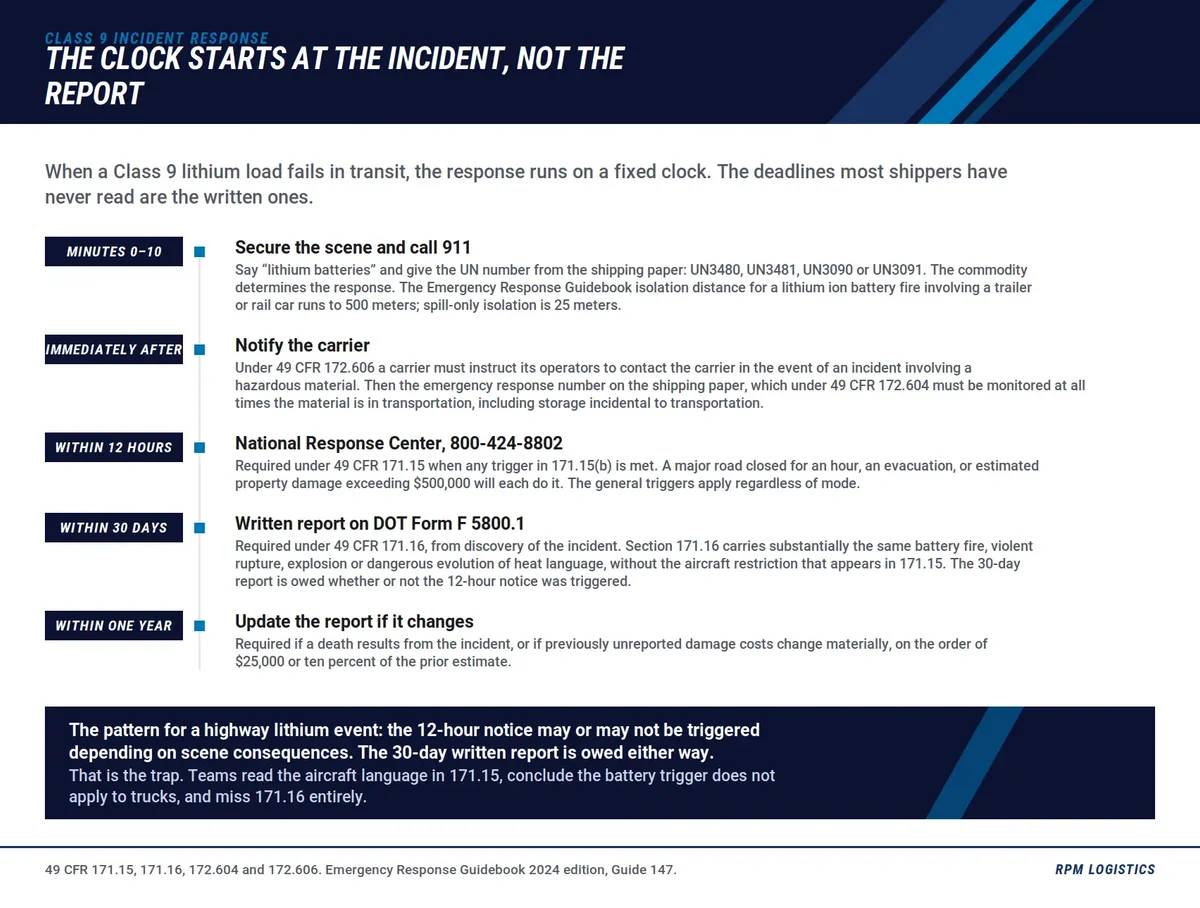
Four deadlines, three of them federal. None of them start when someone decides an incident is serious.
Most lithium battery compliance content covers what has to be true before a load moves. This covers what happens after something goes wrong at mile 300, which is governed by a different set of rules, on deadlines most shippers have never read.
The sequence below is the federal one. It applies to highway freight, it is specific, and getting it wrong is a separate violation from whatever caused the incident.
The first ten minutes
Scene actions come before reporting obligations, and nothing in the regulations changes that order.
- Stop and separate. Get the power unit away from the trailer if that can be done safely. A lithium event in the cargo box is survivable for the tractor only if the two are separated early.
- Call 911 and say "lithium batteries." The commodity determines the response. A dispatcher told "truck fire" sends a different response than one told "Class 9 lithium ion battery cargo."
- Give the UN number. UN3480, UN3481, UN3090 or UN3091. This is the single most useful piece of information the driver can provide, because it routes responders to the correct guidance and it distinguishes lithium ion from lithium metal, which are handled differently.
- Keep people back and upwind. The Emergency Response Guidebook's isolation distances for a lithium ion battery fire involving a trailer or rail car run to 500 meters. Spill-only isolation is 25 meters.
- Do not reboard or reopen the trailer. Cells that appear stable reignite, sometimes long after the visible fire is out.
- Retrieve the shipping papers if they are accessible. They carry the emergency response information responders need and the number that has to be called next.
The driver is not expected to fight a lithium fire. The regulatory obligations begin once the scene is in professional hands.
The notification sequence
Three separate calls, in order, each to a different party for a different reason.
Emergency services. Immediate, and not a regulatory step. It is simply first.
The carrier. Under 49 CFR § 172.606, a carrier must instruct its operators to contact the carrier in the event of an incident involving a hazardous material. This is a standing obligation on the carrier to have told the driver in advance, not something improvised at the scene. If your drivers do not know they are required to call in, that is a compliance gap sitting in your training file.
The emergency response telephone number on the shipping paper. Covered below, because the requirements around it are stricter than most shippers realize.
The immediate notice rule, and the aircraft trap
This is where most published guidance gets it wrong, and the error runs in the direction that leaves a shipper under-reporting.
49 CFR § 171.15 requires notice to the National Response Center within 12 hours of an incident meeting any of its triggers. The number is 800-424-8802.
Section 171.15(b) lists the triggers. One of them covers a battery fire, violent rupture, explosion, or dangerous evolution of heat. Read it carefully: that battery trigger applies during transportation by aircraft. It is modally limited. A lithium fire on a truck does not activate that specific clause.
Shippers who stop reading there conclude no immediate notice is required for a highway lithium incident. That conclusion is usually wrong, because the general triggers in § 171.15(b) apply regardless of mode, and a truck lithium fire reliably hits at least one of them:
- A major transportation artery or facility is closed or shut down for one hour or more
- One or more people are evacuated for one hour or more
- A person is killed, or receives an injury requiring hospitalization
- Estimated property damage exceeds $500,000
- A radioactive, infectious substance, or marine pollutant release occurs
A trailer fire on an interstate closes lanes for well over an hour in practically every case. The road-closure clause is what actually obliges the call, not the battery clause. The practical rule for surface freight: assume immediate notice is required and confirm otherwise, rather than the reverse.
Section 171.15 also specifies what the notice must contain: the reporter's name, the name and address of the person on whose behalf the report is made, the date, time and location of the incident, the extent of injuries, the classification, name and quantity of the material involved, and the type of incident and nature of the hazardous material involvement.
The written report, and the trigger nobody expects
49 CFR § 171.16 requires a detailed written report on DOT Form F 5800.1, filed within 30 days of discovery of the incident. This obligation is independent of the immediate notice. Filing one does not satisfy the other.
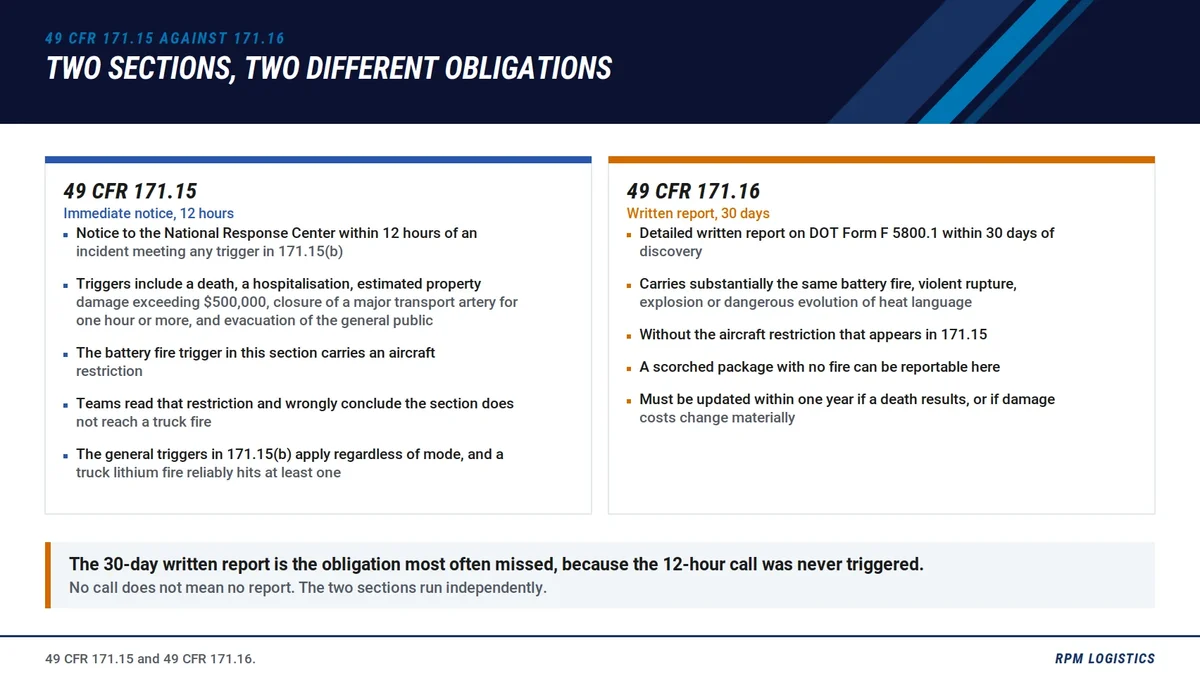
The battery fire language appears in both. The aircraft restriction appears in only one.
Two features of § 171.16 deserve specific attention.
The battery trigger here is not modally limited. Section 171.16 carries substantially the same battery fire, violent rupture, explosion, or dangerous evolution of heat language, without the aircraft restriction that appears in § 171.15. So the pattern for a highway lithium event is: the 12-hour notice may or may not be triggered depending on scene consequences, and the 30-day written report is owed either way.
"Dangerous evolution of heat" is defined more broadly than people assume. The regulation's language includes charring of packaging, melting of packaging, and scorching of packaging. There does not have to be a fire. There does not have to be a release. A scorched overpack discovered at delivery is a reportable incident. This is, in practice, the single most commonly missed reporting obligation in lithium freight, because nothing dramatic happened and the load arrived.
Two further obligations attach to the written report:
- Retention. A copy of the report and all supporting documentation must be retained for two years at the reporting person's principal place of business.
- Updates. A report must be updated within one year if a death results from the incident, or if previously unreported damage costs change materially, on the order of $25,000 or ten percent of the prior estimate.
Undeclared hazardous materials discovered in transportation carry their own written-report trigger, and for surface transport there is no general carve-out. If a lithium shipment is found to have moved undeclared, the discovery itself is reportable.
The emergency response number has to actually work
Every compliance checklist says a fully regulated shipment carries a 24-hour emergency response telephone number. Very few explain what that number is obligated to do, and this is where programs fail an audit after an incident rather than before one.
Under 49 CFR § 172.604, the number must be monitored at all times the material is in transportation, including storage incidental to transportation. The person answering must either be knowledgeable about the material and the emergency response information, or have immediate access to someone who is.
The regulation is explicit about what does not satisfy this:
- An answering service
- An answering machine
- A beeper or callback arrangement where the caller leaves a message and waits
A first responder at the scene calling that number and reaching voicemail is a violation, and it is one that will be discovered precisely when it matters most. The rule also requires that where a third-party emergency response information provider is used, that provider's name or the contract number must appear on the shipping paper immediately next to the number.
Worth auditing this before you need it: call your own number at 2am from an outside line and see who answers.
Lithium ion and lithium metal are not the same emergency
The distinction the UN number carries is not administrative. It changes what responders do.
Lithium ion cells and batteries, UN3480 and UN3481, route to the Emergency Response Guidebook's Guide 147, retitled in the 2024 edition to cover lithium ion and sodium ion batteries. Water is used, in volume, and cooling is the strategy.
Lithium metal cells and batteries, UN3090 and UN3091, are a different problem. Lithium metal is water-reactive. Applying water to a lithium metal fire can intensify it, and the guidance these UN numbers route to reflects that. A responder who treats a lithium metal load as if it were lithium ion can make the situation worse.
This is the operational reason the driver stating the UN number matters more than describing the cargo. "Batteries" is ambiguous. "UN3090" is not.
If you are unclear which UN numbers apply to what you ship, our guide to how lithium batteries are classified covers the four numbers and what changes between them.
Reignition, and why the incident is not over when the fire is out
Lithium cells that have gone into thermal runaway and been extinguished can reignite. Not minutes later, in some cases weeks later. That has three practical consequences the response plan has to account for.
Where the damaged freight goes matters. A scorched pallet placed back in a warehouse or a yard is a live risk to everything around it. Isolation and distance apply to the aftermath, not just the scene.
The receiving facility needs to be told. If a partially damaged load continues to its destination, the consignee is inheriting a hazard they have not been warned about unless somebody says so explicitly.
Onward movement of damaged cells is its own regulated shipment. Moving batteries that were damaged in an incident is not the same as moving the load you originally tendered. That freight now falls under the damaged, defective and recalled rules, with their own packaging and routing requirements. Our guide to shipping damaged and defective lithium batteries covers that pathway. Treat the two as sequential: this article ends where that one begins.
What to document, and when
The reporting obligations above all require facts that are easiest to capture in the first hours and nearly impossible to reconstruct later.
- Time, location and the responding agency's incident number. Required for both reports.
- The shipping paper as tendered, including UN numbers, quantities, packaging type, and the emergency response number and provider reference.
- Photographs of packaging condition, including scorching or melting that falls short of fire. This is the evidence for the reportability determination.
- The road closure duration and any evacuation, because these determine whether the 12-hour notice was triggered.
- Who was notified, at what time, and what was said. Including the call to the emergency response number and whether a knowledgeable person answered.
- Damage estimate and its basis, which drives both the $500,000 immediate-notice threshold and the one-year update obligation.
Chain-of-custody discipline through an incident is what separates a defensible file from a reconstruction. Our coverage of hazmat freight documentation and carrier requirements addresses the routine version of the same discipline.
What is changing
Two developments worth having on the calendar.
The phone number comes off the lithium battery mark at the end of 2026. The telephone number on the lithium battery mark is being phased out effective December 31, 2026. That does not reduce the emergency response number obligation on the shipping paper, which is a separate requirement, but it does mean every mark in circulation needs reviewing before the deadline. See our summary of what changed for lithium battery shipping in 2026.
A harmonization rulemaking is pending, not final. PHMSA published a notice of proposed rulemaking in February 2026 covering new UN entries for vehicles and sodium-ion batteries and a change requiring emergency response information for certain battery-powered equipment to name the predominant battery type. The comment period closed in April 2026. It remains a proposal, and anyone describing it as current law is wrong. Status is checkable at PHMSA and on the Federal Register.
A note on incident statistics: the FAA publishes a verified list of lithium battery incidents in air transport, recording 93 verified events in 2025 against 89 in 2024. Those figures are aviation only and say nothing about surface freight. PHMSA maintains an incident database covering all modes, but publishes no standing lithium-specific surface count. Be wary of any source presenting aviation numbers as an industry-wide trend.
Frequently asked questions
What do you do when a lithium battery shipment catches fire in transit?
Separate the power unit from the trailer if it is safe, call 911 and state that the cargo is lithium batteries with the UN number, keep people back and upwind, do not reopen the trailer, then notify the carrier and the emergency response number on the shipping paper. Reporting obligations follow once the scene is in professional hands.
Do you have to report a lithium battery incident to DOT?
Yes. A written report on DOT Form F 5800.1 is due within 30 days of discovery. A separate immediate notice to the National Response Center is required within 12 hours if the incident closes a major transportation artery for an hour or more, forces an evacuation of an hour or more, causes death or hospitalization, or produces property damage over $500,000.
Is a scorched package reportable if there was no fire?
Yes. The written-report trigger covers a dangerous evolution of heat, which the regulation describes as including charring, melting, or scorching of packaging. There does not need to be a fire or a release. A scorched overpack discovered at delivery is reportable, and this is the most commonly missed obligation in lithium freight.
What is the National Response Center number for a hazmat incident?
800-424-8802. Notice must be given within 12 hours of an incident meeting the triggers in 49 CFR 171.15, and the caller must provide the date, time and location, the classification, name and quantity of material, the extent of any injuries, and the nature of the hazardous material involvement.
Does the lithium battery fire trigger apply to trucks?
The battery fire trigger in the 12-hour immediate notice rule is limited to transportation by aircraft. However, the general triggers in the same rule apply to all modes, and a truck lithium fire almost always closes a major artery for an hour or more, which requires notice. The 30-day written report carries the battery language without a modal limitation and is owed regardless.
What are the requirements for a hazmat emergency response phone number?
It must be monitored at all times the material is in transportation, including storage incidental to transportation, and answered by someone knowledgeable about the material or with immediate access to such a person. Answering services, answering machines, and beeper or callback arrangements do not satisfy the requirement. Where a third-party provider is used, its name or contract number must appear on the shipping paper next to the number.
Are lithium ion and lithium metal battery fires handled the same way?
No. Lithium ion cells and batteries, UN3480 and UN3481, are cooled with water in volume. Lithium metal cells and batteries, UN3090 and UN3091, are water-reactive, and applying water can worsen the fire. This is why stating the UN number to responders matters more than describing the cargo as batteries.
Can a lithium battery fire reignite after it is out?
Yes, sometimes long after the visible fire is extinguished. Damaged cells should be isolated rather than returned to a warehouse or yard, the receiving facility must be told if partially damaged freight continues, and any onward movement of damaged cells becomes a regulated damaged-battery shipment with its own packaging and routing rules.
How long must you keep a hazmat incident report?
Two years from the date of the report, at the reporting person's principal place of business, along with supporting documentation. The report must also be updated within one year if a death results or if damage costs change materially.
Before the incident, not during it
RPM Logistics moves Class 9 lithium freight across all 50 states and Canada with hazmat-qualified carriers, documented custody at each transfer, and emergency response information verified before dispatch rather than assumed. If you want your incident response sequence and your emergency number tested before you need them, talk to our team. For the full compliance picture, start with our lithium battery transport compliance guide.