

Quick answer: Lithium loads are refused for a short list of repeatable marking defects: the wrong Class 9 label, a mark without its matching label on air shipments, an undersized or wrong-colour mark, a UN number that does not match the configuration, and a missing watt-hour rating. Each is checkable in about a minute before tender.
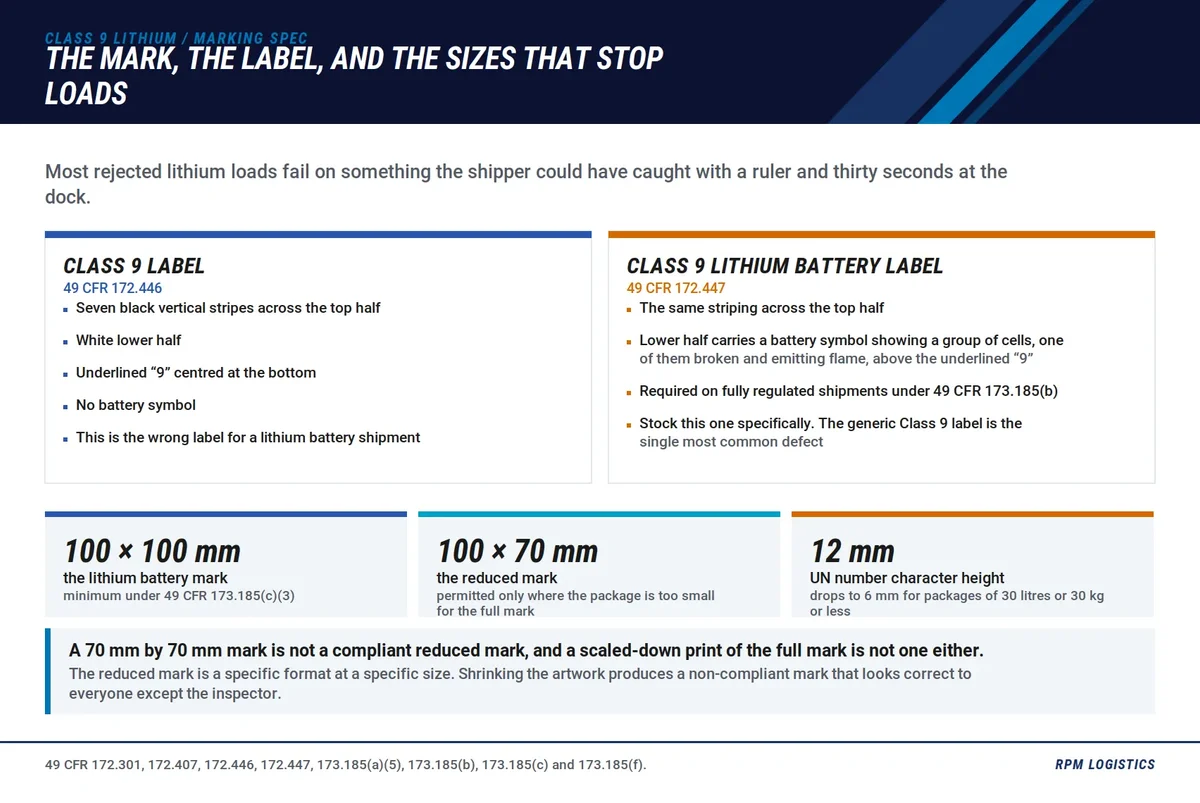
Two labels that look almost identical, one mark with two legal sizes, and a UN number height most shippers have never checked.
There is no shortage of published guidance on what lithium battery marks and labels are supposed to look like. There is almost nothing on what actually gets caught, which is a different list and a shorter one.
This is the failure-mode version. Each item below is a defect a carrier or inspector can observe on the outside of a package, with the rule it breaches and the fix. If you want the underlying requirements in full, our lithium battery transport compliance guide covers them.
The defects that stop loads
1. The generic Class 9 label instead of the lithium battery label
These are two different labels and the substitution is visually obvious once you know to look.
The Class 9 label at 49 CFR § 172.446 is seven black vertical stripes across the top half, a white lower half, and an underlined "9" centred at the bottom. Nothing else. The lithium battery label at 49 CFR § 172.447 uses the same striping, but the lower half carries a battery symbol showing a group of cells, one of them broken and emitting flame, above the underlined "9".
Fix: stock the § 172.447 label specifically. A warehouse that buys "Class 9 labels" generically will end up with the wrong one.
2. The mark applied but the label omitted on an air shipment
This is the most common structural error, and it comes from reading the mark and the label as alternatives.
For fully regulated shipments under 49 CFR § 173.185(b), the Class 9 lithium battery label applies, along with the UN number and proper shipping name. For excepted smaller cells and batteries under § 173.185(c), the lithium battery mark applies instead. So far the either-or reading holds.
It stops holding for air. Under § 173.185(c)(5), packages offered for air transport must carry both the mark and the Class 9 lithium battery label. Not one or the other. Very little published guidance states this plainly, and it is a routine refusal at air sort facilities.
Fix: if the package is going on an aircraft, assume both until you have confirmed otherwise.
3. The mark is the wrong size, or the wrong kind of smaller
Under 49 CFR § 173.185(c)(3), the lithium battery mark must be at least 100 mm wide by 100 mm high. Where the package is too small to take it, a reduced mark of 100 mm wide by 70 mm high is permitted.
Note what the allowance actually is. It reduces the height and holds the width. It is not permission to shrink the mark proportionally to whatever fits. A 70 mm by 70 mm mark is not a compliant reduced mark, and a scaled-down print of the full mark is not either.
Fix: hold two mark sizes, not a scalable artwork file.
4. Wrong colours on the mark
The specification is precise: red hatching at a minimum width of 5 mm, with symbols and letters in black on white or a suitably contrasting background.
This is a real-world failure, not a theoretical one. A published compliance review of a photographed mark on a shipped package found it failed on two of three colour criteria at once: white letters where black was required, on a black background where white or a contrasting background was required. The hatching was the only element that passed.
Fix: check a sample against the specification when a print run changes supplier, not when a load is refused.
5. The UN number does not match the configuration
Four numbers, and the distinction is configuration rather than chemistry alone:
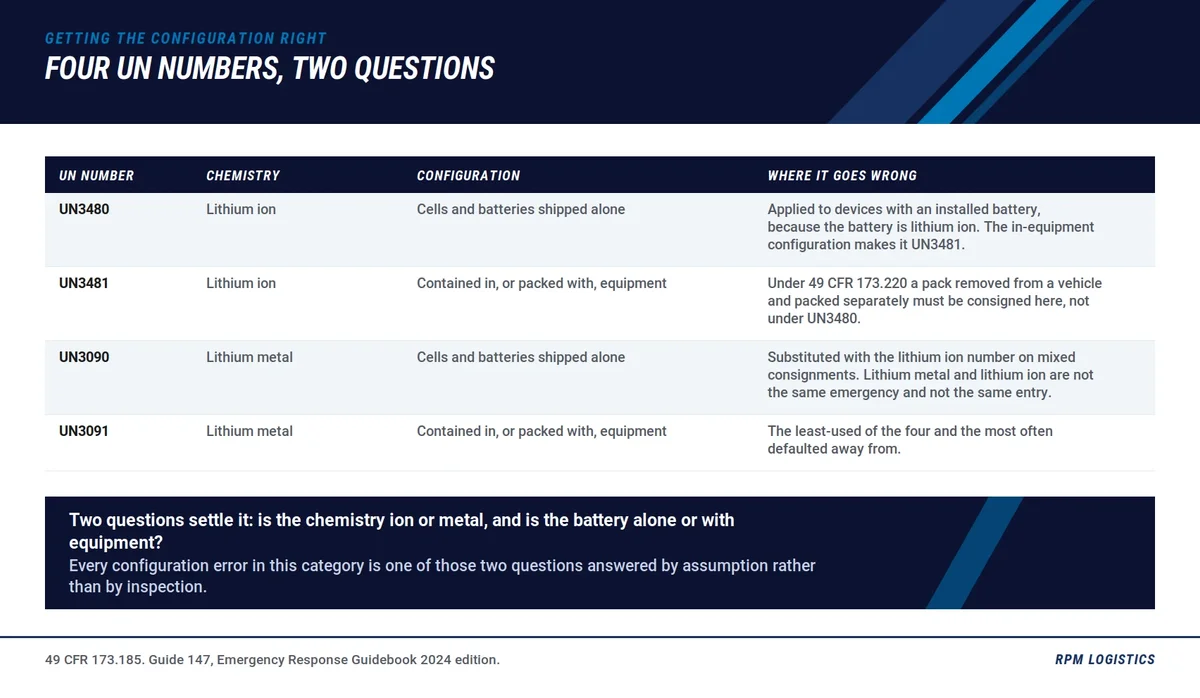
The routine error is treating a device with an installed battery as UN3480 because the battery is lithium ion.
- UN3480: lithium ion cells and batteries shipped alone
- UN3481: lithium ion cells and batteries contained in, or packed with, equipment
- UN3090: lithium metal cells and batteries shipped alone
- UN3091: lithium metal cells and batteries contained in, or packed with, equipment
The routine error is treating a device with an installed battery as UN3480 because the battery is lithium ion, when the in-equipment configuration makes it UN3481. Power banks generate the reverse error, being declared as equipment when they are standalone batteries.
Fix: classify on configuration first, chemistry second. Our guide to how lithium batteries are classified walks the four numbers.
6. UN number characters below the required height
Under 49 CFR § 172.301(a)(1), the identification number on a non-bulk package, preceded by "UN", must be at least 12 mm high. It drops to at least 6 mm for packages with a maximum capacity of 30 litres or less, a net mass of 30 kg or less, or cylinders of 60 litres water capacity or less. For packages of 5 litres or 5 kg or less, the rule requires a size appropriate to the package.
One caution worth knowing: some widely circulated guidance states these breakpoints in terms of gross weight. The regulation is written in terms of capacity and net mass. Where they conflict, the regulation controls.
7. The watt-hour rating is missing from the battery case
Section 173.185(a)(5) requires that, beginning May 10, 2024, each lithium ion battery be marked with the watt-hour rating on the outside case. This is a mark on the battery itself, not on the package, which is why it is missed: the packaging line never sees it, and the defect is only found when someone opens a box.
Fix: make it a receiving check at the point the batteries arrive from the manufacturer, not a shipping check. By the time it is a shipping problem it is too late to fix economically.
8. Damaged or defective marking missing or undersized
Under § 173.185(f), a package containing a damaged or defective battery must be marked with an indication that it contains a "Damaged/defective lithium ion battery" or "Damaged/defective lithium metal battery" as applicable, in characters at least 12 mm high.
The related failure is routing rather than marking: under IATA Special Provision A154, damaged, defective and recalled batteries liable to produce a dangerous evolution of heat are forbidden for air transport. A perfectly marked damaged-battery package tendered to air freight still gets refused. Our guide to shipping damaged and defective lithium batteries covers the ground-only pathway.
9. OVERPACK not marked
Under 49 CFR § 173.25, an overpack must be marked "OVERPACK" in lettering at least 12 mm high, and must carry the proper shipping name, identification number and labels for the hazmat inside, unless the markings and labels representative of each package within are visible from outside.
That exception is where the error lives. Shrink-wrapping a pallet so that one package's mark happens to face outward does not make the representative marks visible for every package type inside.
Fix: if you cannot see a compliant mark for each hazmat package type from outside the overpack, mark the overpack.
10. Label placement and orientation
Carrier acceptance checklists treat this as a pass or fail item rather than a matter of tidiness. One major carrier's dangerous goods checklist requires that the Class 9 lithium battery label sit on the same surface and in the same diamond orientation as the proper shipping name marking, where package dimensions allow, and that the Cargo Aircraft Only label appear on the same surface near the hazard label.
A label applied square instead of on point, or wrapped around a corner, or placed on a different face from the shipping name, is a refusal.
11. Durability
Under 49 CFR § 172.407, a label must be able to withstand 30 days of exposure to transport conditions without substantial deterioration or colour change. Marks printed on standard office labels with water-soluble toner will not survive a wet dock, and a mark that is illegible on arrival is a mark that was not applied.
12. The old mark format after the deadline
Covered in its own section below, because the date matters.
What enforcement actually costs
Marking and labelling defects are not treated as paperwork. The FAA's hazardous materials enforcement actions attach real numbers, and they bundle marking failures with the classification and documentation failures that usually accompany them.
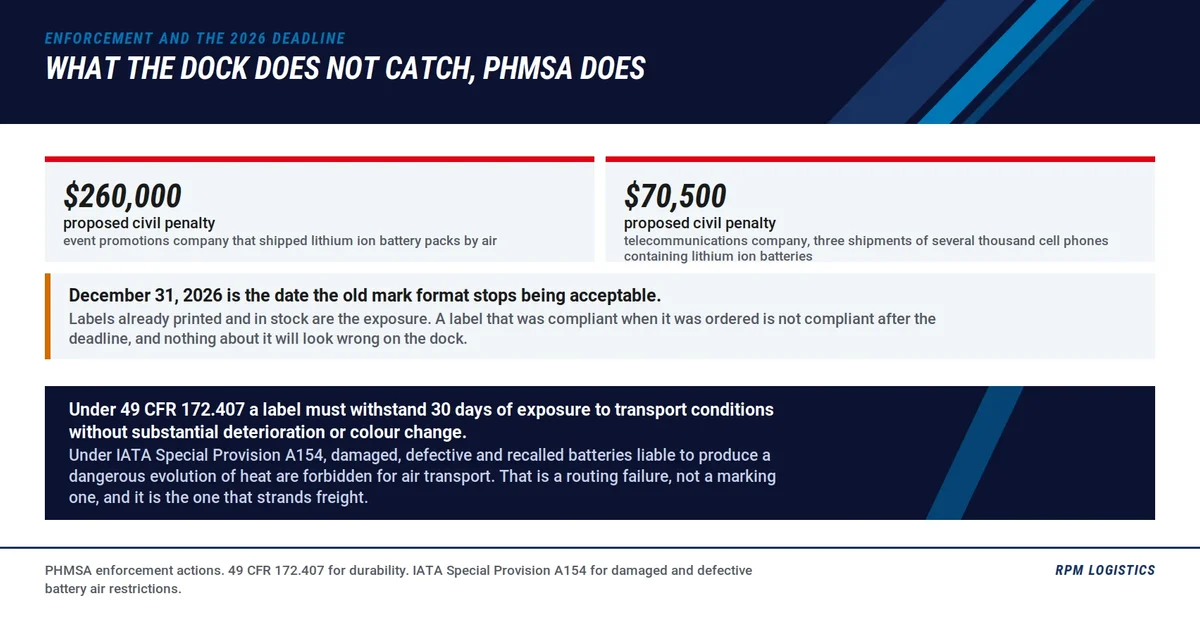
Two recent proposed penalties, and the format deadline that turns compliant labels into non-compliant ones.
- $260,000 proposed civil penalty against an event promotions company that shipped lithium ion battery packs by air. The case cited improper classification, description, packaging, marking and labelling, missing shipping papers, a state of charge above the permitted limit, and no emergency response information. The shipment was found smoking at a sort facility, with a burn hole in the package.
- $70,500 proposed civil penalty against a telecommunications company that offered three shipments of several thousand cell phones containing lithium ion batteries. The materials were found not properly classed, described, packaged, marked, labelled or in proper condition for shipment, with no emergency response information.
- $170,000 proposed civil penalty covering four separate undeclared lithium ion shipments across 2024, one of which was found emitting smoke with three batteries melted together.
Figures published by the FAA's Office of Hazardous Materials Safety. The pattern across all three is worth noting: nobody is penalised for a marking defect alone. Marking failures travel with classification and documentation failures, because they share a root cause in the shipper not knowing what it is offering.
The December 31, 2026 deadline
The lithium battery mark used to require a telephone number for additional information. It no longer does.
The change came through the HM-215Q harmonization rule, published April 10, 2024 and effective May 10, 2024, which aligned the US regulations with the international standards that had already dropped the requirement (Federal Register, April 2024).
The transition provision in the regulation permits the older mark format, in conformance with the requirements in effect on May 9, 2024, to continue to be used until December 31, 2026. That is roughly three months out.
Two practical points, and one that is genuinely unsettled:
- Removing the phone number from the mark does not remove the emergency response number from the shipping paper. Those are separate requirements under different rules, and conflating them is how a shipper solves one problem and creates another. The shipping paper obligation is unchanged.
- Check your print inventory now. Pre-printed stock of the old format has a hard expiry, and a January reorder is a January problem.
- Whether marks already applied to packages in the stream must be replaced is not clearly answered in the regulation, which addresses continued use of the old mark format rather than retroactive replacement. Vendor guidance asserting that older marks "will not be accepted" after the date is interpretation rather than regulatory text. If this affects a large inventory, get a written answer rather than relying on a blog.
Our summary of what changed for lithium battery shipping in 2026 covers the wider set of changes.
Two things published guidance gets wrong
There is no 50 mm minimum for the Class 9 label in the US regulations. Section 172.447 contains no dimensions at all; it opens by excepting size and colour and then specifies the design. Dimensions come from § 172.407, which sets at least 100 mm on each side with a solid inner border approximately 5 mm inside the edge, and allows reduction proportionally provided the symbol and other elements remain clearly visible. It sets no numeric floor. The 50 mm figure that circulates, sometimes cited to § 172.407(c)(1), comes from the IATA Dangerous Goods Regulations. Cite it to IATA or not at all.
Exceptions to the mark do exist for small consignments. At least one widely circulating source states that no exceptions exist and that all lithium battery shipments require the mark regardless of size or capacity. That is incorrect. The mark is not required for button cells installed in equipment, or for consignments of no more than two packages where each package contains no more than four cells or two batteries installed in equipment.
A pre-tender check
Six questions, in order, on the package in front of you.
- Fully regulated or excepted? The watt-hour or lithium content thresholds decide whether you are applying a label, a mark, or both.
- Air or surface? If air, expect both the mark and the Class 9 lithium battery label, and check whether a Cargo Aircraft Only label applies.
- Does the UN number match the configuration rather than just the chemistry, and does it match the declaration?
- Measure the mark. 100 by 100, or 100 by 70 on a small package. Not a proportional shrink.
- Look at the colours. Black on white or contrasting, red hatching at 5 mm minimum.
- Check the surface and orientation. Label on the same face as the shipping name, in diamond orientation, and OVERPACK marked unless representative marks are visible for every package type inside.
For the packaging side of the same check, see lithium battery packaging requirements. For international consignments, IATA and IMDG marking adds requirements this list does not cover.
Frequently asked questions
Why do lithium battery shipments get rejected?
Most refusals come from a short list of observable marking defects: the generic Class 9 label used in place of the lithium battery label, a mark without its matching label on an air shipment, an undersized or incorrectly coloured mark, a UN number that does not match the configuration, characters below the required height, and an unmarked overpack.
What is the difference between the Class 9 label and the Class 9 lithium battery label?
The Class 9 label at 49 CFR 172.446 has seven black vertical stripes on the top half and an underlined 9 at the bottom. The lithium battery label at 49 CFR 172.447 uses the same striping but adds a battery symbol showing a group of cells with one broken and emitting flame. Using the generic label on a lithium shipment is a citable defect.
Does a package with the lithium battery mark also need a Class 9 label?
For air transport, yes. Under 49 CFR 173.185(c)(5), packages offered for air must display both the lithium battery mark and the Class 9 lithium battery label. Reading the two as alternatives is the most common structural marking error.
What size does the lithium battery mark have to be?
At least 100 mm wide by 100 mm high. Where the package is too small, a reduced mark of 100 mm wide by 70 mm high is permitted. The allowance reduces the height and holds the width, so a proportionally scaled-down mark is not compliant.
Does the lithium battery mark still need a phone number?
No. The HM-215Q harmonization rule removed the telephone number requirement from the mark effective May 10, 2024. The older format may continue to be used until December 31, 2026. The separate requirement for an emergency response telephone number on the shipping paper is unchanged.
How tall do UN numbers have to be on a package?
At least 12 mm on a non-bulk package, dropping to at least 6 mm for packages with a maximum capacity of 30 litres or less, a net mass of 30 kg or less, or cylinders of 60 litres water capacity or less. For packages of 5 litres or 5 kg or less, the rule requires a size appropriate to the package.
Do lithium batteries need a watt-hour rating marked on them?
Section 173.185(a)(5) requires that, beginning May 10, 2024, each lithium ion battery be marked with the watt-hour rating on the outside case. Because this is a mark on the battery rather than the package, it is best caught as a receiving check when batteries arrive from the manufacturer.
When do you have to mark a package OVERPACK?
When the markings and labels representative of each package inside are not visible from outside. The lettering must be at least 12 mm high. A pallet wrapped so that one package's mark faces outward does not satisfy the visibility exception for every package type inside.
Are there any exceptions to the lithium battery mark?
Yes. The mark is not required for button cells installed in equipment, or for consignments of no more than two packages where each package contains no more than four cells or two batteries installed in equipment. Guidance stating that no exceptions exist is incorrect.
Catching it before the dock does
RPM Logistics moves Class 9 lithium freight across all 50 states and Canada with hazmat-qualified carriers and documentation verified before dispatch rather than at the dock. If your loads are being refused and you want the defect found before tender, talk to our team.