

Quick answer: A race car ships under different rules and different handling than a street car. Fuel in the car's own tank is exempt from hazmat paperwork on the highway; fuel in jugs is not, and a for-hire carrier cannot use the materials of trade exception to move it. Fire bottles installed in the car ride free. Pull one out and it becomes a regulated Class 2 shipment.
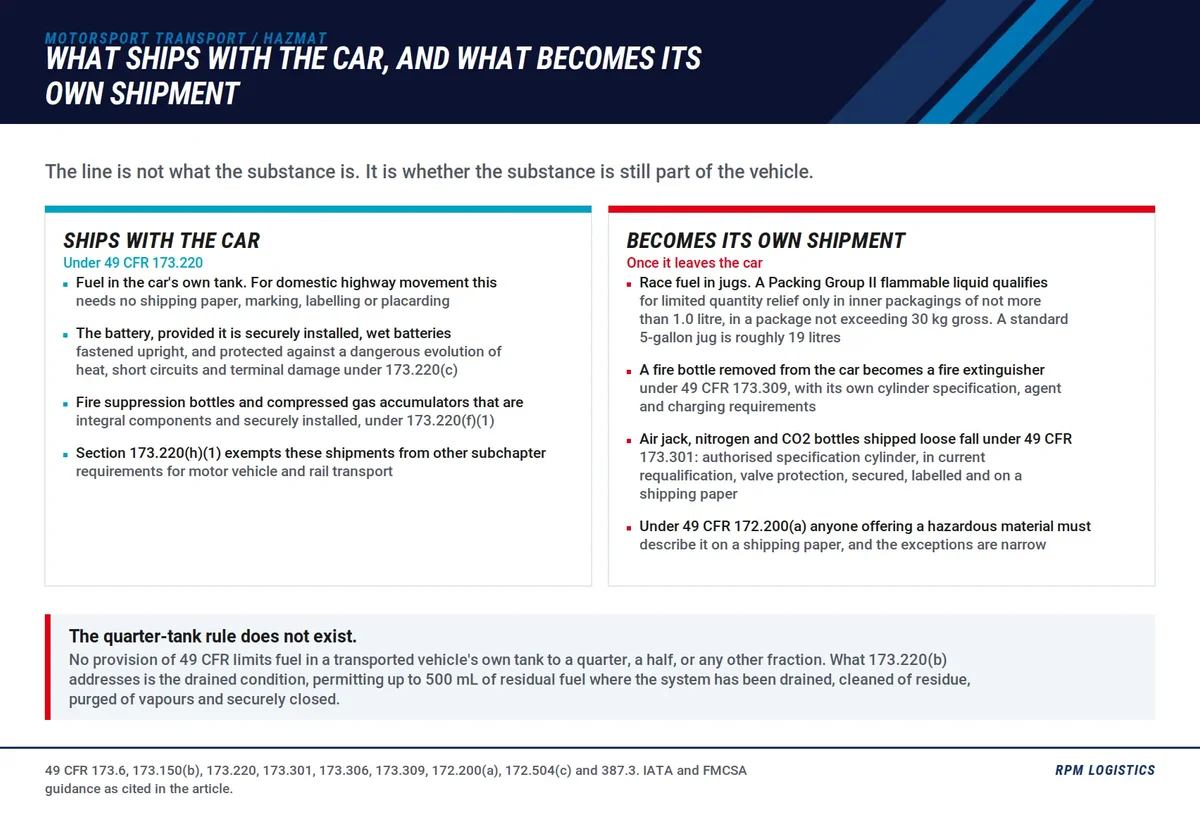
Under 49 CFR 173.220 the car and its installed systems ship as one thing. Take anything off the car and that changes.
Published guidance on moving race cars treats them as expensive low cars. Soft straps, enclosed trailer, mind the splitter. All true, and all beside the point.
A competition vehicle is different cargo in ways that change the paperwork, the equipment and the liability. It has no road-going systems to protect. It has a fire system, fuel and often gas bottles. It travels with a support load that is freight in its own right. And it frequently comes home in a different condition than it left.
What makes a race car different cargo
Start with what it does not have. No cooling system to drain in winter. No usable suspension travel, because solid or spherical bearings replace rubber bushings and ride height is set for a track surface. No jacking points where a crew expects them, because the car is designed to go up on air jacks or a trolley in a pit box. Bodywork that is not structural and will not take being pushed on.
Then what it does have. Slicks with no tread and a shape that flat-spots if the car sits loaded on one point. Ballast bolted where the rules require it, which changes the weight distribution from anything the corresponding road car would show. Splitters, diffusers and undertrays that sit within millimetres of the ground and are the first thing a ramp angle finds.
Practically, that means the loading question is settled before the truck is booked: a car with no suspension travel and a splitter cannot be driven up a ramp at any sensible angle. It goes on a hydraulic lift gate, or it goes on a trailer with a low-angle articulating deck. Confirming which one is on the truck is not a detail.
Preparing a competition vehicle for transport
Half of what circulates on this is wrong, including a widely repeated claim that fluids should be drained to reduce weight. Weight is not the reason for any of it.
- Fuel. The car may ship with fuel in its own tank. There is more detail on this below, because the common "quarter tank" instruction is a carrier policy rather than a federal rule, and the actual regulation says something different.
- Battery. Under 49 CFR § 173.220(c), batteries must be securely installed, wet batteries fastened upright, and all batteries protected against a dangerous evolution of heat, short circuits and damage to terminals. That is a securement and isolation standard, not a blanket instruction to disconnect. A race battery on a quick-release mount needs to be secured properly, not just switched off at the master.
- Fire suppression. Leave it installed. Removing it creates a regulatory problem that keeping it does not. See below.
- Ride height and aero. Raise the car to its transport setting if it has one, and record the setting so it goes back correctly. Removable aero that will not survive strapping should come off and be crated, not left on and hoped for.
- Tyres. If the car will sit loaded for several days, slicks benefit from being set to transport pressure rather than running pressure. Confirm with the team, since this varies by compound and construction.
- Ballast. Confirm it is secured to the car rather than just resting in its tray. Ballast that moves in transit is both a damage risk and a handling surprise at unload.
- Data and timing hardware. Loggers, transponders and cameras are individually valuable and easily removed. Either remove and manifest them, or list them explicitly on the condition record.
Securement fundamentals are covered in our comparison of soft-tie and hard-tie enclosed transport. The race-specific variation is that a car with almost no suspension travel does not settle under strap tension the way a road car does, so tension has to be set and rechecked rather than pulled down hard once.
The hazmat question nobody answers
This is where the category is effectively silent. Across the pages that rank for race car transport, hazardous materials are addressed in roughly one sentence, and not one cites a regulation. Here is what the rules actually say.
The car itself, with fuel in the tank
A vehicle moved as cargo is within the scope of the hazardous materials regulations. Section 173.220(a) says so explicitly, naming transport vehicles alongside vessels and aircraft.
But the same section then exempts itself for surface transport. Under § 173.220(h)(1), shipments made under the provisions of that section are not subject to any other requirements of the subchapter for transportation by motor vehicle or rail car. In practice: a race car with fuel in its own tank, on an enclosed trailer, moving domestically by highway, needs no shipping paper, no marking, no labelling and no placarding.
Air and vessel are different. Section 173.220(h) preserves shipping papers and emergency response information for aircraft, and routes vessel shipments elsewhere. An international move is not the same conversation.
The quarter-tank rule does not exist
Every page in this category tells you to reduce fuel to a quarter tank. It is a sensible carrier policy. It is not in the regulation.
What § 173.220(b) actually addresses is the drained condition: fuel systems must be completely drained, sufficiently cleaned of residue and purged of vapours, with up to 500 mL of residual fuel permitted to remain provided the system is securely closed. Diesel vehicles are excepted from the draining requirement where sufficient ullage is left.
So there are two compliant states, full-ish or properly drained, and a carrier asking for a quarter tank is asking for its own operational comfort. Fine, but know which is which when someone tells you a rule requires it.
The insurance consequence nobody mentions
Because a vehicle moved as cargo is a hazardous material, a motor carrier hauling one is subject to a higher financial responsibility floor. FMCSA guidance confirms that vehicles being transported meet the definition of hazardous material at 49 CFR § 171.8, and that a carrier transporting them must maintain $1,000,000 in public liability coverage under 49 CFR § 387.3.
That is a question worth asking a prospective carrier, and it is not the same question as "how much cargo insurance do you carry." Public liability and cargo coverage are different things. Our guide to DOT compliance for automotive carriers covers what the filings show.
Race fuel in jugs is a different shipment entirely
Once fuel is out of the car's tank and into a container, § 173.220 no longer applies. It is an independent offering of a Class 3 flammable liquid, Packing Group II.
Two exceptions people reach for, and why neither works:
Limited quantity does not apply. Under 49 CFR § 173.150(b), a Packing Group II flammable liquid qualifies only in inner packagings of not more than 1.0 litre each, in a package not exceeding 30 kg gross. A standard 5-gallon fuel jug is roughly 19 litres. It exceeds the inner packaging limit by about nineteen times. No race fuel jug is a limited quantity.
Materials of trade does not apply to a for-hire carrier. The materials of trade exception at 49 CFR § 173.6 allows Packing Group II and III liquids up to 30 kg or 30 litres per package, with an aggregate limit of 200 kg on a vehicle. But the definition at 49 CFR § 171.8 restricts it to material carried to protect the health and safety of the operator, to support the operation or maintenance of the vehicle, or by a private motor carrier in direct support of a principal business that is other than transportation by motor vehicle.
A for-hire transporter's principal business is transportation by motor vehicle. The exception is not available to it. A team hauling its own fuel in its own rig can use materials of trade. A carrier hauling that same fuel for a customer cannot.
The 1,001 pound number is not a free pass
Under 49 CFR § 172.504(c), placards are not required on a transport vehicle carrying less than 454 kg (1,001 pounds) aggregate gross weight of a Table 2 material. Class 3 is a Table 2 material, so at roughly 6.1 pounds per gallon, placarding does not trigger until around 164 gallons of gasoline. Almost no race trailer gets there.
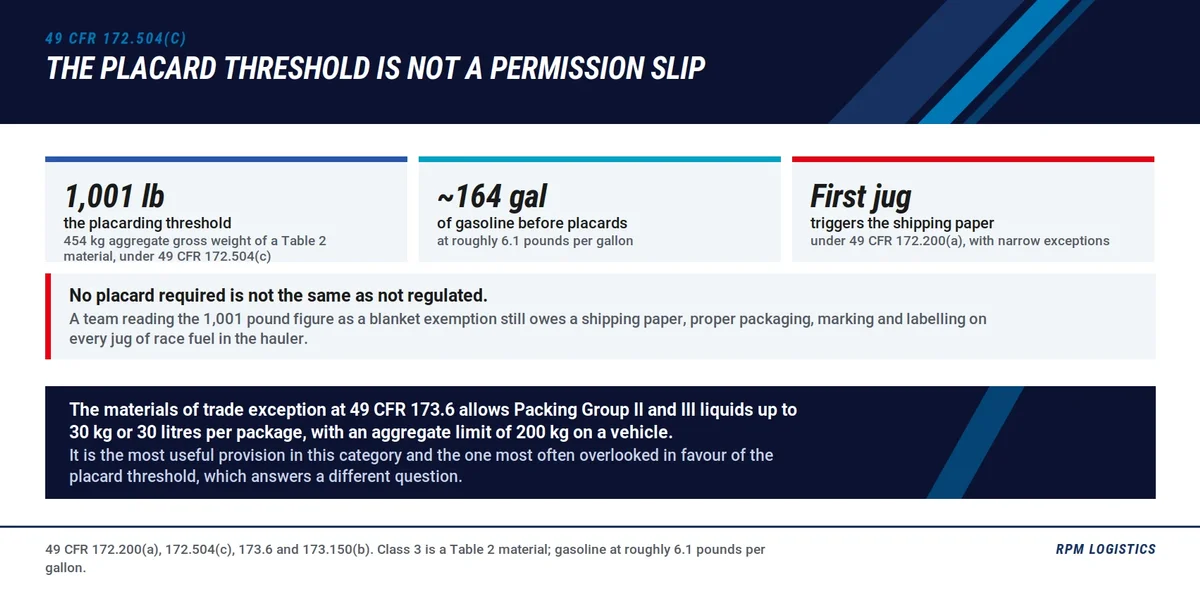
Placarding does not trigger until around 164 gallons. Shipping papers trigger at the first jug.
The trap is reading that as a hazmat-free threshold. It is not. Under 49 CFR § 172.200(a), anyone offering a hazardous material for transportation must describe it on a shipping paper, and the exceptions are narrow. There is no general small-quantity threshold for Class 3. Shipping papers, emergency response information and hazmat employee training can all attach at quantities far below the placarding line.
The practical answer for most teams: the fuel travels with the team, not with the car transporter.
Gas bottles are the hard case
Air jack bottles, nitrogen and CO₂ are Class 2 compressed gases, and the limited quantity relief at 49 CFR § 173.306 is written around aerosols and low-pressure containers. It reaches containers of not more than 4 fluid ounces, metal or plastic aerosol containers up to 1 litre, refillable metal containers up to 0.95 litre charged to 170 psig or less, or up to 114 litres charged to 75 psig or less, in packages not over 30 kg gross.
An air jack bottle running at working pressures in the thousands of psi does not qualify under any branch of that. Shipped loose as cargo, it falls under the general cylinder requirements at 49 CFR § 173.301: an authorised specification cylinder, in current requalification, with valve protection, secured against movement, labelled, and on a shipping paper.
Fire bottles: leave them in the car
This is the cleanest distinction in the whole subject and essentially nobody publishes it.
Under § 173.220(f)(1), items containing hazardous materials that are integral components of the vehicle, naming fire extinguishers and compressed gas accumulators specifically, ride under the vehicle's own entry provided they are securely installed. They are not otherwise subject to the subchapter.
Take that same bottle out and it becomes a fire extinguisher under 49 CFR § 173.309, which requires an authorised specification cylinder, a non-flammable and non-poisonous extinguishing agent, and charging conditions the regulation specifies in detail.
So a plumbed-in system ships free with the car, and a dismounted bottle in the same trailer is a regulated Class 2 shipment with its own paperwork. If the team is pulling the bottle for servicing, that is a decision with a compliance consequence, and it most often comes up on a return leg after an event.
The paddock load is freight
Every page in this category mentions "spares and tools" and stops. The support load for a race weekend is frequently heavier, bulkier and collectively more valuable than the car, and it needs to be treated as a shipment rather than as things that go in the back.
What actually travels: tyre sets on rims, often several compounds; spare engines and gearboxes, which are crated and heavy; tool carts and chests; air jack bottles and lines; awnings, pit boards and garage setup; timing, data acquisition and telemetry hardware; fuel churns and funnels; spare bodywork and aero; wheel guns and generators.
Three things follow:
- Declare weight and cube honestly at booking. A car plus a full paddock setup is a different load plan than a car, and finding that out at loading costs the slot.
- Value the support load separately. A spare engine and a set of data hardware can exceed the deductible on their own. They belong on the manifest with declared values, not folded into the car's number.
- Separate what is hazmat. Gas bottles and fuel do not travel on the same terms as tool carts, and mixing them into one undifferentiated pile is how a compliant load becomes non-compliant.
Who books, and who holds the claim
Almost every page in this category assumes an individual owner shipping one car. Much of the real volume is teams, and the arrangement is different.
The questions worth settling in writing before the first move:
- Who is the shipper of record, the team or the car owner? On an arrive-and-drive arrangement they are not the same party, and the entity on the bill of lading is the one with the contractual relationship.
- Who signs at collection and delivery? A crew member signing at a circuit is binding the party named on the paperwork, whether or not they have authority to.
- Who holds the cargo claim if the car is damaged? The claimant needs insurable interest. An owner whose car was tendered by a team may find the claim runs through the team.
- Who receives at the circuit? Paddock access, credentials and delivery windows are controlled by the event, not the carrier.
Condition documentation carries the weight here. See insurance-grade condition reporting for the standard, which matters more on a race car than on a road car because a competition vehicle arrives with existing damage as a matter of course.
Scheduling a season, not a move
A race calendar is known a year ahead and does not move for logistics. That makes it schedulable in a way most transport is not, and worth treating as a programme rather than a series of bookings.
What changes when you book a season rather than a move: capacity is committed rather than sought, the same crew handles the car repeatedly and learns its quirks, and the return leg is planned rather than arranged on the Sunday night. What does not change is that a rained-off or rescheduled event cascades, so the agreement needs to say what happens when a date moves.
Our guide to event and rally transport covers round-trip booking for touring events, which shares the shape without the competition constraints.
The return leg, when the car is not what it was
This is the most predictable event in motorsport transport and the least planned for. Cars crash. The return leg then involves a vehicle that may not roll, may not steer, may be leaking, and is going somewhere other than where it came from.
What to have arranged in advance:
- A stated procedure for a non-running return. Winching a car with broken suspension or seized steering needs dollies and skates, not a hopeful pull. Our guide to recovering non-running vehicles covers the equipment.
- Fluid containment. A damaged car can leak fuel, oil and coolant into a trailer. Absorbent and containment should be on the truck, not sourced at the circuit.
- A condition record that separates incident damage from transit damage. This is the single most important document on a wrecked return, and it has to be made at the circuit, before loading, with the damage photographed in detail.
- A decision on destination. Wrecked cars often go to a chassis shop or an assessor rather than the team's base. Deciding that on the trailer is how a car ends up in the wrong place.
- The fire bottle question. If the system discharged or is being removed for service, the regulatory position changes as described above.
Frequently asked questions
Does race fuel have to travel separately from the car?
Fuel in the car's own tank ships with the car and, for domestic highway movement, needs no shipping paper, marking, labelling or placarding under 49 CFR 173.220. Fuel in separate containers is an independent Class 3 shipment. It does not qualify as a limited quantity because Packing Group II liquids are limited to 1.0 litre inner packagings, and a for-hire carrier cannot use the materials of trade exception, because that exception is unavailable to a business whose principal business is transportation by motor vehicle.
Do I have to remove the fire suppression bottle before shipping?
No, and you should not. Under 49 CFR 173.220(f)(1), fire extinguishers and compressed gas accumulators that are integral components of the vehicle and securely installed are not otherwise subject to the hazardous materials regulations. A bottle removed and shipped loose becomes a regulated Class 2 shipment under 49 CFR 173.309 with its own packaging and paperwork requirements.
Is there a quarter-tank rule for shipping a race car?
Not in the regulations. The quarter-tank instruction is carrier policy. What 49 CFR 173.220(b) addresses is the drained condition, permitting up to 500 mL of residual fuel where the system has been drained, cleaned of residue, purged of vapours and securely closed, with diesel vehicles excepted where sufficient ullage remains.
How should a race car be secured on a trailer?
Soft straps over the wheels rather than chains to the chassis, on a hydraulic lift gate or a low-angle articulating deck rather than a standard ramp. Because a competition car has almost no suspension travel, it does not settle under strap tension the way a road car does, so tension should be set and rechecked rather than pulled down once.
Can I ship tools, spares and paddock equipment with the car?
Generally yes, but declare the weight and cube at booking rather than at loading, list the support load separately with its own declared values, and separate anything that is hazardous. Compressed gas bottles and fuel do not travel on the same terms as tool carts.
Are air jack and nitrogen bottles restricted in transport?
Yes. They are Class 2 compressed gases, and the limited quantity relief at 49 CFR 173.306 is written around aerosols and low-pressure containers, reaching only much smaller volumes and far lower pressures than a race bottle operates at. Shipped loose, they fall under the general cylinder requirements at 49 CFR 173.301, which require an authorised specification cylinder in current requalification, secured, labelled and on a shipping paper.
What happens if the car is wrecked at the event?
Arrange the return in advance rather than on the night. A non-running return needs dollies and skates rather than a straight winch pull, fluid containment should be on the truck, and the critical document is a condition record made at the circuit before loading that separates incident damage from transit damage. Decide the destination too, since wrecked cars often go to a chassis shop or an assessor rather than the team base.
Who signs for the car, the team or the owner?
Whoever is named as shipper of record, which on an arrive-and-drive arrangement is often not the owner. Settle in writing who is the shipper, who may sign at collection and delivery, and who holds the cargo claim if the car is damaged, since the claimant needs insurable interest.
Does a carrier need special insurance to haul a race car?
A vehicle moved as cargo meets the definition of a hazardous material at 49 CFR 171.8, and a motor carrier transporting one must maintain $1,000,000 in public liability coverage under 49 CFR 387.3. That is separate from cargo coverage, which pays for the car itself and should be confirmed in writing against the vehicle's value.
Moving competition cars as competition cars
RPM Logistics moves race and track vehicles in enclosed equipment across all 50 states and Canada, with lift-gate loading, soft-tie securement, documented custody at each transfer, and secured storage between events. If you are scheduling a season or arranging a return leg for a car that did not finish, talk to our team.