

Quick Answer
The right car hauler trailer depends on the freight you plan to haul. A 3-car trailer behind a heavy pickup suits short dealer and auction runs. An 8-car or stinger rig suits long-haul dealer freight. Rent to test a lane, lease-to-own to build equity with less cash up front, and buy when you have cash and steady loads.
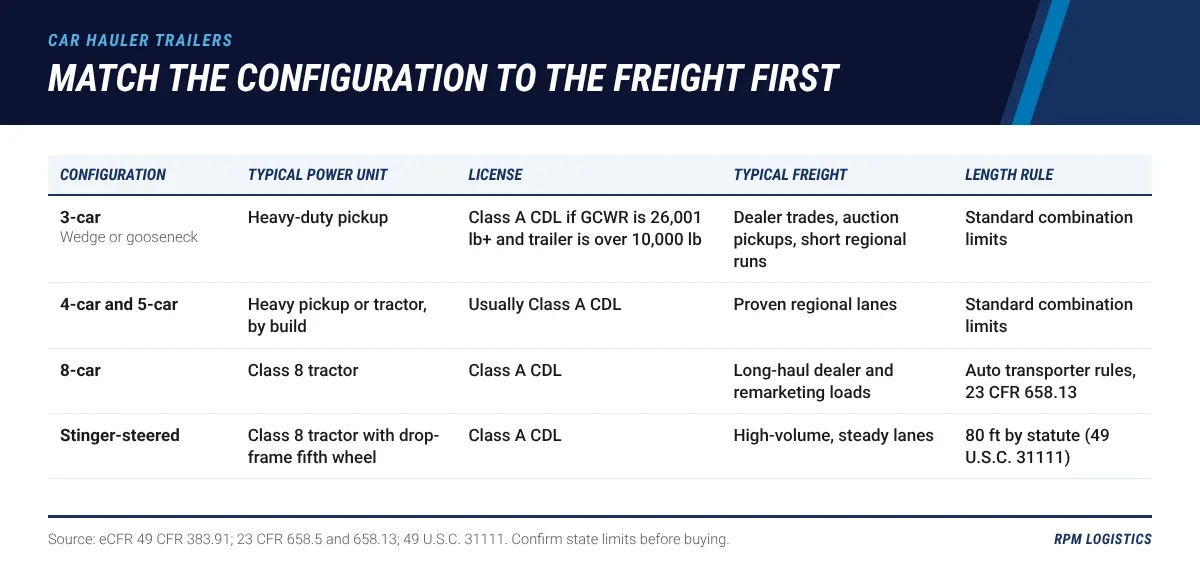
Each step up in capacity changes the truck you need, the license you need and the freight you can win, so the configuration decision comes before the payment decision.
What is a car hauler trailer configuration?
A car hauler trailer configuration is the size and layout of the trailer, usually described by how many vehicles it carries. Owner-operators talk about 3-car, 4-car, 5-car, 8-car and stinger rigs. Each one pairs with a different truck and a different kind of freight.
Federal rules use their own terms. An automobile transporter is "any vehicle combination designed and used specifically for the transport of assembled highway vehicles," under 23 CFR 658.5. A stinger-steered combination places the fifth wheel on a drop frame behind and below the rear axle of the truck. That design lets the trailer carry a vehicle over the cab and tractor.
This guide covers two decisions that most owner-operators make together:
- Which configuration fits the freight you can actually win.
- How to acquire it: rent, lease-to-own or buy.
The order matters. Picking a payment plan before the configuration often leaves a carrier paying for capacity it cannot fill, or turning down loads it cannot carry.
3-car to 8-car and stinger: what each configuration does
Each configuration fits a different slice of the vehicle transport market. Capacity, truck cost and licensing all rise together.
3-car trailers
A 3-car trailer, often a wedge or gooseneck, usually runs behind a heavy-duty pickup. It is the common entry point for new car haulers. Typical work includes dealer trades, auction pickups and short regional runs where a small load moves quickly. Lower purchase cost and a smaller truck make it the easiest setup to start with.
4-car and 5-car trailers
Four- and five-car trailers add capacity without a full tractor-trailer setup in many cases. They suit operators who have proven a lane and want more revenue per trip. More vehicles per load spreads fuel and driver time across more units.
8-car trailers
An 8-car trailer runs behind a Class 8 tractor and carries a full load of cars for long-haul dealer freight. It needs a Class A CDL and a bigger equipment investment. In return, it can bid on the full-load, long-distance moves that make up much of dealer and remarketing freight.
Stinger-steered rigs
Stinger-steered rigs are the high-capacity end of the market. Federal law sets a longer minimum length allowance for them than for traditional transporters, which lets them carry more vehicles. They are built for steady, high-volume lanes, and they cost the most to acquire and run.
RPM Logistics' carrier program lists its preferred trailers in 3-car, 4-car, 5-car, new 8-car and 3-4-car stinger configurations. Our RPM Advantage carrier program page has the current options.
Federal rules that change with configuration
Moving up in configuration often moves you into a new set of federal rules. Check these before you sign for equipment, because the rules can decide which truck and which driver you need.
- CDL Class A. A combination with a gross combination weight rating of 26,001 pounds or more needs a Class A CDL when the towed unit is rated over 10,000 pounds, under 49 CFR 383.91. Many pickup and 3-car combinations cross that line.
- Commercial motor vehicle status. A vehicle or combination rated at 10,001 pounds or more counts as a commercial motor vehicle for federal safety rules, under 49 CFR 390.5. That includes many non-CDL hotshot setups.
- Insurance minimums. For-hire carriers of non-hazardous property in vehicles of 10,001 pounds or more need at least $750,000 in liability coverage, under 49 CFR 387.9.
- Length. The regulation text at 23 CFR 658.13 lists a 75-foot minimum for stinger-steered transporters. Federal statute, 49 U.S.C. 31111, later raised that to 80 feet with set front and rear overhang allowances. Confirm the current figure with your state before you buy a long rig.
- Cargo securement. Each car, light truck or van of 10,000 pounds or less needs at least two tiedowns, front and rear, under 49 CFR 393.128.
Our guide to DOT compliance for automotive carriers covers the rest of the federal checklist.
Lease-to-own vs. rent vs. buy: how each path works
Each acquisition path trades cash up front against flexibility and ownership. None is right for every carrier, and the same carrier may use different paths at different stages.
Path | How it works | Best when | Main trade-off |
|---|---|---|---|
Rent | Pay for use over a set period, then return the trailer | Testing a lane, covering a seasonal spike or replacing a trailer in the shop | No equity, and the cost per month is usually highest |
Lease-to-own | Make payments over a term, with ownership at the end | Growing carriers who want ownership without a large down payment | Total paid is often higher than a cash purchase |
Buy outright | Pay cash and own the trailer at once | Carriers with cash reserves and steady freight | Ties up working capital |
Finance a purchase | Borrow to buy, then repay the lender | Carriers with credit history and revenue evidence | Approval depends on lender criteria |
RPM Advantage describes its preferred equipment program as "the industry's first auto-hauler lease-to-own and rental program." Carriers can lease-to-own, rent, purchase outright or finance through Equipment Funding Solutions. The program says its digital application has no effect on your credit score.
Which path fits which configuration?
The best path usually follows how certain your freight is. The less certain the freight, the more flexibility is worth paying for.
- New 3-car operators testing lanes: renting keeps cash free while you learn which dealers, auctions and routes pay.
- 3-car to 5-car carriers with proven lanes: lease-to-own builds equity while keeping the down payment low.
- 8-car and stinger operators with contracted freight: buying or financing a purchase makes sense when steady loads cover the payment.
- Any size, short-term gap: renting covers a trailer in the shop or a seasonal surge without a long commitment.
These are rules of thumb, not lender rules. Your numbers decide. Our guide to running a car hauling business covers the costs new operators most often miss.
What a trailer really costs per mile
The payment is only part of what a trailer costs. Measuring equipment cost per mile shows whether a configuration pays for itself on the lanes you run.
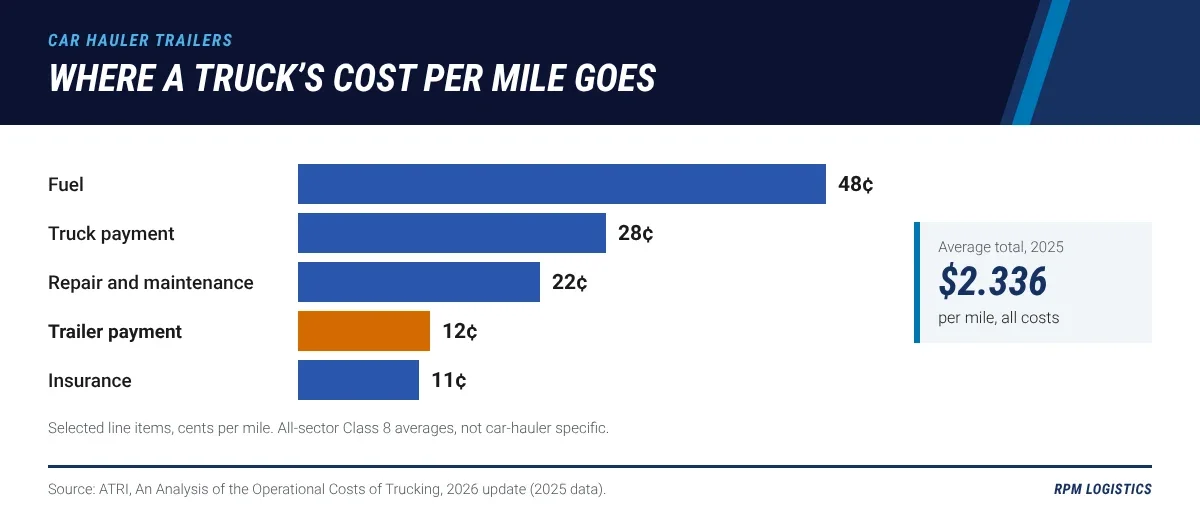
These are all-sector averages, not car-hauler figures, but they show why repair and fuel can outweigh the trailer payment itself.
The American Transportation Research Institute's 2026 update on operational costs put the average cost of running a truck at $2.336 per mile in 2025. Truck and trailer lease or purchase payments came to $0.40 per mile, with $0.12 of that for the trailer. Repair and maintenance added $0.22 per mile, up 8.6% (ATRI, 2026). These are averages across trucking, so treat them as a benchmark, not a quote.
Purchase prices vary widely by size, age and builder. In an October 2026 snapshot of TruckPaper listings, asking prices ranged from about $50,000 for a 2025 5-car trailer to $105,900 to $120,000 for 2024 to 2026 7- and 8-car units. Many new units were listed as "call for price." Asking prices are not sale prices, so get quotes on the exact build you need.
Taxes can change the math for buyers. The IRS set the 2026 Section 179 expensing limit at $2,560,000 (IRS Rev. Proc. 2025-32). Ask your tax adviser how it applies to a purchase or a lease-to-own agreement. Our cost-per-mile calculation guide shows how to build your own number.
Resale, downtime and maintenance
Resale value and downtime often decide whether an owned trailer was a good buy. A trailer that holds its value and stays on the road costs less over its life, even if it costs more up front.
- Build quality. RPM Advantage's preferred trailer partner, Sun Country Trailers, builds with heavy-wall tubular steel and promotes strong resale value.
- Loading design. Ground-level strapping can make loading safer and faster, which means more loads per week.
- Downtime planning. Every day a trailer sits in the shop costs revenue. A rental backup can protect a contract during repairs.
- Maintenance records. Complete records support resale value and help with lender reviews.
Sun Country has served the auto hauling industry for decades and specializes in 5-to-30-plus truck fleets, according to the RPM Advantage page.
Retail rent-to-own lots vs. commercial lease-to-own
Search for car hauler trailer lease-to-own and most results are retail rent-to-own lots. Those programs are built mainly for single-car and utility trailers, often with no credit check. They are a different product from a commercial lease-to-own program for multi-car haulers.
Factor | Retail rent-to-own lot | Commercial carrier program |
|---|---|---|
Typical trailers | Single-car and utility trailers | 3-car to 8-car and stinger auto transporters |
Buyer | Consumers and small businesses | Owner-operators and fleets with operating authority |
Underwriting | Often no credit check | Lender review of credit, authority and revenue |
Freight link | None | Can pair with a carrier network and dedicated freight |
RPM Advantage works with a network of 200-plus niche lenders that specialize in transportation and small-business loans. That depth matters for carriers whose credit profile or time in business does not fit a bank's standard box.
How freight commitments change the decision
A payment is easier to carry when the freight to cover it is already lined up. That is why lenders and carriers both look at revenue before equipment.
RPM Logistics works with 15,000+ active carriers across all 50 states and Canada. RPM Advantage pairs equipment options with a Dedicated Carrier Program for consistent freight, plus financial consultation. A carrier that knows its lanes and weekly volume can choose a configuration and payment plan with far less guesswork.
New carriers should look at how a carrier network works before committing to large equipment. Our guides to joining a logistics carrier network and working as an independent car hauler explain the options.
A checklist before you sign for a trailer
Work through these steps before you commit to any trailer, whichever path you choose.
- List the freight you can realistically win in the next 12 months.
- Match that freight to a configuration, from 3-car to 8-car or stinger.
- Confirm the CDL, insurance and length rules for that configuration.
- Price the matching truck along with the trailer.
- Compare renting, lease-to-own, buying and financing on total cost.
- Estimate cost per mile on your actual lanes.
- Plan for downtime with a backup trailer or rental option.
- Line up freight commitments before the first payment is due.
Owner-operators who want the full picture of the business side should read our guide to the ins and outs of owner-operator trucking and our overview of how the car hauling industry works.
Frequently asked questions
Is it better to rent, lease-to-own or buy a car hauler trailer?
It depends on how certain your freight is. Renting suits testing lanes or covering gaps. Lease-to-own builds equity with less cash up front. Buying suits carriers with cash reserves and steady contracted freight.
Do I need a CDL to pull a 3-car hauler?
Often, yes. A Class A CDL is required when the combination is rated at 26,001 pounds or more and the trailer is rated over 10,000 pounds. Many pickup and 3-car combinations cross that line.
What is a stinger-steered car hauler?
A stinger-steered car hauler places the fifth wheel on a drop frame behind and below the truck's rear axle. Federal law gives these rigs a longer length allowance, so they can carry more vehicles.
How much does a car hauler trailer cost per mile?
ATRI's 2026 update found trailer lease or purchase payments averaged $0.12 per mile across trucking in 2025. Repairs, fuel and insurance add more, so calculate cost per mile on your own lanes.
Is a rent-to-own trailer lot the same as a commercial lease-to-own program?
No. Retail rent-to-own lots mainly serve single-car and utility trailers. Commercial programs serve multi-car auto transporters and use lenders that review authority, credit and revenue.
Does applying for trailer financing hurt my credit score?
The RPM Advantage digital application has no effect on your credit score. A lender may run its own credit check later in the process, so ask before you sign.
Get the right trailer for the freight you haul
The right trailer is the one your freight can pay for. RPM Advantage gives carriers lease-to-own, rental, purchase and financing options on preferred trailers, plus access to consistent freight through RPM Logistics' carrier network. Explore the RPM Advantage program and talk to us about equipment.