

Quick Answer
Shipping e-bike batteries by ground depends on how the battery travels. An e-bike or scooter with its battery installed ships as UN3171, Battery-powered vehicle. A battery packed in the same box but removed ships as UN3481. A spare pack shipped alone is UN3480. Each needs a UN 38.3-tested battery, and spare packs ship as fully regulated Class 9.
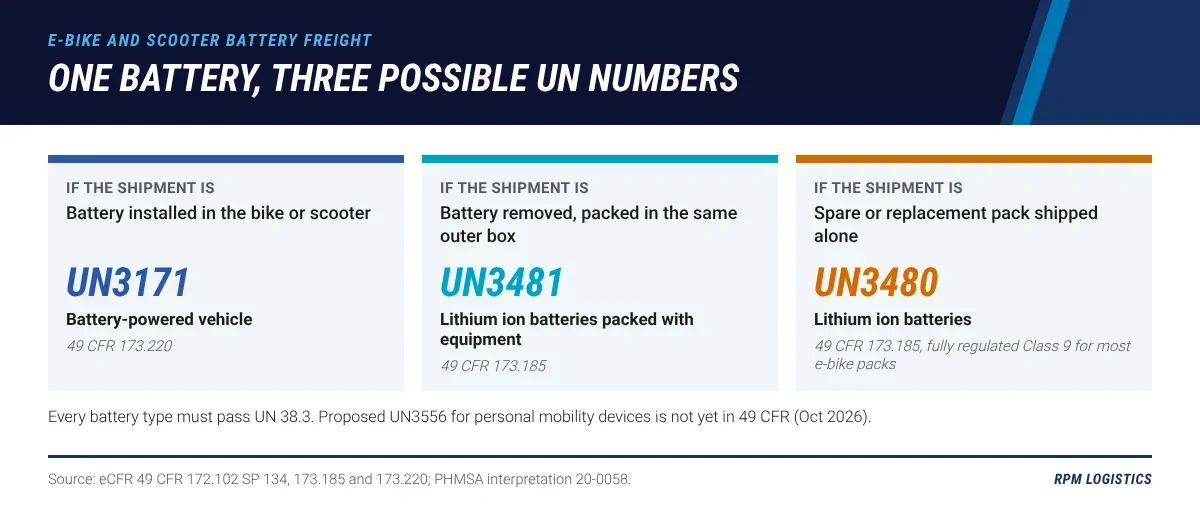
The same 500 Wh pack can ship under three different entries, depending only on whether it is installed, boxed with the bike or shipped on its own.
Why micromobility battery freight is regulated
E-bike and scooter batteries are lithium ion batteries, which the U.S. Hazardous Materials Regulations treat as Class 9 hazardous materials. The rules apply to manufacturers, importers, distributors and retailers that ship bikes, scooters or spare packs.
The risk is real. A CPSC staff report covering 2017 to 2024 counted 45 deaths tied to 29 lithium ion battery fire incidents involving micromobility products. Nineteen of those deaths came from 13 e-bike incidents (CPSC, 2026). In June 2026, the CPSC proposed a mandatory safety standard for micromobility batteries based on UL 2849, UL 2271 and UL 2272 (Federal Register, 2026).
Volume keeps growing. Estimates of 2025 U.S. e-bike imports range from 1.3 million to 2.2 million units, depending on the source and how imports are classified (Bicycle Retailer & Industry News, 2026). More units means more freight, more returns and more batteries moving through warehouses.
Our guide to whether lithium batteries are hazmat covers the basics. This guide covers the micromobility-specific decisions.
Which UN number applies to an e-bike shipment?
The UN number depends on whether the battery is installed, packed with the vehicle or shipped alone. Choosing the right entry is the first decision in every shipment.
Shipment | UN number and name | Main rule |
|---|---|---|
E-bike or scooter with battery installed | UN3171, Battery-powered vehicle | 49 CFR 173.220 |
Battery removed, packed in the same outer box as the bike | UN3481, Lithium ion batteries packed with equipment | 49 CFR 173.185 |
Spare or replacement pack shipped alone | UN3480, Lithium ion batteries | 49 CFR 173.185 |
UN3171 covers more than cars. Special Provision 134 in 49 CFR 172.102 lists bicycles with an electric motor, scooters, self-balancing vehicles and mobility aids as vehicles. It also covers vehicles shipped with some parts detached from the frame.
PHMSA confirmed this for e-bikes in 2020. In a letter on e-bikes with 418 Wh and 504 Wh batteries installed, PHMSA said they ship as UN3171, not UN3481, and that no watt-hour limit applies to a battery installed in and powering a vehicle (PHMSA interpretation 20-0058).
Shipping assembled e-bikes and scooters (UN3171)
Assembled e-bikes and scooters with installed batteries ship under the vehicle rules in 49 CFR 173.220. That section sets conditions for the battery and its installation.
- Battery type tested. The battery must be a type that passed the UN 38.3 tests, as required by 173.185.
- Secured in its holder. The battery must be securely fastened in the battery holder.
- Protected. It must be protected from damage and short circuits.
Assembled bikes and loose battery packs do not ship under the same section, so their paperwork and labeling needs can differ. Before tendering a load of assembled bikes, ask your carrier which shipping papers, markings and labels it requires, and have your compliance team confirm the plan for each product.
Shipping bikes with removed batteries (UN3481)
When the battery is removed from the bike but packed in the same outer box, the shipment becomes UN3481, Lithium ion batteries packed with equipment. Section 173.220(d) points those shipments to the lithium battery rules in 173.185.
Many brands ship bikes this way to protect the battery or simplify assembly at the store. The trade-off is that the box now carries a separately packed battery, which brings in packaging, marking and documentation rules that an installed battery may avoid. Decide on the packing method before you design the box.
Shipping spare and replacement packs (UN3480)
Spare and replacement packs shipped alone are UN3480, Lithium ion batteries, under 49 CFR 173.185. Most e-bike packs exceed the small-battery limits, so they ship as fully regulated Class 9.
- UN 38.3 testing. Each battery type must pass UN 38.3, under 173.185(a)(1).
- Test summary. Each manufacturer and subsequent distributor must make the test summary available, under 173.185(a)(3).
- Watt-hour marking. Lithium ion batteries made after May 10, 2024, must show the Wh rating on the outside case.
- Packaging. Fully regulated batteries need Packing Group II performance packaging.
- Hazard communication. Expect the Class 9 lithium battery label, UN number marking and shipping papers.
Our guides to lithium battery packaging requirements and UN 38.3 test summaries cover these rules in more detail.
Do small scooter batteries qualify for an exception?
Some small scooter batteries can ship under the small-battery exceptions, but most e-bike packs cannot. The limits depend on the battery's watt-hour rating.
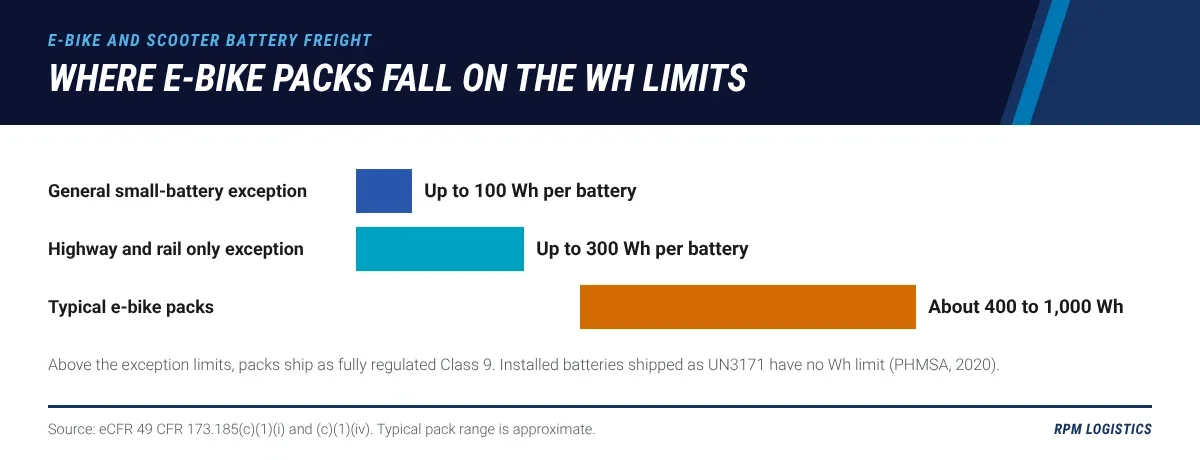
A small scooter pack may fit under the 300 Wh ground-only tier, while a typical e-bike pack sits well above it.
- 100 Wh tier. Under 173.185(c)(1)(i), cells up to 20 Wh and batteries up to 100 Wh can use the small-battery exception.
- 300 Wh ground-only tier. Under 173.185(c)(1)(iv), highway and rail shipments allow cells up to 60 Wh and batteries up to 300 Wh. The package must be marked as forbidden for transport aboard aircraft and vessel.
- Typical e-bike packs. Common e-bike packs run roughly 400 to 1,000 Wh, so they exceed both tiers and ship fully regulated.
Check the Wh rating on each battery model before choosing a packaging plan. A scooter line and an e-bike line from the same brand may ship under different rules.
Is there a state-of-charge limit for ground shipments?
No federal state-of-charge limit applies to lithium ion batteries shipped by ground. The 30% state-of-charge limit for UN3480 is an air rule. Our guide to state-of-charge rules by mode explains where limits apply.
That does not mean charge level is irrelevant. A lower charge reduces the energy available in a fire. Many shippers set their own charge targets for storage and transport, and some venues and warehouses have their own rules.
Returns, damaged packs and recalls
Reverse logistics is where micromobility brands most often run into trouble. Warranty returns and recalls can move batteries into a different, stricter category.
- Damaged or defective batteries. Batteries that are damaged, or identified by the manufacturer as defective for safety reasons, fall under 173.185(f). They can move only by highway, rail or vessel, in individual inner packaging with cushioning inside Packing Group I outer packaging.
- Marking. Packages under 173.185(f) need a "Damaged/defective lithium ion battery" marking in characters at least 12 mm high.
- Recycling and disposal. Section 173.185(d) has exceptions for batteries moved by motor vehicle to storage, disposal or recycling.
- Customer returns. A pack returned by a customer may be intact or damaged. Inspect returns before deciding which rule applies.
CPSC actions can trigger large return flows. In November 2025, the CPSC warned consumers about certain Rad Power Bikes batteries after 31 fire reports. Our guides to shipping damaged and defective batteries and battery recycling logistics cover the reverse flow.
Warehouse-to-retailer freight: LTL or truckload
Most micromobility freight moves from ports and warehouses to retailers by LTL or truckload. The mix of bikes and spare packs in a load decides what paperwork and labeling the shipment needs.
- Assembled bikes only. Truckloads of bikes with installed batteries ship as UN3171 under 173.220. Confirm the carrier's paperwork and labeling needs before tender.
- Spare packs. Pallets of spare packs ship as fully regulated Class 9, with labels, markings and shipping papers.
- Mixed loads. A load mixing assembled bikes and spare packs carries two different entries, and the spare packs ship as fully regulated Class 9 with their own documentation.
- Carrier choice. Not every LTL network accepts lithium battery freight, and parcel networks often limit large packs.
Our guides to LTL vs. truckload for battery freight and carriers that ship lithium batteries compare the options. For storage, see our guide to battery warehousing and NFPA 855.
Importing e-bikes: from port to warehouse
Most e-bikes sold in the U.S. are imported, so compliance starts before the bikes leave the factory. The importer and every later distributor share responsibility for the battery records.
- Collect the test summary for every battery model from the factory before the first shipment.
- Check Wh markings on arrival. Lithium ion batteries made after May 10, 2024, must show the Wh rating on the case.
- Inspect for damage at the warehouse. Packs damaged in ocean transit may need to move under the damaged-battery rules.
- Confirm the domestic carrier early. Line up a ground carrier that accepts lithium battery freight before the container lands.
- Record how each model is packed. Installed, boxed with the bike or shipped alone decides the UN number for the domestic leg.
Building a compliant shipping program
A repeatable shipping program keeps every warehouse and store shipping the same way. It also makes audits and carrier questions easier to answer.
- Train everyone who prepares shipments. Hazmat employees must be trained within 90 days of hire and at least every three years, under 49 CFR 172.704.
- Write packing instructions by product. List the UN number, packaging and markings for each bike, scooter and pack.
- Keep test summaries on file and ready to share with carriers and customers.
- Set a returns intake process that sorts intact, damaged and recalled packs before they ship again.
- Vet carriers for lithium battery acceptance before tendering freight.
Review the program whenever you add a new battery model, change suppliers or open a new warehouse. Each of those changes can alter the UN number, the packaging or the paperwork for a shipment, and a quick review catches problems before freight is tendered.
Rule changes to watch
Two pending rulemakings could change how micromobility batteries ship and sell. Neither is final as of October 2026.
- New UN numbers for personal mobility devices. PHMSA's HM-215R proposal would add UN3556, "Vehicle, lithium ion battery powered," aimed at e-bikes, e-scooters and similar devices (Federal Register, 2026). Until a final rule takes effect, UN3171 remains the U.S. entry.
- A federal battery safety standard. The CPSC's June 2026 proposal would make UL 2849, UL 2271 and UL 2272 mandatory, with changes.
- Local sales rules. New York City already bars selling or renting e-bikes and their batteries unless certified to the UL standards, under Local Law 39 of 2023.
Track both rulemakings, and see our overview of lithium battery shipping regulations in 2026.
Frequently asked questions
What UN number is an e-bike with the battery installed?
An e-bike with its battery installed ships as UN3171, Battery-powered vehicle. PHMSA confirmed this in a 2020 interpretation and said no watt-hour limit applies to an installed battery powering the vehicle.
Can I ship an e-bike battery by itself?
Yes. A spare pack shipped alone is UN3480, Lithium ion batteries. Most e-bike packs exceed the small-battery limits, so they ship as fully regulated Class 9 with specification packaging, labels, markings and shipping papers.
What if the battery is boxed with the bike but not installed?
A battery removed from the bike and packed in the same outer box ships as UN3481, Lithium ion batteries packed with equipment, under 49 CFR 173.185.
Is there a state-of-charge limit for shipping e-bike batteries by truck?
No federal state-of-charge limit applies to ground shipments. The 30% limit for UN3480 applies to air transport.
How do I ship a recalled or damaged e-bike battery?
Batteries that are damaged or identified as defective for safety reasons fall under 49 CFR 173.185(f). They can move only by highway, rail or vessel, in Packing Group I outer packaging with a "Damaged/defective lithium ion battery" marking.
Do scooter batteries qualify for the small-battery exception?
Some do. Batteries up to 100 Wh can use the general exception, and batteries up to 300 Wh can use a highway and rail only exception. Most e-bike packs exceed both.
Move micromobility freight with a carrier that knows the entries
Micromobility freight mixes vehicles, spare packs and returns, and each follows different rules. RPM Logistics moves Class 9 lithium battery freight by ground across all 50 states and Canada. Start with our lithium battery transport compliance guide, or request a quote with your battery Wh ratings and shipment mix.