

Quick Answer
Model-year changeover logistics is the work of moving outgoing model-year units out of the network while incoming units ship in. For several weeks both model years compete for the same railcars, car carriers and lot space. OEMs manage it by sequencing outbound and inbound loads, staging units off-site and booking carrier capacity early.
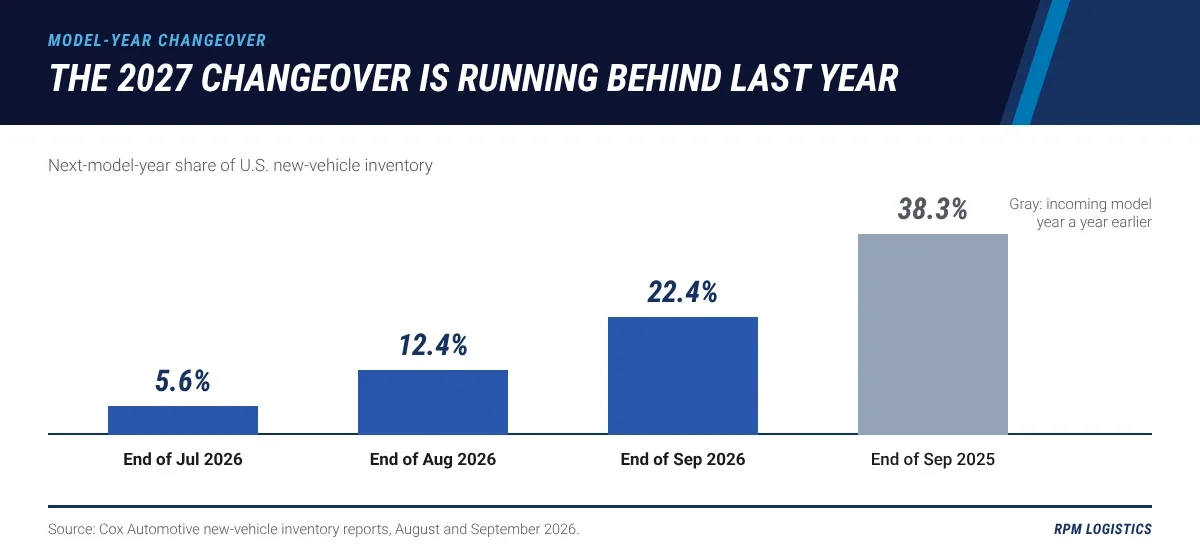
The 2027 changeover is running about 16 points behind last year's pace, which pushes more of the overlap into the fourth quarter.
What is a model-year changeover?
A model-year changeover is the period when an automaker's production, inventory and sales shift from one model year to the next. Outgoing units still sit in the pipeline and on dealer lots while incoming units start to ship. Both have to move through the same distribution network at the same time.
Federal rules define the model year. The EPA treats it as the manufacturer's annual production period that includes January 1 of that calendar year. That production period can start as early as January 2 of the previous calendar year, under 40 CFR 85.2304. That is why a 2027 model can arrive in 2026.
NHTSA's VIN rule defines model year as the year that designates a vehicle model, regardless of the calendar year it was built, as long as the production period does not exceed 24 months, under 49 CFR 565.12. The tenth character of the VIN shows the model year.
For logistics teams, the definition matters less than the overlap. The weeks when both model years are moving are when capacity, yard space and dealer patience run short.
Why the 2027 changeover is running late
The 2027 changeover is running well behind last year's pace. That shifts more of the overlap into the fourth quarter, when holiday weeks already tighten carrier capacity.
- Next-model-year share is lower. 2027 models were 22.4% of new-vehicle inventory at the end of September 2026. A year earlier, the incoming model year was 38.3% (Cox Automotive, 2026).
- The ramp is just starting. The 2027 share rose from 5.6% at the end of July to 12.4% at the end of August, then to 22.4% in September (Cox Automotive, 2026).
- Total supply is rising. New-vehicle inventory reached 2.80 million units at the end of September, with 82 days' supply, up from 75 in August.
- Prices are near records. The average transaction price was $50,562 in September 2026, $52 below the December 2025 record. Incentives were 6.6% of ATP (Cox Automotive, 2026).
Cox Automotive points to a lighter new-product cycle and to tariffs that "add friction" as automakers localize supply chains and adjust production. Whatever the cause, a late changeover means outgoing 2026 units stay in the network longer, while 2027 units arrive later and faster.
The capacity collision: two model years, one network
The core logistics problem in a changeover is capacity collision. Outbound moves of aged units and inbound moves of new units need the same equipment in the same weeks.
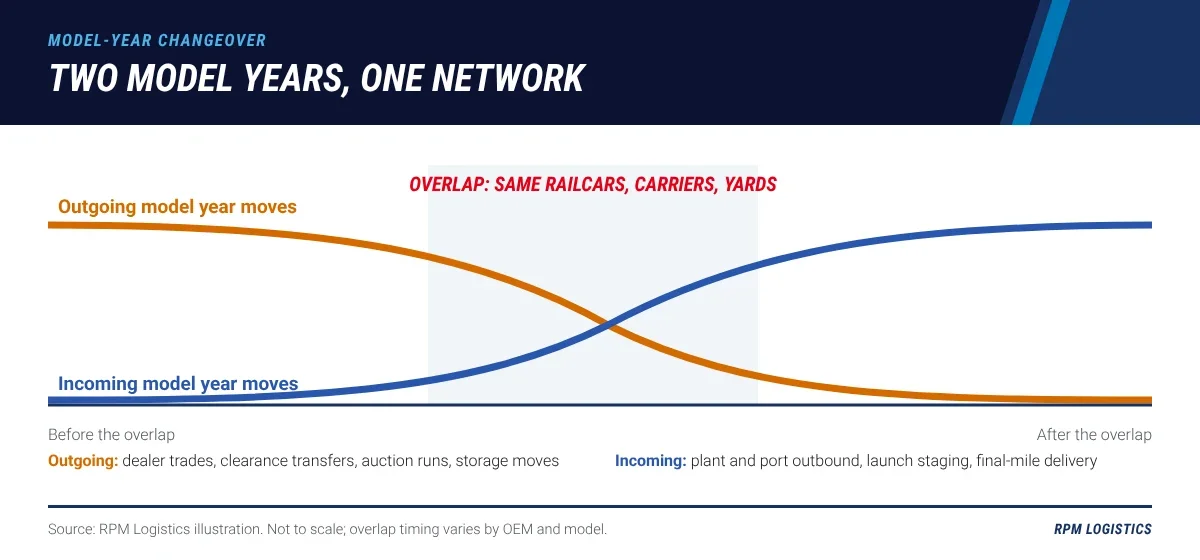
The middle of the overlap is where outbound clearance and inbound launch volume both peak, and where unplanned moves get the least capacity.
Outgoing model-year units create several kinds of moves:
- Dealer trades and transfers to markets with stronger demand for a given trim.
- Clearance and remarketing moves for aged units headed to auctions.
- Storage moves when lots fill before units sell.
Incoming model-year units create their own:
- Plant and port outbound moves to rail ramps and distribution points.
- Launch staging for units held until a release date.
- Final-mile deliveries to dealers.
Rail carries a large share of this volume. The Association of American Railroads says freight rail moves nearly 75% of the new cars and light trucks purchased in the U.S. at some point in their trip. Final-mile delivery from rail ramps and ports to dealers usually runs by truck. Our guides to rail vs. truck break-even and port-to-dealer logistics explain how the legs connect.
Regulatory dates that limit how long a model year can run
Federal rules put hard limits on how long an OEM can keep building an outgoing model year. Those limits turn changeover timing into a compliance question as well as a logistics one.
- The December 31 certificate cutoff. Units produced after December 31 of the model year are not covered by that year's EPA certificate of conformity, under 40 CFR 85.2305. Production of a 2026 model has to end by December 31, 2026.
- The 24-month production cap. NHTSA's model-year definition applies only when the production period does not exceed 24 months, under 49 CFR 565.12.
- Stop-sale rules. Under federal recall law, a dealer may sell or lease a new vehicle under a recall only after the defect is fixed (49 U.S.C. 30120). Recalled units can sit in yards or on lots waiting for parts.
These dates mostly affect production, not transport. Still, a late production push near the cutoff can send a final wave of outgoing units into the network just as incoming units peak.
How to sequence outbound and inbound moves
Sequencing is the main tool for managing a changeover. The goal is to keep outbound clearance and inbound launch volume from peaking in the same week on the same lanes.
- Map the overlap window. Use production schedules and current inventory mix to estimate when each model year's volume peaks.
- Clear aged units first where you can. Move outgoing units out of crowded lots before incoming allocation arrives.
- Stage launch units off-site. Hold incoming units at storage near the market if dealer lots are full.
- Book carrier capacity early. Commit volume to carriers before the overlap, not during it.
- Separate lanes by priority. Give launch-critical and sold-unit deliveries first claim on capacity.
- Plan for stop-sale holds. Set aside yard space for recalled units waiting for repair.
Lead times change across modes. Our guide to finished-vehicle lead times breaks them down. For multi-modal planning, see rail vs. over-the-road distribution.
Staging and storage during the overlap
Storage is the pressure valve in a changeover. When lots fill faster than units sell, staging keeps new units from waiting on rail ramps or in ports.
- Stage near demand. Hold units near the markets that will receive them, so deliveries are short when release dates arrive.
- Separate model years in the yard. Clear labeling by model year and status prevents the wrong unit from shipping.
- Track holds and releases. Launch embargoes, stop-sale holds and quality holds all need clear status in the yard system.
- Protect condition in storage. Batteries, tires and finishes need attention when units sit for weeks.
RPM Logistics operates 70+ storage locations across the U.S. and Canada. Our guide to compound and yard operations covers how staged units are managed.
How dealers feel the changeover
Dealers feel the changeover as a space and cash problem. Outgoing units age on the lot while incoming allocation competes for the same floorplan lines and prep capacity.
- Aging outgoing units need trades, transfers or clearance moves before they cross aging cutoffs.
- Incoming allocation needs lot space and pre-delivery prep before it can sell.
- Customer orders for the new model year can stall if units sit in staging.
OEM logistics teams can ease the pressure by coordinating dealer trade programs with inbound allocation timing. Our guide to balancing inventory across rooftops covers how groups move units between stores.
Carrier capacity in the fourth quarter
A late changeover pushes more volume into the fourth quarter, which already has tight weeks. Thanksgiving and the December holidays thin driver availability just as year-end sales push dealers to move units.
- Book recurring capacity for the overlap weeks instead of relying on the spot market.
- Share forecasts with carriers early, including expected weekly volume by lane.
- Plan holiday weeks around fewer drivers, and shift non-urgent moves to the weeks before and after.
- Use multiple modes where lanes allow, so a rail delay does not stall final-mile deliveries.
Our analysis of fall and holiday capacity covers the pattern. Surges outside the changeover follow similar rules, as our piece on OEM production surges explains.
Import and port timing
Imported models add another layer to the changeover. Vehicles built abroad arrive by vessel, clear customs and process at a port before they reach rail or truck.
- Vessel schedules set the pace. A late sailing can push a batch of incoming units into the busiest weeks of the overlap.
- Port processing takes time. Units may need inspection, accessory installation or holds before release.
- Tariff changes can shift timing. Cox Automotive notes tariffs add friction as automakers adjust sourcing and production.
- Upfit work adds a stop. Some units route through an upfitter before delivery. See our guide to ship-thru upfitting logistics.
Port backups can ripple inland quickly. Our analysis of port congestion and finished-vehicle throughput covers how delays spread.
A changeover planning timeline
Changeover planning works best on a rolling timeline that starts well before the first incoming unit ships. The exact dates depend on each OEM's production schedule.
- About 90 days before the overlap: forecast weekly volume by model year and lane, and share it with carriers.
- About 60 days before: lock recurring carrier capacity and reserve storage near key markets.
- About 30 days before: move aged outgoing units out of crowded lots and confirm launch staging plans.
- During the overlap: review dwell time, holds and tender acceptance weekly, and shift volume between lanes as needed.
- After the overlap: review what worked, and adjust capacity plans for the next changeover.
Treat these as starting points rather than fixed rules. A late changeover like 2027's compresses the timeline, so the early steps matter more.
Communication holds the timeline together. Share weekly updates with carriers, storage yards and dealer groups, so each one can adjust staffing and space before volume arrives rather than after it backs up.
Metrics to watch during a changeover
A few metrics show whether a changeover is under control. Track them weekly through the overlap.
- Dwell time at plants, rail ramps, ports and storage yards.
- Tender acceptance on key lanes, which shows whether carriers can cover the volume.
- Days' supply by model year at the dealer level.
- Units on hold for stop-sales, quality checks or launch embargoes.
- Damage rates on rushed moves, since overlap pressure can raise handling errors.
- On-time delivery to dealers, split by model year, so launch units and clearance units can be judged separately.
Our guide to finished-vehicle logistics KPIs explains how to define and track each one.
Frequently asked questions
What is a model-year changeover in the auto industry?
It is the period when an automaker's production, inventory and sales shift from one model year to the next. Outgoing and incoming units move through the same distribution network at the same time.
Why do 2027 models arrive in 2026?
EPA rules let a model year's production period start as early as January 2 of the previous calendar year. That lets automakers build and ship next-year models months before the calendar changes.
How long does the model-year overlap last?
It varies by automaker and model. The overlap can run for weeks or months, depending on production schedules and how fast outgoing units sell.
Why is the 2027 changeover running late?
Cox Automotive points to a lighter new-product cycle and tariff-related supply chain changes. 2027 models were 22.4% of inventory at the end of September 2026, against 38.3% for the incoming year a year earlier.
How do OEMs avoid capacity problems during changeover?
They sequence outbound and inbound moves, stage units at storage near demand and book carrier capacity before the overlap peaks.
What happens to recalled units during a changeover?
Under federal law, a dealer can sell or lease a new vehicle under recall only after the defect is fixed. Recalled units often wait in yards or on lots for parts, which uses storage space during the overlap.
Plan the overlap before it starts
A changeover goes smoothly when capacity, storage and sequencing are planned before both model years peak. RPM Logistics supports OEM distribution with carrier capacity, staging and storage across all 50 states and Canada. Learn more about our OEM logistics services, or contact sales to plan your next changeover.