

Quick Answer
To ship an RV, request a quote with the RV's type, weight ratings and both addresses. Then confirm the method: driveaway for motorhomes, towaway for trailers and trailer haul for pop-ups. Prep the RV, attend the pickup inspection and inspect again at delivery before signing. Most owners spend about an hour on prep.
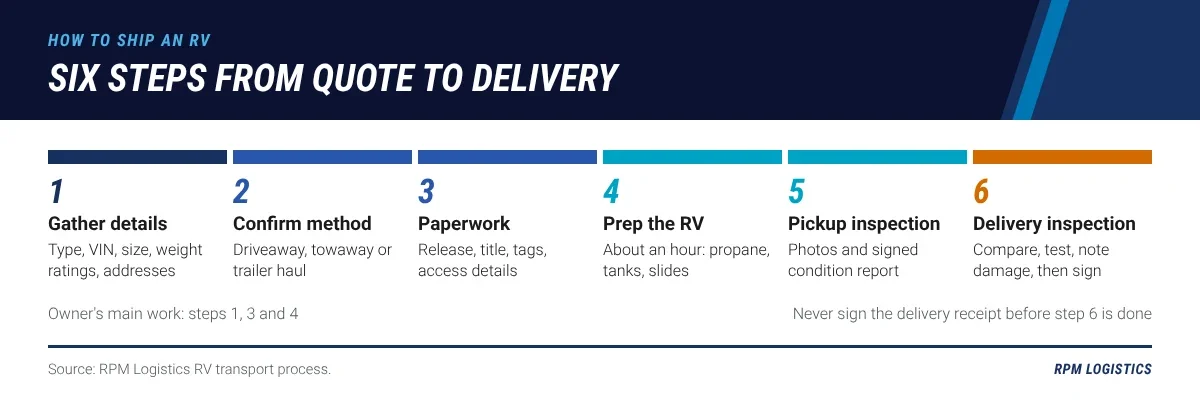
The owner's work is concentrated at both ends: accurate details before the quote, and a careful inspection before signing at delivery.
What does shipping an RV involve?
Shipping an RV means hiring a transport provider to move your motorhome, travel trailer, fifth wheel or camper from one address to another. A professional driver either drives the RV, tows it or carries it on a trailer. You prepare the unit, and you check its condition at both ends.
Owners ship RVs for many reasons. Common ones include buying from an out-of-state dealer or private seller, relocating, sending a unit to a repair shop, and moving between seasonal homes. Dealers also move units between lots and to and from shows.
The market is large but cooling. U.S. RV wholesale shipments reached 342,220 units in 2025, according to the RV Industry Association. Shipments through August 2026 were 207,191, down 14.2% from the same period in 2025. RVIA's fall forecast puts full-year 2026 at about 290,000 units (RVIA, 2026). Fewer new units means more used and private-party sales, and many of those need a transport leg.
Step 1: Gather your RV's details and request a quote
An accurate quote starts with accurate details. Have this information ready before you contact a transport provider:
- RV type: Class A, B or C motorhome, travel trailer, fifth wheel, toy hauler, or folding or pop-up camper.
- Year, make and model, plus the VIN.
- Length, height and width, including ladders, air conditioners and awnings.
- Weight ratings from the RV's weight labels.
- Pickup and delivery addresses, including any gate, storage yard or campground rules.
- Your timing: the earliest pickup date and any delivery deadline.
- Condition: whether the RV runs, rolls and has working brakes and lights.
RPM Logistics returns RV quotes within one business day with a pickup window and an estimated delivery date. Cost depends on many factors beyond distance, as our guide to RV transport explains.
Step 2: Confirm the right transport method
The RV's type decides the method in most cases. There are three standard ways to move an RV:
Method | How it works | Used for | Keep in mind |
|---|---|---|---|
Driveaway | A screened driver drives the motorhome on its own chassis | Class A, B and C motorhomes | Adds miles to the odometer |
Towaway | A driver tows the unit with a properly rated truck and hitch, one unit per trip | Travel trailers, fifth wheels and toy haulers | Truck and hitch must match the unit's weight and hitch type |
Trailer haul | The camper is loaded onto a trailer and secured | Folding and pop-up campers | Suits small, light units |
Federal rules describe driveaway-towaway operations as moving an empty vehicle with one or more sets of wheels on the road, such as from a dealer to a buyer, under 49 CFR 390.5T. Our guides to how driveaway works and driveaway vs. haulaway cover the trade-offs.
How weight ratings decide the driver and equipment
An RV's weight ratings decide what truck, hitch and driver license the move needs. Reading them before you request a quote prevents surprises on pickup day.
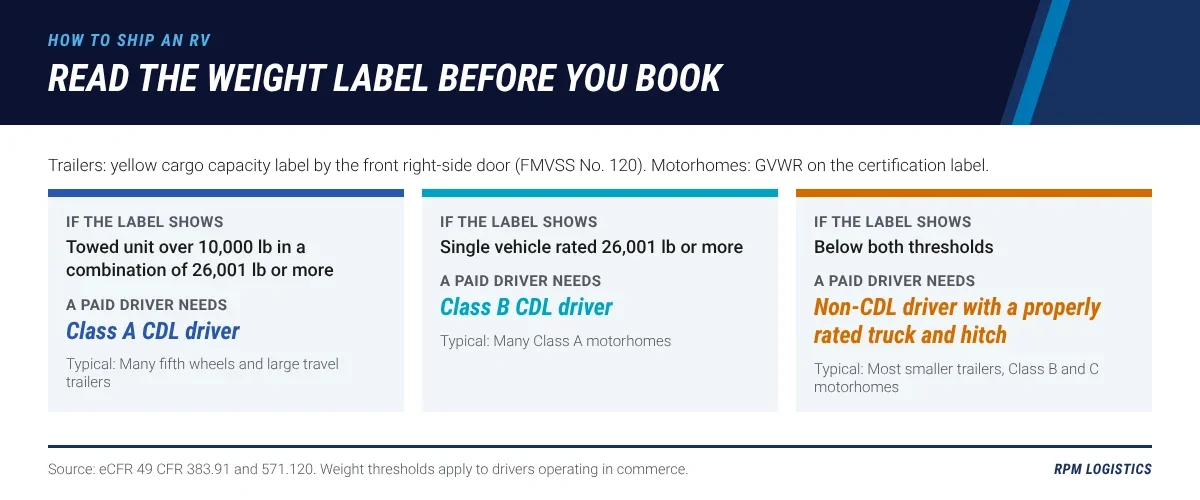
Personal RV owners are generally outside the federal CDL rules, but a paid driver delivering the same RV is operating in commerce, so the weight thresholds apply.
Find the weights on the RV's labels. Travel trailers and fifth wheels carry a yellow "Recreation Vehicle Trailer Cargo Carrying Capacity" label near the front right-side door, under FMVSS No. 120. Motorhomes show the gross vehicle weight rating on the certification label.
Those numbers drive the license rules for a paid driver:
- Class A CDL: a combination rated at 26,001 pounds or more, where the towed unit is rated over 10,000 pounds. Many fifth wheels and large travel trailers fall here.
- Class B CDL: a single vehicle rated at 26,001 pounds or more, which includes many Class A motorhomes.
- No CDL: lighter units, as long as the truck and hitch are properly rated.
Owners driving their own RVs for personal use are generally outside the federal CDL rules, though FMCSA notes that states may extend CDL rules to recreational vehicle drivers. Oversize units can need permits too. See our guide to over-dimensional transport for buses, RVs and chassis.
Step 3: Handle the paperwork before pickup
Paperwork problems delay more RV pickups than mechanical ones. Sort these items out before the driver is scheduled:
- Proof of ownership or release. For a dealer or private-seller purchase, confirm the seller will release the RV to the driver, and who will be present.
- Title and registration. An RV bought out of state may need a temporary tag or transit permit to move on its own wheels. Check the rules in both states.
- Insurance. Ask how the carrier's cargo coverage applies and whether your own policy covers the RV in transit.
- Canada moves. Cross-border moves need title and customs paperwork in order early. See our guide to cross-border vehicle transport.
- Access details. Share gate codes, storage yard hours and campground check-out rules with the transport provider.
An owner or an authorized person must be present at both pickup and delivery. Name that person in advance if you cannot attend.
Step 4: Prepare the RV for transport
Preparing an RV takes most owners about an hour. Good prep protects the unit and keeps pickup on schedule.
- Check for open recalls. Run the VIN through NHTSA's recall lookup, and check both the chassis and the coach.
- Close the propane valves. Turn off LP cylinders and tanks at the valve. Most carriers require it, and some tunnels and bridges restrict propane.
- Empty the holding tanks. Drain black and gray tanks, and drain fresh water unless your carrier says otherwise.
- Secure slide-outs, awnings and steps. Retract and lock every slide-out, awning, step and antenna.
- Lock down the interior. Secure cabinets, drawers, the fridge and loose items so nothing shifts in transit.
- Remove personal property. Personal items are usually excluded from cargo coverage, so take valuables out.
- Check tires, brakes and lights. Towed units need working brakes and lights. Note tire age and pressure.
- Record fuel and mileage. For a motorhome driveaway, leave enough fuel for the start of the trip and note the odometer.
- Leave keys and manuals. Provide all keys, including compartment keys, plus any hitch or slide-out instructions.
Step 5: Attend the pickup inspection
The pickup inspection creates the record that protects you if anything changes in transit. Take part in it rather than handing over keys and leaving.
- Walk the RV with the driver. Look at every side, the roof if reachable, the undercarriage and the interior.
- Compare notes with the photos. RPM Logistics drivers take timestamped photos at pickup, and both sides sign the condition report.
- Note existing damage. Scratches, dents, cracked trim and leaks should all be on the report.
- Confirm the delivery contact and the estimated delivery date before the driver leaves.
RPM Logistics drivers are screened for motor vehicle records at onboarding and monitored continuously after that. Carrier authority and insurance are confirmed before dispatch. Our guide to photo condition reports explains why the pickup record matters.
Step 6: Inspect at delivery before you sign
The delivery inspection is the most important step for you as the owner. Once you sign the delivery receipt without noting a problem, a later claim becomes harder to support.
- Inspect in good light. If delivery is late in the day, use a flashlight and go slowly.
- Compare against the pickup report. Check each panel and note any change from the pickup record.
- Test the basics. Extend slide-outs, open awnings, and check lights, brakes and the hitch.
- Check the interior. Look for shifted items, open cabinets, water spots and new damage.
- Note problems on the receipt. Write any damage on the delivery receipt before signing, and photograph it.
For dealer and show purchases, the delivery inspection doubles as a pre-delivery inspection. RPM Logistics supports pre-delivery inspection for those purchases and closes out the condition report after a second inspection on arrival. That report becomes the record if there is a claim.
How long does it take to ship an RV?
How long it takes to ship an RV depends on distance, method, season and pickup access. Short regional moves can finish within a day or two. Cross-country moves usually take longer, and oversize permits or weather can add days.
Peak season matters too. Spring and early summer are the busiest months for RV transport, as owners head out and dealers restock. Book early in those months, and see our guide to peak-season transport capacity. If the RV must wait between pickup and delivery, RPM Logistics has 70+ storage locations across the U.S. and Canada.
Shipping an RV bought from a private seller
Private-party purchases add steps that dealer purchases handle for you. The seller is not a business, so you need to arrange release, paperwork and access yourself.
- Confirm payment has cleared before you schedule pickup, so the seller will release the RV.
- Get a signed bill of sale and the title, or confirm when the title will be mailed if there is a lien payoff.
- Name the person at pickup. If the seller will not be there, get written authorization for the person who will.
- Ask about storage yard rules. Many yards limit pickup hours or require the owner's authorization in advance.
- Do your own inspection first. If you have not seen the RV in person, consider a pre-purchase inspection before transport. Our guide to pre-purchase inspection logistics explains how to arrange one.
Questions to ask an RV transport provider
Ask these questions before you book, and get the answers in writing:
- Which method will you use, and what truck, hitch and driver license does it need?
- How are drivers screened, and how is carrier authority and insurance checked?
- What is the cargo coverage limit, and what does it exclude?
- How is condition documented at pickup and delivery?
- What is the pickup window and estimated delivery date?
- What happens if the RV cannot be delivered on time, and is storage available?
Common mistakes when shipping an RV
- Guessing the weight. A wrong weight can mean the wrong truck shows up.
- Forgetting extras in the measurements. Roof air conditioners, ladders and bike racks change the height and length.
- Leaving tanks full. Full tanks add weight and can leak.
- Skipping the recall check. An open recall can delay a dealer delivery or affect safety in transit.
- Signing before inspecting. Always inspect at delivery before signing the receipt.
Frequently asked questions
How do I prepare my RV for shipping?
Close the propane valves, empty the holding tanks, retract and lock slide-outs and awnings, secure the interior and remove personal items. Check for open recalls and test lights and brakes. Most owners need about an hour.
Should my RV be driven, towed or hauled?
Motorhomes usually move by driveaway on their own chassis. Travel trailers, fifth wheels and toy haulers are towed. Folding and pop-up campers are usually hauled on a trailer.
Does the driver need a CDL to move my RV?
It depends on the weight ratings. A paid driver needs a Class A CDL for combinations of 26,001 pounds or more with a towed unit over 10,000 pounds, and a Class B CDL for single vehicles of 26,001 pounds or more.
Can I leave belongings inside my RV during transport?
Personal property is usually excluded from cargo coverage, so remove valuables. Secure anything that stays so it cannot shift in transit.
What should I check when my RV is delivered?
Compare the RV against the pickup condition report, test slide-outs, awnings, lights and brakes, and check the interior. Note any damage on the delivery receipt before signing.
Do I need to be present at pickup and delivery?
An owner or an authorized person must be present at both ends. Name that person in advance if you cannot attend.
Ship your RV with a clear process
A good RV move comes down to accurate details, simple prep and careful inspections. RPM Logistics moves motorhomes, travel trailers, fifth wheels, toy haulers and campers across all 50 states and Canada. Get an RV quote through our RV transport service, with a pickup window and estimated delivery date in one business day.