

Quick Answer
Museum car transport for a loan or exhibition has to meet the loan agreement, not just reach the address. That usually means a carrier approved in advance, enclosed transport, condition reports at every handoff and proof of insurance. The car must also arrive ready for local fire-code display rules on fuel, batteries and sealed fill openings.
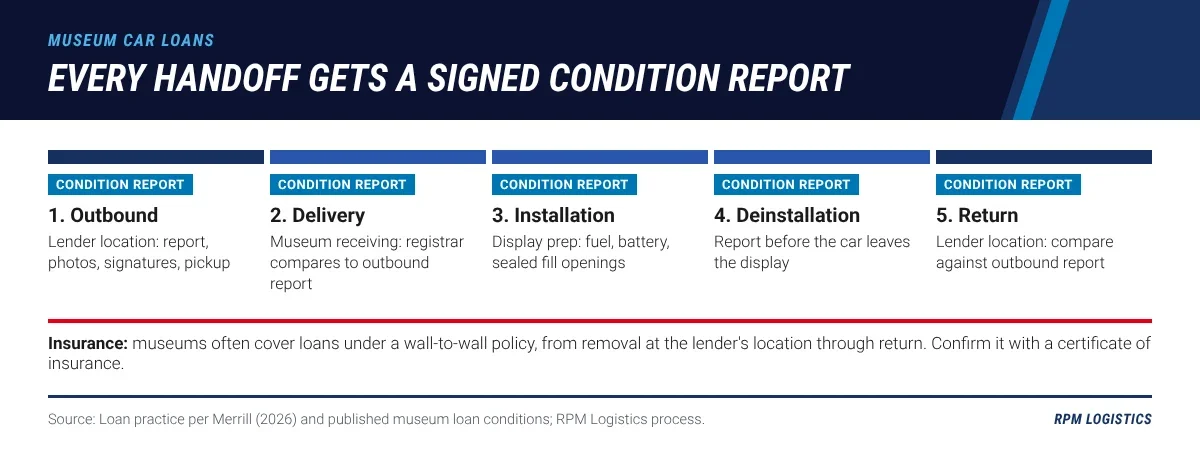
Every handoff is a point where the car's condition must be documented and signed, so the return report can be checked against the outgoing one.
What is a museum or exhibition car loan?
A museum or exhibition car loan is an agreement where a private owner, company or another museum lends a vehicle for display for a set period. The borrower displays the car and returns it in the same condition. The loan agreement sets the rules for insurance, transport, condition and credit.
Car loans are common in museum programs. Some exhibitions are built almost entirely around them:
- Local collectors. The Savoy Automobile Museum in Cartersville, Georgia, ran "Locally Owned" in 2025, featuring cars from private collectors living near the museum.
- Historic vehicles on public display. The Hagerty Drivers Foundation's "Cars at the Capital" showed the Beatnik Bandit and Dodge Deora on the National Mall in September 2024, lent by a museum and a private collection (Hagerty, 2024). An earlier edition displayed the Hudson Hornet and the Chrysler Turbine car, both lent by collections (Hagerty).
- Corporate lenders. The Saratoga Automobile Museum's 2025 Corvette exhibition used six cars lent by the GM Heritage Collection.
Each of these moves has to meet the terms both sides signed. That makes museum transport closer to fine-art shipping than to a routine car move.
What a loan agreement asks of transport
Most loan agreements include clauses that the transport provider has to meet. Read the agreement before booking, and share the relevant clauses with your carrier.
- Who pays for transport. Many museums pay for shipping, though some agreements put the cost on the lender. Merrill notes that shipping terms are "usually dictated by the lender and paid for by the museum" (Merrill, 2026).
- Carrier approval. Some agreements require that packing and transport use carriers approved in advance (University of Alaska Museum of the North).
- Insurance. Agreements often require "wall-to-wall" coverage that runs from removal at the lender's location to return, with a certificate of insurance for the lender.
- Condition reports. Reports are commonly required before shipment, on delivery, after installation and on return.
- Couriers. Some lenders require a courier to accompany the object or attend installation.
- Damage notice. Agreements usually require immediate notice to the lender and carrier if damage occurs in transit.
- Handling limits. Some museums allow no cleaning or repair beyond light dusting while the car is on loan.
Write the transport method into the agreement, including enclosed transport and securement type. That avoids disputes later about what was promised.
Insurance: who covers the car and when
Insurance is the clause lenders read most closely. The agreement should say who insures the car at each stage, and for how much.
Museums often insure borrowed objects under an all-risk, wall-to-wall policy that names the lender as an additional insured. Some loan agreements let the lender keep their own insurance instead. Either way, the lender should get a certificate of insurance and have their own insurer review it.
Check how each policy values the car. Hagerty's business insurance for museums lists coverage for vehicles on loan and for transit, and says it pays true market value at the time of loss (Hagerty). Market value and agreed value are not the same. Our guide to agreed value vs. actual cash value explains the difference.
Also confirm the transport provider's cargo coverage limit against the car's value. If the car's value exceeds that limit, decide in writing which policy fills the gap.
Fire-code prep for indoor display
Vehicles shown indoors usually have to meet local fire-code rules before they can be placed. Those rules affect how the car must arrive, so plan them before pickup.
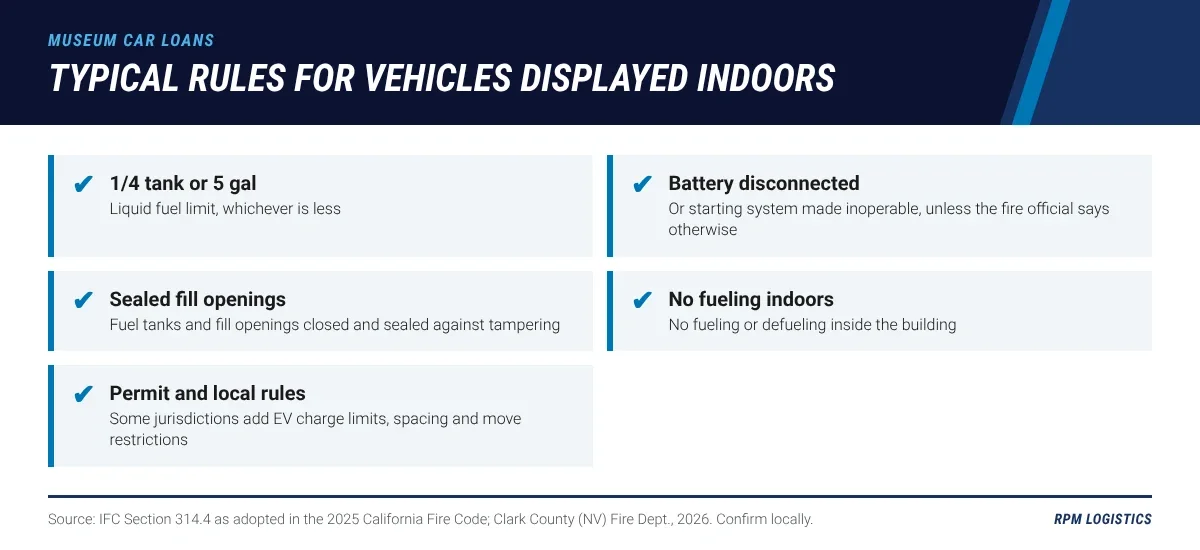
Fuel level is the item most likely to stop an installation, because the car usually cannot be defueled inside the building once it arrives.
Many jurisdictions base their rules on International Fire Code Section 314.4. In California's 2025 Fire Code, which follows that section, vehicles may be displayed indoors only when:
- The ignition battery is disconnected or the starting system is made inoperable, unless the fire official requires it to stay connected.
- Liquid fuel does not exceed one-quarter tank or 5 gallons, whichever is less.
- Fuel tanks and fill openings are closed and sealed to prevent tampering.
- The vehicle is not fueled or defueled inside the building.
Local rules can add more. Clark County, Nevada, for example, requires a display permit, limits hybrid and electric high-voltage batteries to a 30% state of charge, and bars moving vehicles through occupied spaces without approval (Clark County Fire Department, 2026). Always confirm with the museum, which works with its local fire marshal.
For transport, that means planning fuel level before pickup. Many enclosed carriers load and unload cars under their own power, so agree on a fuel level that works for both loading and display rules.
Preparing the car before pickup
Lenders can head off most problems by preparing the car before the transport provider arrives. Agree on each step with the museum first, since some museums have their own preparation rules.
- Set the fuel level. Bring fuel down to the display limit, leaving enough to load if the car drives onto the trailer.
- Plan the battery. Decide whether the battery will be disconnected at pickup or at installation, and who will do it.
- Check for leaks. Note any fluid leaks, since venues often require drip pans and protected floors.
- Check tires. Set tire pressure, because the car may sit in one position for months.
- Gather documents. Include the title or proof of ownership, the loan agreement and any provenance records the museum will display.
- Provide keys and instructions. Hand over keys, kill-switch details and starting instructions for older cars.
Planning the loan calendar
Transport for a museum loan should be planned when the loan is negotiated, not just before the exhibition opens. A simple calendar keeps every party on the same dates.
- When the agreement is signed: confirm transport terms, book outbound and return moves and request the certificate of insurance.
- Several weeks before delivery: confirm the venue's fire-code requirements, access route and installation window.
- The week of delivery: complete the outbound condition report and confirm the courier, if required.
- At closing: confirm the deinstallation date and return route, then complete the return report.
Estate and collection moves often involve museum loans too. Our guide to estate car collection transport covers multi-car planning.
Build some slack into each date. Weather, venue changes and exhibition delays happen, and a carrier that knows the full calendar can adjust a pickup or hold a car in storage without breaking the terms of the loan.
Choosing transport for a loaned car
A loaned car usually calls for enclosed transport with soft-tie securement. Museums and lenders expect the car to arrive exactly as it left.
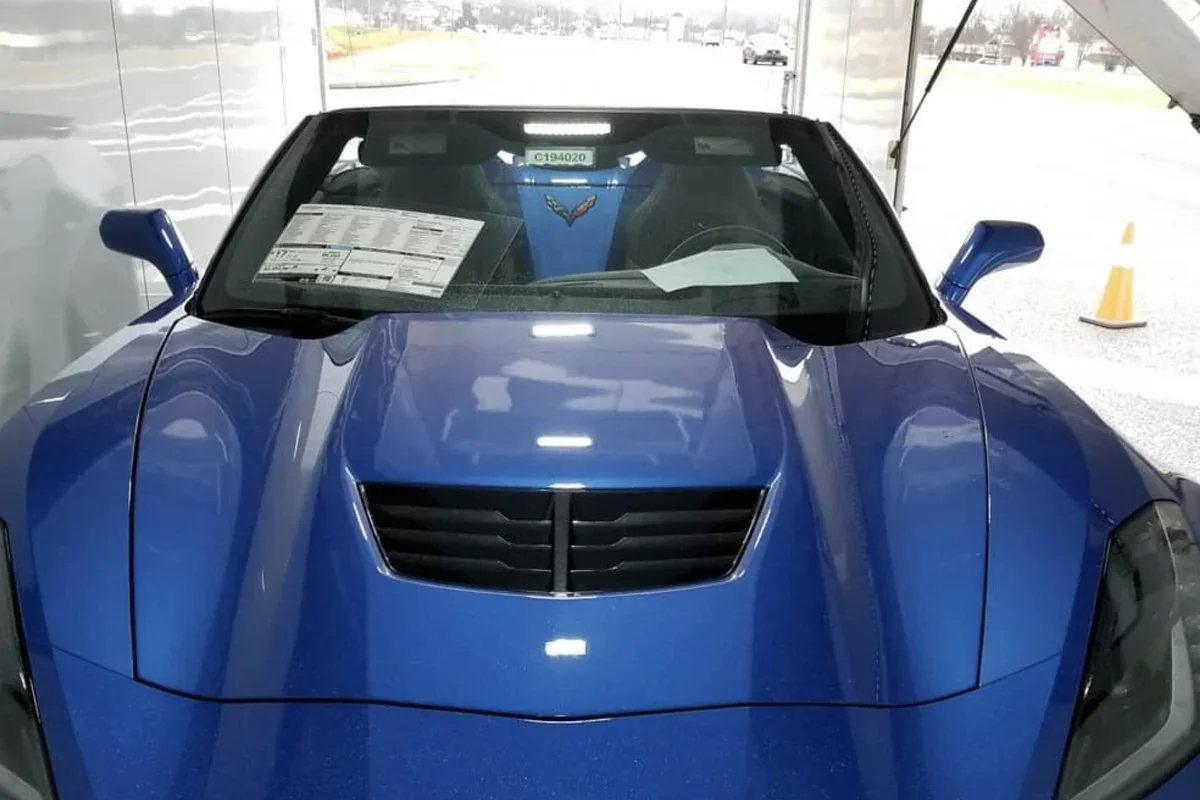
Inside an enclosed trailer the car is out of weather, road debris and public view, which is the condition most loan agreements are written to expect.
- Enclosed trailers protect against weather, road debris and public view. See our enclosed transport service.
- Soft-tie securement holds the car by its wheels and avoids stress on the suspension. Our guide to soft-tie vs. hard-tie securement explains why.
- Liftgates help with low cars and non-running cars that cannot drive up a ramp.
- Direct routing limits time on the road and the number of handoffs.
Older and non-running cars need special handling. Our guide to pre-war and antique vehicle transport covers winching and loading for cars that cannot move under their own power.
Condition reports at every handoff
Condition reports are the backbone of a loan. They prove what condition the car was in at each stage, which settles questions on return.
- Outbound report at the lender's location. Photograph every panel, the interior, the engine bay and the undercarriage.
- Delivery report at the museum. The registrar compares the car against the outbound report.
- Installation report. Note any change after the car is placed on display.
- Deinstallation report. Record condition before the car leaves the display.
- Return report at the lender's location. Compare against the outbound report and note any change.
Each report should be signed by both parties at that handoff. Our guide to insurance-grade condition reporting shows what a complete record includes.
Installation and deinstallation day
Installation day has its own constraints. Museums often schedule vehicle moves outside public hours and set rules for how cars enter the building.
- Confirm the delivery window with the museum's registrar or exhibition team.
- Check access. Ask about door widths, ramps, floor loads and the path from the truck to the display.
- Protect floors. Some venues require drip pans or drop cloths under vehicles.
- Plan vehicle movement. Some venues bar moving cars during public hours or through occupied spaces.
- Arrange courier attendance if the loan agreement requires it.
Deinstallation needs the same planning. Book the return transport when the loan is signed, not when the exhibition closes.
International loans and immunity from seizure
Cars lent from abroad for U.S. exhibitions can qualify for federal immunity from seizure. Under 22 U.S.C. 2459, an object of cultural significance imported for temporary exhibition by a nonprofit institution can be protected once the government finds it culturally significant and publishes notice in the Federal Register.
That protection extends to "any carrier engaged in transporting" the object. The museum handles the application, but the transport plan should match the protected dates and route. International moves also involve customs entry. Our guide to bonded and in-transit vehicles explains how cars move under customs control.
A checklist for lenders and registrars
Use this checklist when planning transport for a museum or exhibition loan.
- Read the loan agreement's transport, insurance and condition clauses.
- Confirm who pays for transport and who approves the carrier.
- Get a certificate of insurance and confirm coverage values.
- Confirm fire-code requirements for fuel, batteries and fill openings.
- Book enclosed transport with soft-tie securement.
- Schedule delivery around museum hours and access limits.
- Complete signed condition reports at every handoff.
- Book the return leg when the loan is signed.
Cars that also appear at shows follow a similar process. Our guides to concours show car transport and event and rally transport cover those moves.
Frequently asked questions
Who pays to ship a car lent to a museum?
It depends on the loan agreement. Many museums pay for transport, but some agreements put the cost on the lender. The agreement should state who pays and who approves the carrier.
Does a museum insure a loaned car?
Many museums insure loaned objects under a wall-to-wall policy that covers the car from removal to return. Some agreements let the lender keep their own insurance. Always get a certificate of insurance.
How much fuel can a car have when displayed indoors?
Many local fire codes based on International Fire Code Section 314.4 limit fuel to one-quarter tank or 5 gallons, whichever is less. Confirm the local rule with the museum.
Does the battery need to be disconnected for museum display?
Usually, yes. Fire codes based on Section 314.4 generally require the ignition battery to be disconnected or the starting system made inoperable, unless the fire official says otherwise.
What condition reports are needed for a museum car loan?
Typical loans require reports before shipment, on delivery, after installation, at deinstallation and on return. Each should be signed by both parties at that handoff.
Should a loaned car travel in enclosed transport?
Yes, in most cases. Enclosed transport with soft-tie securement protects the car and is what most lenders and museums expect.
Move loaned cars to the standard the agreement sets
A museum loan is only as strong as the transport that supports it. RPM Logistics moves collector and historic vehicles in enclosed transport with detailed condition documentation across all 50 states and Canada. Learn more about our high-value vehicle transport, or request a quote with your loan dates and venue details.