

Quick answer: Inherited car collection transport is the moving of a deceased collector's vehicles on the estate's behalf. Do it in six steps: confirm who has authority to release each car, keep insurance in force, appraise, document every car, route each one to its destination, then release with signatures. Confirm legal and tax steps with the estate attorney.
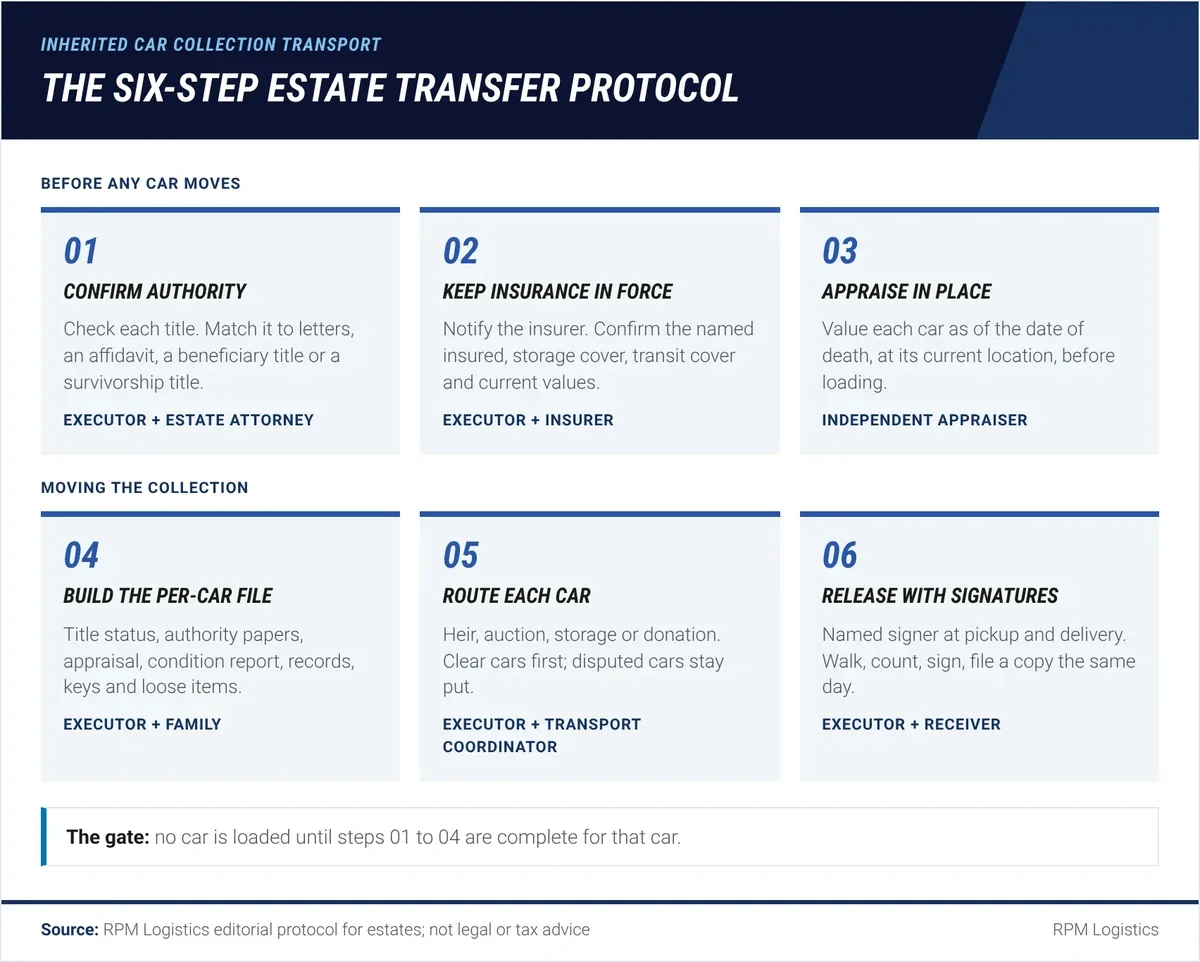
The order matters more than the speed. A car that moves before steps one to four are done is harder to value, insure and account for.
An estate car collection is a group of vehicles owned by someone who has died, now held for heirs, buyers or a charity. Moving one is not the same job as moving a collector's own cars. The owner is gone. The person giving instructions is an executor, trustee or heir, and the authority to act comes from paperwork, not from the title.
This guide is for that person and the advisors around them: estate attorneys, wealth managers and family offices. It covers the transport side only. Nothing here is legal or tax advice. Rules differ by state and by estate, so confirm each legal step with the estate attorney before a car leaves the property.
Why an Estate Move Differs From a Collector's Own Move
An estate move differs because the person releasing the cars usually does not own them yet. A collector relocating a collection decides everything alone. In an estate, several people have a stake in each car, and a court or a will may decide where it ends up.
That changes three things about transport:
- Who signs. The carrier needs a release from someone with documented authority, not from whoever has the keys.
- What gets recorded. Condition at pickup becomes part of the estate record, not just a damage-claim baseline.
- Where cars go. One collection can split across heirs in different states, an auction house, storage and a museum.
The physical move still follows collector-car practice. For trailer selection, multi-car sequencing and partner selection, see our guide to relocating a luxury vehicle collection. The rest of this article covers the estate layer on top of it.
The Estate Transfer Protocol: Six Steps in Order
The estate transfer protocol is a fixed sequence that keeps each car accountable from the owner's death to its new home. Each step depends on the one before it. Skipping ahead is the most common source of disputes and claim problems.
- Confirm authority. Identify who can legally release each car and gather the document that proves it.
- Keep insurance in force. Notify the insurer and confirm coverage for storage and transit.
- Appraise. Establish date-of-death value for each car before it moves.
- Document each car. Build a per-car file: title, authority papers, appraisal, condition report, records and keys.
- Route. Assign every car a destination and a release order.
- Release with signatures. Sign off condition and contents at pickup and at delivery, and file copies with the estate.
Step 1: Confirm Who Has Authority to Release Each Car
Authority means documented legal standing to hand a car to a carrier. It depends on how each car was titled, so check every title separately. Two cars in the same garage can follow different paths.
The table below shows common ownership paths and the document that usually proves authority. Treat it as a checklist to raise with the estate attorney, not a ruling on any estate.
How the car was held | Who usually has authority | Typical proof | State example (verify locally) |
|---|---|---|---|
Joint title with a surviving co-owner | Surviving owner | Title plus certified death certificate | Texas DMV offers a rights of survivorship agreement for vehicles (Form VTR-122) |
Transfer-on-death or beneficiary title | Named beneficiary | Title plus certified death certificate | Virginia: beneficiary applies for title within 120 days of death (Virginia DMV) |
Will admitted to probate | Executor | Letters testamentary | Texas DMV accepts letters testamentary or letters of administration |
No will, probate opened | Court-appointed administrator | Letters of administration | Ask the attorney which documents the state DMV accepts |
Small estate, no probate | Heir or successor | State affidavit | California REG 5 requires at least 40 days since death (California DMV, 2024) |
Car held in a trust | Successor trustee | Trust certification or trust documents | Set by the trust and state law |
Timing rules are real constraints on transport dates. Nevada DMV, for example, says a new title under its transfer-on-death process is mailed in 4 to 6 weeks. A carrier can often move a car on the strength of letters testamentary before the title is reissued. Ask the attorney whether that is appropriate for your estate.
Step 2: Keep Insurance in Force After the Owner's Death
Insurance continuity means no car sits or travels uninsured between the owner's death and its delivery. The policy was written for a living owner. The estate needs to know whether it still applies, and to whom.
Notify the insurer early and ask these questions in writing:
- Does the policy continue for the estate, and who is now the named insured?
- Does coverage still apply while cars are stored at the residence or elsewhere?
- Does it cover cars while in transit on a carrier's trailer?
- Are the insured values current, and can they be updated after the appraisal?
Collector policies often insure at an agreed figure. Hagerty says its collector policies pay the full insured value, agreed in advance, on a covered total loss. That only helps if the figure is current. Hagerty reported the average insured value of the 1990 to 1993 Chevrolet 454 SS rose 57% since 2021 (Hagerty, 2025). A policy set years ago may understate today's value.
The carrier's coverage does not replace the owner's policy. The federal minimum in 49 CFR 387.9, $750,000 for many for-hire carriers, is public liability coverage, not cargo coverage. There is no federal cargo insurance minimum for auto transport carriers. For how agreed value and actual cash value pay out, read agreed value vs. actual cash value for classic cars.
Step 3: Appraise Before Anything Moves
An appraisal before transport fixes each car's value as of the date of death, while its condition is still undisturbed. Executors usually need that figure whether or not the estate owes tax.
Federal rules show why. The IRS says an heir's basis in inherited property is generally its fair market value on the date of death. The estate tax regulation defines fair market value as the price between a willing buyer and willing seller. Its automobile example in 26 CFR 20.2031-1 lists make, model, age and condition as value inputs. Condition is in the rule, so condition evidence matters.
Key federal figures executors raise with their advisors:
- The basic exclusion amount is $15,000,000 for deaths in 2026 (IRS, 2026).
- Form 706, when required, is due within 9 months of death, with an automatic 6-month extension available (IRS, 2026).
- An alternate valuation date 6 months after death can be elected only if it lowers both the gross estate and the tax (IRS Form 706 instructions, 2026).
- For personal effects of marked artistic or intrinsic value over $3,000 in total, 26 CFR 20.2031-6 calls for sworn expert appraisals.
Whether any of these apply to a given estate is a question for the attorney and CPA. The transport point is simpler. Get the appraisal done at the car's current location, before loading. A car appraised after a cross-country trip carries a question nobody can answer later: was that chip there on the date of death?
Step 4: Document Each Car for the Estate Record
The per-car estate file is a single folder for each vehicle that travels with it or ahead of it. It lets an heir, auction house or buyer accept the car without calling the executor for missing pieces.
The table below lists what each file should hold and why it matters at handoff.
Item | Who supplies it | Why it matters in transport |
|---|---|---|
Title (original or status note) | Executor or attorney | Shows which authority path applies to this car |
Certified death certificate copy | Executor | Required on most transfer paths; keep originals with the attorney |
Letters testamentary, letters of administration or affidavit | Attorney | Proves the person signing the release can sign it |
Appraisal | Independent appraiser | Sets the declared value and supports any later claim |
Condition report with photos | Appraiser, then carrier at pickup | Records condition on the date it left the estate |
Records and provenance binder | Family or collection manager | Service history, build sheets and show awards can carry real value |
Keys, fobs, remotes and codes | Executor | Counted at pickup, counted again at delivery |
Tool roll, jack, spare, manuals, car cover | Executor | Original pieces are often part of the car's value |
Hagerty grades collector cars from #1 Concours to #4 Fair across four condition levels. A good condition report gives an appraiser enough detail to place a car on that scale. Our guide to insurance-grade condition reporting sets out the photo and notation standard to ask for.
Label every loose item with the car's VIN before it goes in a box. Estate garages often hold spare parts, wheels and trim for several cars. Once those items scatter across destinations, nobody can match them back.
Step 5: Route a Collection Split Across Several Destinations
Routing means giving every car a destination, a transport mode and a release date. In estates, the collection rarely stays together. Each car follows whatever the will, the heirs or the sale plan decides.
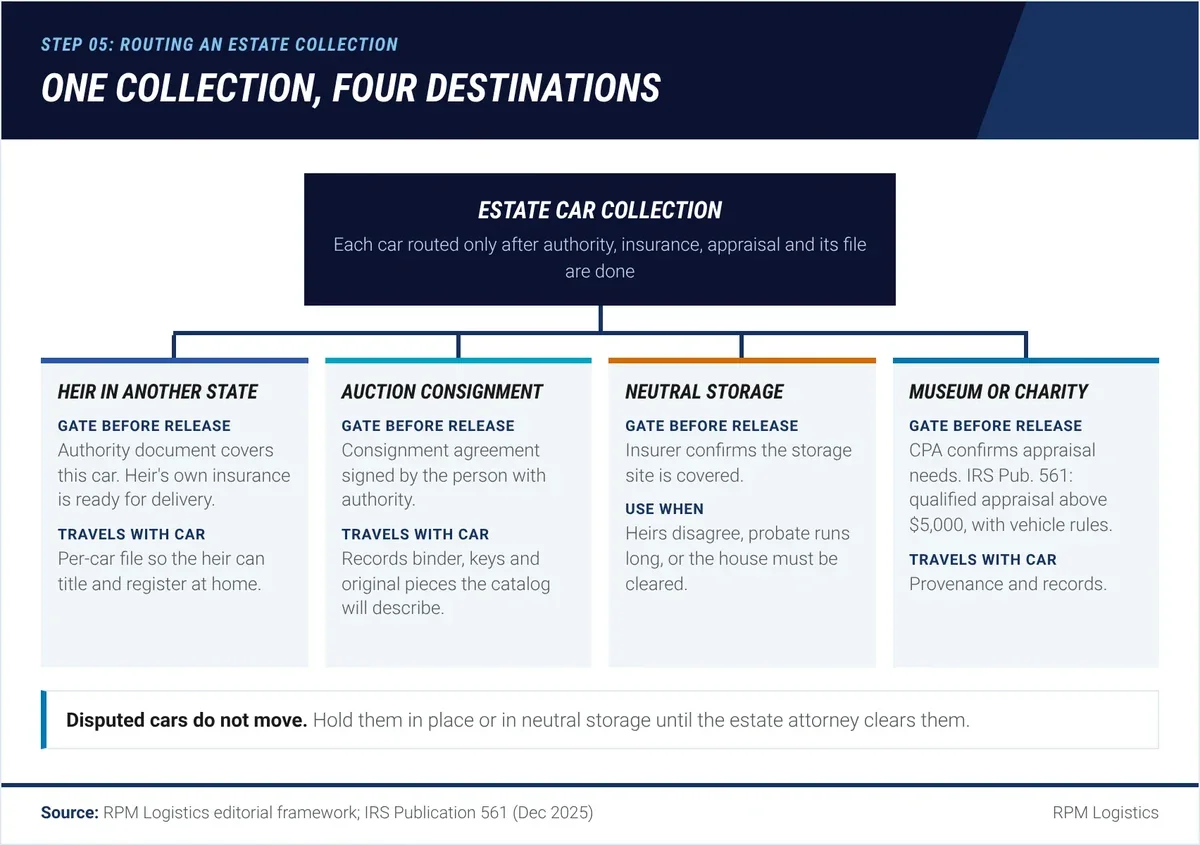
Each branch has its own paperwork gate. Route a car only after its gate is cleared.
The four common destinations each carry different requirements:
- Heir in another state. The heir will title and register in their own state. Send the per-car file with the car or ahead of it.
- Auction consignment. The auction house sets the check-in window. Our guide to classic car auction transport logistics covers consignment timing.
- Storage while the estate is open. Useful when heirs disagree or probate runs long. Confirm the insurer covers the storage site.
- Donation. IRS Publication 561 requires a qualified appraisal for most noncash gifts claimed above $5,000, with special rules for vehicles (IRS, 2025). The CPA decides how this applies.
Release order matters when a collection splits. Move cars with clear authority and a ready destination first. Hold disputed cars in place or in neutral storage until the attorney clears them. Group cars bound for the same region on one enclosed load where timing allows.
Some estate cars need special handling. Long-stored non-runners need winch loading and a frame-safe plan, covered in barn-find recovery transport. Brass-era and prewar cars bring their own securement and clearance issues; see antique and pre-war vehicle transport. For most collector cars, enclosed transport with soft-tie securement is the default. Our comparison of soft-tie vs. hard-tie enclosed transport explains why.
A transport coordinator can quote an estate move accurately only with the full picture. Send these details in one request:
- Number of cars, with year, make, model and VIN for each.
- Running status, and whether each car rolls, steers and brakes.
- Pickup site access: driveway length, gate, slope and low branches.
- Every destination, with a named receiver and phone number.
- Declared value per car, taken from the appraisal.
- Any car on hold pending the attorney's clearance.
Step 6: Release Each Car With Signatures at Both Ends
Release is the documented handoff of a car from the estate to the carrier, and from the carrier to the receiver. Both ends need a named signer with authority, not whoever happens to be on site.
At pickup, the executor or a named representative should:
- Walk the car with the driver and sign the condition report.
- Count keys, fobs and loose items against the per-car file.
- Confirm the delivery contact's name and phone number on the order.
- Keep a signed copy for the estate file the same day.
At delivery, the receiving heir, auction house or storage site repeats the walk and count. Any difference gets noted on the delivery receipt before signing. A note made at delivery carries weight. A complaint raised three weeks later, after the car has been driven, rarely does.
Can Heirs Drive an Inherited Car Instead of Shipping It?
Driving an inherited car home is possible in some cases, but it adds risks that transport avoids. The registration may lapse. The policy may not cover a new driver. Miles and road wear also change the condition the appraisal recorded.
For a collector car, those risks usually outweigh the savings. Settle authority and insurance first. If a car needs a short move before then, use a carrier rather than a family member's driving. Our complete guide to classic car transport covers open versus enclosed choices for single cars.
Frequently Asked Questions
Can I drive my deceased parent's car before the title is transferred?
It depends on the state, the registration and the insurance policy. Policies differ on who is covered after the owner's death, and registration may lapse. Before driving the car, ask the insurer in writing whether you are covered, and ask the estate attorney whether you have authority to use it. For a collector car, shipping avoids added miles and condition questions.
What type of car transport is best for inherited classic cars?
Enclosed transport is the usual choice for classic and collector cars. It shields paint, chrome and interiors from weather and road debris, and keeps the car out of view. Soft-tie securement, using straps through the wheels rather than chains on the frame, suits most collector cars. Non-running cars need winch loading, so mention that when you request a quote.
Can an inherited car be shipped before probate is finished?
Often yes, if the person releasing the car has documented authority, such as letters testamentary or letters of administration. A transport provider needs proof of authority to release, not a reissued title. Disputed cars are better left in place or in storage. Confirm with the estate attorney before moving any car while the estate is open.
What documents should travel with an estate vehicle?
Keep a per-car file with a title copy or title status note, a certified death certificate copy and the authority document. Add the appraisal, the signed condition report and the records binder. Count keys, fobs and loose items into the file. Originals of legal documents usually stay with the estate attorney, with copies traveling with the car.
Should an inherited collector car be appraised before it is moved?
Yes, in most cases. An appraisal at the car's current location records its value and condition as of the date of death, before transport adds any variable. The IRS generally uses date-of-death fair market value as an heir's basis. Your attorney or CPA will say which appraisal standard the estate needs.
Plan the Estate Collection Move With One Coordinator
An estate move goes best when one coordinator holds the per-car files, the release order and every signature. RPM arranges enclosed transport and manages booking, documentation, condition reporting and coordination across all 50 states and Canada. Get a Classic Car Quote