

Quick answer: Fleet transport exception management is how a transport partner spots, reports, owns and closes a move that goes off plan. Think no-shows, delays, damage and paperwork gaps. Judge partners on it first. Clean moves look much the same from one vendor to the next. Exceptions are where partners differ, and where your costs land.
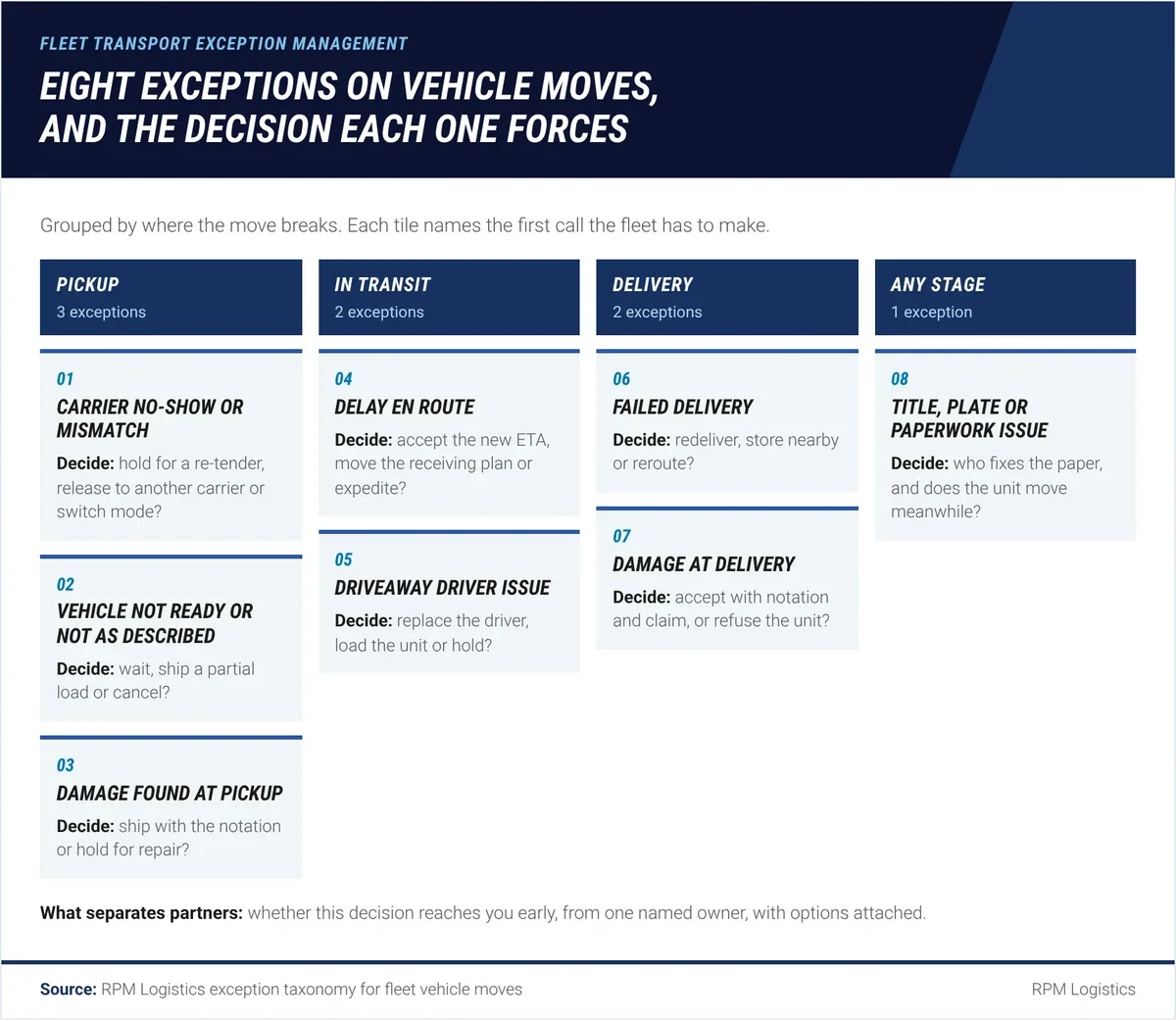
Every exception forces a decision on the fleet's side. A good partner puts that decision in front of you with options, before you go looking for it.
A fleet transport exception is any vehicle move that departs from its booked plan in time, condition, place or paperwork. Exception management is the process that finds the departure, puts one party in charge of it and closes it with a record. Most moves never need it. The ones that do drive much of what the program costs.
This is the last piece in our fleet series, and it takes a clear position. Fleets should judge transport partners on their exceptions first and their clean moves second. The rate card, the network map and the demo all describe the moves that go to plan. None of them shows what happens on the ones that don't.
Clean Moves Don't Separate Partners. Exceptions Do.
A clean move is a weak test of a transport partner because nearly any competent provider can deliver one. The truck shows up, the unit loads, the paperwork matches and the vehicle arrives in the window. Two vendors with very different operations can post the same result on that move.
The scale of fleet buying makes the difference matter. US fleet sales reached 2.6 million new vehicles in 2024, or 17.3% of new-vehicle sales (Cox Automotive, 2025). Many of those units move more than once before and during service. Even a small share of exceptions turns into a steady weekly workload at that volume.
Standard procurement questions miss this. They ask about on-time rates, damage rates and coverage. Those are averages, and averages hide the tail. Our guide to the seven vendor selection questions fleet managers should ask covers that broad ground. This piece narrows to one lens: how a partner behaves when a move breaks.
There is also a reporting problem. Outcome metrics such as on-time delivery tell you how often something went wrong. They do not tell you who found it first or how long it sat. That gap is why fleet transport KPIs built on outcomes need a handling view next to them.
Eight Exceptions Specific to Vehicle Moves
A vehicle transport exception differs from a freight exception because the cargo is a titled, drivable, recallable asset. Generic logistics guides list missed pickups, weather and damaged packages. Vehicle moves add title status, recalls, keys, condition reports and driven-move risks that box freight never carries.
The table below sets out eight exceptions by stage. The last column is the decision the fleet has to make. That decision is what a good partner frames for you, early.
Exception | Stage | What it looks like on a vehicle move | The fleet's first decision |
|---|---|---|---|
1. Carrier no-show or mismatch | Pickup | No truck in the window, or a driver who does not match the booked carrier | Hold for a re-tender, release to another carrier or switch mode? |
2. Vehicle not ready or not as described | Pickup | Unit still at the upfitter, won't start, open recall, wrong spec or missing keys | Wait, ship a partial load or cancel? |
3. Damage found at pickup | Pickup | Prior damage noted on the condition report before loading | Ship with the notation or hold for repair? |
4. Delay en route | In transit | Weather, breakdown, an hours-of-service limit or a reshuffled load | Accept the new ETA, move the receiving plan or expedite? |
5. Driveaway driver issue | In transit (driven moves) | Driver unavailable or late, or a unit problem found on the road | Replace the driver, load the unit or hold? |
6. Failed delivery | Delivery | Site closed, no one authorized to sign, access blocked | Redeliver, store nearby or reroute? |
7. Damage at delivery | Delivery | New damage noted against the pickup report | Accept with notation and claim, or refuse the unit? |
8. Title, plate or paperwork issue | Any stage | Missing MCO or title, expired temporary tag, wrong release or bill of lading | Who fixes the paper, and does the unit move meanwhile? |
Pickup exceptions start before the truck arrives
Three of the eight happen at pickup, and most start with the unit, not the carrier. A truck held at a lot for an unready vehicle loses time it needs for its next stop. Across trucking, drivers were detained at 39.3% of stops in 2023, per ATRI's driver detention research. That added up to 135 million lost hours (ATRI, 2024).
Recalls are a pickup exception too. NHTSA counted 997 recalls in 2025, and more than 29 million vehicles were recalled, per NHTSA's recall safety guidance (NHTSA, 2026). A unit under a "Do Not Drive" recall should not go on a driven move. Our piece on setting a fleet transport mode policy treats that as a hard override.
A mismatched driver is the exception most worth catching. CargoNet logged 158 fictitious pickups in Q2 2026, down only slightly from 165 a year earlier (Verisk CargoNet, 2026). Verisk's Q2 2026 release covers all cargo in the US and Canada, not vehicles alone. The rule still holds: a driver who does not match the booking is an exception, not a pickup.
In-transit exceptions are mostly timing
Delays en route come from weather, equipment and the clock. The FHWA Road Weather Management Program estimates that snow, ice and fog cause 23% of non-recurrent highway delay. That is about 544 million vehicle-hours of delay a year (FHWA estimate). Winter lanes need wider windows and earlier notice.
Hours-of-service rules turn short delays into long ones. A property-carrying driver may drive 11 hours inside a 14-hour window (49 CFR 395.3). Then 10 hours off duty must follow. A three-hour hold at pickup can push delivery into the next day. A good partner says so when the hold starts, not when the window closes.
Delivery and paperwork exceptions land on your team
Failed deliveries and paperwork gaps often start on the fleet's side of the move. A closed yard, an unnamed receiver or a missing title release stops a unit that arrived on time. These spill into the work covered in the gap between delivered and ready for deployment. They also cluster at the transfers mapped in our piece on who owns status at each fleet vehicle handoff.
What Good Exception Handling Looks Like
Good exception handling is a sequence of five acts: first notice, a named owner, options, documentation, and closure with a root cause. Each one can be observed and tested. None depends on a particular software platform.
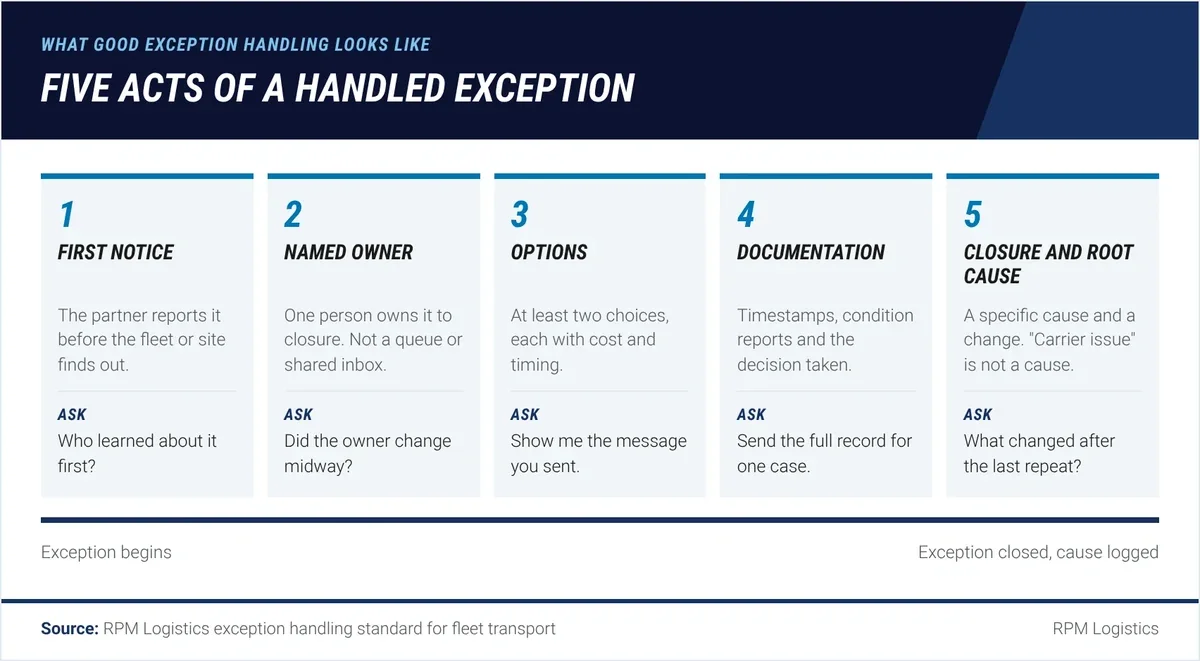
The sequence describes behavior, not tools. A partner can run it by phone and email, and a partner with a polished portal can still skip steps.
Contract terms such as notification windows, credit-backs and claim timelines belong in the agreement. The fleet transport SLA guide covers how to write them. The five acts below are how you tell whether a partner lives up to those terms.
- First notice. The partner tells you before you find out. The test is simple: who learned about the exception first, the fleet or the partner? If your driver or receiving site calls the partner, the notice failed.
- A named owner. One person owns the exception until it closes. Not a queue, not a shared inbox. The owner can be reached and does not change halfway through.
- Options, not updates. A status update says the truck is late. An option says what you can do about it, with cost and timing. Good partners bring at least two, such as a new ETA or a re-tender at a stated premium.
- Documentation. Each exception leaves a record with timestamps, the condition report and the decision taken. Damage exceptions depend on matched photos at pickup and delivery, as our guide to photo condition reports for fleet damage claims explains.
- Closure and root cause. The exception closes with a stated cause and a fix. "Carrier issue" is not a cause. "Upfitter released units before the build sheet cleared" is.
Documentation matters most when an exception becomes a claim. Under 49 CFR Part 370, a carrier must acknowledge a written claim within 30 days. It must pay, decline or offer a settlement within 120 days. Those clocks reward the side with the better record.
The Exception Scorecard
An exception scorecard is a short set of criteria for rating a partner's handling, each paired with a way to verify it. It sits beside your rate and coverage review, not in place of it. Score each row pass, partial or fail.
The table below lists six criteria. The third column matters most. A criterion you cannot verify is a sales claim, not a score.
Criterion | What good looks like | How to verify it |
|---|---|---|
1. First notice | The partner reports the exception before the fleet or site finds it | For each sample exception, ask who reported it first and when |
2. Named owner | One person, by name, owns each exception to closure | Ask for the owner's name on three past exceptions; check whether it changed midway |
3. Options presented | Two or more choices with cost and timing, offered early | Ask to see the actual message sent to the customer on a past delay |
4. Documentation | Timestamps, condition reports and decisions kept per exception | Request the full record for one closed damage exception |
5. Escalation path | A named person above the owner, used before the fleet asks | Ask how many exceptions were escalated last quarter, and by whom |
6. Closure and root cause | Each exception closes with a specific cause and a change | Ask what changed after the last repeat exception on one lane |
Weight the rows by what an exception costs you. A late spare unit and a late crew truck are not the same miss. The $500 transport decision lays out how to tier moves by consequence. Use those tiers to decide which exceptions go to the escalation row.
How to Test Exception Handling Before You Sign
The exception procurement test is three checks run before contract award: an exception sample, exception-focused reference calls and a trial lane. Each puts real exceptions in front of you instead of a description of the process.
Ask for the last 10 exceptions and how each closed
Ask each finalist for its last 10 closed exceptions on vehicle moves, anonymized. Ask for these fields on each:
- Exception type, using the eight-row taxonomy above
- When it began, when the customer heard, and from whom
- The owner's role and the options offered
- Closure date and the stated root cause
Read the sample for patterns, not perfection. A partner that sends 10 delays and no damage or paperwork cases may be filtering. A partner that says it has no recent exceptions is likely very small or not counting. Both answers tell you something.
Run reference calls on exceptions only
Standard reference calls ask whether the client is happy. Ask instead about one move that went wrong. Who called whom first? Was the same person on it from start to close? What options came back, and how fast? Would the reference book that lane with the partner again?
References are chosen by the vendor, so they skew positive. The exception questions still work. A reference who cannot recall any exception handling at all is a thin reference.
Run a trial lane with known friction
A trial lane is a short paid pilot on a lane you expect to produce exceptions. Pick one with an upfitter pickup, a tight receiving window or winter weather. Then log every exception against the scorecard. A trial on your easiest lane only tests clean moves, which is the problem this article started with.
Keep the Exception Log After You Sign
An exception log is the fleet's own record of every exception, kept in the same fields as the procurement sample. It turns the scorecard into a running review. It also keeps the partner's account honest, because you hold your own copy.
Review it quarterly by exception type and lane. Repeat causes on one lane point to a process fix. Repeat failures on first notice point to a partner problem. Units that move between employees and sites belong in the same log, including vehicle relocation services for corporate fleets.
Partners can add their own signals. RPM Logistics sends a satisfaction survey to the pickup and delivery contacts on every move. Those responses show how an exception felt at each end, beside what the log records. RPM also tracks a network accident frequency of 3.5 accidents per million miles moved (RPM Logistics, 2026 YTD). That is a measured network figure, not a promise for any single move.
On driven moves, RPM driveaway drivers are MVR-screened at onboarding, with continuous MVR monitoring. On carrier moves, carriers are screened to RPM onboarding criteria, including MVR checks, before a load is booked. Screening is a control applied before the move. It does not replace handling an exception well once it occurs.
Frequently Asked Questions
What is the exception management process in fleet transport?
The exception management process in fleet transport has five steps. The partner gives first notice before the fleet finds out. One named owner takes the exception. The owner presents options with cost and timing. Each decision is documented with timestamps and condition reports. The exception then closes with a specific root cause and a change that stops it from repeating.
What is management by exception?
Management by exception is a practice where managers act only on results that fall outside a set plan or tolerance. Routine work runs without review. In fleet transport, it means the fleet trusts clean moves to run and spends its attention on the moves that break. That only works if the partner reliably reports those breaks first.
What are the most common vehicle transport exceptions?
Common vehicle transport exceptions include carrier no-shows, units not ready or not as described at pickup, damage found at pickup or delivery, and delays en route. Others are driveaway driver issues, failed deliveries and title, plate or paperwork problems. Unlike general freight, vehicle moves add recalls, keys, title status and condition reports to the list.
How should a transport partner escalate a delivery delay?
A partner should report a delay when it becomes likely, not after the delivery window passes. The named owner should explain the cause and the new ETA. The owner should offer options such as a revised receiving plan or a re-tender with cost. If the delay touches a critical unit, a named manager above the owner should step in without being asked.
How do you evaluate a fleet transport partner on exception handling?
Ask each finalist for its last 10 closed vehicle exceptions, with who reported each first, the owner, options offered and root cause. Run reference calls about moves that went wrong. Then run a short trial lane chosen to produce exceptions, and score it on first notice, ownership, options, documentation, escalation and closure.
What is the difference between exception management and shipment tracking?
Shipment tracking reports where a load is and whether it is on schedule. Exception management is what happens once a move departs from plan: who notices, who owns it, what options exist and how it closes. Tracking can feed exception management, but it does not replace a named owner, documented decisions or a root cause.
Judge Your Transport Partner on Its Worst Week
RPM Logistics arranges fleet transport in all 50 states and Canada, managing booking, documentation, condition reporting and coordination. To see how your current program handles the moves that go off plan, Get a Fleet Assessment.