

Quick answer: A fleet vehicle handoff is any point where custody of a new unit passes between parties: OEM, upfitter, transporter, dealer, driver. Delays and disputes often start there. The party holding the vehicle is rarely the party holding its status. Fleet managers should name one status owner and require a document at every transfer.
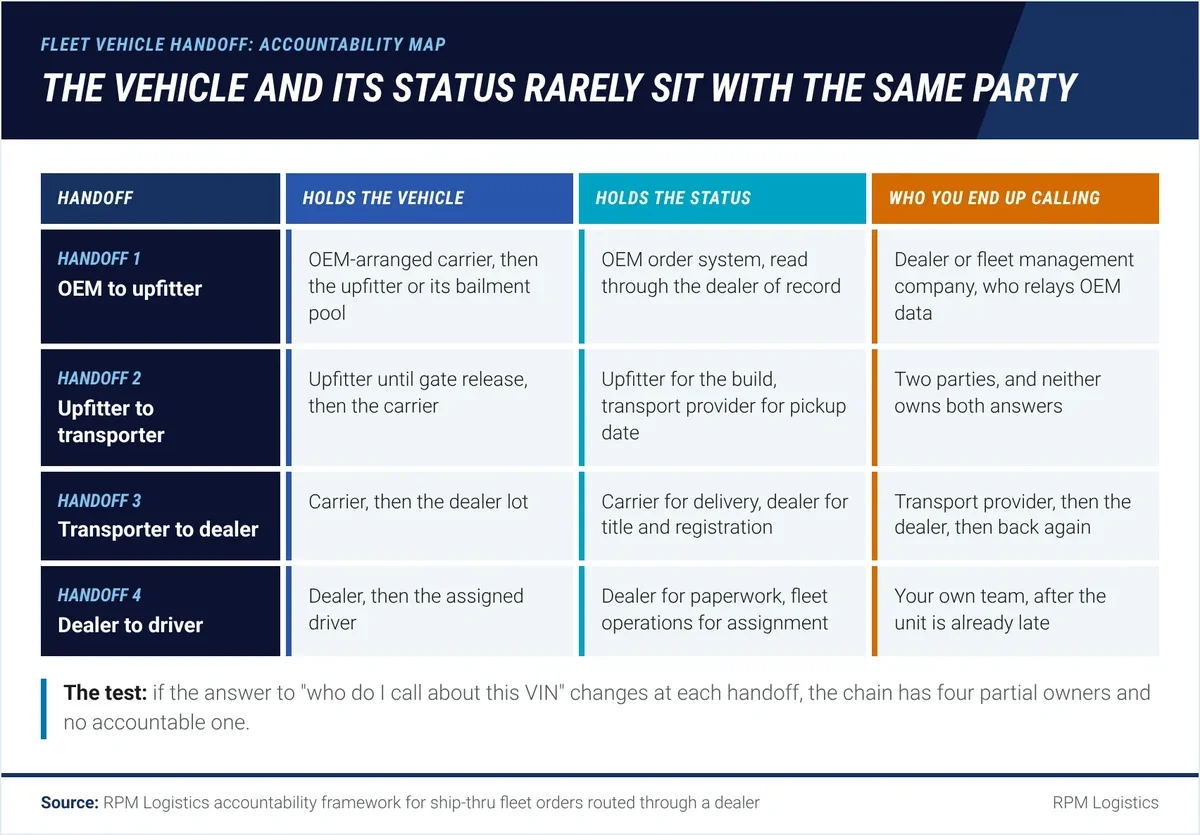
The map reflects a ship-thru order routed through a dealer. Drop-ship orders remove a row but keep the split.
A fleet vehicle handoff is a change of custody between two parties in the delivery chain. A typical upfitted order touches five parties and four handoffs. Each party has a defined job. Nobody is paid to own the gaps between them.
This piece takes a position. The handoff problem is not a scheduling problem, and better sequencing will not fix it. It is an accountability problem. Fleet managers solve it by deciding who owns status and what paper moves with the vehicle.
Five Parties, Four Handoffs, No Owner
The fleet handoff problem is that no one party answers for a vehicle end to end.
The OEM owns the build. The upfitter owns the body and equipment. The transporter owns its leg, and the dealer owns the paperwork. The driver owns the unit once the keys change hands.
The volume makes this a material issue, not an edge case. US fleet sales reached 2.6 million new vehicles in 2024 (Cox Automotive, 2025). That was 17.3% of new-vehicle sales, per Cox Automotive's 2024 fleet sales analysis. Many of those units pass through more than one set of hands before service.
The chain is also long in time. Fleet order-to-delivery fell from 18 weeks in 2024 to 15 weeks in 2025 (Automotive Fleet, 2025). Pickups and vans ran near 20 weeks.
Upfit lead time runs close to three months, plus about one more month for post-production transport (Automotive Fleet, 2025). That same survey advises planning 8 to 12 months for upfit units.
One more number from that survey matters here. It found 85% of upfit units were completed early or on time (Automotive Fleet, 2025). So the upfit itself runs on schedule most of the time. When a truck is late anyway, the transfers deserve the first look, because no one clearly owns the answer there.
At Each Handoff, the Vehicle and the Information Split
The core flaw is that custody and information travel separately. One party has the truck in its yard. A different party has the record of location, build and title status. The fleet manager calls a third.
The table below sets out the split for a ship-thru order routed through a dealer. Roles shift by program. Drop-ship and direct-to-fleet orders drop a row but keep the split.
Handoff | Holds the vehicle | Holds the status | Who the fleet manager calls |
|---|---|---|---|
1. OEM to upfitter | OEM-arranged carrier, then the upfitter or its bailment pool | OEM order system, seen through the dealer of record | Dealer or fleet management company |
2. Upfitter to transporter | Upfitter until gate release, then the carrier | Upfitter for the build; transport provider for pickup | Two parties, neither owns both answers |
3. Transporter to dealer | Carrier, then the dealer lot | Carrier for delivery; dealer for title and registration | Transport provider, then the dealer |
4. Dealer to driver | Dealer, then the assigned driver | Dealer for paperwork; fleet operations for assignment | Internal team, usually after a miss |
Read the last column. At three of the four handoffs, the person you call does not hold the vehicle. At handoff 2, the answer is split across two firms. So a finished chassis can sit at an upfitter for a week, each party assuming another booked it.
This article does not cover the order of the legs themselves. For that, see how RPM approaches ship-thru upfit transport sequencing and scheduling. The argument here sits one level up: who is answerable while those legs run.
Why the split matters more on upfitted units
Upfitted units spend long stretches in third-party custody. Standard truck bodies run 6 to 10 weeks. Custom bodies can take 20 to 40 weeks, per a Holman upfitting executive (Automotive Fleet, 2024). For that window, a chassis may sit in a bailment pool, owned by one party and parked at another.
The "Who Do I Call" Test
The "who do I call" test is a simple audit of any VIN in your pipeline. Ask who will answer for its status today. Then ask who answers for it next month, after the next handoff.
If the name changes, you do not have an owner. You have a relay.
Run the test on three units at different stages. Score each answer on three questions:
- Speed: Can you name the party in under a minute, without checking email threads?
- Completeness: Can that party report location, build status and title status, or only one of the three?
- Consequence: Is that party on the hook, by contract, if the answer turns out wrong?
Expect a pass on speed for one stage and gaps on the rest.
A dealer can tell you the MCO arrived. It often cannot tell you which carrier holds the unit. A carrier can give a delivery window. It cannot tell you whether the upfitter installed the right shelving package.
A failed test is not a vendor failure. Each party is answering within its own scope. The failure is the fleet's, for never assigning anyone the whole scope.
Name One Owner of Status, Not One Owner of Everything
A single status owner is one named party accountable for every unit's location, state and next step. That duty spans all four handoffs. It does not have to hold the vehicle. It has to hold the record and answer for it.
This differs from consolidating vendors. Many fleets will move toward running one logistics partner across the vehicle lifecycle. But a fleet can keep three upfitters and two dealers and still name one status owner today.
The candidates each bring strengths and blind spots. The table below compares them.
Candidate owner | Sees well | Blind spot | Works when |
|---|---|---|---|
Dealer of record | OEM order status, MCO, registration | Upfitter floor and carrier legs | Units are drop-shipped to the dealer and released locally |
Fleet management company | Order, spec and invoice data | Physical custody between handoffs | The contract makes it answerable for transport legs too |
Upfitter | Build, equipment and its own yard | Everything before arrival and after release | One upfitter handles the full order and ships to one site |
Logistics partner | Every move, condition at pickup and delivery | Upfit spec unless it is given the build sheet | It manages every transport leg and receives the build sheet |
Internal coordinator | Your priorities and in-service needs | Anything vendors do not report | Volume is low enough for one person to chase each VIN |
Our position: pick the party that touches the most handoffs and give it the build sheet. In multi-site programs, that is often whoever books transport, because transport crosses three of the four transfers. Then write the duty into the contract, so status ownership has a consequence.
Require a Handoff Artifact at Every Transfer
A handoff artifact is the signed document that must change hands before custody moves. The rule is short: no artifact, no transfer. If the receiving party will not sign, the vehicle does not move. The status owner hears about it that day.
Federal rules already set this precedent for one handoff. Under 49 CFR Part 568, the chassis maker must furnish an incomplete vehicle document (IVD). It is attached to the vehicle or sent to the next manufacturer. An intermediate manufacturer whose work changes it must add an addendum listing its changes.
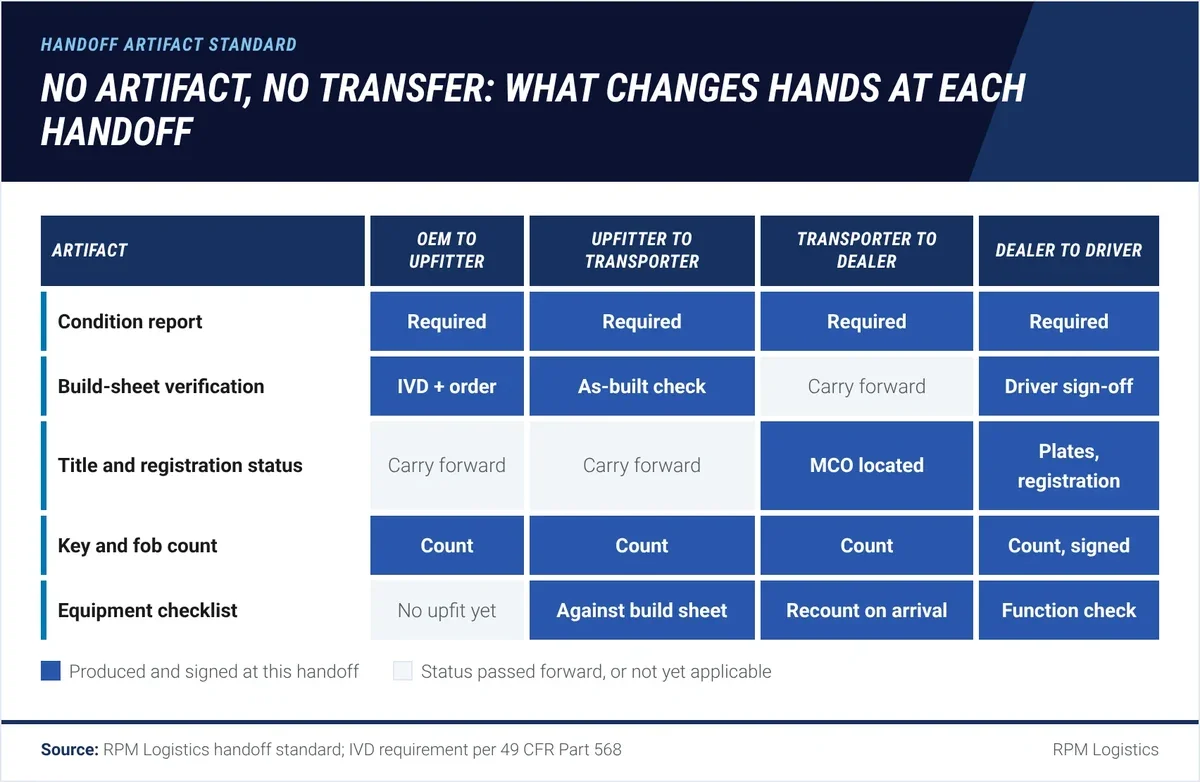
Only the IVD is required by federal rule. The other artifacts exist only if the fleet writes them into contracts.
Fleets should hold every handoff to that standard. Five artifacts cover the usual points of dispute:
- Condition report: photos and damage codes at release and at receipt, at every transfer. Protocols are covered in how photo condition reports settle fleet damage claims.
- Build-sheet verification: the as-built unit checked line by line against the order, starting with the IVD.
- Title and registration status: where the MCO (manufacturer's certificate of origin) sits, and whether plates can be issued. See bulk titling and registration for national fleet programs.
- Key and fob count: a number, written down and signed at each transfer. A missing fob found at the driver is a cost no one will own.
- Equipment checklist: racks, bins, ladders, inverters and loose items, counted at upfitter release and again on arrival.
None of these documents is new. What is new is making them a condition of transfer rather than a courtesy. A chain that documents condition only at first pickup and final delivery leaves the upfitter's custody undocumented.
The Paper Decides Who Pays
Handoff artifacts decide which party pays when something goes wrong. A damage claim is only as strong as the record placing the damage inside one party's custody.
Under 49 USC 14706, the receiving, delivering or any route carrier is liable for actual loss on interstate moves. Carriers must allow at least 9 months to file a claim and 2 years to sue (49 USC 14706(e)). Those rules cover carriers. Damage that happened in an upfitter's yard is a separate conversation with a different party.
Under 49 CFR Part 370, a carrier must acknowledge a claim within 30 days. It must pay, decline or make a firm offer within 120 days, and report status every 60 days after that if still open. Those clocks run on paper. A claim that cannot place the damage in one leg has little to work with inside them.
The release handoff is also where impersonation works. CargoNet logged 158 fictitious pickups in the US and Canada in Q2 2026, down only slightly from 165 (Verisk CargoNet, 2026). Verisk's Q2 2026 cargo theft release covers all cargo, not vehicles alone. Still, a gate that releases a unit without matching the booked carrier has no artifact protecting it.
What Fleet Managers Should Change This Quarter
The fix is a few contract and process changes, not a new system. None of them requires new software.
- Name the status owner in writing. One party, one contact, all four handoffs. Put it in the order documents, not in an email.
- Hand that owner the build sheet. A party that cannot see the spec cannot verify the build.
- Make artifacts a release condition. Add the five artifacts to upfitter and transport terms. Our fleet transport SLA guide covers where those clauses belong.
- Require same-day status after every transfer. If a unit changes hands and the owner does not know by end of day, treat it as a miss.
- Match the move type to the handoff. A professional driveaway move puts one driver with the unit from gate to gate. Haulaway adds a load and unload. Each choice changes who signs what.
- Stop at the driver. The status owner's job ends when the driver signs for keys and equipment. What follows is the arrival-to-in-service readiness work, owned by your receiving team.
One caution on cost. Accountability adds a little friction to each transfer. That friction is worth it on units whose delay idles a crew. The $500 transport decision makes that case in cost terms.
Fleets running corporate relocations alongside new-unit delivery face the same split. The same rules apply to corporate fleet vehicle relocation services, where units move between drivers, sites and storage.
Frequently Asked Questions
What is a fleet vehicle handoff?
A fleet vehicle handoff is a change of custody between two parties delivering a new fleet unit. A typical upfitted order has four: OEM to upfitter, upfitter to transporter, transporter to dealer, and dealer to driver. At each one, the vehicle, its paperwork and its status can separate. Delays and damage disputes often begin there.
Who is responsible for a fleet vehicle during upfitting?
The upfitter holds physical custody while the unit is in its yard or bailment pool. Ownership may sit with the OEM, the dealer or the fleet, depending on the order type. Status often sits with the dealer or fleet management company. Fleets should name one party accountable for reporting status during upfit, and write that duty into the order documents.
What documents should change hands at each fleet vehicle handoff?
Five artifacts cover the usual points of dispute: a condition report, build-sheet check, title status, key count and equipment checklist. Not every artifact applies at every transfer. The condition report and key count should be signed at all four. Federal rules already require one: the incomplete vehicle document that travels with an incomplete chassis.
What is an incomplete vehicle document?
An incomplete vehicle document, or IVD, is the record a chassis manufacturer must furnish under 49 CFR Part 568. It identifies the vehicle, lists weight ratings and states how the vehicle can be completed while meeting federal safety standards. It travels attached to the vehicle or goes to the next manufacturer. Intermediate manufacturers add an addendum when their work changes it.
Who pays if a fleet vehicle is damaged between handoffs?
It depends on whose custody the damage happened in, and that is a records question. For interstate carriers, federal law makes the receiving, delivering or route carrier liable for actual loss, subject to claim rules. Damage in an upfitter's yard is a separate matter. Without condition reports at each transfer, placing the damage in one party's custody becomes difficult.
How do you track fleet vehicles through ship-thru upfitting?
Track by VIN, and assign one status owner who reports after every transfer, not one contact per stage. Give that owner the build sheet so it can confirm the as-built unit, not just its location. Require a signed artifact at each release. Treat any transfer the owner learns about late as a missed status update.
Get One Accountable View of Your Fleet Handoffs
RPM Logistics arranges fleet transport in all 50 states and Canada, handling booking, documentation and condition reporting. If your handoffs fail the "who do I call" test, Get a Fleet Assessment.