

Quick answer: On a single vehicle move, the rate gap between two options is usually small and the consequence gap is not. What decides whether the cheaper booking is correct is not the saving, it is what the vehicle is for and what it costs to recover if the move fails. Sometimes the cheap option is right. The point is to know which case you are in before you book.
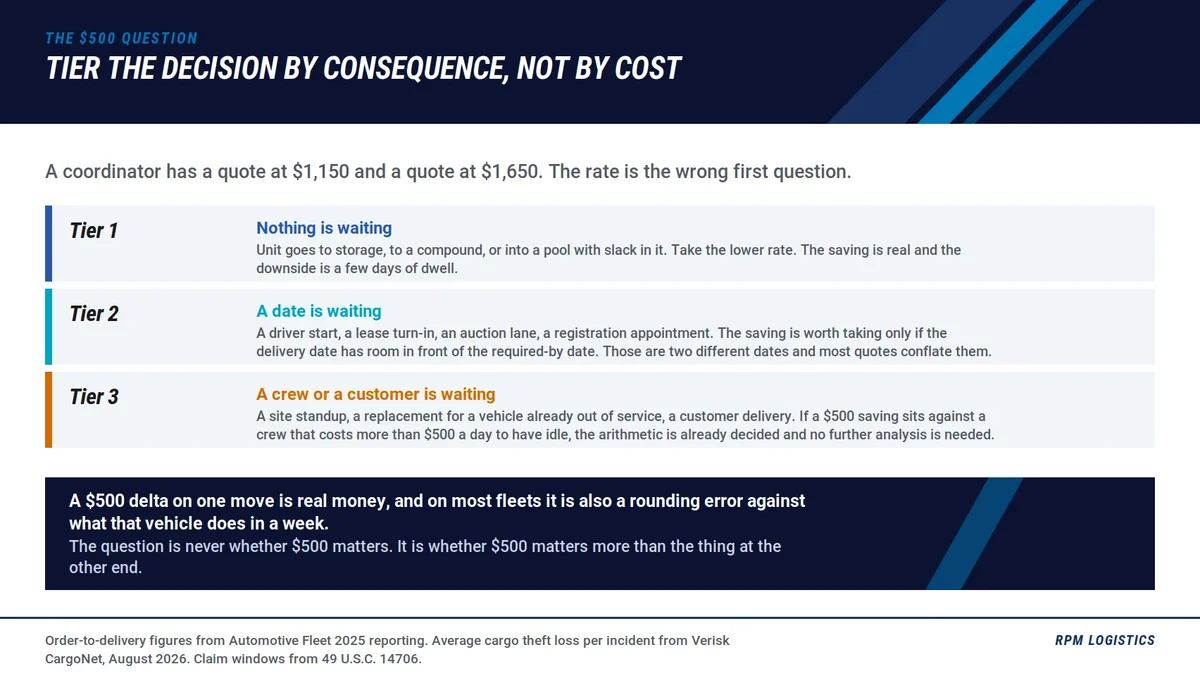
The same lane, the same carrier and the same $500 saving produce completely different outcomes depending on what is waiting at the other end.
This is not an argument that cheap transport is expensive. That argument has been made, including by us, and it operates at the level of an annual program: aggregate rates against aggregate damage, delay and administrative cost, and the conclusion is that the lowest per-unit rate rarely produces the lowest total spend. Our analysis of what poor fleet transport actually costs covers that ground.
This is about something narrower and more common: one vehicle, one lane, one week, and two options in front of you right now. A coordinator has a quote at $1,150 and a quote at $1,650. Nobody is going to run a total cost of ownership model on a single booking, and they should not have to. What they need is a way to tell, in about ninety seconds, whether this is a move where the cheaper option is fine or a move where it is the most expensive decision they will make this month.
Why the rate is the wrong first question
At program scale, the rate is a legitimate primary variable because volume makes the difference material. At single-move scale it usually is not.
A $500 delta on one move is real money and it is also, on most fleets, a rounding error against what that vehicle does in a week. The asymmetry is the whole point. The saving is bounded and known. The exposure is unbounded and unknown until you look at it.
What makes this a decision problem rather than an arithmetic problem is that the exposure is not a property of the move. It is a property of the vehicle's job. The same lane, the same carrier, the same $500 saving produces completely different outcomes depending on what is waiting at the other end.
Tier the decision by consequence, not by cost
The useful question is not "what could go wrong" but "what happens on the first day this vehicle is not where it is supposed to be."
What the vehicle is for | Cost of a day late | Take the cheaper option? |
|---|---|---|
Spare or pool unit with no assigned work | Effectively zero. Nothing is waiting. | Yes. This is what the low rate is for. |
Replacement for a unit still running acceptably | Near zero. The old unit covers. | Yes, provided the outgoing unit is not already committed elsewhere. |
Assigned to a named driver starting soon | One person underproductive, or a rental. | Usually, if there is schedule slack. Check the start date first. |
Required for a crew to work | The whole crew, not one person. A four-person crew idle is four days of labour for one day of delay. | No. The saving is smaller than one day of exposure. |
Tied to a contract or service start date | Contractual, and often visible to the customer. | No. |
Replacing a unit already out of service | Whatever the gap is currently costing, extended. | No. You are already paying for this. |
Site standup or seasonal peak with a fixed date | Compounding, because other decisions were sequenced against it. | No. |
Two thirds of a typical fleet's moves sit in the top three rows. That is the part worth saying plainly: most of the time, the cheaper option is the correct one, and a policy that treats every move as high-stakes wastes money as reliably as one that treats every move as a commodity.
The discipline is in knowing which rows you are in and having the information to tell. That is usually a question nobody asks the requester, because the booking request arrives as a lane and a date rather than as a purpose.
What recovery actually costs
The exposure that matters is rarely the damage itself. It is what it costs to get back to where you were supposed to be.
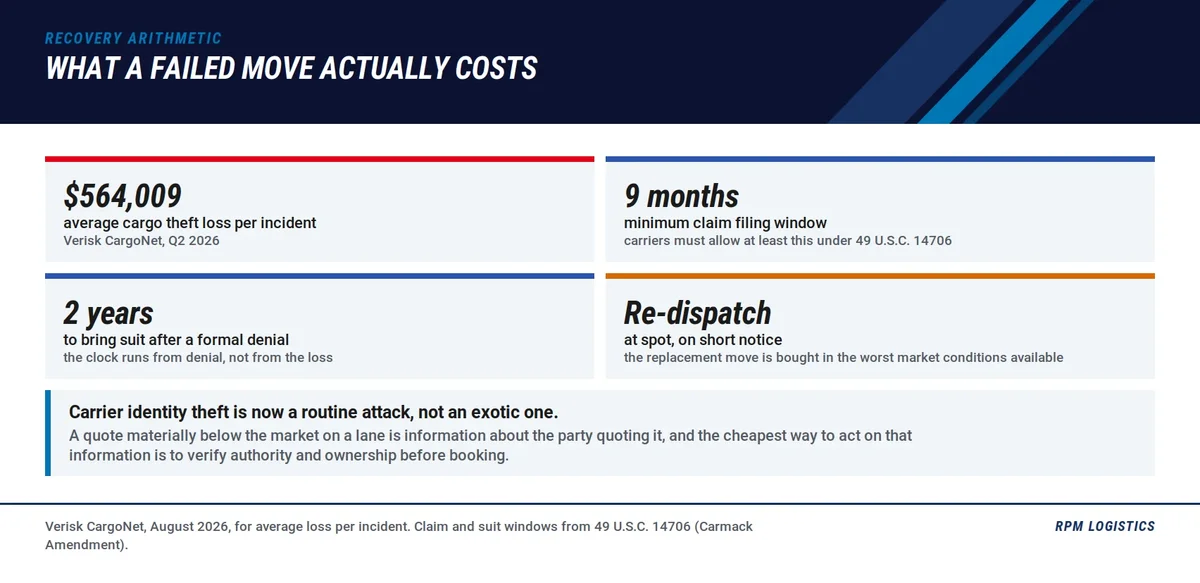
Recovery is not one number. It is a re-dispatch, a claim window, and an asset that is not working during both.
When a move fails, whether through delay, damage in transit, or a carrier that stops responding, the fleet does not simply absorb a loss. It buys its way out. That purchase has a predictable shape:
- Re-booking at whatever the market is today. The replacement move is urgent, which removes every advantage the original booking had. This is the clearest reversal: the decision that saved money on a planned move creates an unplanned one at a worse price.
- A substitute vehicle. A rental or a reassigned unit from somewhere else in the fleet, which frequently just relocates the problem.
- Labour that cannot be redeployed. A crew scheduled around an asset that did not arrive is the largest single line in most failure cases, and it is entirely invisible on the transport side.
- Rescheduling cost at the destination. Installers, customers, inspectors, and site access windows that were booked against the original date.
- Administrative time on recovery. Finding out what happened, arranging the replacement, and pursuing a claim.
The structural feature worth noticing: every one of those costs is incurred at short notice by definition, which is the most expensive way to buy anything. The original decision optimized a planned purchase. The recovery is an unplanned one.
Replacement is also slower than most people assume when the failure is severe enough to need a different vehicle. Automotive Fleet reported average fleet order-to-delivery running about 15 weeks in 2025, improved from 18 weeks in 2024, with pickups and vans closer to 20 weeks. A damaged unit that needs replacing rather than repairing is not a week-long problem.
What a lower rate can actually mean
Not every cheap quote is cheap for a worrying reason. Empty backhaul capacity, a carrier already running the lane, and flexible timing are all legitimate sources of a lower number, and they carry no added risk at all.
The ones worth a second look are structural rather than commercial:
- The booking party will not perform the move. A party arranging transportation it does not intend to haul needs broker authority. If the load is re-tendered without disclosure, the vehicle ends up with a carrier you never approved and the liability chain breaks at the first handoff. See what double brokering does to your liability chain.
- Coverage does not match the vehicle's value. Standard cargo coverage is a market convention, not a guarantee, and it is frequently well below what a modern upfitted unit is worth. Confirming the limit takes one email.
- The authority is real but the party using it is not. Carrier identity theft is now a routine attack, and Verisk CargoNet recorded average cargo theft losses of $564,009 per incident in the second quarter of 2026 (Verisk CargoNet, August 2026). Sourcing from an unfamiliar channel to save a few hundred dollars is where this exposure enters.
All three are checkable before booking rather than after. Operating authority, authority type, and insurance filings are public and take minutes to verify through FMCSA. Our guide to DOT compliance for automotive carriers covers what those records establish.
It is also worth knowing the clock you are on if something does go wrong. Under the Carmack Amendment, 49 U.S.C. § 14706, carriers must allow at least nine months to file a claim and two years to bring suit after a formal denial. Those are floors, and the practical deadlines in a carrier agreement or insurance policy are usually much shorter.
The decision rule
Three questions, in order. It takes about ninety seconds and it is designed to be used by whoever actually books the move rather than by a procurement committee.
One. What is waiting for this vehicle? If the answer is nothing or a spare, stop here and take the cheaper option. This resolves most moves.
Two. If it arrives three days late, who cannot work? One person is a scheduling problem. A crew, a customer, or a contract date is a different category. If the answer is more than one person, the rate stops being the deciding variable.
Three. Is the saving larger than one day of that exposure? If a $500 saving sits against a crew that costs more than $500 a day to have idle, the arithmetic is already decided and no further analysis is needed.
If all three clear, book the cheaper option without guilt. If question two or three fails, the relevant comparison is no longer between the two rates. It is between the higher rate and the cost of being wrong, and at that point you are buying certainty rather than transport.
A fourth question applies regardless of the first three: do you know who is actually going to move this vehicle? That one is not about price tiers. A move that cannot answer it should not be booked at any rate.
Making this a policy rather than a habit
The rule only works if the person booking has the information the first question requires, which usually means changing the request rather than the decision.
- Put purpose on the transport request. A lane and a date is not enough to tier the decision. One field stating what the vehicle is for and what date it must be working changes every booking downstream.
- Set a value or exposure threshold above which the cheapest option is not the default. Write the number down. A threshold that lives in someone's judgement is applied inconsistently and cannot be audited.
- Distinguish the required-by date from the delivery date. These are treated as the same field in most systems and they are not the same thing, particularly once the readiness tasks after arrival are counted. See why a delivered vehicle is not yet a deployed one.
- Keep a short list of carriers cleared in advance for the moves that matter. The point of pre-clearing is that the decision does not have to be made under time pressure by whoever is covering the desk.
Where scheduling is genuinely tight, mode is a lever the rate conversation usually ignores. Driveaway and haulaway carry different timing and risk profiles, and the right answer varies per move rather than per program. See driveaway versus haulaway.
What this does not replace
Two adjacent questions this rule deliberately does not answer.
How to compare quotes that are not comparable. Once you have decided the move warrants attention, the quotes in front of you may still be measuring different things. Fuel handling, mileage calculation, accessorials, and service fee structure all vary between providers. Our buyer's guide to comparing fleet transportation quotes handles that.
What to require contractually from a provider. Per-move decisions are a poor substitute for enforceable commitments on a relationship you use repeatedly. See our fleet transport SLA guide.
Frequently asked questions
Is the cheapest vehicle transport option ever the right choice?
Often, yes. For a spare or pool unit with nothing waiting on it, or a replacement for a vehicle still running acceptably, the low rate is the correct decision and treating every move as high-stakes wastes money. The discipline is knowing which moves those are.
How do you decide whether to pay more for a vehicle move?
Ask what is waiting for the vehicle, who cannot work if it arrives three days late, and whether the saving is larger than one day of that exposure. If nothing is waiting, take the cheaper option. If a crew, a customer, or a contract date depends on it, the rate is no longer the deciding variable.
What does it actually cost when a vehicle move fails?
Rarely just the damage. The recoverable costs are re-booking at short notice, a substitute or rental vehicle, labour that was scheduled around the asset and cannot be redeployed, rescheduling at the destination, and administrative time. All of them are incurred at short notice, which is the most expensive way to buy anything.
Why is a low transport quote sometimes a warning sign?
Usually it is not. Empty backhaul capacity and flexible timing are legitimate reasons for a lower number. The structural concerns are a booking party that will not perform the move and may re-tender it without disclosure, cargo coverage below the vehicle's value, and carrier identity theft. All three are verifiable before booking.
How do you verify a carrier before booking a single move?
Confirm operating authority status and authority type through FMCSA, check that financial security filings are current, confirm the cargo coverage limit against the vehicle's value in writing, and establish who will physically perform the move. This takes minutes and is worth doing on any move where a delay would stop more than one person working.
Should fleets have a policy on when to take the lowest transport rate?
Yes, and it should be a written threshold rather than a judgement call. Add the vehicle's purpose and required-in-service date to the transport request so the person booking can tier the decision, and pre-clear carriers for the moves that matter so the choice is not made under time pressure.
What is the difference between the delivery date and the required-by date?
The delivery date is when the vehicle arrives. The required-by date is when it must be working, which is later once readiness tasks such as plates, telematics installation, and driver assignment are counted. Most transport requests capture only the first, which is how moves get booked against the wrong deadline.
Booking the moves that matter
RPM Logistics moves fleet vehicles across all 50 states and Canada through a contracted carrier network rather than open load boards, with motor vehicle record screening at onboarding and continuous monitoring thereafter, documented custody at each transfer, and more than 70 storage locations when timing needs a buffer. If you want help separating the moves that warrant attention from the ones that do not, talk to our team.