

Quick answer: A delivered vehicle is not a deployed vehicle. Between arrival and first productive shift sits a set of readiness tasks, from keys and plates to telematics activation and driver assignment, that transport does not cover and operations often has not been told to expect. The gap is usually days, and it is nobody's job.
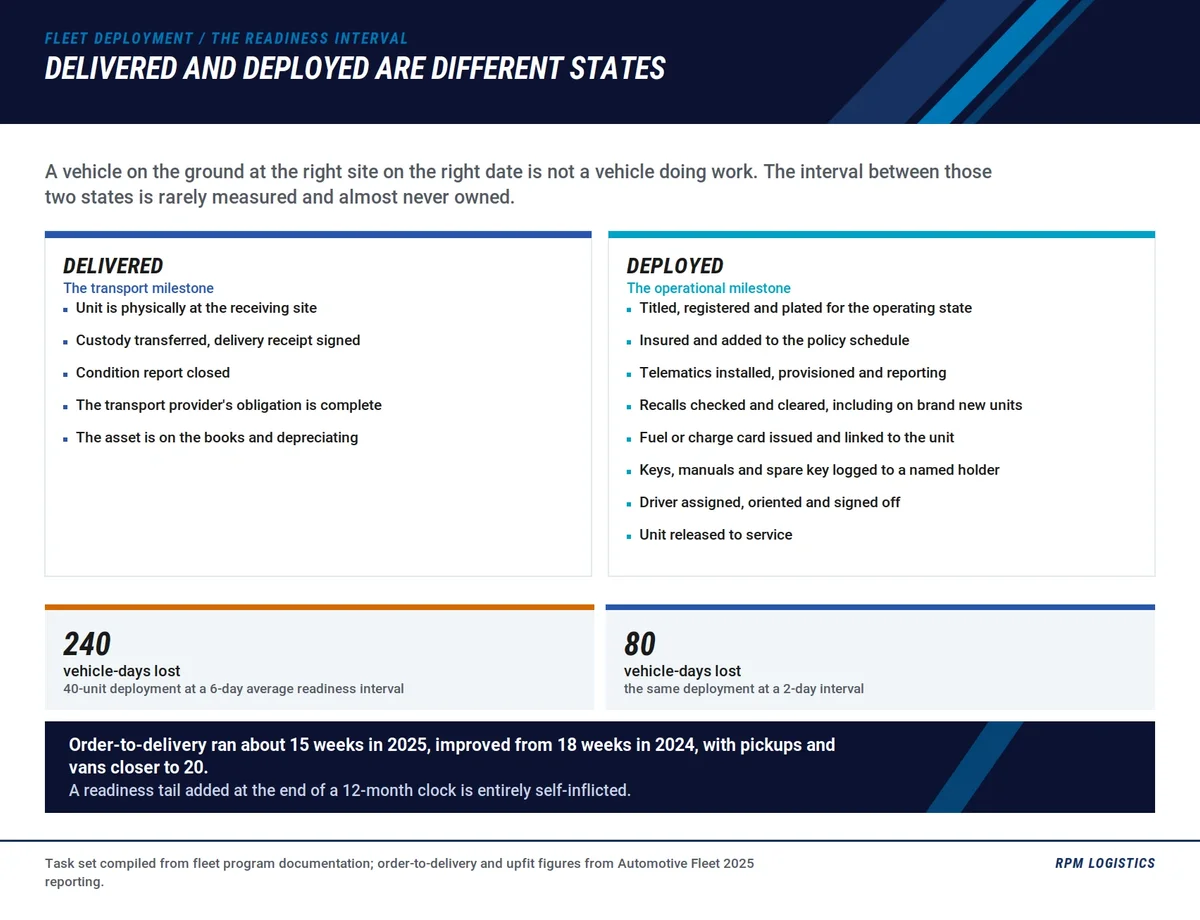
Between the two states sit somewhere between 8 and 15 discrete tasks depending on vehicle type and program.
Fleet transport programs are measured on delivery. The vehicle left on schedule, arrived undamaged, and the delivery was documented. By every metric on the transport side, the move succeeded.
Then the vehicle sits. Three days, sometimes three weeks. Not because anything went wrong, but because arriving is not the same as being usable, and the work between those two states belongs to no single person.
This is an argument for treating deployment readiness as a defined stage with an owner, rather than as the thing that happens automatically after the carrier leaves.
Delivered and deployed are different states
A vehicle is delivered when it is physically at its destination and the condition record is signed. A vehicle is deployed when a driver can get in and do the work it was bought to do.
Between those states sit somewhere between 8 and 15 discrete tasks depending on vehicle type and program. None of them is difficult. Most take minutes. The problem is not complexity, it is that they are distributed across 5 or 6 departments that each assume another one has it.
The arithmetic is unflattering. On a 40-vehicle deployment, a 6-day average readiness interval is 240 vehicle-days during which the fleet owns the asset, pays for it, and gets nothing from it. At a 2-day interval the same deployment loses 80. The difference is not equipment or headcount, it is whether anyone was assigned.
The cost of that gap is easy to underrate because it does not show up anywhere. There is no line item for a vehicle that is present but not working. Transport reports on-time delivery. Operations reports headcount and utilization. The days in between fall into the space between two reports.
Scale makes it worse rather than better. On a single unit, someone notices and chases it down. On a forty-vehicle deployment, the units that are ready get used and the ones that are not become somebody's Tuesday problem, repeatedly.
Why the gap exists
Three structural reasons, and none of them is carelessness.
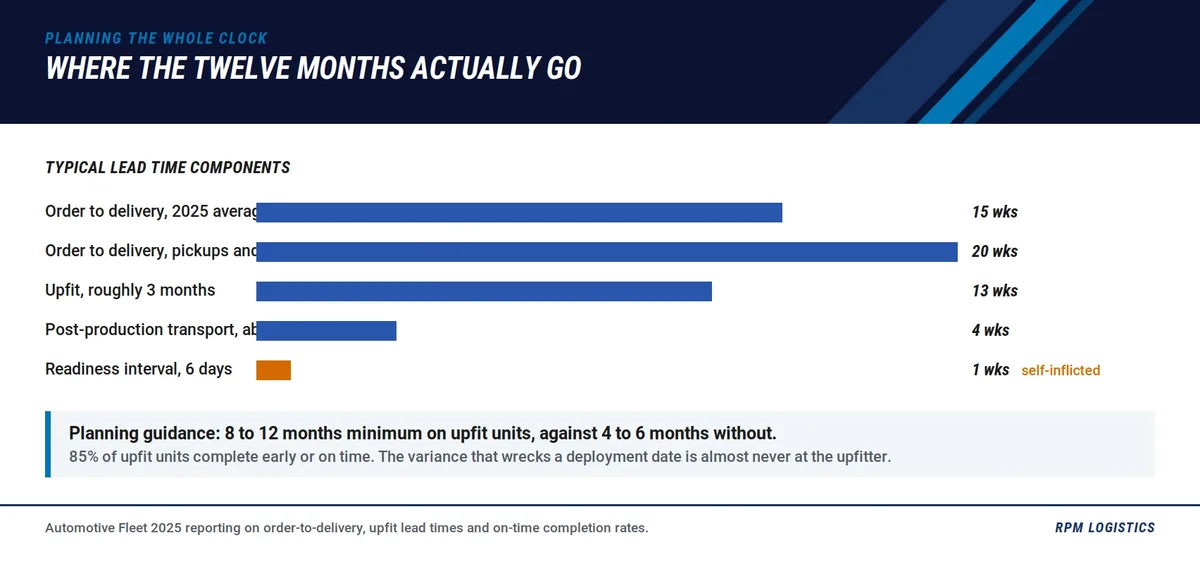
With 85% of upfit units completing early or on time, the upfitter is usually not the constraint.
Transport scope ends at the tailgate. A carrier's obligation is to deliver the vehicle in the condition it was collected in, to the right place, on time. That is the right scope. It also means every readiness task is outside it by definition. A transport contract that is doing its job perfectly still leaves the vehicle unusable.
Acquisition thinks in delivery dates. The procurement milestone is the delivery date, because that is what the purchase order and the lease schedule reference. Order-to-delivery timelines dominate the planning conversation, and reasonably so: Automotive Fleet reported average fleet order-to-delivery running about 15 weeks in 2025, improved from 18 weeks in 2024, with pickups and vans closer to 20 weeks. When the number everybody has been watching for four months finally lands, it feels like the finish line.
Operations inherits a vehicle it did not schedule. The receiving site is frequently told a vehicle is coming, not what it needs to do when it arrives. If nobody has been assigned to receive and commission it, the vehicle is parked, and parked is a stable state. Nothing escalates.
Our post on standing up vehicles at a new site covers the sequencing side of this, where the site itself is the constraint. What follows assumes the opposite case: the site is ready, the vehicle has arrived, and it still is not working.
The readiness checklist
This is the part that is usually missing. Not the list of tasks, which most fleets could produce from memory, but the assignment of each one to a named owner.
Readiness item | Typical owner | Fails when |
|---|---|---|
Arrival inspection against the condition record | Receiving site supervisor | No named receiver on site at delivery |
Open recall check before first use | Fleet administration | Assumed complete because the vehicle is new |
Key custody, including second key and any fobs | Receiving site supervisor | Keys travel with paperwork instead of the vehicle |
Fuel level or state of charge sufficient for first shift | Receiving site | Delivered near empty by design and nobody budgets the trip |
Plates physically mounted and registration in the vehicle | Fleet administration | Registration completed but documents never reach the unit |
Insurance card and required documentation in the cab | Fleet administration or risk | Held centrally, never distributed |
Telematics or dashcam hardware installed and reporting | Fleet technology | Installer scheduled after deployment rather than before |
Decals, numbering and any regulatory markings applied | Fleet administration | Vendor booked reactively once someone notices |
Fuel card and toll transponder assigned and active | Fleet administration | Card issued to a vehicle number that does not exist yet |
Upfit function check on equipment, not just the chassis | Operations or maintenance | Everyone inspects the vehicle, nobody tests the equipment |
Maintenance record opened in the fleet system | Maintenance | Unit enters service before it exists in the system |
Driver assigned and named | Operations | Vehicle arrives before the hire does |
Driver qualification confirmed for the unit class | Safety or compliance | Assumed from a general licence check |
Driver orientation on unit-specific equipment | Operations | Treated as optional on a familiar-looking vehicle |
Formal acceptance, unit marked in service | Fleet manager | No acceptance step exists, so the vehicle is never formally anything |
Read the right-hand column rather than the left. The tasks are trivial. The failure modes are all the same failure: a handoff where the sending side considers it done and the receiving side has not been told it started.
Two items deserve specific attention because they are the ones most often assumed rather than checked.
Open recalls. A new vehicle is not automatically free of them, and a unit can be delivered with an open recall outstanding. Checking by VIN before first use takes a minute through NHTSA's recall lookup and prevents putting a driver in a unit with a known defect.
Driver qualification for the specific unit class. A driver who is licensed is not necessarily qualified for a particular vehicle, and for commercial units the qualification file requirements under FMCSA regulations are specific. Fleets adding a heavier or differently configured unit to a familiar mix are the ones most likely to skip this.
Registration timing sits upstream of this list and is worth treating as its own problem. Our coverage of bulk titling and registration for national programs addresses the lead-time question directly. For the purposes of the checklist, the relevant item is narrower: the plates are on the vehicle and the paperwork is inside it.
The ownership problem is the actual problem
A fleet can have every item above documented in a procedure and still lose a week per vehicle, because a checklist without owners is a description rather than an assignment.
The pattern is consistent. Tasks that sit clearly inside one department get done. Tasks that require one department to act on a trigger from another are where units stall. Telematics installation is the classic case: fleet technology cannot schedule an installer until it knows the vehicle has landed, and the receiving site does not consider notifying fleet technology part of receiving a vehicle.
Three things fix most of it.
Name a receiver per delivery, not per site. A site is not a person. A delivery arriving at a location with no named individual expecting it is the origin of most of the failure modes in the table.
Define what "in service" means and require someone to declare it. Without a formal acceptance step there is no moment at which a vehicle transitions from arrived to deployed, which means there is no point at which anyone is accountable for the delay. A single field in the fleet system, set by a named role, changes the behaviour more than any amount of procedure.
Trigger the downstream tasks off the delivery notification, not off someone noticing. The delivery confirmation already exists. Routing it to fleet technology, administration and maintenance at the same time it goes to operations removes the dependency on a human remembering to forward it.
Measure the interval, or it stays invisible
The reason this gap persists is that no standard fleet metric contains it. On-time delivery ends at arrival. Utilization starts at deployment. The days between are measured by neither.
The fix is a single interval: arrival date to in-service date. It requires the acceptance step above to exist, which is part of why the two changes work together.
What that number does, once it exists:
- It makes the problem arguable. "Vehicles take a while to get going" is not actionable. "Our median arrival-to-service interval is nine days and our target is two" is.
- It separates transport performance from deployment performance. Useful in both directions, since it stops transport being blamed for downstream delay and stops deployment delay hiding inside a transport metric.
- It identifies which task is the constraint. In most programs it is one item, not fifteen, and it is usually telematics installation, decals, or a driver who has not started.
Our post on fleet transport KPIs covers the outcome-versus-activity distinction more broadly. This interval is the clearest example of an outcome metric that nearly every program is missing.
Where it gets harder
Three cases where the interval reliably stretches, and where the readiness plan needs to be made before the vehicle ships rather than after it lands.
Upfitted units. The finished vehicle has equipment that needs functional testing by someone who knows what correct looks like, which is rarely the person receiving it. Upfit programs already carry a long clock. Automotive Fleet's 2025 reporting put upfit lead times at roughly 3 months plus about 1 additional month for post-production transport, and recommended planning 8 to 12 months minimum on upfit units against 4 to 6 months without. With 85% of upfit units completing early or on time, the upfitter is usually not the constraint. A readiness tail added at the end of a 12-month clock is entirely self-inflicted. See upfitting and ship-thru transport for the scheduling side.
Electric units. State of charge on arrival, charger availability at the site, and access credentials for the charging network are three items that do not exist on an internal combustion checklist. A delivered EV with no way to charge is a particularly visible version of this problem. See planning an ICE to EV transition.
Units replacing something still in service. The new vehicle cannot deploy until the old one comes out, and the old one often cannot come out until the new one deploys. Somebody has to break the loop deliberately, usually by accepting a short overlap. Our coverage of make-ready and the turnover pipeline addresses the outbound side.
What this asks of a transport partner
Not much, which is the point. The readiness gap is a fleet-side problem and it does not get solved by a carrier.
What a transport partner can do is remove the excuses: accurate advance notification so the receiving site knows a specific vehicle is arriving on a specific day, a condition record available at the moment of delivery rather than after it, keys and documents that travel with the unit, and delivery scheduling that can be held to a window when a named receiver has to be present. RPM Logistics moves fleet vehicles across all 50 states and Canada with documented custody at each transfer, motor vehicle record screening at onboarding with continuous monitoring thereafter, an accident frequency of 3.5 per million miles in 2026 year to date, and more than 70 storage locations available when a receiving site is not ready to take a unit.
The arrival inspection is worth protecting specifically. A unit that arrives with no named receiver present gets a signature and no examination, which means any damage question later has a gap exactly where the evidence should be. That is a readiness failure and a claims failure at the same time, and it costs nothing to prevent.
Storage is worth naming as a deliberate option rather than a failure. A vehicle held in secured storage for six days because the site cannot commission it is a better outcome than the same vehicle sitting unattended in a lot with nobody accountable for it. See fleet vehicle storage between assignments.
Frequently asked questions
What is the difference between a delivered vehicle and a deployed vehicle?
A vehicle is delivered when it is physically at its destination with the condition record signed. It is deployed when a driver can use it for the work it was acquired for. Between those states sit eight to fifteen readiness tasks including key custody, plate mounting, telematics activation, driver assignment, and formal acceptance.
Who is responsible for getting a delivered vehicle into service?
In most fleets, nobody in particular, which is the problem. Transport scope ends at delivery, acquisition measures the delivery date, and the receiving site often has not been assigned to commission the unit. The fix is naming a receiver for each delivery and requiring a formal acceptance step before a vehicle counts as in service.
How long does it take to get a new fleet vehicle into service after delivery?
Most fleets do not know, because no standard metric measures it. Tracking arrival date to in-service date as a single interval is what makes the delay visible and usually reveals that one task, rather than all of them, is the constraint.
What should be on a fleet vehicle readiness checklist?
Arrival inspection against the condition record, open recall check by VIN, key custody, fuel or charge level, plates mounted and registration in the vehicle, insurance documentation in the cab, telematics installed and reporting, decals and markings applied, fuel card and toll transponder active, upfit function check, maintenance record opened, driver assigned, driver qualification confirmed, unit-specific orientation, and a formal acceptance marking the vehicle in service. Each item needs a named owner.
Why do new vehicles sit unused after delivery?
Usually because a task requiring one department to act on a trigger from another never got triggered. Telematics installation is the most common example: the technology team cannot schedule an installer until it knows the vehicle landed, and the receiving site does not consider that notification part of receiving a vehicle.
Should you check for recalls on a brand new fleet vehicle?
Yes. A new vehicle can be delivered with an open recall outstanding. Checking by VIN through NHTSA's recall lookup before first use takes a minute and prevents assigning a driver to a unit with a known defect.
What is different about deploying an electric fleet vehicle?
Three items that do not appear on an internal combustion checklist: state of charge on arrival, charger availability at the receiving site, and access credentials for the charging network the vehicle will use. A delivered EV with no way to charge is not a deployed vehicle.
How do you measure deployment readiness?
Track the interval from arrival date to in-service date. It requires a formal acceptance step to exist so that in-service has a defined moment. The interval separates transport performance from deployment performance and identifies which readiness task is actually the constraint.
Closing the interval
RPM Logistics moves fleet vehicles across all 50 states and Canada with advance delivery notification, documented custody at each transfer, and secured storage when a receiving site is not ready to commission a unit. If your vehicles are arriving on time and still not working for a week, talk to our team about where the handoff is breaking.