

Quick Answer
Oversized freight shipping is the transport of cargo too large or heavy for standard shipping limits. For trucks, freight is oversize when the loaded load passes 102 inches wide, the state height limit or 80,000 pounds gross. Those loads need flatbed or specialized trailers, state permits and sometimes escorts.
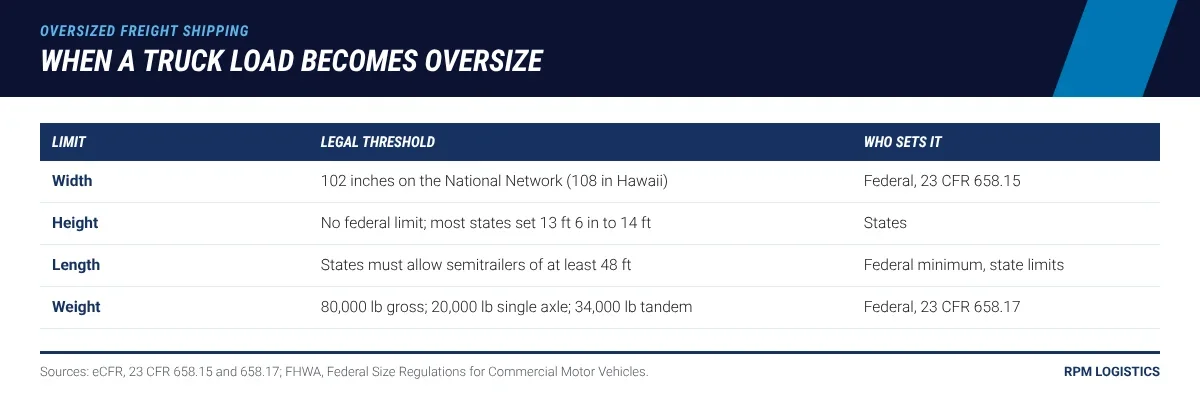
Width is the one limit that is the same in every state. Height and length change at the state line, so the route matters as much as the load.
What is oversized freight?
Oversized freight is cargo that exceeds the size or weight a carrier or the law allows for standard handling. The term means different things depending on how the freight ships.
- Parcel oversize: a package past a parcel carrier's size or weight caps. Each carrier sets its own rules and surcharges.
- LTL oversize: freight too long, tall or bulky for normal pallet handling. Less-than-truckload carriers charge extra or refuse it.
- Truckload oversize: a load that exceeds legal vehicle limits on the road. This needs state permits.
This guide focuses on the third case: freight that is oversize under highway law. That is where permits, escorts and route planning come in. In logistics, this is usually called over-dimensional freight, or OD freight.
What are common examples of oversized freight?
Common examples of oversized freight are large single items that cannot be broken down for shipping. They show up across construction, energy, manufacturing and marine work.
- Construction machinery: excavators, dozers, cranes and loaders.
- Industrial equipment: presses, generators, compressors and production line modules.
- Energy components: transformers, tanks and pressure vessels.
- Structural materials: long steel beams, precast concrete and trusses.
- Prefabricated structures: modular buildings, sheds and equipment enclosures.
- Vehicles and vessels: buses, specialty trucks and boats on cradles.
Each example fails a different limit. Beams fail on length. Tanks and modular buildings fail on width. Transformers fail on weight. Machinery often fails on height once loaded.
Knowing which limit your load breaks tells you which trailer, permit and escort rules apply. Heavy machines have their own preparation steps, covered in our heavy equipment shipping guide.
How do you know if your freight is oversize?
You know freight is oversize when the loaded truck passes any legal limit on the route. The test applies to the load on the trailer, not to the item on the ground.
Limit | Legal threshold | Source |
|---|---|---|
Width | 102 inches on the National Network (108 in Hawaii) | 23 CFR 658.15 |
Height | No federal limit; most states set 13 ft 6 in to 14 ft | State law |
Length | States must allow semitrailers of at least 48 ft; overhang rules vary | Federal minimum, state limits |
Weight | 80,000 lb gross; 20,000 lb single axle; 34,000 lb tandem | 23 CFR 658.17 |
The width limit comes from 23 CFR 658.15, which bars states from setting any other width on covered roads. The Federal Highway Administration notes there is no federal height requirement. Weight limits sit in 23 CFR 658.17.
A load that passes one limit is oversize, even if it is legal on the others. A 9-foot-wide crate that weighs 6,000 pounds still needs a width permit.
What is the difference between oversize and overweight freight?
Oversize freight exceeds a legal dimension. Overweight freight exceeds a legal weight. A load can be one, the other or both.
- Oversize only: a wide but light load, such as a large tank or a boat hull.
- Overweight only: a compact but heavy load, such as a transformer.
- Both: a large machine that is wide, tall and heavy.
The difference matters because the rules diverge. Width often triggers escort requirements. Weight triggers axle planning and bridge checks. Overweight loads usually call for heavy haul equipment with extra axles.
States issue a combined oversize and overweight permit in many cases. Our guide to over-dimensional freight regulations and permits covers how those permits work.
Can every oversized load get a permit?
No. Permits for loads over the federal limits mostly go to nondivisible loads, meaning loads that cannot reasonably be split.
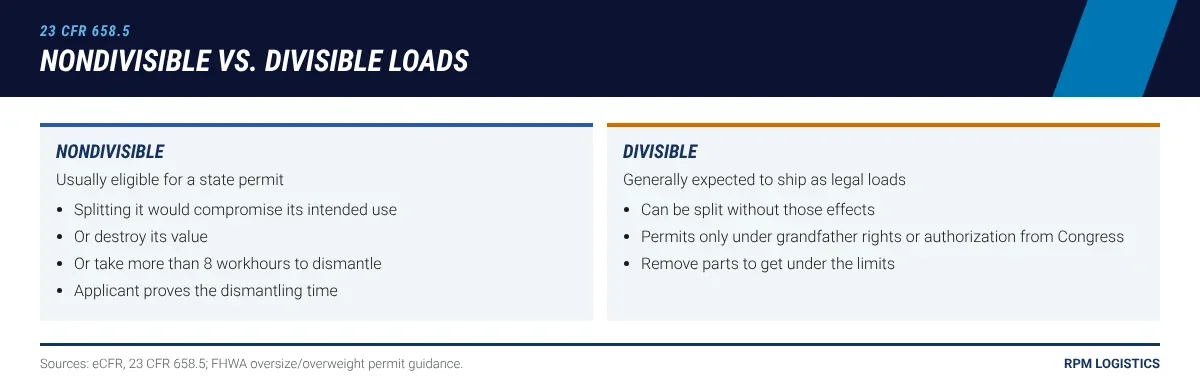
The 8-workhour test puts the burden on the shipper. If a part comes off in an afternoon, plan for it to ship separately.
Under 23 CFR 658.5, a load is nondivisible if splitting it would compromise its use or destroy its value. A load also qualifies if dismantling would take more than 8 workhours. The permit applicant must prove the dismantling time.
The FHWA notes that states may issue permits for divisible loads only under grandfather rights or specific authorization from Congress. In practice, if a load can come apart, plan to ship it in legal pieces.
This test drives early decisions. Removing a bucket, an exhaust stack or a set of mirrors can turn an oversize load into a legal one.
How should you measure oversized freight?
You should measure oversized freight in the exact position it will ship, then add the trailer. Small measuring errors can change the trailer, the permit and the escort plan.
- Measure the widest point, including mirrors, handrails, lugs and anything bolted on.
- Measure the height at the tallest point in transport position, not at rest.
- Measure the length including anything that will overhang the deck.
- Weigh the load as it will ship, including crating, skids and attachments.
- Add the deck height of the planned trailer to get the loaded height.
- Mark lift and tie points and the center of gravity if it is off center.
Brochure specs rarely match the unit on the dock. Measure the actual load and send photos with the numbers.
Which shipping mode fits oversized freight?
The shipping mode for oversized freight depends on how far past the limits the load goes. Legal-size loads have more options and lower costs.
Mode | Best for | Watch for |
|---|---|---|
LTL | Bulky or long items that stay inside legal limits | Carrier-specific length and density charges |
Flatbed truckload | Legal or slightly oversize loads that crane or forklift on | Deck height can push tall loads over the limit |
Step deck | Taller loads that fit the lower deck | Shorter usable deck length |
RGN or lowboy | Tall or heavy loads, and machines that drive on | Higher cost; more permits and planning |
Multi-axle specialized | Very heavy loads that need weight spread out | Route surveys and longer lead times |
Start with the cheapest mode that keeps the load legal. Move up only when the dimensions force it. For low-deck trailers, see what a lowboy trailer is used for.
What permits, escorts and markings are required?
Oversized loads need a permit from every state on the route, plus whatever escorts and markings those permits require. Requirements change at each state line.
- Oversize and overweight permits: issued by each state, usually for a set route, dates and hours.
- Escorts: pilot cars ahead of or behind the load, required once a load passes state thresholds.
- Route surveys: a physical check of clearances and turns, often required for the largest loads.
- Flags, lights and banners: "Oversize Load" signs, warning flags at the corners and lights for wide loads.
The FHWA notes the federal government does not issue these permits. Shippers or their carriers must contact each state on the route. Many states also limit oversize travel to daylight hours and restrict weekends and holidays.
Escorts and travel windows often shape the schedule more than distance. Daylight-only travel can stretch a trip that a legal load would finish in one day.
What does oversized freight shipping cost?
Oversized freight shipping costs depend on how far the load exceeds the limits and how many states it crosses. Distance matters, but it is rarely the biggest variable.
- Trailer type: specialized trailers cost more than standard flatbeds.
- Permits: each state on the route adds its own fee.
- Escorts: priced per escort vehicle, and some loads need more than one.
- Surveys and utility work: route surveys, and sometimes lifting overhead lines.
- Travel windows: daylight-only travel adds days and driver time.
- Loading and unloading: cranes, riggers or forklifts at each end.
The fastest way to lower cost is to make the load smaller. Removing parts to get under 102 inches wide avoids width permits and most escort costs.
Compare quotes line by line. Some include permits and escorts, and some list them as extras. Our article on why standard procurement fails for over-dimensional loads explains how to read those differences.
How should oversized freight be packaged and secured?
Oversized freight should be packaged for open-deck exposure and secured under the federal cargo securement rules. Most oversize loads ride on open trailers, so weather and road debris reach the cargo.
- Protect exposed surfaces with tarps, shrink wrap or crating suited to highway speeds.
- Secure loose parts or ship them separately with clear labels.
- Provide tie points that can take chain or strap tension without damage.
- Note fragile areas where straps or chains should not contact the load.
Machines of 10,000 pounds or more follow a specific rule. Under 49 CFR 393.130, they need at least four tiedowns, with accessories lowered and articulation restrained. Tell the carrier in advance if a part cannot be lowered or locked.
How much lead time does oversized freight need?
Oversized freight needs enough lead time for permits, escorts and any route survey. A legal flatbed load can move within days. A large multi-state permit load takes longer to arrange.
Give the carrier your final dimensions as early as possible. Permits are written to specific measurements. If the load changes after permits issue, they may need to be reissued.
Build slack into the delivery date. Weather, travel restrictions and site delays affect oversize loads more than standard freight. When a date is fixed, say so up front so the plan can work back from it.
Oversized loads are often high-value too. Confirm the carrier's identity at pickup, as our guide to freight fraud recommends.
How RPM ships oversized freight
RPM ships over-dimensional freight through a network of vetted carriers. We handle oversize and overweight permits, escorts, route surveys, and flags, lights and banners, so the move stays compliant from pickup to delivery.
We start with your dimensions, weight and site details, then match the load to the right carrier and equipment. You get one point of contact throughout the move.
For shipments crossing into Canada or Mexico, see our cross-border freight services. For legal-size freight, see our full range of freight shipping services.
Request an oversized freight quote with your load's dimensions, weight and pickup and delivery locations.
Frequently asked questions
What size is considered oversized freight?
For trucks, freight is oversize when the loaded load is wider than 102 inches or taller than the state height limit. Length past state rules also counts. Most states set height at 13 feet 6 inches to 14 feet.
How much weight makes a load overweight?
On the Interstate, a truck is overweight above 80,000 pounds gross, 20,000 pounds on a single axle or 34,000 pounds on a tandem axle. The Bridge Formula can set a lower limit.
Do oversized loads need a permit in every state?
Yes. Each state issues its own oversize and overweight permits. A load crossing four states needs four permits, each with its own route, dates and conditions.
When does an oversized load need an escort?
When it passes a state's escort threshold, usually for width, length or height. Thresholds differ by state, so one move can need escorts in some states and not others.
Can I ship oversized freight LTL?
Sometimes. LTL works for bulky or long items that stay inside legal limits, but carriers set their own length and handling charges. Loads past legal limits need truckload service and permits.
How can I lower the cost of shipping oversized freight?
Reduce the load's dimensions. Removing parts to get under 102 inches wide or the state height limit can avoid permits and escorts. Accurate measurements also prevent costly re-permitting.