

Quick Answer
Used EV dealer transport is the movement of pre-owned electric vehicles between dealers, auctions and buyers. Before loading, check the state of charge, the 12-volt battery, any battery or underbody damage and open recalls. Confirm the car can be put in transport mode. A used EV with suspected pack damage should not ship as a routine unit.
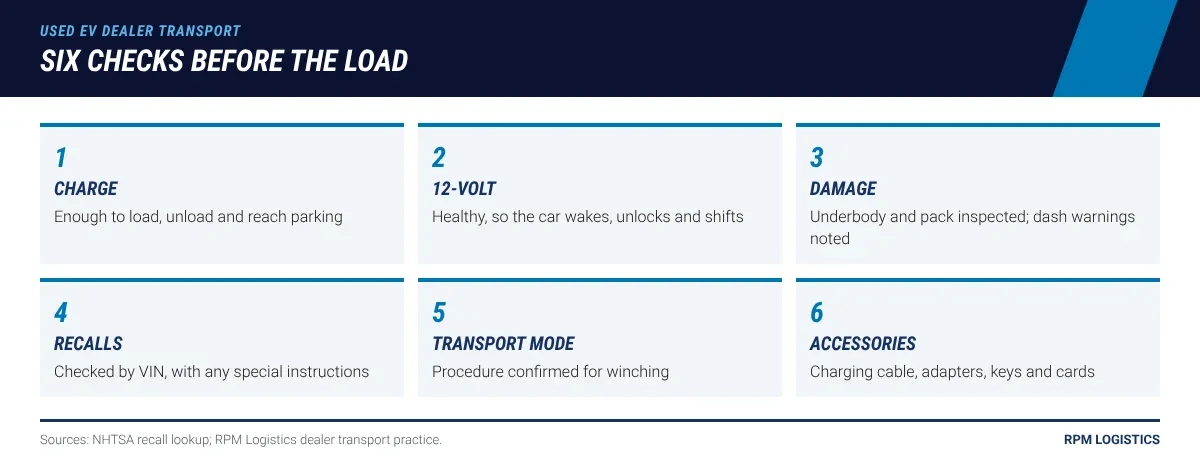
A dead 12-volt battery strands more EVs at pickup than an empty traction pack; check both before the truck is dispatched.
What is used EV dealer transport?
Used EV dealer transport covers every move of a pre-owned electric vehicle in the wholesale and retail chain. That includes trade-ins going to auction, dealer-to-dealer trades, auction purchases coming back to a lot and retail deliveries to buyers.
The volume is growing. An estimated 47,862 used EVs sold in the U.S. in September 2026, up 21.2% from a year earlier, according to Cox Automotive's EV Market Monitor. Used EVs reached a record 3.3% of all used-vehicle sales that month. The average listing price fell 1.8% to $36,767.
Used EVs raise transport questions that gas cars do not. Their batteries have a charge level, a health level and a damage history that all matter in transit. A dealer that ships a few EVs a year may not have a process for any of them.
For fleet-scale EV moves, see our guide to EV fleet transport and storage. This article covers the dealer and wholesale side.
What should you check before loading a used EV?
Before loading a used EV, check six things: charge, the 12-volt battery, damage, recalls, transport mode and accessories. Each one can stop a pickup or create a problem at delivery.
State of charge
A used EV needs enough charge to load, unload and reach its parking spot at the destination. A car shipped nearly empty can sit at the delivery site with no way to move it. Many dealers aim for a moderate charge for transport, following the manufacturer's guidance for the model.
The 12-volt battery
Most EVs rely on a small 12-volt battery to wake up, unlock and shift into neutral. If that battery is dead, the car may not respond even with a charged traction pack. Test or charge the 12-volt battery before pickup, especially for cars that have sat on a lot.
Battery and underbody damage
Look under the car for impacts, scrapes, dents or fluid near the battery pack. Check the dash for battery warnings. Any sign of pack damage changes how the vehicle should move, as covered below.
Recalls
Check the VIN through NHTSA's recall lookup. Some EV recalls involve the battery and carry special parking or charging instructions until repaired. Those instructions matter during transport and storage too.
Transport mode
Many EVs have a transport, tow or neutral-hold mode that lets them roll freely for winching. Confirm the procedure for the model and leave instructions for the driver. Some EVs should not be towed with drive wheels on the ground.
Accessories
Ship the mobile charging cable, adapters and all keys or key cards with the car. Missing charging equipment and keys are common reasons for price adjustments at auction or delivery.
How should a used EV with battery damage be moved?
A used EV with suspected battery damage should not be moved as a routine unit. Damaged lithium-ion packs can overheat or ignite, sometimes long after the event that damaged them. The move needs a plan from someone qualified to assess the pack.
Signs that a used EV needs special handling:
- Visible pack damage, such as dents, cracks or punctures under the car.
- Battery warnings on the dash or in the vehicle's app.
- Smoke, odor, heat or hissing from under the car.
- Flood exposure, especially saltwater.
- A recent collision involving the underbody.
Isolate the vehicle outdoors, away from buildings and other cars, and contact the manufacturer or a specialist. If a damaged pack is removed for shipment, it becomes a damaged lithium battery shipment with its own packaging rules under 49 CFR 173.185. Our guide to shipping damaged and defective lithium batteries covers those requirements.
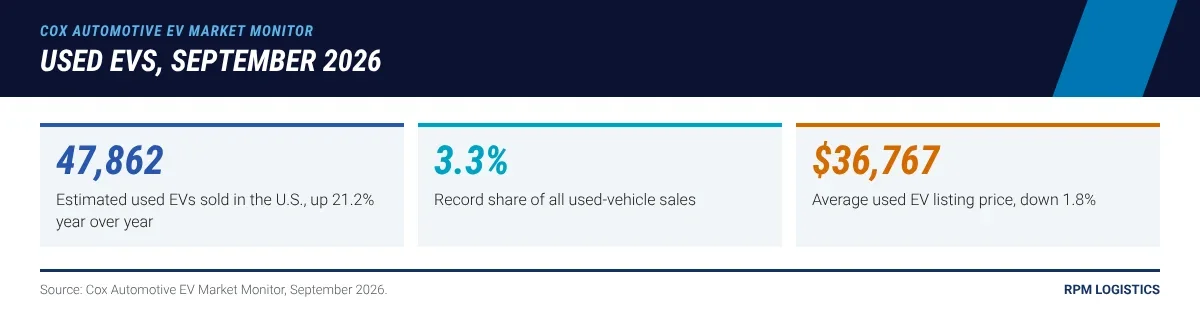
At 3.3% of used sales, EVs now appear regularly on dealer transport lists rather than as one-off units.
Do used EVs need special trailers or equipment?
Most used EVs ship on standard open or enclosed car carriers. Two factors still change the equipment plan: weight and ground clearance.
- Weight. EVs are often heavier than gas cars of similar size because of the battery. Carriers need to account for that on upper decks and when planning total load weight.
- Clearance. The battery pack sits low under many EVs. Steep ramps and rough loading surfaces can scrape the pack, so low-angle loading helps.
- Winching. A non-running EV that cannot enter transport mode may need skates or a flatbed instead of a winch.
Securement should follow the manufacturer's tie-down points, avoiding the battery enclosure. Our comparison of soft-tie and hard-tie transport explains the options for higher-value units.
Should battery health be documented before a used EV ships?
Yes. Battery health, sometimes called state of health, is one of the biggest factors in a used EV's value. Recording it before transport protects both the seller and the buyer if questions come up later.
What to record:
- State of charge at pickup and at delivery.
- Estimated range shown on the dash at pickup.
- Battery health report, if the dealer or auction has one.
- Warning messages, with a photo of the dash.
- Charging equipment included with the car.
A photo condition report should include the dash with the car powered on. That one image captures charge, range and warnings at the moment of handoff. Our guide to insurance-grade condition reporting shows what else a strong report includes.
How do dealers move used EVs to and from auction?
Dealers move used EVs to and from auction the same way they move other units, with a few added steps. The goal is a car that can be driven through the lane or onto the next carrier without help.
- Charge before pickup, so the car can move at the auction.
- Tell the auction the car is an EV, so it can plan charging and parking.
- Include charging equipment with the vehicle, not in a separate box.
- Book a carrier that handles EVs regularly, especially for heavy models.
Market timing matters too. The Manheim Used Vehicle Value Index stood at 205.9 in September 2026, down 0.6% from a year earlier (Cox Automotive, 2026). Cox also noted that EV days' supply declined during the period. Our guides to trade-in and auction logistics and auction vehicle transport cover the wider process.
What about dealer trades and retail deliveries?
Dealer trades and retail deliveries of used EVs need a handoff that leaves the receiving party able to charge and drive the car. A buyer who receives an EV at 5% charge and no cable has a poor first day.
For dealer trades:
- Confirm the receiving dealer can charge the model on arrival.
- Send the battery health report and charging equipment with the car.
- Use a carrier with experience in the model's transport procedure.
For retail deliveries:
- Deliver with enough charge for the buyer to reach a charger.
- Walk the buyer through charging and any open recall instructions.
- Record charge and range on the delivery receipt.
Our article on choosing a reliable dealer-to-dealer transport partner covers carrier selection for trades.
How should used EVs be stored before and after transport?
Used EVs should be stored where they can be monitored and, ideally, kept at a stable charge. Long waits on a lot can drain the 12-volt battery and the traction pack.
- Park EVs with space around them where the site's fire plan allows.
- Check charge weekly for units that will sit more than a few days.
- Keep damaged EVs separate, outdoors and away from buildings.
- Follow recall instructions on parking or charging for affected models.
Dealers handling battery recalls at scale should also read our guide to EV battery recall reverse logistics.
What goes wrong most often in used EV moves?
Most problems in used EV moves come from missing information at dispatch. The carrier arrives expecting a car that drives on and off, and finds one that will not wake up, unlock or roll.
- Dead 12-volt battery, so the car cannot be unlocked or shifted.
- Near-empty traction battery, so the car cannot move under its own power.
- No transport mode instructions, so the driver cannot winch it safely.
- Missing key card or fob, common on models that use phone-as-key access.
- Undisclosed damage found at pickup, which stops the load.
Each of these causes a dry run, a delay or a price dispute. A short EV checklist attached to every transport order prevents most of them.
What about hybrids and plug-in hybrids?
Hybrids and plug-in hybrids usually ship like gas cars, with a few EV-style checks added. They carry a smaller high-voltage battery and a 12-volt battery, so the same damage and recall checks apply.
Plug-in hybrids also have charging cables that should ship with the car. Fuel level still matters, since many hybrids start on the gas engine. Our older guide to hybrid and electric vehicle shipping covers basic preparation for owners.
How should insurance and claims work for used EV moves?
Insurance and claims for used EV moves work like other vehicle moves, with battery questions added. A carrier's cargo coverage applies to physical damage in transit, subject to its terms and limits.
Two steps make EV claims easier to resolve:
- Document the battery at both ends, with charge, range and warnings on the condition report.
- Inspect the underbody at delivery, since pack damage can be hidden from a walkaround.
Confirm that cargo limits cover the vehicle's value, especially for higher-priced EVs. If a battery fault appears after delivery, the pickup and delivery records show whether it existed before the move.
How RPM supports dealer EV moves
RPM Logistics moves new and used EVs for dealers, dealer groups, auctions and remarketers across all 50 states and Canada. A network of more than 15,000 active carriers includes open and enclosed equipment for heavier EVs, with low-angle loading where needed.
Every move includes photo condition reports at pickup and delivery, including the powered-on dash where the vehicle allows. For program details, see our dealership transport services. Talk to our dealer team about your next used EV move.
Frequently asked questions
What charge level should a used EV have for transport?
Enough to load, unload and reach parking at the destination, following the manufacturer's guidance for the model. Many dealers aim for a moderate charge rather than full or nearly empty.
Why won't an EV unlock or shift at pickup?
The 12-volt battery is often dead. Most EVs need it to wake up and shift into neutral, even with a charged traction pack. Test or charge it before pickup.
Can a damaged used EV be shipped on a car carrier?
Not as a routine unit. Suspected battery damage needs assessment by a qualified person, and the move needs its own plan. A removed damaged pack ships under damaged lithium battery rules.
How many used EVs are sold in the U.S.?
Cox Automotive estimated 47,862 used EV sales in September 2026, a record 3.3% of used-vehicle sales.
Should battery health be recorded before shipping a used EV?
Yes. Record charge, estimated range, any battery health report and warning messages at pickup and delivery. A photo of the powered-on dash captures most of it.
Do EVs need special car carriers?
Most ship on standard open or enclosed carriers. Weight and low ground clearance mean carriers should plan deck loading and use low-angle ramps where needed.