

Quick Answer
Budgeting 2027 fleet transport spend starts with a forecast of how many vehicles will move, by move type and lane. Multiply volume by realistic unit costs for each mode, then add known seasonal and accessorial costs. Hold a separate reserve, sized from your own exception history, for damage, dry runs, rush moves and storage overruns.
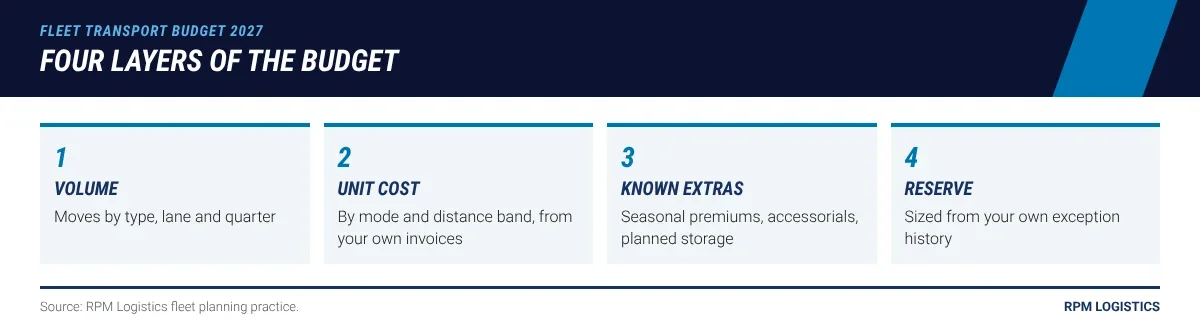
Most budget misses come from the first layer, not the rates: a replacement wave nobody counted will break any per-move estimate.
What goes into a fleet transport budget?
A fleet transport budget covers the cost of moving vehicles through their life in the fleet: delivery, reassignment, upfit, storage, relocation and remarketing. It is a volume plan first and a rate plan second.
The planning cycle for 2027 is happening against a moving market. Cox Automotive forecast about 15.8 million U.S. new-vehicle sales for 2026, down 2.4% from 2025 (Cox Automotive, 2025). Fleet sales reached 2,227,876 units in 2025, with commercial fleet sales down 4% and government down 12.8% (Bobit Business Media, 2026). Each of those numbers shapes how many vehicles your program will move next year.
A complete budget has four layers:
- Volume: how many moves, of which types, on which lanes.
- Unit cost: what each move type costs by mode and distance.
- Known extras: seasonal premiums, accessorials and storage you can predict.
- Reserve: money held for exceptions you cannot predict by unit.
Our article on the hidden costs of poor fleet transport explains why the last layer is so often underfunded.
How do you forecast 2027 fleet move volume?
You forecast 2027 fleet move volume by listing every event that will cause a vehicle to move. Each event type has its own source of truth inside the fleet.
Move type | Where the forecast comes from |
|---|---|
New-unit deliveries | Replacement schedule and approved orders |
Lease returns and retirements | Lease maturity dates and replacement policy |
Reassignments between drivers | HR turnover history and hiring plans |
Upfit and ship-thru moves | Order specs and upfitter schedules |
Site openings and closures | Real estate and operations plans |
Remarketing moves | Retirement list and sale channel plan |
Repair and recall moves | Prior-year history |
Add the counts by quarter, not just for the year. Fleet moves cluster around model-year changeover, lease maturities and budget releases. A quarterly view shows where capacity will be tight and where rush costs are likely.
Our guide to securing carrier capacity before peak season covers how to plan around those clusters.
How should you estimate unit costs for 2027?
You should estimate unit costs from your own 2026 invoices, broken out by mode, distance band and lane. National averages rarely match a specific program's mix of urban, rural, short and long moves.
Build the unit-cost table this way:
- Pull 12 months of invoices and tag each move by type, mode and distance.
- Calculate the average cost for each combination, such as short driveaway or long haulaway.
- Separate accessorials, such as storage, fuel surcharges and dry-run fees.
- Adjust for known changes, such as new lanes or a provider change.
- Apply a cost outlook for carrier operating costs.
Carrier costs set the floor for rates. The average marginal cost of operating a truck reached $2.336 per mile in 2025, the highest in ATRI's annual report (ATRI, 2026). Truck and trailer payments alone ran 40.4 cents per mile. Track carrier operating costs as one input to your rate outlook for renewals.
Compare quotes on the same basis when you test the market. Our buyer's guide on why fleet transport quotes aren't apples to apples shows how to normalize them.
Which costs can you forecast, and which belong in reserve?
Costs you can tie to a known move belong in the forecast. Costs that happen to some moves, but not predictably to any one, belong in a reserve.
Forecast these | Hold these in reserve |
|---|---|
Planned deliveries, returns and reassignments | Damage deductibles and claims you absorb |
Known seasonal premiums on busy lanes | Dry runs when a vehicle is not ready |
Planned storage between assignments | Storage overruns when sales or hires slip |
Fuel surcharges under your contract formula | Rush moves when a start date moves up |
Upfit and ship-thru transport legs | Re-delivery after a failed handoff |
Size the reserve from your own history. Total the exception costs from the last 12 to 24 months, then express them as a share of planned spend. That share, adjusted for any process changes, is a defensible reserve for 2027. Our article on fleet transport exception management explains where those costs usually come from.
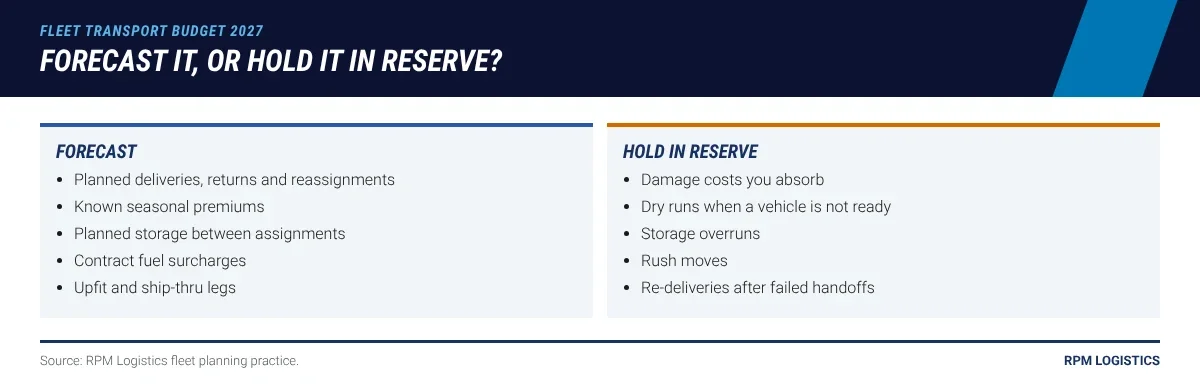
The right column is where budgets get raided mid-year; sizing it from your own exception history makes it defensible in the planning meeting.
What does a simple budget calculation look like?
Here is a hypothetical example to show the structure, not real rates. Suppose a fleet plans 400 new-unit deliveries, 350 lease returns and 250 reassignments in 2027.
- Volume. 1,000 planned moves, split by type and distance band.
- Unit cost. Each type and band gets its own average from 2026 invoices, adjusted for the cost outlook.
- Known extras. Add planned storage for returns waiting on a sale slot, seasonal premiums for fall moves and expected fuel surcharges.
- Reserve. If exceptions cost the equivalent of a given share of spend over the last two years, hold that share again, adjusted for process changes.
The value of the structure is that each line can be explained. When finance asks why the budget rose, the answer points to more returns, a new lane or a higher fuel base, not a guess.
Who should own the fleet transport budget?
The fleet transport budget works best with one owner who can see every move type, usually the fleet manager or fleet operations lead. Split ownership, such as HR paying for reassignments and procurement paying for deliveries, hides the total and invites duplicate bookings.
The owner should:
- Collect volume forecasts from HR, operations, procurement and remarketing.
- Hold the reserve and approve draws against it.
- Report monthly variances to finance with causes.
- Bring the budget assumptions into provider negotiations.
How should EV transitions change the 2027 budget?
EV transitions change the 2027 budget by adding new move types and changing some unit costs. Plan them as their own budget lines rather than folding them into general deliveries.
- Delivery sequencing around charger installation dates at each site.
- Heavier units, which can affect load planning on multi-car carriers.
- Charging stops or charge-level requirements for driveaway moves.
- Storage for units that arrive before chargers are ready.
Our guide to fleet electrification at scale covers how to sequence these steps.
How do remarketing values affect the transport budget?
Remarketing values affect the transport budget because they change the trade-off between moving a vehicle fast and moving it cheaply. In a soft market, a few extra days to sale can cost more in value than the transport savings.
The Manheim Used Vehicle Value Index stood at 205.9 in September 2026, down 0.6% from a year earlier (Cox Automotive, 2026). Cox also reported that depreciation accelerated in the third quarter.
For budgeting, that means:
- Budget remarketing moves to happen promptly, not batched for months to save on transport.
- Include storage cost for retired units waiting for a sale slot.
- Coordinate with remarketing so transport and sale dates are planned together.
Our article on how a $500 transport decision can create a $5,000 fleet problem shows why the cheapest move is not always the lowest-cost one.
What should you build into the 2027 contract?
You should build the budget's assumptions into the 2027 contract, so the plan and the invoices use the same rules. Budgets drift when rates, accessorials and service levels are agreed loosely.
- Rate tables by mode, distance band and lane, matching your budget categories.
- Fuel surcharge formula with a stated base price and index.
- Accessorial schedule, including storage, dry runs and waiting time.
- Service levels for pickup and delivery windows, tied to your planning.
- Reporting that tags each move by type, so actuals can be compared to the plan.
Our fleet transport SLA guide covers what to negotiate. Logistics is a large line in most businesses: U.S. business logistics costs equaled 7.8% of GDP in the 2026 CSCMP State of Logistics Report.
How do you track the budget during 2027?
You track the budget during 2027 by comparing actual moves and costs to the plan each month, by move type. A single total hides the cause of a variance.
A monthly review should show:
- Planned vs. actual move counts by type.
- Planned vs. actual unit cost by mode and distance band.
- Reserve drawn, with the cause of each exception.
- Forecast changes for the rest of the year, such as a delayed replacement wave.
Check volume variances first. If moves run 15% over plan, the fix may be in the forecast rather than the carrier rates. Our guide to fleet transport KPIs covers the operating measures that sit behind the budget.
What 2027 risks should fleet teams plan around?
Fleet teams should plan around the risks that move volume or cost by more than a few percent. Each one belongs in the forecast as a scenario, not a surprise.
- Replacement timing. Delayed or accelerated orders shift deliveries and returns between quarters.
- Electrification steps. EV rollouts add new move types, charging stops and storage needs.
- Headcount changes. Hiring waves and reductions drive reassignment volume.
- Site changes. Openings, closures and consolidations create one-time relocation spikes.
- Fuel prices. Changes flow through surcharge formulas within weeks.
- Remarketing markets. Softer values reward faster moves to sale.
For one-time events, such as a merger or site consolidation, see our guide to fleet logistics for mergers and consolidations.
How RPM supports fleet transport planning
RPM Logistics handles delivery, reassignment, storage, relocation and remarketing moves for corporate, rental, government and commercial fleets across all 50 states and Canada. Programs can plan around one provider for most move types, which keeps rates, reporting and service levels on the same basis.
- Driveaway and haulaway matched to each lane.
- 70+ storage locations in the U.S. and Canada for planned holds.
- Photo condition reports at every pickup and delivery.
- Driver screening through motor vehicle record checks at onboarding, with continuous monitoring after that.
For program details, see our fleet vehicle logistics services. Talk to our fleet team about building your 2027 transport plan.
Frequently asked questions
How do you build a fleet transport budget?
Forecast move volume by type and lane, then apply unit costs by mode and distance. Add known seasonal and accessorial costs, and hold a reserve sized from your exception history.
What is a reasonable reserve for fleet transport exceptions?
Base it on your own history. Total exception costs from the last 12 to 24 months, express them as a share of planned spend and adjust for any process changes.
What costs should be in a fleet transport reserve?
Damage costs you absorb, dry runs, storage overruns, rush moves and re-deliveries after failed handoffs. These happen to some moves but cannot be tied to any one in advance.
Why do fleet transport budgets go over?
Overruns often come from volume rather than rates. Unplanned replacement waves, hiring changes and site moves add trips the budget never counted.
Should fleet transport be budgeted by quarter?
Yes. Moves cluster around model-year changeover, lease maturities and budget releases, so a quarterly view shows where capacity and costs will peak.
What should a fleet transport contract include for budgeting?
Rate tables by mode and distance, a fuel surcharge formula, an accessorial schedule, service levels and reporting that tags each move by type.