

Quick Answer
Heavy haul trucking moves loads that exceed the legal weight or size limits for a standard truck. Federal rules cap Interstate trucks at 80,000 pounds gross and 102 inches wide. Loads above those limits need state permits, a trailer with enough axles to spread the weight, and often escorts and a route survey.
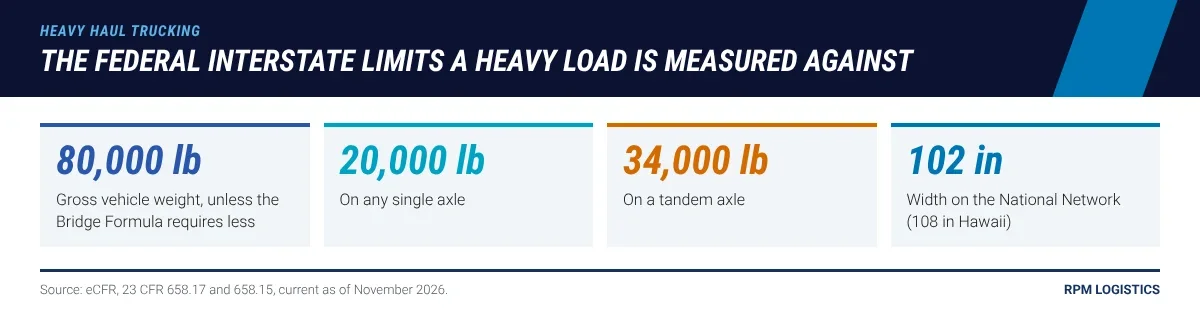
A load can be legal on gross weight and still overweight on one axle group. Heavy haul planning checks every limit, not just the total.
What is heavy haul trucking?
Heavy haul trucking is the transport of loads too heavy, too wide, too tall or too long for a standard tractor and trailer. It covers construction machinery, industrial equipment, transformers, structural steel and similar cargo.
The line is set by law, not by the type of cargo. A small excavator on a step deck can be a routine legal load. A large one on the same trailer can be overweight on its axles and need a permit.
Heavy haul is a subset of over-dimensional freight. "Heavy haul" stresses weight. "Oversize" stresses dimensions. Many loads are both, and the planning steps overlap. For the dimension side, see our guide to over-dimensional freight regulations and permits.
What are the legal weight limits for trucks?
The legal weight limits for trucks on the Interstate are set in federal law. States enforce them and can issue permits to exceed them for qualifying loads. Under 23 CFR 658.17, the core limits are:
- 80,000 pounds gross vehicle weight, unless the Bridge Formula requires less.
- 20,000 pounds on any single axle.
- 34,000 pounds on a tandem axle.
The fourth limit is the Bridge Formula. It caps the weight on any group of consecutive axles based on how many axles there are and how far apart they sit. The aim is to protect bridges from weight concentrated over a short span.
The rule includes one useful exception. Two consecutive tandem sets may carry 34,000 pounds each if the first and last axles are at least 36 feet apart.
A standard five-axle tractor and trailer has little room left once the tractor and trailer weight is counted. That is why a heavy machine can push a truck past the limit quickly.
What are the legal size limits?
The legal size limits are split between federal and state law. Federal law sets width. States set height, and most set length within federal rules.
Dimension | Legal limit | Who sets it |
|---|---|---|
Width | 102 inches on the National Network (108 in Hawaii) | Federal, 23 CFR 658.15 |
Height | No federal limit; most states set 13 ft 6 in to 14 ft | States |
Semitrailer length | States must allow at least 48 ft, or a longer grandfathered length | Federal minimum, state limits |
Gross weight | 80,000 lb on the Interstate | Federal, 23 CFR 658.17 |
The width rule in 23 CFR 658.15 bars states from setting any width limit other than 102 inches on covered roads. Height is different. The Federal Highway Administration notes there is no federal height requirement, and some roads have lower clearances than the state limit.
Height is measured on the loaded trailer. A machine that is 11 feet tall on the ground can become a 14-foot load on a flatbed.
When does a heavy load need a permit?
A heavy load needs a permit when it exceeds any legal weight or size limit on the route. The permit comes from each state the load crosses, not from the federal government.
Federal guidance from the FHWA describes oversize and overweight permits as a state option. Each state decides what it will permit and on what terms. A multi-state move needs a permit for every state on the route.
Permits mostly apply to nondivisible loads. Under 23 CFR 658.5, a load is nondivisible if splitting it would:
- Compromise the intended use of the vehicle.
- Destroy the value of the load.
- Take more than 8 workhours to dismantle with appropriate equipment.
The applicant carries the burden of proof on dismantling time. If a load can be split under those tests, most states expect it to be split.
Permits typically fix the route, the travel days and the travel hours. Many states also restrict oversize moves on weekends, holidays and at night. Those limits shape the schedule as much as the distance does.
What trailers are used in heavy haul trucking?
Heavy haul trucking uses trailers chosen for deck height and axle count. Deck height controls the load's total height. Axle count controls how the weight spreads.
Trailer | Typical use | Trade-off |
|---|---|---|
Flatbed | Legal-height loads that load by crane or forklift | High deck adds height quickly |
Step deck | Taller loads that still fit a lower rear deck | Limited length on the lower deck |
Removable gooseneck (RGN) | Tracked and wheeled machines that drive on | Gooseneck must be detached and reattached to load |
Lowboy | Tall, heavy machines that need the lowest deck | Ground clearance limits some routes |
Multi-axle and modular | Very heavy loads that need weight spread over many axles | More permits, more planning time |
Adding axles is how heavy haul trucking carries more weight within each axle limit. Jeeps, boosters and extra trailer axles spread the load across more of the road. For a closer look at low-deck options, see what a lowboy trailer is used for.
How is a heavy haul move planned?
A heavy haul move is planned from the load outward. The load's specs choose the trailer. The trailer and load together set the permits, escorts and route.
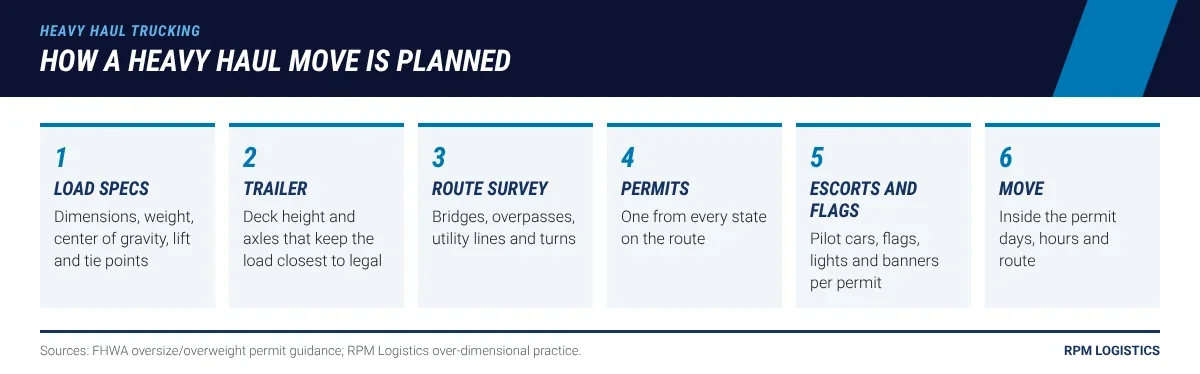
Each step depends on the one before it. A wrong weight in step one carries into every permit that follows.
- Confirm load specs. Length, width, height and weight, plus the center of gravity and lift or tie points.
- Match the trailer. Pick a deck height and axle setup that keep the load as close to legal as possible.
- Survey the route. Check bridges, overpasses, utility lines, turns and construction zones.
- Secure state permits. File with every state on the route, using the final loaded dimensions.
- Arrange escorts and markings. Pilot cars, flags, lights and banners as each permit requires.
- Load, secure and move. Inside the permit's days, hours and route.
Most delays trace back to step one. A spec sheet that lists the machine's weight without attachments can change the trailer, the permits and the escorts.
What should a shipper provide for a heavy haul quote?
A shipper should provide exact dimensions, exact weight and the conditions at both ends of the move. Estimates force the carrier to plan for the worst case, which raises cost.
- Dimensions: length, width and height in the transport position.
- Weight: operating weight with any attachments that will ship with the load.
- Photos or drawings: showing lift points, tie points and anything that sticks out.
- Loading method: drive on, crane, forklift or skidding.
- Site access: gate widths, ground conditions, overhead lines and hours at pickup and delivery.
- Timing: the earliest pickup and the latest delivery date that still works.
Pickup and delivery sites cause as many problems as the highway. A soft gravel lot can stop a lowboy that the permit route would handle easily.
What drives heavy haul trucking costs?
Heavy haul trucking costs are driven by the load's weight and size more than by distance alone. Each limit the load exceeds adds planning, permits or equipment.
- Trailer type and axle count: more axles cost more to run and to permit.
- Permit fees: set by each state, so every state on the route adds a cost.
- Escorts: one or more pilot cars, set by each state's thresholds.
- Route surveys: required for some large loads before a permit is issued.
- Travel restrictions: daylight-only and weekend limits add days on the road.
- Loading support: cranes or riggers at either end.
Two loads of the same weight can price very differently. A load that stays under 102 inches wide avoids width permits and most escort costs.
Standard truckload procurement often misses these line items. Our article on why standard procurement fails for over-dimensional loads covers how to compare quotes that price permits and escorts differently.
How are heavy loads secured?
Heavy loads are secured under the federal cargo securement rules in 49 CFR Part 393. Machines of 10,000 pounds or more follow a specific rule for heavy vehicles, equipment and machinery.
Under 49 CFR 393.130, accessory equipment such as a hydraulic shovel must be fully lowered and secured. Articulated machines must be restrained so they cannot articulate in transit. The machine needs at least four tiedowns, attached as close as practicable to the front and rear or to designed mounting points.
Those rules affect the shipper too. If a bucket cannot be lowered or a joint cannot be locked, tell the carrier before the truck arrives. Our heavy equipment shipping guide covers machine preparation step by step.
What are the common heavy haul mistakes?
The common heavy haul mistakes come from wrong specs, late permits and site surprises. Each one is preventable with information the shipper already has.
- Using brochure dimensions. Measure the actual unit, with attachments, in the position it will ship.
- Ignoring loaded height. Add the trailer deck height before deciding whether a load is legal.
- Booking too close to the deadline. Multi-state permits and surveys take time to arrange.
- Changing the load after permits issue. A new attachment can void the permit's dimensions.
- Skipping the site check. Low wires, tight gates and soft ground stop trucks at the last mile.
Heavy loads are also high-value loads. Check that the carrier on the paperwork is the carrier at the dock. Our guide to freight fraud explains how double brokering and identity theft show up in specialized freight.
How RPM handles heavy haul and over-dimensional freight
RPM moves heavy haul and over-dimensional freight through a network of vetted carriers. Our team handles oversize and overweight permits, escorts, route surveys, and flags, lights and banners for each move.
We start with your load specs and site details, then match the move to a qualified carrier and plan it around the permits it needs. You get one point of contact from quote to delivery.
For loads crossing into Canada or Mexico, see our cross-border freight services. When the timeline is tight, ask about expedited freight.
Request a heavy haul quote with your dimensions, weight and pickup and delivery locations.
Frequently asked questions
What is considered heavy haul trucking?
Heavy haul trucking moves loads that exceed legal weight or size limits for a standard truck. On the Interstate, that means over 80,000 pounds gross, over axle limits or wider than 102 inches.
What is the maximum weight a truck can legally carry?
Federal law caps Interstate trucks at 80,000 pounds gross, 20,000 pounds on a single axle and 34,000 pounds on a tandem. The Bridge Formula can lower the allowed weight further.
Who issues heavy haul permits?
Each state issues its own oversize and overweight permits. A multi-state move needs a permit from every state on the route. The federal government does not issue them.
What is a nondivisible load?
A load that cannot be split without compromising its use, destroying its value or taking more than 8 workhours to dismantle. Permits for overweight loads mostly require this.
Is there a federal height limit for trucks?
No. States set height limits, and most fall between 13 feet 6 inches and 14 feet. Height is measured on the loaded trailer, so deck height counts.
What trailer is used for heavy haul?
It depends on the load. Step decks, removable goosenecks and lowboys lower the deck for tall loads. Multi-axle setups spread very heavy loads within axle limits.