

Quick answer: Freight fraud is theft or financial loss achieved through deception rather than force, including carrier impersonation, fictitious pickups, and double brokering. In 2026 the pattern inverted: completed thefts are falling while losses per incident have roughly doubled and fraud attempts have surged. The crime moved from the parking lot into the paperwork.
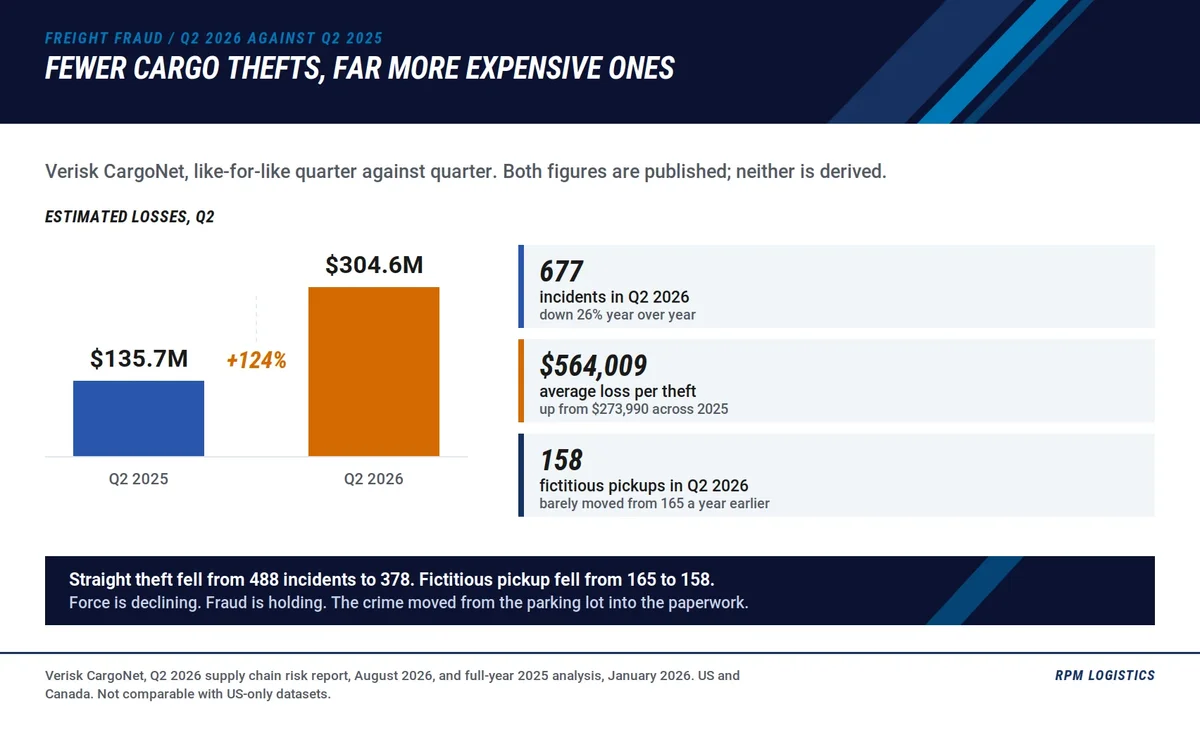
Like-for-like quarter against quarter. Incidents down 26%, losses up 124%.
Freight fraud is the use of deception to obtain cargo, payment, or access to a supply chain that the perpetrator is not entitled to. It covers carrier and broker identity theft, fictitious pickups, undisclosed re-brokering, fraudulent load postings, and the credential compromise that enables all of them. What separates it from conventional cargo theft is that the victim usually participates: freight is released, a load is tendered, or an invoice is paid, because the paperwork looked correct.
The 2026 picture is genuinely different from 2024 and 2025, and most published analysis has not caught up. This piece sets out what the numbers show, why the leading data sources disagree with each other more sharply than usual, and what actually changed in the mechanism.
The headline shift: fewer thefts, far larger losses
Start with the full-year 2025 baseline. Verisk CargoNet estimated $725 million in US and Canadian cargo theft losses across 2025, a 60% increase year over year, on 2,646 confirmed incidents, up 18% from 2,243. Average loss per theft rose 36% to $273,990 from $202,364 (Verisk CargoNet, January 2026).
One figure inside that release deserves more attention than it received. Total supply chain crime events in 2025 came to 3,594, against 3,607 in 2024. Total events were effectively flat while confirmed thefts rose 18%. A larger share of the same volume of incidents was converting into actual loss.
Through 2026 the divergence widened:
- Q1 2026: 767 supply chain crime events, down 5.3% year over year, with $131.58 million in estimated losses and 596 confirmed cargo theft reports (Verisk CargoNet, April 2026).
- Q2 2026: 677 incidents, down 26% year over year and 14% quarter over quarter, but $304.6 million in losses against $135.7 million in Q2 2025. Average loss per theft reached $564,009 (Verisk CargoNet, August 2026).
- First half of 2026: losses above $359 million, with average stolen commodity value near $341,518, per Verisk CargoNet reporting published in September 2026.
Incidents down 26%, losses up 124%. That is not a volume story, it is a targeting story. Fewer attempts, each aimed at substantially more valuable freight.
Why the data sources disagree, and why it matters
Here is a problem no other analysis of this topic addresses, and it will trip up anyone building a risk case on a single number.
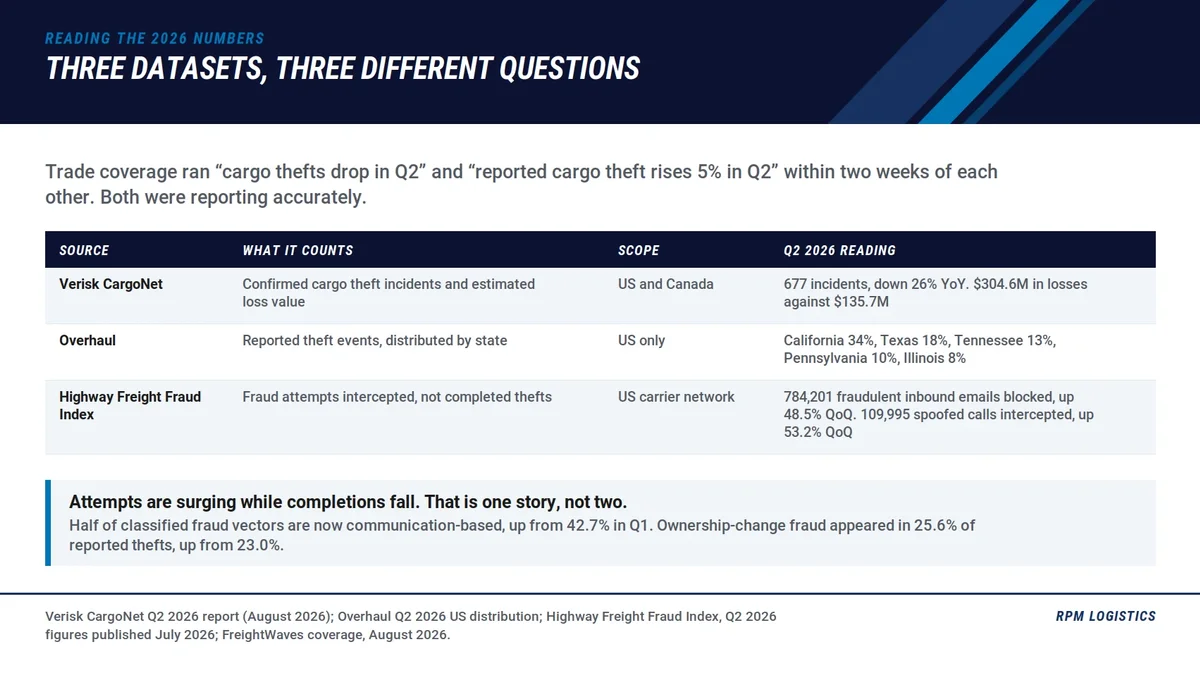
The datasets do not contradict each other. They count different things over different geographies.
For the second quarter of 2026, the two most-cited datasets disagree on direction, not just magnitude:
Source | Scope | Q2 2026 finding |
|---|---|---|
Verisk CargoNet | United States and Canada | 677 incidents, down 26% year over year, down 14% quarter over quarter |
Overhaul | United States only | 605 loads targeted, up 5% quarter over quarter, down 5% year over year |
Trade coverage ran "cargo thefts drop in Q2" and "reported cargo theft rises 5% in Q2" within two weeks of each other (FreightWaves, August 2026). Both headlines were accurate to their source. Neither was accurate about the industry.
The state-level splits diverge too. CargoNet's Q2 leaders are California and Texas. Overhaul's Q2 distribution runs California at 34%, Texas 18%, Tennessee 13%, Pennsylvania 10%, and Illinois 8%. Tennessee does not appear in CargoNet's top tier at all.
Three rules follow, and they apply to any risk assessment built on this data:
- Never average the two. Different geographic scope and different reporting populations. The average of an incompatible pair is not a better number.
- Never mix them inside a single claim. A sentence that pairs CargoNet's loss figure with Overhaul's incident count describes nothing real.
- State the scope every time. US plus Canada and US only are not interchangeable, and the difference is large enough to reverse a trend line.
The third dataset that explains the contradiction
A third measurement resolves the apparent conflict, and it is the most useful number in the category right now because it counts something different.
Highway's Freight Fraud Index tracks fraud attempts rather than completed thefts. Its second-quarter 2026 figures, published in July 2026, report 784,201 fraudulent inbound emails blocked, up 48.5% quarter over quarter and 58.3% year over year, and 109,995 spoofed calls intercepted, up 53.2% quarter over quarter and 159.3% year over year. Half of classified fraud vectors are now communication-based, up from 42.7% in the first quarter. Ownership-change fraud appeared in 25.6% of reported thefts, up from 23.0%. These are one vendor's first-party detection figures, so treat them as attempt indicators rather than industry totals.
Put the three together and the 2026 story resolves cleanly:
Attempts are rising steeply. Completed thefts are falling. Losses per completed theft have roughly doubled. Criminals are making far more attempts, succeeding less often, and doing much more damage when they do.
That is what a shift from opportunistic physical theft to targeted fraud looks like in aggregate data. It also explains why a company can simultaneously report record fraud volume and a declining theft rate without contradicting itself.
What actually changed in the mechanism
The operational change behind the numbers is a move from fabricated identities to stolen legitimate ones.
The FBI's Internet Crime Complaint Center documented the current scheme in an April 2026 public service announcement (FBI IC3, alert I-043026-PSA). It proceeds in four phases: phish credentials from broker and carrier accounts, post fraudulent loads under those stolen identities to harvest further carrier data, bid on legitimate shipments while impersonating carriers with clean records, then reroute freight through a cross-dock to a complicit driver. The alert specifically notes that actors modify FMCSA registration records and insurance certificates to survive a vetting check.
Two related tactics show up in the same period. Ownership-change fraud, where criminals acquire dormant motor carrier businesses with clean safety histories rather than registering new ones, appeared in roughly a quarter of reported thefts by the second quarter of 2026. And business email compromise remained the primary access point for the most sophisticated schemes in Q2 2026, according to Verisk CargoNet's analysis.
The practical consequence is uncomfortable: a clean carrier record is now necessary but not sufficient. The record can be genuine and the person using it can still be an impostor. Vetting that checks a record once at onboarding tests the wrong thing. Our guide to DOT compliance for automotive carriers covers what an authority check does and does not establish.
Fraud is also holding share as force declines. CargoNet's Q2 2026 data shows straight theft, meaning cargo taken from a parked trailer, falling from 488 incidents to 378, while fictitious pickups moved only from 165 to 158. BSI attributed 17% of US cargo theft incidents in 2025 to fictitious pickups, against roughly 5% for strategic theft globally, making the United States a distinct outlier (BSI, April 2026).
What it costs the industry
The American Transportation Research Institute put direct industry cost at more than $18 million per day, roughly $6.6 billion annualized, with average annual losses above $520,000 per motor carrier and above $1.84 million per logistics service provider (ATRI, October 2025). These remain the most recent ATRI figures; the institute has a follow-up carrier and broker survey underway.
ATRI's dataset is worth using precisely because almost nobody does. Most published analysis runs on a single CargoNet press release, which produces an industry-wide conversation anchored to one reporting population.
For context on the vehicle side specifically: the National Insurance Crime Bureau recorded 659,880 US vehicle thefts in 2025, down 23.2% from 850,708 (NICB, July 2026). That is street-level vehicle theft, not freight in transit, and the two move independently. Improvement in one says nothing about the other.
The regulatory response in 2026
Three federal developments this year bear directly on freight fraud, and they are frequently misreported.
The Broker and Freight Forwarder Financial Responsibility Rule took effect January 16, 2026. It requires brokers to maintain $75,000 in security, restricts trust fund assets to cash, irrevocable letters of credit, and Treasury bonds that are liquidable within seven calendar days, and gives FMCSA authority to suspend operating authority within seven business days of notice if security is not restored. A surety or financial institution that violates the requirements loses the ability to file instruments for three years. The rule makes financial security status a more meaningful vetting signal than it was.
FMCSA's Motus registration system is rolling out. Announced in the Federal Register in April 2026, Motus adds mandatory identity verification for new applicants and for existing registrants on first access (Federal Register, April 2026). Phase I released in December 2025 to supporting companies, with broader availability planned for the second quarter of 2026. The agency's stated rationale cites a significant increase in presumed fraudulent activity in which erroneous registrant information is used to commit cargo and monetary theft. Identity verification at the registration layer is the most direct structural answer to impersonation yet attempted.
Broker transparency has not been finalized, and no freight fraud legislation has passed. The transparency notice of proposed rulemaking published in November 2024 and its comment period closed in March 2025; trade reporting in August 2026 indicated FMCSA advanced it to OMB as a supplemental proposal rather than a final rule. On the legislative side, S. 337 was placed on the Senate calendar in February 2026 but has not received a floor vote, H.R. 880 has seen no action since February 2025, and the SAFER Transport Act bills remain in committee. Only the Combating Organized Retail Crime Act has passed a chamber. Treat any claim that these are now law as incorrect; status is verifiable at govinfo.gov.
What is coming
Three trajectories are reasonably clear from the current data.
Severity keeps climbing while counts fall. The pattern has held across three consecutive quarters. Targeting is improving, which means high-value consignments should expect more attention, not less, even as headline theft numbers improve.
Identity verification moves upstream. Motus places verification at registration rather than at the dock. Combined with the financial responsibility rule, the cost of maintaining a credible fraudulent identity is rising. Expect displacement toward credential theft from legitimate parties rather than fabrication of new ones, which is already visible in the ownership-change numbers.
Communication channels become the primary attack surface. With half of classified fraud vectors now communication-based, the control that matters most is whether a shipper can confirm a counterparty through a channel the counterparty did not supply.
What shippers should do differently
- Vet continuously, not once. Authority status, insurance filings, and ownership change between onboarding and the next load. RPM Logistics screens motor vehicle records at onboarding and monitors them continuously across its contracted carrier network.
- Control the communication channel. Confirm driver and equipment assignments using contact details from your own vendor file or the FMCSA record, never from an inbound email or rate confirmation.
- Reduce the number of parties who can re-tender. A contracted carrier network creates fewer opportunities for an undisclosed handoff than load-by-load sourcing from open boards. See what double brokering is and why it breaks the liability chain.
- Harden the release point. Most fraud is complete on paper before a truck appears, but the gate is the last control. See gate verification for fictitious pickups.
- Shorten exposure windows. Loaded high-value freight sitting in open staging is the easiest target in the chain. RPM Logistics operates more than 70 storage locations across the United States and Canada. See yard and compound management and secure vehicle storage.
- Document custody at every transfer. Chain-of-custody records determine whether a loss is a covered claim or an argument. See insurance-grade condition reporting.
Frequently asked questions
What is freight fraud?
Freight fraud is theft or financial loss achieved through deception rather than force. It includes carrier and broker identity theft, fictitious pickups, undisclosed re-brokering, fraudulent load postings, and the credential compromise that enables them.
Is cargo theft increasing or decreasing in 2026?
Both, depending on what is measured. Completed thefts are falling: Verisk CargoNet recorded 677 incidents in Q2 2026, down 26% year over year. Losses are rising sharply: $304.6 million in the same quarter against $135.7 million a year earlier, with an average loss of $564,009. Fraud attempts are rising fastest of all.
How much does cargo theft cost the trucking industry?
ATRI put direct industry cost above $18 million per day, roughly $6.6 billion annualized, with average annual losses above $520,000 per motor carrier and above $1.84 million per logistics service provider, in research published in October 2025.
Why do cargo theft statistics differ between sources?
Scope and reporting population. Verisk CargoNet covers the United States and Canada; Overhaul covers the United States only. For Q2 2026 they disagreed on direction, with CargoNet reporting a 26% year-over-year decline and Overhaul a 5% quarterly increase. Highway's Freight Fraud Index measures attempts rather than completed thefts. Never average or blend them.
What is strategic cargo theft?
Strategic cargo theft is theft accomplished through deception rather than force, including carrier impersonation, fictitious pickups, and fraudulent load postings. BSI attributed roughly 5% of global cargo theft incidents to strategic theft, while fictitious pickups alone accounted for 17% of US incidents in 2025.
Who is liable when freight is stolen?
Under the Carmack Amendment, liability attaches to the receiving and delivering carriers, not to brokers. When a load has been re-tendered without disclosure, the party named on the bill of lading may never have taken possession, which complicates both recovery and insurance response.
What is FMCSA Motus?
Motus is FMCSA's new registration system, announced in the Federal Register in April 2026. It adds mandatory identity verification for new applicants and for existing registrants on first access. Phase I released in December 2025 to supporting companies, with broader availability planned for the second quarter of 2026.
How do you verify a carrier before booking a load?
Confirm operating authority status and authority type, check financial security filings, review safety record, and confirm driver and equipment assignments through contact details you obtained independently rather than from an inbound communication. Repeat verification on an ongoing basis, since a record that was clean at onboarding can change.
Moving high-value freight through a vetted network
RPM Logistics moves finished vehicles across all 50 states and Canada through a contracted carrier network, with motor vehicle record screening at onboarding and continuous monitoring thereafter, documented custody at each transfer, and secured storage rather than open staging. If you want to review how your transport program holds up against the 2026 fraud pattern, talk to our team.