

Quick answer: A fictitious pickup is a cargo theft in which a criminal poses as the assigned carrier, arrives with paperwork that matches the load tender, and is handed the freight voluntarily. No lock is cut and no fence is breached. Because the shipper releases the goods, these losses often fall outside standard theft coverage.
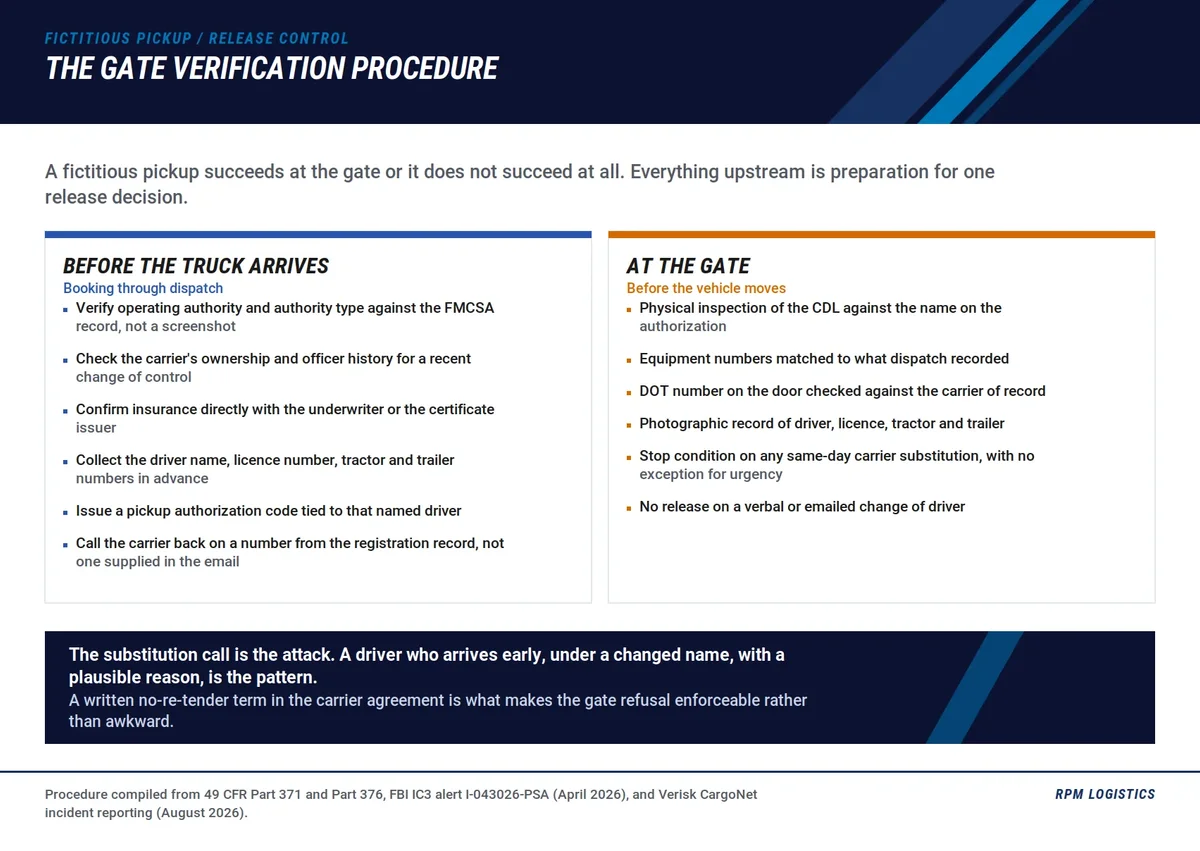
Two stages. Everything in the first column has to be settled before the truck is in the lane.
A fictitious pickup is the theft of a shipment by a person who impersonates the carrier scheduled to collect it. The thief books or intercepts a real load, shows up during the assigned window with a driver name and truck description that match what the shipper expects, signs for the freight, and drives away. The shipper hands over the cargo believing it is completing a normal pickup. Everything about the transaction looks routine until the load never arrives.
This is the fastest-changing category in cargo crime, and it is the one most likely to be handled badly when it happens. Verisk CargoNet recorded 158 fictitious pickup incidents in the second quarter of 2026, down slightly from 165 in the same quarter of 2025 (Verisk CargoNet, August 2026). Over the same period, straight theft, meaning cargo taken by force or stealth from a parked trailer, fell from 488 incidents to 378. Fraud is holding its share while brute-force theft declines. The crime is moving from the yard into the paperwork.
What separates a fictitious pickup from other cargo theft
The distinguishing feature is consent. In a straight theft, the criminal takes possession without the owner's knowledge. In a fictitious pickup, the owner or the owner's agent physically hands the freight over. That single difference drives everything that follows: how the scheme is built, how hard it is to detect at the dock, and whether an insurer treats the loss as theft at all.
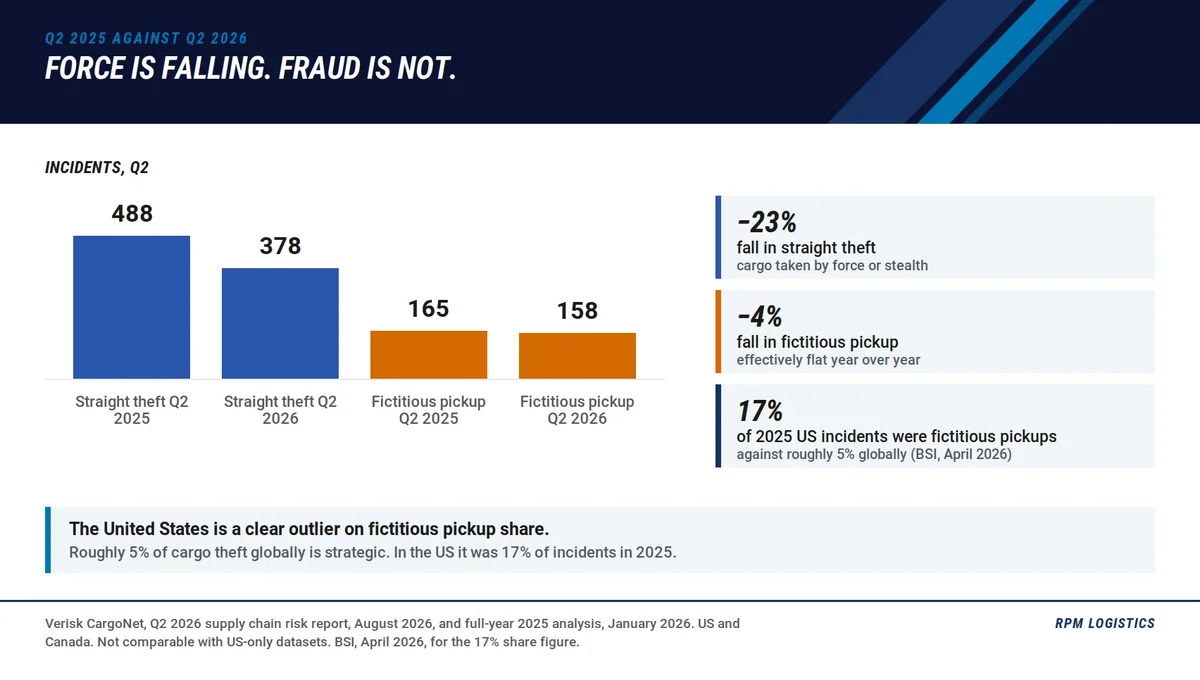
Straight theft fell 23%. Fictitious pickup fell 4%. The composition of the threat is shifting.
Two related terms get used interchangeably and should not be. Strategic cargo theft is the broader category of thefts that use deception rather than force, including identity theft and fraudulent load boards. Double brokering is the unlawful re-tendering of a load by a party that was supposed to haul or broker it, which is sometimes a precursor to theft and sometimes just a contract violation. A fictitious pickup is a specific outcome: freight released to an impostor.
Scale matters for context. Verisk CargoNet estimated $725 million in US and Canadian cargo theft losses across 2025, a 60% increase year over year, with 2,646 confirmed incidents and an average loss of $273,990 per theft (Verisk CargoNet, January 2026). BSI attributed 17% of US cargo theft incidents in 2025 to fictitious pickups, against roughly 5% for strategic theft globally, which makes the United States a clear outlier (BSI, April 2026).
How the scheme actually runs in 2026
The method has changed in a way most published guidance has not caught up with. The old model was a fabricated carrier: a fake MC number, a throwaway company, a spoofed phone line. That still happens, but the higher-value version now starts with a legitimate identity.
The FBI's Internet Crime Complaint Center documented the current pattern in a public service announcement issued in April 2026 (FBI IC3, alert I-043026-PSA). It runs in four phases. Criminals phish credentials from broker and carrier accounts. They post fraudulent loads under the stolen identities to harvest more carrier information. They bid on legitimate shipments while impersonating real carriers with clean records. Then they reroute the freight through a cross-dock to a complicit or unwitting driver. The alert notes that actors modify FMCSA registration records and insurance certificates to keep the impersonation intact through a vetting check.
Two consequences follow for anyone releasing freight. First, a carrier that passes an authority check can still be the wrong party, because the authority is real and the person using it is not. Second, the compromise usually happens days before the truck appears. By the time a driver is at the gate, the fraud is already complete on paper. The gate is the last place to catch it, not the first.
Why finished vehicles draw this attention
Vehicles combine high unit value, immediate resale liquidity, and the ability to move themselves. A loaded car hauler does not need a warehouse, a buyer for bulk commodity, or equipment to break down a pallet. Individual units can be retitled, exported, or sold through private channels quickly.
The broader vehicle theft picture is improving. The National Insurance Crime Bureau reported 659,880 US vehicle thefts in 2025, down 23.2% from 850,708 in 2024 (NICB, July 2026). That decline reflects gains in recovery technology and law enforcement coordination on street-level theft. It says nothing about freight in transit, where the target is not a parked car but a consignment of them, and where the attack is administrative rather than physical.
Severity is also rising even as counts fall. CargoNet put average loss per theft at $564,009 in the second quarter of 2026, with total quarterly losses of $304.6 million against $135.7 million a year earlier, on 26% fewer incidents. Through the first half of 2026 the same source reported losses above $359 million with an average stolen commodity value near $341,518 (Verisk CargoNet, September 2026). Fewer thefts, much larger ones. High-value consignments are being selected deliberately, which is precisely the profile of a loaded vehicle transporter.
Gate verification: the procedure nobody publishes
Most guidance on this topic ends at "verify the driver." That is not a procedure. Below is the sequence, in order, with the point of each step. It assumes the load was booked through a legitimate process and the risk being tested is impersonation at the point of release.
Before the truck arrives
- Confirm the driver assignment through a channel you initiated. Call the carrier on the number listed in the FMCSA record or your own vendor file, not a number on the rate confirmation or in an email signature. Inbound contact details are the part of the transaction the impostor controls.
- Record the expected details in writing before pickup day. Driver full name, license number and issuing state, tractor and trailer numbers, and the carrier's DOT number. A detail captured in advance is a detail that cannot be improvised at the gate.
- Issue a pickup authorization number tied to that specific driver and communicated only to the carrier through the verified channel. The driver should be able to state it without being prompted.
At the gate
- Ask for the authorization number first, before showing any paperwork. Order matters. A driver who is shown the bill of lading and then asked to confirm details has been handed the answers.
- Check the government-issued CDL against the name you recorded in advance. Confirm the photograph, the expiration date, and that the license class covers the equipment. Inspect the physical document, not a photo of it on a phone.
- Match the tractor and trailer numbers to what the carrier gave you. A substitution that the carrier cannot explain on a recorded call is a stop condition, not a paperwork exception.
- Read the DOT number off the door and compare it to the carrier of record. Then confirm the operating authority is active and the insurance filing is current. Our guide to DOT compliance for automotive carriers covers what an authority check does and does not prove.
- Photograph the driver, the license, the tractor, the trailer, and the door markings. These images are the evidentiary record if the load does not arrive. The same discipline used in insurance-grade condition reporting applies here, for a different reason.
- Do not release on a same-day carrier substitution. Late reassignment is the single most common cover story in this scheme. If the assigned carrier genuinely cannot cover, re-tender through your normal process and restart verification.
The controlling principle is that every check compares the person in front of you to information captured before they arrived, through a channel they could not influence. Verification that relies on documents the driver brought is not verification.
Facility design carries part of this load as well. Controlled access, camera coverage at the release point, and staged release areas limit what an impostor can accomplish even after reaching the gate, which is why yard and compound management and secure vehicle storage belong in the same conversation as driver verification.
Does cargo insurance cover a fictitious pickup?
This is the question shippers most need answered and the one the published material almost universally avoids. The short version: coverage is not automatic, and the reason is a policy provision called voluntary parting.
Most cargo and crime policies distinguish between property taken without the owner's consent and property the owner handed over. A voluntary parting exclusion removes coverage where the insured willingly transferred possession, even if that transfer was induced by deception. Because a fictitious pickup is by definition a release rather than a taking, insurers may classify the loss as fraud or as voluntary parting rather than theft, and the treatment differs by policy form.
What this means in practice:
- The policy language decides the outcome, not the facts of the crime. Two shippers who suffer identical incidents can get opposite claim results depending on whether their form carries a voluntary parting exclusion and whether any fraud or deception endorsement buys it back.
- Carrier liability is a separate question from cargo insurance. If the freight was released to a party that was never the contracted carrier, the contracted carrier may argue it never took possession and therefore never incurred liability.
- Documentation quality drives what is recoverable. The gate record described above is what distinguishes a documented impersonation from an unexplained disappearance.
Read the actual exclusions on your cargo and crime forms before an incident, and ask your broker directly how the policy responds to freight released to an impostor. That conversation is inexpensive in advance and impossible after. Our coverage of transport damage claims and photo condition reports addresses the documentation side of claim disputes more generally.
The first hour after a load does not arrive
Recovery odds fall sharply with time, and the first sixty minutes are largely procedural. Work the list in order.
- Confirm the load is actually missing. Call the consignee and the carrier of record on verified numbers. Rule out a delivery appointment error before escalating.
- Notify law enforcement where the freight was released and obtain a report number. Nothing downstream moves without it. Insurers and recovery networks both require it.
- File a theft report with a cargo theft recovery network so the load details circulate to law enforcement and other members while the freight is still moving.
- Notify your insurer and broker in writing. Most policies carry prompt-notice conditions, and delay is itself a coverage argument.
- Preserve the evidence. Gate photographs, the signed bill of lading, all email and phone records with the party claiming to be the carrier, and gate or yard camera footage before retention windows overwrite it.
- Notify the legitimate carrier whose identity was used. They are a victim too, they may have other loads exposed, and their cooperation matters to the investigation.
- Freeze related tenders. If credentials were compromised, other loads booked through the same channel are at risk right now.
Where a vehicle is later recovered damaged or non-running, moving it becomes its own logistics problem. Our guide to damage recovery logistics covers handling and transport of non-drivable units.
What actually reduces exposure
No control eliminates this risk. A layered approach reduces both the probability of a successful impersonation and the size of the loss when one occurs.
- Vet carriers continuously, not once. Authority status, insurance filings, and ownership can change between onboarding and the next load. RPM Logistics screens motor vehicle records at onboarding and monitors them continuously across its contracted carrier network.
- Control the communication channel. Verified contact records and outbound-only confirmation defeat most of the current playbook, because the scheme depends on the victim trusting inbound contact details.
- Watch for ownership and authority changes. Acquisition of dormant motor carrier businesses with clean histories is a documented tactic, which is why a clean record is necessary but not sufficient.
- Use secured storage rather than open staging for high-value consignments. RPM Logistics operates more than 70 storage locations across the United States and Canada, which shortens the window in which a loaded unit sits exposed.
- Document custody at every transfer. Chain-of-custody records are the difference between a covered claim and an argument.
Federal infrastructure is tightening as well. FMCSA's Motus registration system, announced in the Federal Register in April 2026, adds mandatory identity verification for new applicants and for existing registrants on first access (Federal Register, April 2026). Phase I was released in December 2025 to supporting companies, with broader availability planned for the second quarter of 2026. The agency's stated rationale cites a significant increase in presumed fraudulent activity in which erroneous registrant information is used to commit cargo and monetary theft.
Frequently asked questions
What is a fictitious pickup?
A fictitious pickup is a cargo theft in which a criminal impersonates the carrier assigned to collect a shipment and is voluntarily handed the freight. The shipper releases the load believing it is a legitimate pickup.
What is the difference between a fictitious pickup and double brokering?
A fictitious pickup ends with freight released to an impostor who intends to steal it. Double brokering is the unlawful re-tendering of a load by a party that agreed to handle it, which may be a contract violation without any theft. Double brokering is sometimes used as a step toward a fictitious pickup.
Does cargo insurance cover a fictitious pickup?
Not automatically. Because the shipper voluntarily released the freight, many policies treat the loss under a voluntary parting exclusion rather than as theft. Whether the claim is paid depends on the specific policy form and any fraud or deception endorsement. Review the exclusions with your broker before an incident occurs.
How do you spot a fake driver at pickup?
Compare the driver against details you captured before the truck arrived through a channel you initiated. Ask for a pre-issued pickup authorization number before showing paperwork, inspect the physical CDL, match tractor and trailer numbers, verify the DOT number on the door against the carrier of record, and photograph everything. Treat a same-day carrier substitution as a stop condition.
Is cargo theft increasing or decreasing?
Incident counts are falling while losses rise sharply. Verisk CargoNet recorded 677 incidents in the second quarter of 2026, down 26% year over year, but $304.6 million in losses against $135.7 million a year earlier, with an average loss of $564,009 per theft.
What should you do in the first hour after a load is stolen?
Confirm the load is genuinely missing, report to law enforcement where the freight was released and obtain a report number, file with a cargo theft recovery network, notify your insurer in writing, preserve gate photographs and camera footage before retention windows expire, notify the carrier whose identity was used, and freeze any related tenders booked through the same channel.
Why are vehicles a target for fictitious pickups?
Vehicles carry high unit value, resell quickly through private and export channels, and can be driven away without specialized equipment or a buyer for bulk commodity. A loaded transporter concentrates significant value in a single release event.
Moving high-value vehicles with verified carriers
RPM Logistics moves finished vehicles across all 50 states and Canada through a contracted carrier network, with motor vehicle record screening at onboarding and continuous monitoring thereafter. Freight is released against documented custody procedures and staged in secured storage rather than open lots. If you are evaluating how your current transport program handles carrier verification and custody documentation, talk to our team.