

Quick answer: The best solutions for cargo theft prevention match a control to each attack. Identity verification and callback controls stop fictitious pickups and double brokering before release. Locks, seals, secured parking and escorts slow physical theft. GPS trackers locate a stolen load without preventing the theft; insurance pays after a loss, within policy terms.
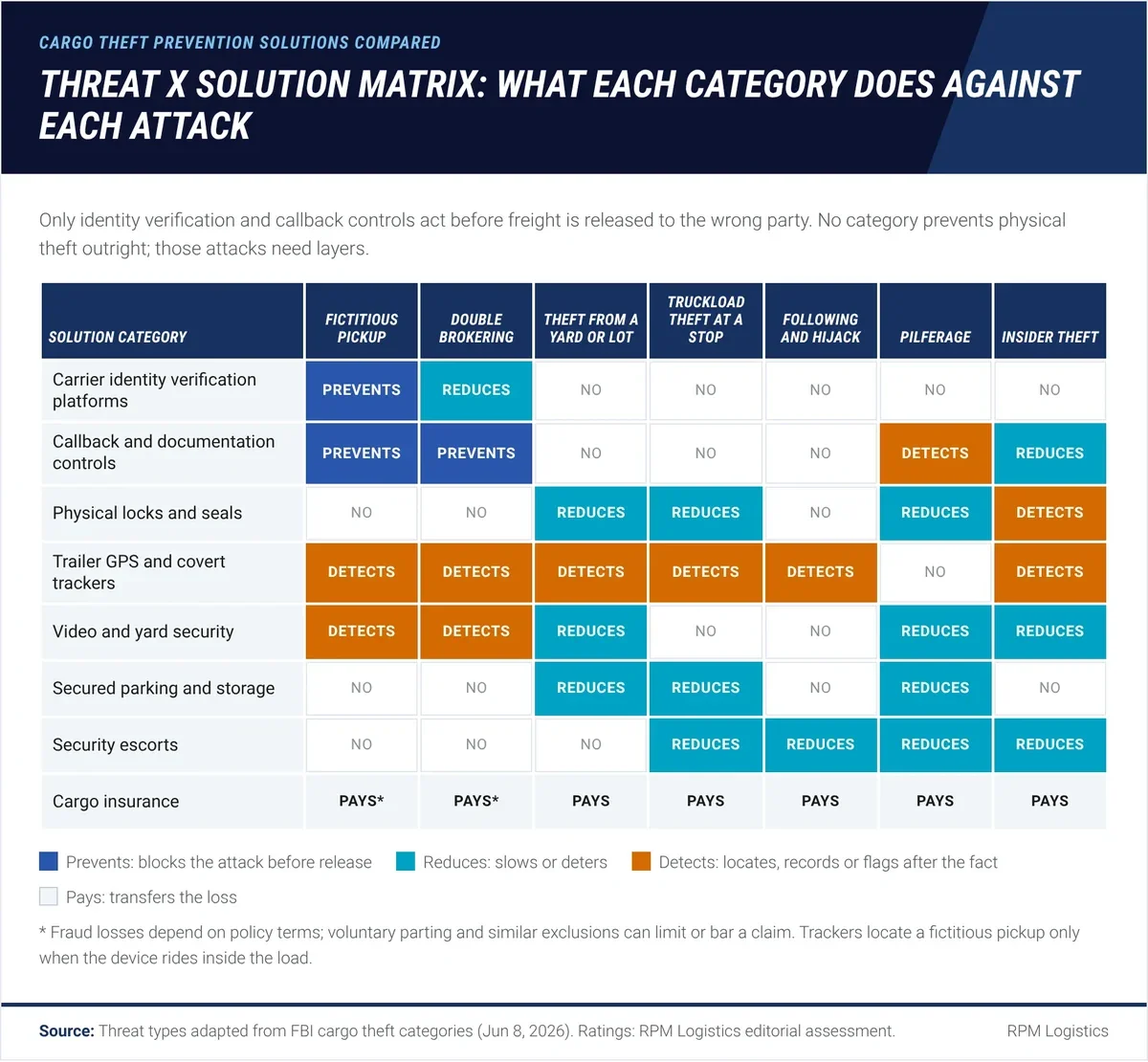
Read across a row to see where a solution works. Read down a column to see which layers an attack needs. No physical-theft column has a single "prevents" cell.
Cargo theft prevention solutions are the products, services and procedures used to keep freight from being stolen. They fall into eight categories, from carrier identity checks to cargo insurance. No single category covers every attack. A tracker that finds a hijacked trailer does nothing against an impostor who is handed the load at the gate.
Our cargo theft prevention playbook assigns controls to the shipper, broker, carrier and facility. This comparison answers a buyer's question instead. Which category answers which attack, what does it fail to stop, and what does it take to run?
Every category here is described generically. No vendor is named or ranked.
Why one solution is never enough
One solution is never enough because attacks enter at different points in a load's life. Fraud wins at tender and at the gate. Physical theft happens in yards, at truck stops and on the road. A control placed at one point has no reach at the others.
The mix of attacks has also shifted toward fewer, larger losses. Verisk CargoNet counted 677 incidents in Q2 2026, down 26% year over year. Estimated losses more than doubled to $304.6 million (Verisk CargoNet, Aug 6, 2026).
The average loss among thefts with a reported value reached $564,009. Verisk reported that compromised business email accounts let organized groups identify high-value shipments and impersonate trusted parties.
The seven attacks a prevention program must cover
A prevention program must cover seven attack patterns, each with its own entry point. The FBI groups cargo theft into four categories: straight, strategic, cyber and pilferage (FBI Philadelphia, June 8, 2026). For buying decisions, those categories need splitting further. A lock that slows a yard thief does nothing at the gate.
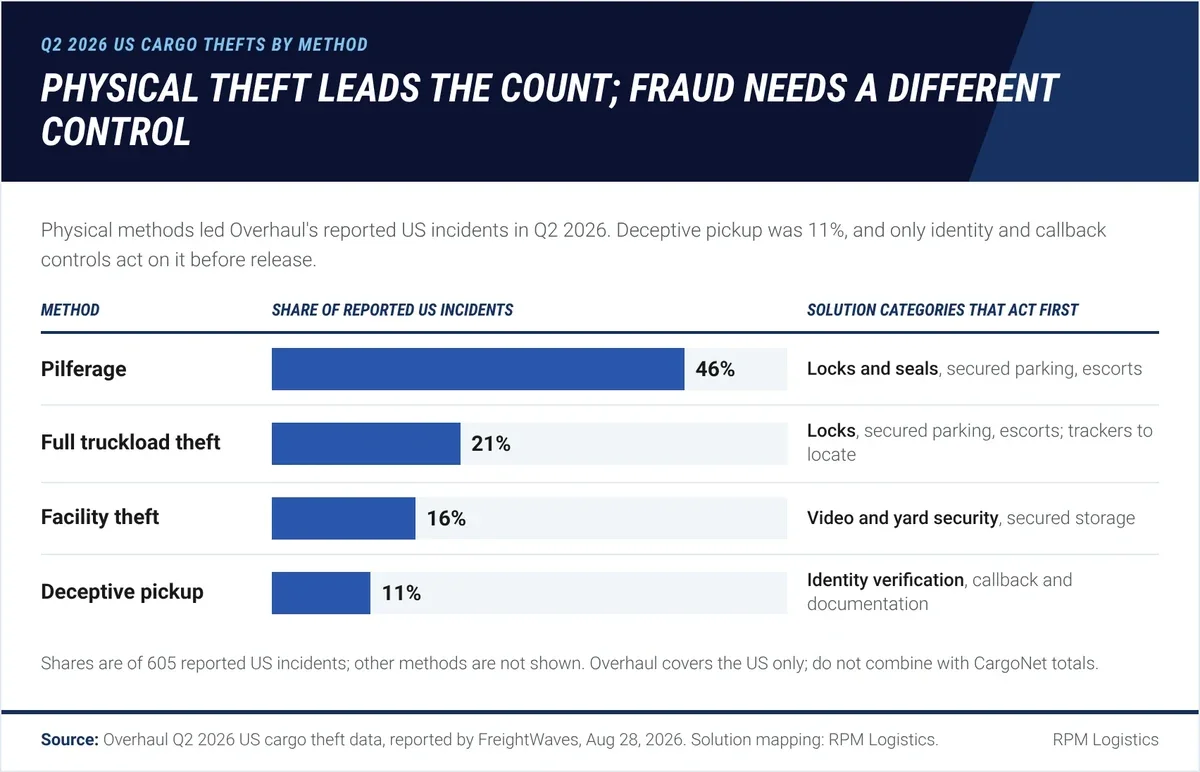
The largest shares belong to attacks no single product prevents. Physical theft needs layers; fraud needs process.
- Fictitious pickup: an impostor poses as the assigned carrier and is handed the freight. Verisk CargoNet counted 158 fictitious pickups in Q2 2026, against 165 a year earlier.
- Double brokering: the booked carrier re-tenders the load to a party the shipper never approved.
- Theft from a yard or lot: a loaded trailer or vehicle is taken from a shipper, terminal or storage lot.
- Truckload theft at a stop: a loaded trailer is taken while the driver rests, fuels or waits.
- Following and hijack: thieves follow a truck from origin and strike en route or at its first stop.
- Pilferage: part of a load is removed, often at a stop, and found missing only at delivery.
- Insider theft: an employee or driver with legitimate access takes or leaks the load.
Physical methods still make up most reported incidents. Overhaul's US data for Q2 2026 put pilferage at 46% of incidents and full truckload theft at 21%. Facility theft was 16% and deceptive pickup 11% (FreightWaves, Aug 28, 2026). Warehouses and distribution centers made up 37% of theft locations, and truck stops and fuel stations 15%.
Your role in the chain changes the mix you face. ATRI found strategic theft in 20.3% of incidents reported by motor carriers. For brokers and logistics providers, the share was 62.5% (ATRI, via Overdrive, 2025).
Pilferage led carrier incidents at 39.9%. ATRI's figures cover 2023 incidents, so read them as a pattern, not a current count.
Threat x solution matrix
The threat x solution matrix shows which category prevents, reduces, detects or pays for each attack. The table below reads by threat. The hero graphic above shows the same ratings by solution.
Threat | Prevents it before release | Reduces or deters it | Only detects, locates or pays |
|---|---|---|---|
Fictitious pickup | Identity verification; callback and documentation | None | In-load trackers; video; insurance, subject to policy terms |
Double brokering | Callback and documentation | Identity verification, at booking only | Trackers; video; insurance, subject to policy terms |
Theft from a yard or lot | None outright | Locks and seals; video and yard security; secured storage | Trackers; insurance |
Truckload theft at a stop | None outright | Locks; secured parking; escorts | Trackers; insurance |
Following and hijack | None outright | Escorts | Trackers; insurance |
Pilferage | None outright | Locks and seals; video; secured parking; escorts | Shortage records; insurance |
Insider theft | None outright | Documentation; video; escorts | Seals; trackers; insurance |
Two readings matter most. First, only two categories prevent anything, and only against fraud. Both are low-cost compared with hardware or escorts.
Second, every physical attack needs at least two layers, because no single category stops it. That is the case for layering, made with the matrix rather than a slogan.
Eight cargo theft prevention solutions compared
The eight categories differ in what they act on, when they act and what they cost. The table compares them side by side. Cost and effort are qualitative tiers, not market prices.
Solution category | Main attack it answers | What it does not stop | Cost and effort |
|---|---|---|---|
Carrier identity verification platforms | Fictitious pickup; carrier impersonation | Re-tender after booking; theft after release | Subscription; low effort per load |
Callback and documentation controls | Fictitious pickup; double brokering | Any theft after a correct release | Staff time; high discipline |
Physical locks and seals | Yard and stop theft; pilferage | Fraud, where the thief is handed the load | Low hardware cost; driver habits |
Trailer GPS and covert trackers | Recovery after any theft | The theft itself; pilferage from a parked trailer | Hardware plus monitoring fees |
Video and yard security | Facility theft; insider theft | Anything after the gate | Capital cost plus monitoring |
Secured parking and storage | Theft at rest; facility theft | Fraud; theft while moving | Per-night or per-day fees; route planning |
Security escorts | Following, hijack and stop theft | Fraud at tender or the gate | Highest recurring cost; advance booking |
Cargo insurance | Financial loss after any theft | The theft; excluded losses; indirect costs | Premium and deductible |
1. Carrier identity verification platforms
Carrier identity verification platforms are subscription services that check a carrier's records before booking. They cover authority, insurance, contacts and ownership history. They target impersonation and purchased carriers.
One vendor index found ownership-change fraud in 25.6% of reported thefts in Q2 2026 (Highway Freight Fraud Index, 2026). A platform checks the company you book. It cannot see a re-tender made after booking, or the person who arrives at the gate.
2. Callback and documentation controls
Callback and documentation controls are procedures, not products. They include callbacks to numbers you sourced yourself and pickup codes. They also include a carrier name match across paperwork and truck, and VIN-level records.
The same index reported 784,201 fraudulent inbound emails blocked in Q2 2026, up 58.3%, and 109,995 spoofed calls, up 159.3%. A callback works only when you dial a number from your own records. The steps are in our fictitious pickup gate verification procedure and our guide on how to prevent double brokering.
3. Physical locks and seals
Physical locks and seals include rear door locks, king-pin locks and glad-hand or air cuff locks. High-security seals are built to ISO 17712. A king-pin lock stops an unauthorized tractor from hooking a parked trailer.
A seal does not stop entry; it shows that entry happened. None of these matter in a fraud, because the thief receives the keys and the paperwork. For finished vehicles on open carriers, door locks and seals do not apply, so vehicle key control carries more of the weight.
4. Trailer GPS and covert trackers
Trailer GPS and covert trackers report where a trailer is, or where a device hidden in the load is. Their value is recovery. ATRI found that 73.5% of cargo stolen from motor carriers is never recovered (ATRI, via Overdrive, 2025).
A tracker on the booked carrier's trailer shows nothing in a fictitious pickup, because the impostor brings a different truck. Only a device inside the load follows the freight. A trailer tracker also misses pilferage, since the trailer never moves.
5. Video and yard security
Video and yard security covers cameras, lighting, fencing and gate control where freight waits. It matters because warehouses and distribution centers made up 37% of US theft locations in Q2 2026 (Overhaul, 2026). Cameras record an impostor at the gate; they do not stop the release unless gate staff act on the record. Video also has no reach once the load leaves the property.
6. Secured parking and storage
Secured parking and storage means fenced, gated and watched lots for loads between legs. It answers theft at rest. Truck stops and fuel stations made up 15% of US theft locations in Q2 2026, and midnight to 6 a.m. accounted for 28% of reports (Overhaul, 2026).
Secured lots cost per night or per day, and capacity near major lanes is limited. For vehicles held between assignments, see our guide to secure fleet vehicle storage.
7. Security escorts
Security escorts are armed or unarmed escort vehicles that shadow a load from pickup to delivery. They are the only category that acts against following and hijack while the truck is moving. They also carry the highest recurring cost and need advance booking with a specialist provider.
An escort does nothing at tender. If the load was released to an impostor, the escort is guarding the thief.
8. Cargo insurance
Cargo insurance transfers the financial loss; it prevents nothing. There is no federal cargo insurance minimum for auto transport carriers. The $750,000 figure in 49 CFR 387.9 is public liability, not cargo.
Fraud losses can fall under voluntary parting exclusions. Insurance also leaves indirect costs uncovered, which ATRI puts at 3 to 6 times the value of the stolen cargo. Our guide to insurance-grade condition reporting covers the records a claim needs.
Four gaps buyers miss
The gaps buyers miss are the attacks a solution looks like it covers but does not. Each one below comes from the "does not stop" column above.
- Tracking does not stop fraud. In a fictitious pickup, the freight leaves on the thief's truck. A tracker on the booked carrier's equipment follows the wrong vehicle.
- Verification at booking is not verification at pickup. A platform clears the carrier you booked. A re-tender or a fake driver appears later, at dispatch or the gate.
- Seals detect; they do not prevent. A broken seal tells you pilferage happened, often at delivery, after the loss.
- Insurance is not a control. It pays within terms, after a deductible, and leaves downtime and lost business uncovered.
Cost and effort tiers
Cost and effort tiers group the categories by how they are paid for and what they demand. The cheapest tier is procedural. It and the identity platforms in the subscription tier are the only spend that prevents fraud. The table sets out the five tiers.
Tier | Categories | What you pay for | Typical failure |
|---|---|---|---|
Procedural | Callback and documentation controls | Staff time and training | Skipped under schedule pressure |
Subscription | Identity verification platforms; tracker monitoring | Recurring per-user or per-device fees | Alerts nobody acts on |
Hardware | Locks, seals, trackers, cameras | One-time equipment plus replacement | Device not fitted or not used |
Per-load service | Secured parking; security escorts | Fees per night, day or move | No capacity on the lane or date |
Risk transfer | Cargo insurance | Premium and deductible | Exclusion found after the loss |
Set those costs against the losses at stake. ATRI puts average annual theft losses at more than $520,000 per motor carrier. Logistics service providers lose more than $1.84 million (ATRI, Oct 8, 2025). It estimates the industry cost as high as $6.6 billion a year.
How to layer solutions by load value
Layering by load value means adding categories as the value at risk rises. Procedural controls apply to every load. The $100,000 mark is the common market threshold for high-value freight. A practical build looks like this:
- Every load: identity verification and callback and documentation controls. They cost little and are the only categories that prevent fraud.
- From $100,000: add locks and seals or enclosed equipment, plus insurance matched to declared value.
- From $250,000: add secured parking or staging and a no-stop window after pickup.
- From $500,000: add an in-load covert tracker.
- Above $1 million, or when the insurer requires it: consider a security escort.
Our guide to high-value freight security by value tier sets the full schedule by load phase. Lane, season and commodity can move a load up a tier. Holiday weekends are one example; see our cargo theft statistics for 2026 for the Labor Day pattern.
Questions to ask before buying any solution
The right questions test a solution against the attacks it claims to cover, not against a feature list. Ask every provider, in any category, the same five questions:
- Which attack does it act on, and at what point? Tender, gate, yard, stop or road. A product that acts after release cannot stop fraud.
- Does it prevent, reduce, detect or pay? Place it in the matrix before you compare prices.
- Who acts on an alert, and how fast? A tracker or camera with nobody watching is a recording, not a control.
- What does it need from drivers or gate staff? Locks, seals and callbacks fail when a step is skipped.
- Does it match your insurer's conditions? Some cargo policies set parking, attendance or device rules. A broken condition can limit a claim.
What changes for finished vehicles
Finished vehicles change the comparison because the cargo can be driven away. A thief needs keys, not a forklift, so key control does much of the work that door locks do for boxed freight. Open carriers leave units visible in yards and at stops. Enclosed equipment hides them.
Vehicles also carry a built-in identity record. A VIN-level condition report at origin, matched at delivery, proves custody as well as condition. That makes documentation controls stronger for vehicles than for most freight.
Average loss size raises the stakes too. CargoNet's 2025 average loss per theft was $273,990, up 36% (Verisk CargoNet, 2026).
Frequently Asked Questions
What are the current trends in cargo theft?
In CargoNet's data, thefts are falling while losses rise. Verisk CargoNet counted 677 incidents in Q2 2026, down 26%, while estimated losses more than doubled to $304.6 million. Verisk reported that compromised email accounts let organized groups identify high-value shipments and impersonate trusted parties. The average loss among thefts with a reported value reached $564,009.
What is the best theft deterrent for trucks?
No single deterrent covers every attack. For a parked loaded trailer, king-pin, glad-hand and high-security rear door locks slow theft at stops and yards. Against fictitious pickups, the best defense is a callback to a number you sourced yourself. A deterrent does nothing when thieves are handed the load.
What are common types of cargo theft?
The FBI groups cargo theft into straight, strategic, cyber and pilferage categories. In practice, buyers face seven attacks. They are fictitious pickup, double brokering, yard theft, truckload theft at a stop, following and hijack, pilferage and insider theft. In Overhaul's Q2 2026 US data, pilferage was 46% of incidents and deceptive pickup 11%.
Does GPS tracking prevent cargo theft?
No: GPS tracking helps locate a stolen trailer or load, which improves recovery, but it does not stop the theft. ATRI found that 73.5% of cargo stolen from motor carriers is never recovered. In a fictitious pickup, a tracker on the booked carrier's trailer follows the wrong truck. Only a covert device inside the load follows the freight.
Does cargo insurance cover theft by a fictitious pickup?
It depends on the policy. Some cargo policies limit or exclude losses where freight was handed over voluntarily, which describes a fictitious pickup. Read the theft and fraud terms before tender, and confirm the carrier's cargo limit covers the declared value. Insurance also leaves indirect costs uncovered, and ATRI puts those at 3 to 6 times the stolen cargo's value.
Build the right layers into your next vehicle move
RPM arranges vehicle transport across all 50 states and Canada. Carriers are screened to RPM onboarding criteria, including MVR checks, before a load is booked. Contact Sales to plan the controls for your next shipment.