

Quick answer: High-value freight is cargo whose value exceeds the standard cargo insurance carriers customarily hold, which in US trucking is $100,000 per load. No federal rule sets that number. It comes from carrier policy limits and broker agreements, which means the threshold is a market convention rather than a legal definition.
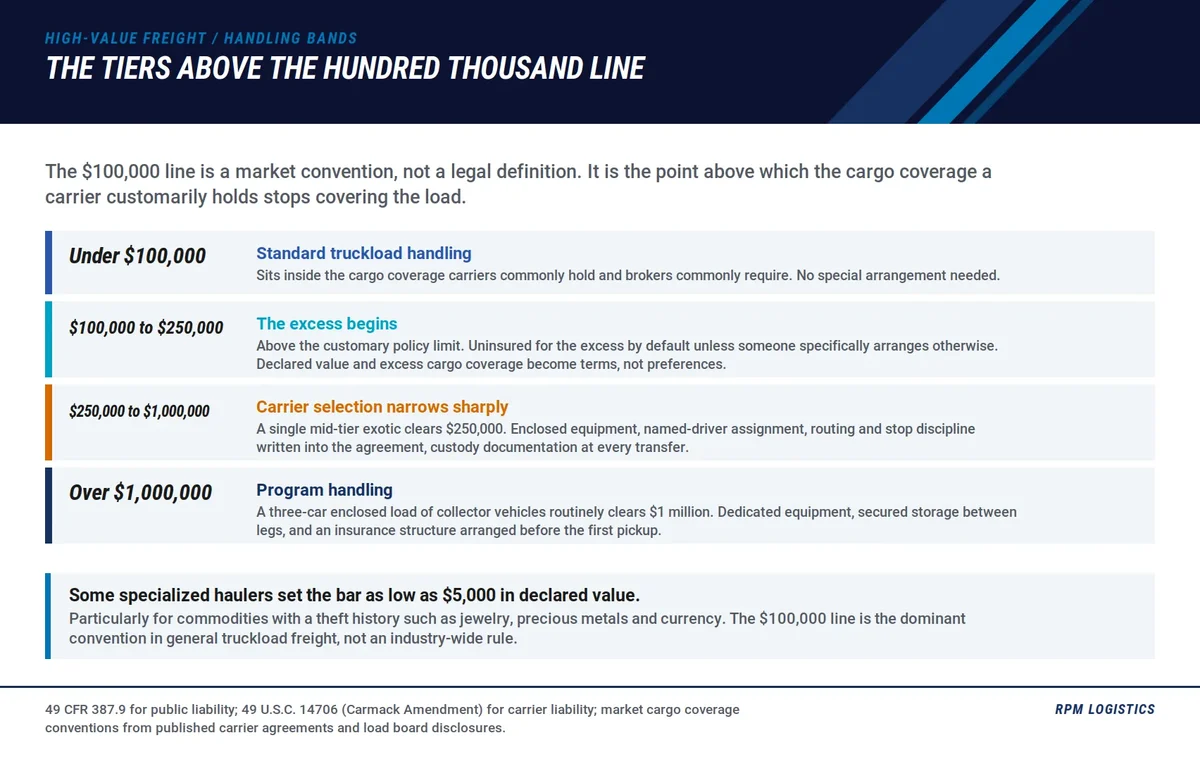
A $120,000 load and a $1.4 million load are both “high-value” and share almost nothing in how they should be handled or priced.
High-value freight is any shipment worth more than the cargo coverage a motor carrier typically maintains. In practice that means $100,000 or more per load. Above that line, standard carrier liability stops being a meaningful backstop, and the shipment needs deliberate decisions about insurance, equipment, carrier selection, and custody documentation that a routine load does not.
The number gets repeated across the industry as though it were a regulation. It is not. Understanding where it actually comes from matters, because the threshold determines who is willing to haul your freight, what happens when something goes wrong, and how much of a loss you personally absorb.
Where the $100,000 threshold comes from
There is no federal minimum cargo insurance requirement for general freight. This is the single most misunderstood point in the category, and most published material either gets it wrong or avoids it.
Federal financial responsibility rules do set minimums, but they govern public liability, meaning bodily injury and property damage to third parties, not cargo. Under 49 CFR § 387.9, a for-hire carrier operating vehicles over 10,001 pounds in general freight must carry $750,000 in public liability coverage. That figure protects the motorist you hit, not the freight you are carrying. Cargo coverage for general commodities is left to the market.
What filled the gap is convention. Carriers commonly carry $100,000 in cargo coverage, brokers commonly require it in their carrier agreements, and load boards commonly display it. Once enough parties standardized on the same number, it became the working definition of where "normal" freight ends. Several carriers state this openly: high-value freight is any load exceeding the cargo coverage minimums customarily required of commercial motor carriers, with $100,000 being the market norm.
Two practical consequences follow:
- The threshold moves when the market moves. It is a norm, not a statute, so it can and does drift. Treat any source citing it as a fixed legal line with suspicion.
- Exceeding it is not a formality. Above $100,000 you are, by default, uninsured for the excess unless someone specifically arranges otherwise. That is the whole reason the category exists.
Worth noting that the convention is not universal. Some specialized haulers set the bar as low as $5,000 in declared value, particularly for commodities with a theft history such as jewelry, precious metals, and currency. Others decline to name a number at all and define high-value by risk profile rather than price. The $100,000 line is the dominant convention in general truckload freight, not an industry-wide rule.
The value tiers
Very few carriers publish a tier structure. Anderson Trucking Service is the clearest exception, and its four bands have become the de facto reference in the category. The structure below follows theirs, with the operational consequences that typically attach at each level.
Tier | Load value | What typically changes |
|---|---|---|
Tier 1 | $100,000 to $250,000 | Exceeds standard cargo coverage. Requires excess cargo insurance or a declared-value arrangement. Carrier selection narrows. |
Tier 2 | $250,000 to $500,000 | Excess coverage becomes load-specific rather than blanket. Written security expectations, restricted stops, and documented custody become normal requirements. |
Tier 3 | $500,000 to $1,000,000 | Dedicated equipment, vetted named drivers, and pre-approved routing and parking. Insurer may impose conditions as a term of coverage. |
Tier 4 | Above $1,000,000 | Bespoke arrangements. Underwriting is per-shipment. Team drivers, no-stop windows, and escort arrangements appear at this level. |
The tiers matter because the common alternative is a single flat definition, which is close to useless operationally. A $120,000 load and a $1.4 million load are both "high-value" and share almost nothing in terms of how they should be handled or priced.
What the industry counts as high-value freight
Ask any carrier what qualifies and you get a remarkably consistent list. Across commodity lists published by the major carriers and brokers competing in this space, the same categories recur:
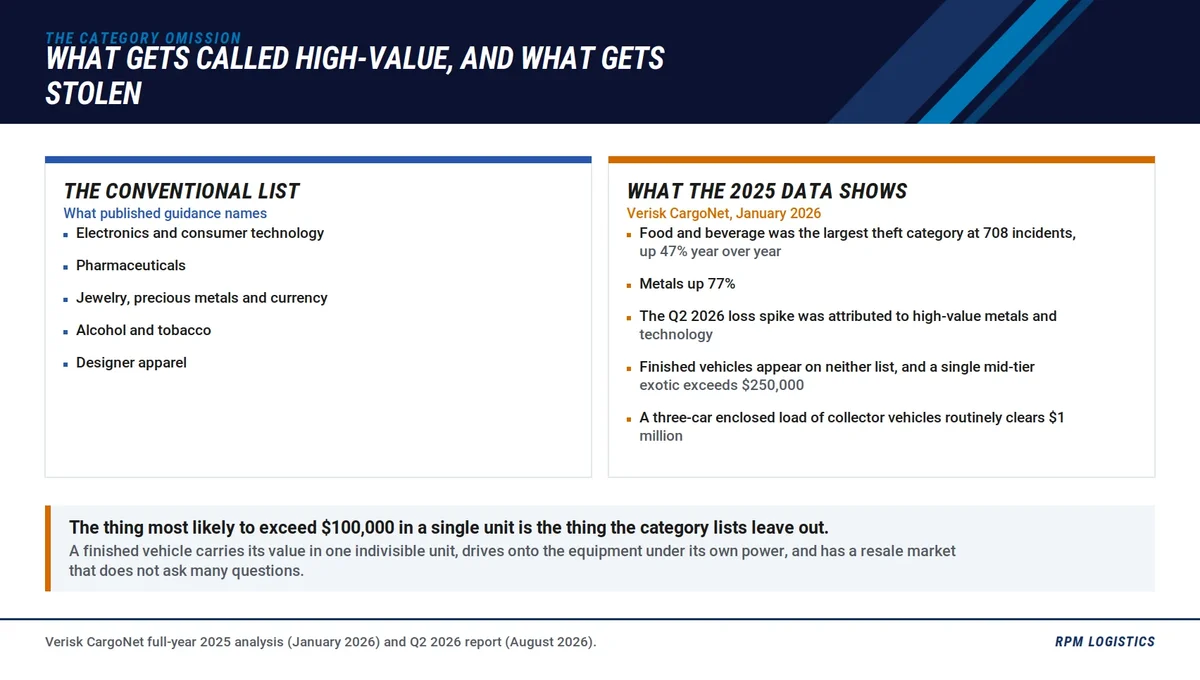
Finished vehicles are missing from almost every published high-value freight list, and a single unit routinely clears the threshold.
- Electronics and technology: semiconductors, servers, telecom equipment, computers, circuit boards
- Pharmaceuticals and medical: vaccines, biologics, specialty medications, imaging equipment, diagnostic devices
- Luxury goods: jewelry, watches, designer apparel, handbags, cosmetics
- Fine art and antiques: including large installations
- Aerospace and defense: aircraft components, avionics, military equipment
- Precious metals and currency: bullion, gemstones, coins, bonds, stock certificates
- Precision machinery and prototypes: tooling, sensors, pre-release products, R&D materials
The omission
Something is missing from that list, and it is the thing most likely to exceed $100,000 in a single unit.
Across fifteen published commodity lists from carriers and brokers marketing high-value freight services, finished vehicles appear exactly once, as a two-word bullet reading "new cars" with no elaboration, no threshold logic attached, and no discussion of how vehicles should actually be handled. Collector, exotic, and classic vehicles appear zero times. Where automotive shows up at all, and it does on three lists, it means parts: components, aerospace-adjacent assemblies, industrial automotive supply.
This is difficult to defend on the category's own logic. A single mid-tier exotic exceeds $250,000. A three-car enclosed load of collector vehicles routinely clears $1 million. A transporter carrying eight new luxury SUVs is above the threshold before the doors close. By every definition the industry publishes, finished vehicles are high-value freight. The category simply does not treat them as such, because high-value freight marketing grew out of general commodity truckload and vehicle transport grew out of a separate trade.
The gap has a practical cost. Shippers moving vehicles get either generalist high-value freight providers with no vehicle-specific handling competence, or vehicle transporters who have never been asked to meet a high-value freight security standard. The middle is thinly occupied.
What gets called high-value versus what actually gets stolen
There is a second mismatch worth noting, between the commodities the category markets around and the commodities criminals actually take.
Verisk CargoNet's 2025 analysis found food and beverage the largest theft category at 708 incidents, up 47% year over year, with metals up 77%. Its second-quarter 2026 report attributed the loss spike to high-value metals and technology. Electronics and pharmaceuticals, which appear on nearly every high-value freight commodity list, are targets, but so are commodity categories that no provider markets as high-value at all.
The lesson is that theft targeting follows resale liquidity and volume, not the marketing category. Freight becomes attractive when it is easy to move and easy to sell, which is precisely the argument for treating finished vehicles as a high-exposure commodity: individually identifiable, immediately drivable, and saleable through private and export channels without breaking down a pallet or finding a bulk buyer.
Carrier liability is not insurance
This distinction decides what you actually recover, and it surprises shippers more often than any other part of the category.
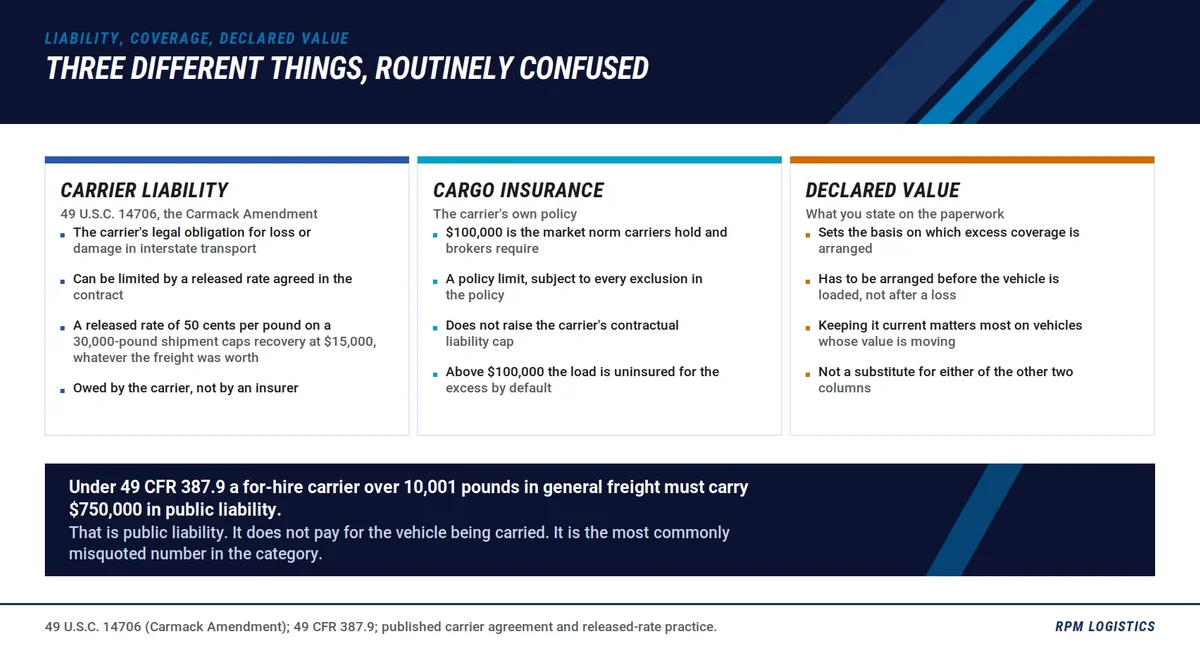
A carrier's $100,000 cargo policy does not mean you recover $100,000.
Carrier liability is the carrier's legal obligation for loss or damage under the Carmack Amendment, 49 U.S.C. § 14706. It is real, but it can be limited. For non-household goods, a carrier may limit liability by a released-rate declaration or a written agreement, frequently expressed as a rate per pound. A released rate of 50 cents per pound on a 30,000-pound shipment caps recovery at $15,000, whatever the freight was worth. Carmack also sets minimum claim windows: at least nine months to file a claim and two years to bring suit after a formal denial.
Cargo insurance is a separate policy that responds to loss of the goods themselves, subject to its own limits, exclusions, and conditions. It is what actually covers the gap between a limited liability figure and the value of the freight.
Three things follow that matter above $100,000:
- A carrier's $100,000 cargo policy does not mean you recover $100,000. It means the policy limit is $100,000, subject to exclusions, and the carrier's liability may separately be capped lower by a released rate.
- Declared value and insured value are different things. Declaring a higher value on the bill of lading affects the carrier's liability limit and the rate. It does not by itself create insurance.
- Exclusions decide outcomes more often than limits do. Freight released to an impostor, for instance, is frequently treated under a voluntary parting exclusion rather than as theft. We cover that specific problem in detail in our guide to fictitious pickups and gate verification.
For vehicles specifically, the valuation basis matters as much as the limit. An agreed-value arrangement fixes what the unit is worth before it moves; an actual-cash-value basis leaves it to be argued after a loss, which on a collector car is a very large argument. Our comparison of agreed value versus actual cash value covers how that choice plays out.
What the risk actually looks like
High-value freight attracts targeted attention, and the 2026 data shows targeting getting sharper even as raw theft counts fall.
Verisk CargoNet recorded 677 cargo theft incidents in the second quarter of 2026, down 26% year over year, but $304.6 million in losses against $135.7 million a year earlier. Average loss per theft reached $564,009 (Verisk CargoNet, August 2026). Across the first half of 2026 the same source reported losses above $359 million with an average stolen commodity value near $341,518. For full-year 2025, losses were an estimated $725 million on 2,646 confirmed incidents, with an average of $273,990 per theft (Verisk CargoNet, January 2026).
Read those three averages in sequence: $273,990 for 2025, $341,518 for the first half of 2026, $564,009 for the second quarter alone. Criminals are making fewer attempts and selecting far more valuable targets. That trend is the whole argument for treating high-value freight as a distinct discipline rather than a premium service tier.
The cost is not limited to the freight. The American Transportation Research Institute put direct industry cost above $18 million per day, roughly $6.6 billion annualized, with average annual losses above $521,000 per motor carrier, and found that indirect expenses can reach three to six times the value of the stolen cargo (ATRI, October 2025). Replacement, expedited re-shipment, customer remediation, investigation time, and premium consequences all sit outside the claim.
What changes operationally above the threshold
Crossing $100,000 is not just an insurance event. A set of operating decisions that are optional on routine freight become deliberate, and the further up the tiers a load sits, the fewer of them remain discretionary.
Carrier selection narrows sharply
Most carriers will not accept a load above their cargo policy limit, because doing so exposes them to uninsured liability. That removes a large share of available capacity the moment you cross the line. The practical effect is that high-value loads take longer to cover and price differently, not because the freight is harder to haul but because the pool willing to touch it is smaller.
Routing and stop discipline become terms, not preferences
Above roughly $250,000, insurers and shippers commonly impose conditions: no unattended stops in the first leg, pre-approved overnight parking, restricted routing away from known theft corridors, and in some cases team drivers so the unit is never left unmanned. These are conditions of coverage as often as they are service features, which means violating them can affect a claim rather than just a service level.
Custody documentation stops being optional
On routine freight, a signed bill of lading is usually enough. On high-value freight the question after a loss is not whether a document exists but whether it proves who held the unit at each point. For vehicles that means photographic condition records at every transfer, not just at origin and destination.
Storage between legs becomes a decision
Freight sitting still is freight exposed. On a routine load, where it sits between legs is a logistics detail. On a high-value load it is a security decision, and open staging in an unsecured lot is where a large share of loss originates. This is why secured facility capacity matters more at this tier than equipment specification does.
What drives the price
Nobody in this category publishes pricing. Reviewing the carrier and broker pages marketing high-value freight services, every one routes to a quote form and not one gives a number or even a directional multiplier. That makes comparison difficult, so it is worth being explicit about what actually generates the premium.
- Excess cargo coverage. The largest single driver above $250,000. Blanket excess policies are cheaper per load than per-shipment underwriting, which is why providers who handle high-value freight routinely price better than generalists who arrange it occasionally.
- Capacity scarcity. Fewer eligible carriers means less competitive tension on the lane, independent of any added service.
- Equipment. Enclosed trailers carry fewer units than open equipment, so the fixed cost of the move spreads across a smaller load. On vehicles this is often the single biggest line item.
- Dedicated or expedited service. Removing consolidation stops reduces exposure and removes the economics of shared capacity at the same time.
- Team drivers. Two drivers on one unit roughly doubles the labour cost and is common above $1 million.
- Documentation and handling labour. Condition reporting, staged loading, and custody records take time at both ends.
Compare quotes on what is included rather than the headline rate. A cheaper number that excludes excess coverage is not cheaper, it is a different product, and the difference surfaces only after a loss.
What to require from a high-value freight carrier
The category has a credibility problem worth naming. Reviewing the carrier and broker pages marketing high-value freight services, the pattern is consistent: every one asserts that carriers and drivers are "vetted," "hand-selected," or "pre-qualified," and not one publishes the criteria. Only a single provider states a specific cargo insurance figure alongside its operating authority number. None publishes pricing.
Ask for the specifics the marketing omits.
- A stated cargo insurance limit, in dollars, and a certificate naming your shipment or a blanket policy you can read. "Fully insured" is not a limit.
- The carrier's operating authority and DOT number, and confirmation the authority type matches the service. A party arranging transportation it will not perform needs broker authority, not carrier authority. See our guides to DOT compliance for automotive carriers and what double brokering does to your liability chain.
- The actual driver screening method and its cadence. Screening once at onboarding tests a different thing than continuous monitoring. RPM Logistics screens motor vehicle records at onboarding and monitors them continuously across its contracted carrier network.
- Whether the load can be re-tendered, and under what disclosure. Get it in writing.
- Where the freight sits between legs. Open staging is where exposure concentrates. RPM Logistics operates more than 70 secured storage locations across the United States and Canada. See secure vehicle storage and yard and compound management.
- The condition documentation standard at every custody transfer. On vehicles this is what determines whether a damage claim is paid or argued. See insurance-grade condition reporting.
- The equipment specification. For vehicles this means enclosed versus open, tie-down method, and lift-gate or ramp angle for low-clearance units. See soft-tie versus hard-tie enclosed transport.
Cross-border and export exposure
High-value freight crossing a border carries a risk profile that domestic moves do not, and it is the reason vehicle theft and export fraud are so closely linked.
Once a unit leaves the country, recovery becomes a diplomatic and customs problem rather than a law enforcement one. Federal enforcement actions in 2026 have repeatedly involved stolen vehicles moved interstate and then exported in sealed containers, with VIN alteration and plate swapping used to survive inspection along the way. The National Insurance Crime Bureau recorded 659,880 US vehicle thefts in 2025, down 23.2% from the prior year, with recovery rates improving alongside better titling and port screening (NICB, July 2026). That improvement depends heavily on a unit being reported and flagged quickly, which in turn depends on the shipper noticing.
Three implications for high-value freight moving across a border:
- Documentation gaps are harder to fix after the fact. Customs paperwork errors that would be an administrative nuisance on routine freight can strand a high-value consignment or, worse, obscure a diversion until the unit is gone.
- In-bond movement adds custody handoffs. Each handoff is a point where identity and authority need re-verification. See bonded transport and in-transit customs for vehicles.
- Report fast. For vehicles, getting VINs into the national theft databases quickly is what triggers a flag at titling or at a port. A delay of days meaningfully reduces the chance of interception.
Where vehicles fit
Applying the tier structure to finished vehicles makes the category legible in a way the general commodity framing does not.
Tier | Typical vehicle freight | Handling implication |
|---|---|---|
$100K to $250K | Single high-line unit; a small dealer transfer of luxury SUVs; a two-unit fleet move of upfitted commercial chassis | Enclosed transport becomes a considered choice rather than an upsell. Condition documentation at both ends. |
$250K to $500K | Single exotic; a multi-unit collector move; a loaded transporter of new luxury inventory | Named driver, documented custody, restricted stop policy, excess coverage arranged per load. |
$500K to $1M | Three-to-five-unit collector consignment; concours-bound vehicles; auction lots in transit | Dedicated equipment, soft-tie securement, pre-approved routing and secured overnight staging. |
Above $1M | Full collection relocation; a single seven-figure unit; museum or estate movements | Per-shipment underwriting, agreed-value basis established in advance, bespoke security arrangements. |
The practical point is that a vehicle shipper crosses into high-value freight far earlier than a general commodity shipper does. One car can do what a full trailer of consumer goods cannot. Our coverage of supercar dealer inventory, collection relocation, and concours and white-glove delivery addresses each of those tiers directly.
Frequently asked questions
What is considered high-value freight?
High-value freight is generally cargo valued at $100,000 or more per load, the point at which value exceeds the cargo insurance most motor carriers customarily carry. Some specialized haulers set the threshold lower, at around $5,000 declared value, for commodities with a strong theft history such as jewelry and precious metals.
Is there a legal definition of high-value freight?
No. There is no federal minimum cargo insurance requirement for general freight, so no regulation establishes a threshold. Federal financial responsibility rules under 49 CFR § 387.9 set $750,000 in public liability coverage for vehicles over 10,001 pounds in general freight, but that covers injury and third-party property damage rather than cargo. The $100,000 figure is a market convention set by carrier policy limits and broker agreements.
What is the difference between carrier liability and cargo insurance?
Carrier liability is the carrier's legal obligation for loss or damage under the Carmack Amendment, and it can be limited by a released rate expressed per pound. Cargo insurance is a separate policy covering the goods themselves. A released rate of 50 cents per pound on a 30,000-pound shipment caps liability at $15,000 regardless of the freight's actual value, which is why high-value shipments need insurance rather than liability alone.
Are finished vehicles considered high-value freight?
By the industry's own $100,000 threshold, yes, though the category rarely treats them that way. A single exotic exceeds $250,000, a multi-unit collector load routinely clears $1 million, and a loaded transporter of new luxury vehicles passes the threshold before departure. Across fifteen published commodity lists from high-value freight providers, finished vehicles appear once and collector vehicles not at all.
How much does cargo theft cost when it happens?
Verisk CargoNet put average loss per theft at $564,009 in the second quarter of 2026, up from $273,990 across full-year 2025. ATRI found that indirect expenses can reach three to six times the value of the stolen cargo, covering replacement, expedited re-shipment, investigation, and customer remediation.
Does high-value freight cost more to ship?
Yes. The premium reflects excess insurance, narrower carrier selection, dedicated or specialized equipment, restricted routing and stops, and additional documentation. Very few providers publish pricing, so compare what is actually included rather than the headline rate.
How are carriers selected for high-value shipments?
Selection should turn on verifiable specifics: stated cargo insurance limits, confirmed operating authority of the correct type, a disclosed driver screening method and its cadence, written terms on whether a load may be re-tendered, secured storage between legs, and a documented condition reporting standard. Most providers assert that carriers are vetted without publishing any criteria.
Does high-value freight require dedicated equipment?
Above roughly $500,000 it usually does. For vehicles that means enclosed transport, appropriate securement method, and equipment suited to low-clearance or non-running units. Below that, equipment is a judgment call based on the commodity and route rather than the value alone.
Moving high-value vehicles as high-value freight
RPM Logistics moves finished vehicles across all 50 states and Canada through a contracted carrier network, with motor vehicle record screening at onboarding and continuous monitoring thereafter, documented custody at every transfer, secured storage rather than open staging, and enclosed equipment for units that require it. If you are moving vehicles above the $100,000 line and want the handling standard to match the value, talk to our team.