

Quick answer: The way to prevent double brokering is to verify identity at every handoff, not only at booking. Confirm the broker's authority and $75,000 bond. Get the operating authority in writing and ban re-brokering by contract. Match the carrier name on the rate confirmation, bill of lading and truck, then match VINs at delivery.
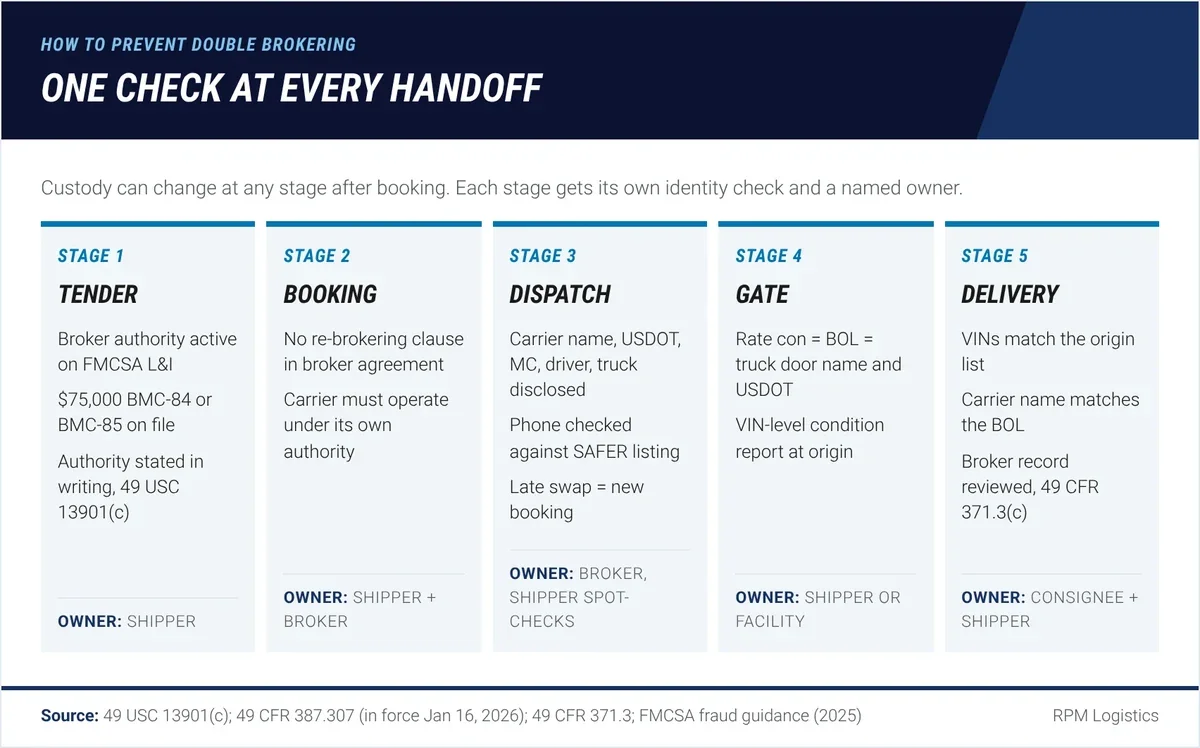
Most shipping programs check identity once, at booking. Custody can change at any of the four later handoffs, so each one gets its own check.
Double brokering is the undisclosed re-tender of a load to a carrier the shipper never approved. Double brokering prevention is the set of checks that confirm the carrier you booked is the carrier that hauls. This guide is written for OEMs, dealer groups, remarketers and fleet owners who tender finished vehicles to brokers and carriers.
The law and penalties are covered in our explainer on what double brokering is and who is liable. This piece covers the work: eight checks, their owners, and the signals of an unapproved handoff.
Why prevention falls to the shipper
Prevention falls to the shipper because federal enforcement has historically been thin. FMCSA told Congress it issued about 20 notices of claim for unauthorized brokering under 49 U.S.C. 14916 between 2014 and 2019 (FMCSA report to Congress on unlawful brokerage, 2024). That is a handful of cases across six years.
Double brokering is one route into cargo theft, and theft losses are large. Verisk CargoNet estimated 2025 US and Canadian cargo theft losses at $725 million, up 60% (Verisk CargoNet, 2026). The average loss per theft rose 36% to $273,990 (Verisk CargoNet, 2026).
The method has also shifted. In its Q1 2026 analysis of 767 supply chain crime events, CargoNet identified impersonation as a primary criminal method. It recommended identity verification throughout the shipment lifecycle, from booking to delivery (Verisk CargoNet, April 2026). That is the structure of the playbook below.
The 8-step shipper verification playbook
The playbook is eight checks spread across five handoffs: tender, booking, dispatch, gate and delivery. Steps 1 to 3 happen before you tender. Steps 4 and 5 happen between booking and pickup. Steps 6 and 7 happen at the vehicle, and step 8 closes the file after delivery.
1. Confirm broker authority and a live bond
A property broker needs broker operating authority and $75,000 in security (49 CFR 387.307). The filing is Form BMC-84 for a surety bond or BMC-85 for a trust fund. Look up the company in FMCSA's Licensing and Insurance system. Confirm the authority is active and typed as broker, then confirm a BMC-84 or BMC-85 is on file.
The Broker and Freight Forwarder Financial Responsibility rule took effect on January 16, 2026. FMCSA can now suspend a broker's authority when its security drops below $75,000 and is not restored (FMCSA, 2026). A broker with a lapsed bond is a warning sign. So is a "broker" whose only authority is carrier authority.
2. Ask for the operating authority in writing at tender
Federal law already requires the written statement you need. Under 49 U.S.C. 13901(c), a registrant "shall specify, in writing, the authority under which the person is providing such transportation or service".
Make it a tender requirement. The rate confirmation states the broker's MC number and whether it acts as broker or carrier. If it acts as broker, it names the carrier before dispatch. A party that claims carrier authority, then hands the load off, has put the conflict in writing.
3. Ban re-brokering in your transportation agreement
Your contract is where a ban on re-brokering your loads has to live. A common claim online says federal broker rules require shipper consent before re-brokering. They do not. 49 CFR Part 371 covers broker records, misrepresentation and rebating, but it contains no re-brokering consent provision.
Ask counsel to add three terms to the broker agreement.
- No re-brokering clause: the broker tenders only to a carrier with its own authority. That carrier may not re-tender or co-broker.
- Carrier disclosure: the carrier's legal name, USDOT and MC numbers come before dispatch and appear on the bill of lading.
- Carmack language: the carrier named on the bill of lading accepts liability under the Carmack Amendment (49 U.S.C. 14706). Carmack bars a carrier from setting less than 9 months to file a claim or 2 years to sue.
Carrier-side terms such as security, parking and route rules belong in a separate document. Our cargo theft prevention playbook covers those.
4. Get and check the carrier's identity before dispatch
Carrier identity means legal name, USDOT number, MC number and dispatch phone. Get these before the truck rolls. Ask the broker for the driver's name and the truck and trailer numbers too.
Then check them against the federal record, not against what the dispatcher sends. FMCSA advises confirming phone numbers in SAFER and treats a missing number as a red flag (FMCSA, 2025). Call the number listed in SAFER, not the number in the email. Our guide to DOT compliance checks for automotive carriers walks through the lookup.
5. Lock the communication channel
Locking the channel means accepting load changes only from known domains and known phone numbers. Communication-based attacks made up 50% of classified fraud vectors in Q2 2026 (Highway Freight Fraud Index, 2026). Highway, a carrier identity vendor, blocked 784,201 fraudulent inbound emails that quarter, up 58.3% year over year.
Write these rules into your load process:
- Reject carrier contact from free email domains or lookalike domains.
- Treat a late change of driver, truck or phone number as a new booking that needs new checks.
- Re-verify a carrier after a recent change of ownership or contact details. Highway found ownership-change fraud in 25.6% of reported thefts in Q2 2026 (Highway Freight Fraud Index, 2026).
Authority age alone does not prove much. CargoNet reported in April 2026 that criminal networks were buying legitimate carriers, which gives them established authority and history.
6. Run the three-way name match at the gate
The three-way name match compares three records. They are the rate confirmation, the bill of lading for car transport, and the truck door. All three must show the same carrier name and USDOT number before a vehicle is released.
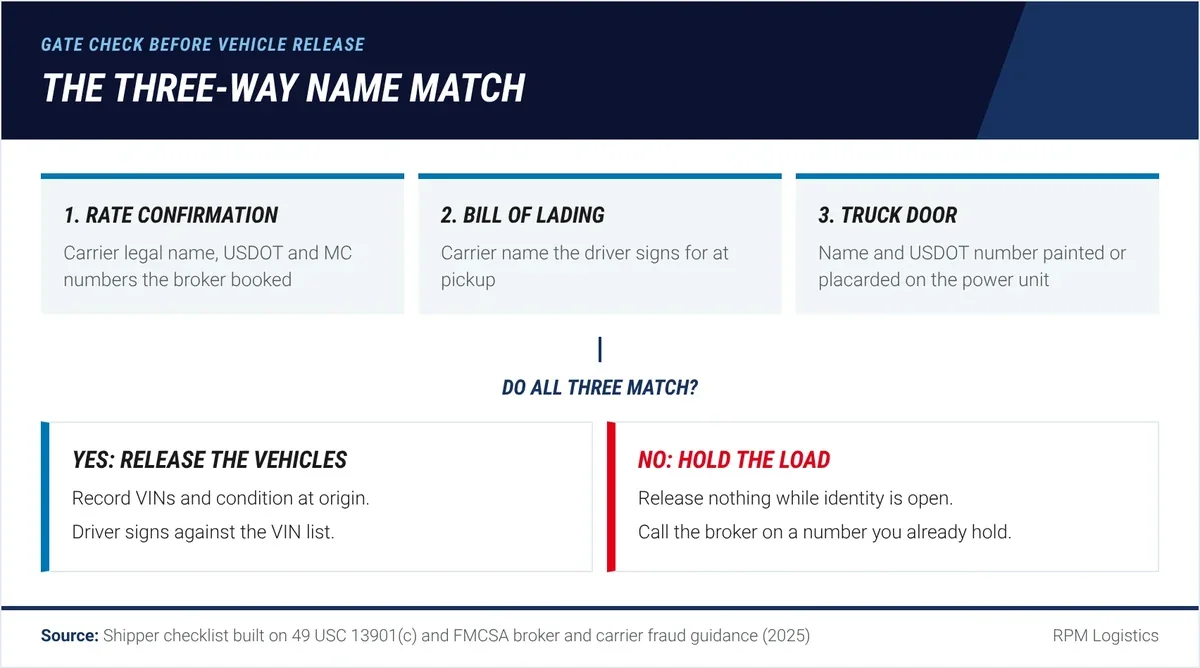
A mismatch is a hold, not a judgment call. The cost of a delayed pickup is small next to a released load nobody can trace.
A mismatch can mean double brokering or a fictitious pickup. CargoNet counted 158 fictitious pickups in Q2 2026, against 165 a year earlier (Verisk CargoNet, 2026). Driver ID, release codes and the rest of the gate routine are in our fictitious pickup gate verification procedure.
7. Record VINs at origin and match them at delivery
A VIN-level condition report is signed at pickup. It records each vehicle's VIN, odometer and damage, with photos. For finished vehicles it is also tamper evidence. Each unit carries a unique VIN, so the delivery receipt can prove the same vehicles arrived in the same condition.
Require the delivering driver to sign the delivery receipt against the origin VIN list. Check that the receiving carrier's name on the delivery paperwork matches the carrier on the bill of lading. A different carrier name at delivery signals that custody changed in transit. Our guide to insurance-grade condition reporting lists what the origin record should contain.
8. Reconcile payment and request the broker's record
Reconciliation is the last check. The carrier that delivered should be the carrier the broker paid. Under 49 CFR 371.3, brokers must keep a record of each transaction for three years. The record names the originating motor carrier and its registration number.
Each party to a brokered transaction has the right to review that record under 371.3(c). Spot-check it on a sample of loads each quarter. If the record names a carrier you never saw at the gate, you have found an undisclosed handoff to investigate.
How to detect double brokering after tender
You detect double brokering by comparing what you booked with what shows up. The gap can appear at dispatch, at the gate, or only at invoice. Missing it is costly. ATRI puts the annualized cost of cargo theft at up to $6.6 billion, over $18 million a day (ATRI, 2025).
The table below lists the signals by stage, for any vehicle shipment.
Stage | What you booked | Signal of a re-tendered load | Action |
|---|---|---|---|
Booking | Broker or carrier with stated authority | Party with carrier-only authority quotes as a broker, or rate far below market | Ask for the 13901(c) authority statement before tender |
Dispatch | Named carrier, driver and truck | Carrier name withheld until the day of pickup, or a same-day substitution | Re-run SAFER and L&I checks on the new carrier |
Dispatch | Contact on a known domain and phone | New email domain, free email address, or a call from an unlisted number | Confirm by calling the SAFER-listed number |
Gate | Carrier on the rate confirmation | Truck door name or USDOT number differs from the paperwork | Hold the load and call the broker on a known number |
Delivery | Same carrier and same VINs | Different carrier name on delivery paperwork, or a VIN missing from the receipt | Note exceptions on the receipt and open a claim file |
Invoice | Payment to the booked carrier | Payment request from a third party, or a carrier asking you to pay it directly | Request the 371.3 transaction record |
The per-firm cost is steep. ATRI found logistics service providers lose more than $1.84 million a year to theft (ATRI, 2025). Motor carriers lose more than $520,000.
Prevention advice that does not hold up for shippers
Some common advice fails against the regulations or against how vehicles move. The table below sets each claim against what holds.
Common advice | Why it falls short | What to do instead |
|---|---|---|
"Federal rules require your consent before a broker re-brokers" | 49 CFR Part 371 has no re-brokering consent provision | Write the prohibition into your broker agreement |
"Avoid carriers with new authority" | Criminal networks buy established carriers, per CargoNet (2026) | Check recent ownership and contact changes, not only age |
"Get a certificate of insurance" | A certificate shows coverage exists, not who is driving your load | Run the three-way name match at the gate |
"Track the shipment with an app link" | A tracking link follows a phone, which can be on any truck | Match the truck door, USDOT number and VINs in person |
"Check the broker once at onboarding" | Broker security can lapse after onboarding | Re-check BMC-84 or BMC-85 status on a schedule |
One pending change is worth watching. According to CCJ, FMCSA sent a supplemental broker transparency proposal to OMB for review on August 27, 2026. It is still a proposal, not a rule, so build your program on current requirements.
What to do if you suspect a load was double brokered
Stop the release first and investigate second. Do not hand over vehicles while the identity question is open. Call the broker on a phone number you already hold, not on one supplied in the moment.
- Record the truck door name, USDOT number, plates and driver ID.
- Preserve the rate confirmation, bill of lading, emails and call logs.
- Request the broker's transaction record under 49 CFR 371.3(c).
- Report fraud to FMCSA's National Consumer Complaint Database and to the FBI's IC3, as FMCSA advises.
For trend data and the 2026 regulatory picture, see our analysis of freight fraud in 2026.
Frequently Asked Questions
How do you detect double brokering on a vehicle shipment?
Compare what you booked with what arrives, and treat any mismatch as a possible unapproved handoff. The carrier name and USDOT number on the rate confirmation should match the bill of lading and truck door. Watch for same-day carrier swaps, new email domains and calls from unlisted numbers. At delivery, match VINs and the carrier name against the origin paperwork.
Is double brokering illegal?
Brokering a load without broker registration and the required $75,000 financial security violates 49 U.S.C. 14916. A carrier that re-tenders a load under carrier-only authority is brokering without authority. FMCSA's inflation-adjusted penalty for operating without required registration is $13,676 per violation (49 CFR Part 386, 2026). Re-brokering by a licensed broker against your contract terms is a contract issue between you and that broker.
What is an example of double brokering?
A typical pattern: a dealer group tenders a load of vehicles to a broker. The broker books a carrier, which accepts and then re-posts the load to a load board at a lower rate. A second carrier shows up at the gate under its own name. The shipper never approved that carrier, and the carrier it did approve never touched the vehicles.
Does federal law require shipper consent before a load is re-brokered?
No. 49 CFR Part 371 governs broker records, misrepresentation and rebating, and it contains no provision requiring shipper consent before re-brokering. Despite what some online guides say, the protection comes from your contract. Add a clause that bars re-brokering and co-brokering, and require the carrier's name, USDOT and MC numbers before dispatch.
Can a shipper see which carrier a broker used?
Yes. Under 49 CFR 371.3, a broker must keep a record of each transaction for three years. The record names the originating motor carrier and its registration number, and paragraph (c) lets each party review it. Request it in writing and compare it with your gate records.
Work with RPM
RPM arranges transport and manages booking, documentation, condition reporting and coordination across all 50 states and Canada. Contact Sales to discuss your next vehicle program.