

Quick answer: High value freight security is the set of controls that protect loads worth $100,000 or more against theft and fraud. Identity checks, written terms and matched insurance apply at every value tier. No-stop windows and secured staging become non-negotiable above $250,000. Dedicated equipment follows at $500,000, and per-load underwriting above $1 million.
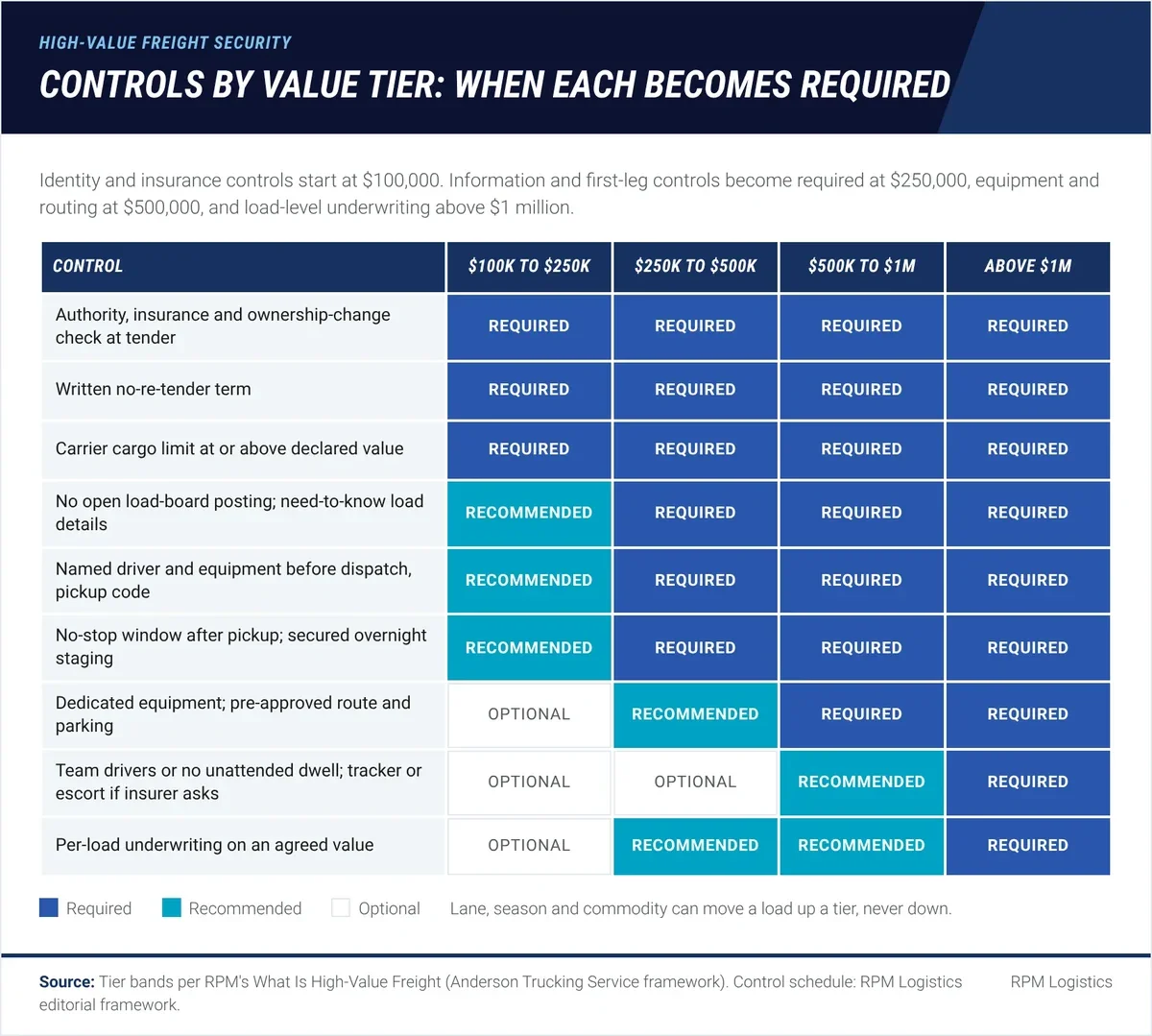
The tier sets the floor. A high-theft lane or holiday weekend can move a load up a column, never down.
High-value freight is cargo worth $100,000 or more per load, the point where value outruns a standard carrier cargo policy. Our guide to what counts as high-value freight covers that threshold and the four value tiers. This article starts where that one stops. It sets out which controls become non-negotiable at each tier and at each phase of a load.
Verisk CargoNet put the Q2 2026 average cargo theft loss at $564,009 among thefts with a reported value. The 2025 average was $273,990 (Verisk CargoNet, 2026). Q2 incidents fell 26% year over year, yet losses rose to $304.6 million. Verisk says organized theft now follows value, demand and resale opportunity.
Why security should scale with cargo value
Security should scale with value because control costs and loss sizes both rise by tier. A no-stop window costs a scheduling decision; a security escort costs a daily fee and advance booking. Putting an escort on a $120,000 load wastes money. Skipping the no-stop window on a $900,000 load invites a loss.
Value also changes who writes the rules. In the lower tiers, the shipper and broker set most controls. Above $500,000, the insurer can set them through conditions in the cargo policy. Three principles shape the tier plan below:
- The tier sets the floor. Lane, season and commodity can raise the required controls. They never lower them.
- Identity controls apply at every tier. Verisk says compromised email accounts let criminals identify high-value shipments and impersonate trusted parties (Verisk CargoNet, 2026).
- Physical controls scale with value. Escorts, team drivers and covert tracking devices earn their cost only at the top tiers.
Security controls by value tier
Controls by value tier is a schedule of protections that become required as declared value crosses each threshold. The thresholds are $100,000, $250,000, $500,000 and $1 million. The table shows when each control moves from optional to recommended to required.
Control | $100K to $250K | $250K to $500K | $500K to $1M | Above $1M |
|---|---|---|---|---|
Authority, insurance and ownership-change check at tender | Required | Required | Required | Required |
Written no-re-tender term | Required | Required | Required | Required |
Carrier cargo limit at or above declared value | Required | Required | Required | Required |
No open load-board posting; load details on a need-to-know basis | Recommended | Required | Required | Required |
Named driver and equipment confirmed before dispatch, with a pickup code | Recommended | Required | Required | Required |
No-stop window after pickup and secured overnight staging | Recommended | Required | Required | Required |
Dedicated equipment with pre-approved route and parking | Optional | Recommended | Required | Required |
Team drivers or no unattended dwell; covert tracker or escort if the insurer asks | Optional | Optional | Recommended | Required |
Per-load underwriting on an agreed value | Optional | Recommended | Recommended | Required |
$100,000 to $250,000: lock down identity and paperwork
The first tier is about who gets the load: check authority, cargo limit and any recent ownership change. Highway's Freight Fraud Index found ownership-change fraud in 25.6% of reported thefts in Q2 2026 (Highway, 2026). Put a no-re-tender term in writing. Our explainer on what double brokering is and who is liable covers the law.
$250,000 to $500,000: control information and the first leg
At the second tier, the load details become the asset to protect. Keep the load off open load boards and share VINs, values and addresses only with people who need them. Confirm the named driver and equipment before dispatch, and issue a pickup code.
Add a no-stop window after pickup and secured overnight staging. Our cargo theft prevention playbook assigns these controls to shipper, broker, carrier and facility.
$500,000 to $1 million: dedicate the equipment and the route
At the third tier, consolidation becomes the risk. A shared trailer means extra stops, extra handoffs and extra people who know the load. Book dedicated equipment, agree the route and parking in writing, and expect the insurer to attach conditions. A covert tracking device, owned and monitored by the shipper's provider, becomes a reasonable add-on here.
Above $1 million: underwrite the load, not the carrier
Above $1 million, the shipment needs its own underwriting and an agreed value set before pickup. Team drivers or a no-unattended-dwell rule apply, and an escort may become a policy condition. Any exception needs written sign-off from a named person. ATRI puts average theft losses for logistics service providers above $1.84 million a year (ATRI, Oct 8, 2025).
Security by load phase
Load-phase security ties each control to where the load is: tender, pickup and the first miles, in-transit stops, or delivery. Each phase fails in a different way. The table pairs each phase with its threat, a published data point and tier controls.
Phase | Main threat | Data point | Baseline control | Added at $250K and up |
|---|---|---|---|---|
Tender | Impersonation, account takeover, ownership-change fraud | Ownership-change fraud in 25.6% of reported thefts, Q2 2026 (Highway) | Authority, insurance and ownership check | No load-board posting; need-to-know details |
Pickup and first 50 miles | Fictitious pickup; trucks followed from origin | 68% of Red Zone incidents in the first 50 miles (Overhaul, Jul 2025 to Jun 2026) | Gate identity check | Pickup code; no-stop window; no overnight staging on open lots |
In-transit stops | Pilferage and full truckload theft | Pilferage 46% of US incidents, Q2 2026 (Overhaul) | Stop plan; locked trailer; keys held by the driver | Pre-approved parking (required from $500K); team drivers above $1M |
Delivery | Release to the wrong party; unrecorded damage | Not broken out in the 2026 datasets reviewed | VIN match against the origin list | No after-hours drops; named receiver only |
Tender: where impersonation starts
Tender is the phase where the load is offered and booked. CargoNet counted 158 fictitious pickups in Q2 2026, against 165 a year earlier (Verisk CargoNet, 2026). Confirm contacts through phone numbers you sourced, not numbers in the email. At $250,000 and up, limit who sees the load details at all.
Pickup, dwell and the first 50 miles
In Southern California, the first miles after pickup carry the most risk. Overhaul studied its regional Red Zone, the first 200 miles of travel out of the region. It found 68% of incidents within the first 50 miles. That share rose from 61% in the prior analysis (Overhaul, reported by Truck News, Aug 13, 2026).
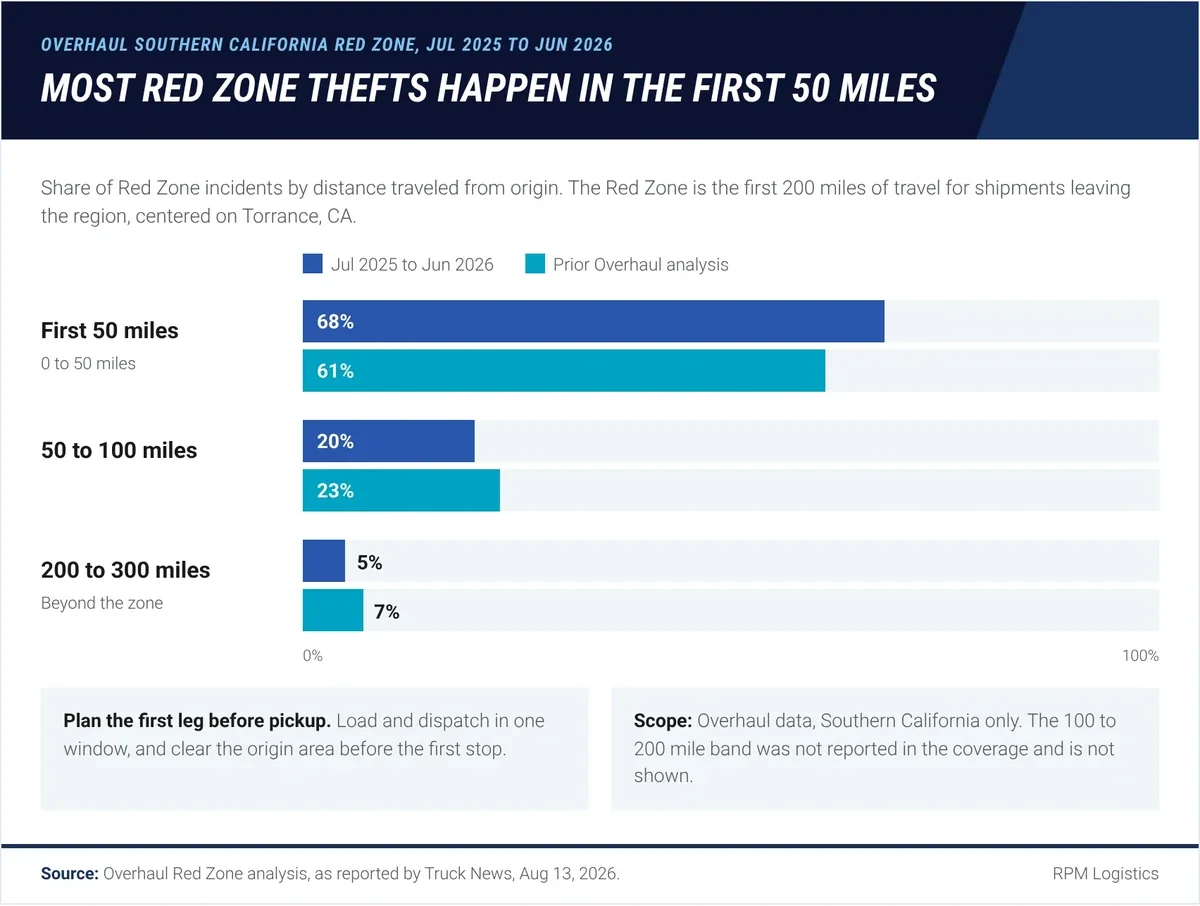
The 100 to 200 mile band was not reported in the coverage, so the chart shows only the published shares.
The 50 to 100 mile band held 20% of incidents, down from 23%. The 200 to 300 mile band held 5%, down from 7%. The Red Zone held 38% of all US cargo thefts in the 12 months to June 2026 (Overhaul, 2026). Overhaul says one common tactic is to follow trucks from warehouses and wait for a chance at the cargo.
Dwell before pickup matters too. Warehouses and distribution centers made up 37% of theft locations in Q2 2026, and midnight to 6 a.m. accounted for 28% of reports (Overhaul via FreightWaves, Aug 28, 2026). Overhaul's data covers the US only, so do not set it beside CargoNet totals. Controls for this phase:
- Load and dispatch in one window, so loaded trailers do not sit overnight on open lots.
- Run the gate identity check before release. Our fictitious pickup gate procedure lists the steps.
- Above $250,000, agree a no-stop window after pickup that clears the origin area.
In-transit stops: where pilferage happens
An in-transit stop is any fuel, rest or hours-of-service break between pickup and delivery. Pilferage made up 46% of US incidents in Q2 2026, and full truckload theft 21% (Overhaul, 2026).
Plan stops before dispatch, keep trailers locked, and keep vehicle keys with the driver. Above $500,000, pre-approve parking; above $1 million, use a team driver. For holiday risk, see our cargo theft statistics for 2026.
Delivery: release only against the record
Delivery is the final custody transfer and needs the same identity discipline as pickup. Release only to the named receiver, match each VIN against the origin list, and photograph condition at handoff. Our guide to insurance-grade condition reporting lists what that record should hold. At $250,000 and up, ban after-hours drops unless a named person signs for the vehicles.
Applying the tiers to finished vehicles
Finished vehicles reach high-value tiers faster than most freight, because one unit can carry six or seven figures. Auto and parts made up 11% of US incidents in Q1 2026, up 51% from Q1 2025 (Overhaul via FreightWaves, 2026). That category includes parts, so treat it as context. The table maps common vehicle moves to tier and exposure.
Shipment type | Typical tier | Specific exposure | Controls that matter most |
|---|---|---|---|
Exotic and supercar dealer inventory | $250K to $1M per load | Model, VIN and location details shared across sales staff, lenders and transporters | Enclosed equipment; no load-board posting; per-unit cargo limit |
Collector cars, single or multi-unit | $100K to above $1M | Value tied to condition; disputes over valuation after a loss | Agreed value; soft-tie securement; matched condition reports |
OEM prototypes and pre-production units | Set by program value, not resale | Photos and design leaks as well as theft | Covered or enclosed equipment; need-to-know dispatch; no identifying paperwork on view |
High-line auction and remarketing transit | $100K to $500K | Several gate releases and handoffs in a short window | Release codes; VIN match at each handoff |
Four controls carry most of the weight for vehicles:
- Enclosed equipment. It hides the units from view in yards, at stops and on the road. For securement, see soft-tie versus hard-tie enclosed transport.
- No load-board exposure. A public posting tells strangers the model, the origin and the pickup date.
- Need-to-know dispatch. The driver gets addresses and contacts. Values and VIN lists go only to parties who sign for the units.
- VIN-level documentation. Each unit has its own record at origin and delivery. It is proof of custody as well as condition.
Dealer inventory adds floorplan and consignment questions. Our guide to supercar dealer inventory transport covers the service terms.
Declared value versus the carrier's cargo limit
Declared value is the value the shipper states for the load. The carrier's cargo limit is the most its policy pays per load or per unit. Any gap above that limit is uninsured unless someone covers it. Under 49 U.S.C. 14706(c)(1)(A), a carrier may limit liability to a value set by the shipper's written declaration or by written agreement.
Carriers carry heavy theft exposure of their own. ATRI found motor carriers lose more than $520,000 a year to theft on average (ATRI, 2025). A carrier's policy is not built around your load. Check these five points before tender.
Check | What to look for | Why it matters at higher tiers |
|---|---|---|
Per-load limit | A dollar limit at or above the declared value of this load | A $1.2M load on a $250K policy leaves most of the value uninsured |
Per-unit limit | A per-vehicle limit at or above the most valuable unit | One exotic can exceed a per-unit cap even when the load total fits |
Theft and fraud terms | How the policy treats freight released to an impostor | Voluntary parting exclusions can defeat a fictitious pickup claim |
Policy conditions | Rules on unattended vehicles, parking and stops | A broken condition can void cover, so the security plan must match it |
Valuation basis | Agreed value or actual cash value | Actual cash value defers the valuation argument until after a loss |
The example figures in the table are illustrations, not market rates. To close a gap, raise the carrier's limit, buy shipper-side cargo or excess cover, or split the load. Splitting a $900,000 load into two shipments can drop each one a tier. It also adds a second pickup, so the identity controls run twice.
Where escorts and tracking devices fit
Escorts and covert tracking devices are top-tier add-ons that the shipper or its insurer arranges with a specialist provider. They deter and locate. They do not verify identity. In a fictitious pickup, the freight is released to an impostor, and a tracker simply follows the impostor's truck.
Deceptive pickups made up 11% of US incidents in Q2 2026 (Overhaul, 2026). Those losses are decided at tender and at the gate, not on the highway. Use the add-ons where they earn their cost.
- Security escort: when the insurer requires one, when a unit is irreplaceable, or above $1 million in a theft corridor.
- Covert tracking device: from $500,000, inside the load or vehicle, owned by the shipper and monitored by its provider.
- Neither: as a substitute for tender checks, gate checks or a matched cargo limit.
Frequently Asked Questions
What is considered high value freight?
High value freight is cargo worth $100,000 or more per load, a market convention rather than a federal rule. It marks the point where value exceeds a standard carrier cargo policy. Finished vehicles cross it quickly, since a single exotic or a small collector load can exceed $250,000. Security requirements then rise with each value tier above the threshold.
How common is cargo theft?
Verisk CargoNet counted 2,646 confirmed cargo thefts in the US and Canada in 2025, about seven a day. Estimated 2025 losses reached nearly $725 million. In Q2 2026, incidents fell 26% year over year, but losses rose to $304.6 million. Overhaul, which covers the US only, reported 605 thefts in Q2 2026; both count reported cases only.
What security does a high value shipment need?
It depends on the value tier. Every high value shipment needs identity checks, a no-re-tender term and a cargo limit that covers declared value. Above $250,000, add need-to-know load details, a named driver, a pickup code and a no-stop window. Above $500,000, add dedicated equipment and an agreed route, and above $1 million, underwrite the load.
When does a high value load need a security escort?
An escort makes sense when the insurer requires one or a single unit cannot be replaced. It also fits a load above $1 million on a known theft corridor. Below those points, spend first on tender and gate controls. An escort does not stop a fictitious pickup, because that fraud happens at tender and at the gate.
Where are high value loads most likely to be stolen?
The data points to origin areas and parked equipment. Overhaul found 68% of incidents in its Southern California Red Zone within the first 50 miles of travel. Warehouses and distribution centers made up 37% of US theft locations in Q2 2026. Pilferage accounted for 46% of US incidents that quarter, so plan the first leg and every stop before dispatch.
Set the security tier for your next vehicle move
RPM arranges enclosed and open vehicle transport across all 50 states and Canada, with carriers screened to RPM onboarding criteria, including MVR checks, before a load is booked. Contact Sales to plan controls around the value of your next high-value shipment.