

Quick answer: Fleet transport mode selection is the call, made for each move, on whether a unit is driven or loaded on a carrier. A fleet-wide standing preference gets that call wrong by design. Write a mode policy instead: a default per move type, named override triggers, clear decision rights and a log of every exception.
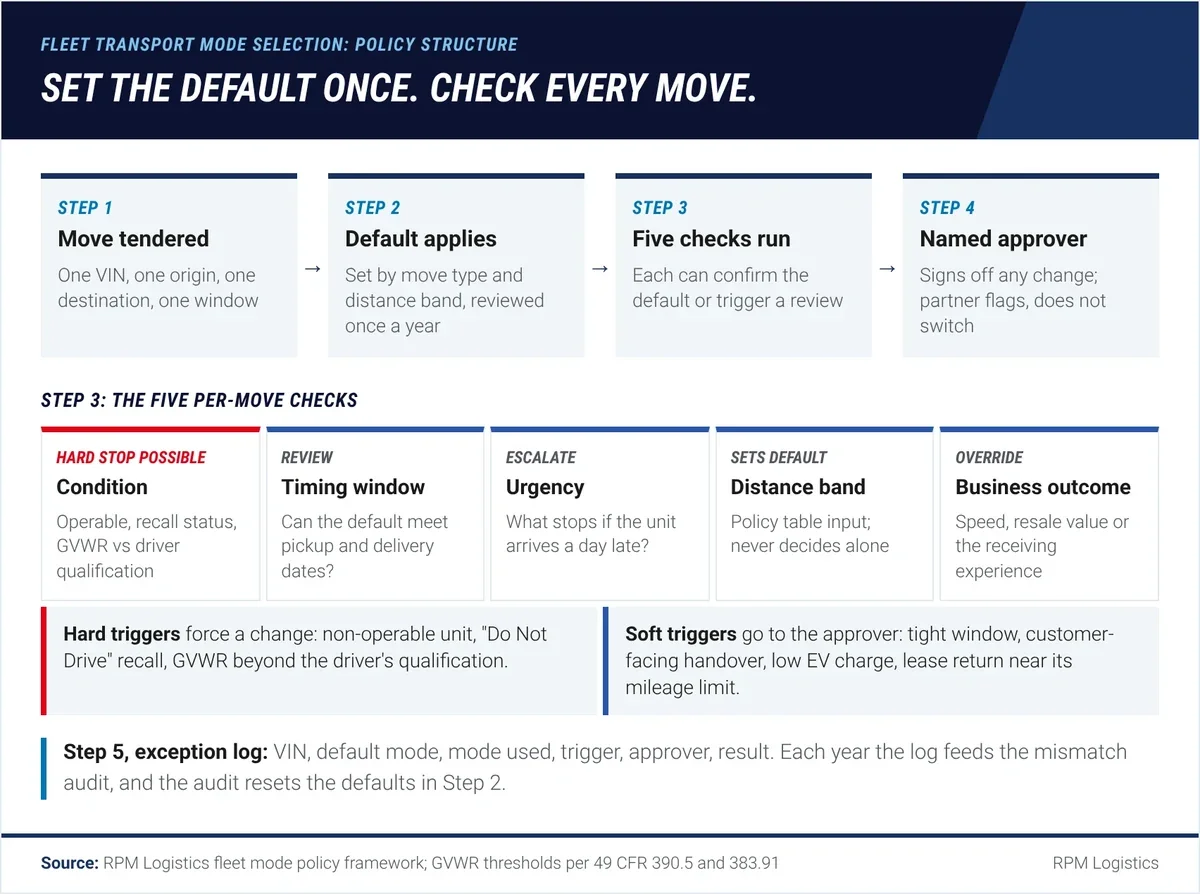
The policy sets the default and the exits from it. It does not pick a winning mode, and it should not try to.
A fleet transport mode policy is the written rule set that decides how each fleet move is made. It covers who chooses, what the starting answer is, and when that answer changes. Most fleets never write one. They inherit a habit instead.
This piece takes a position. A fleet that calls itself a "driveaway fleet" or a "haulaway fleet" has already made a mistake. So has a fleet that buys transport from a vendor that only offers one mode. Mode belongs to the move, not to the fleet.
The Mistake Is the Standing Preference
A standing mode preference is a fleet-wide rule that every unit moves one way unless someone fights it. It feels efficient. It removes a decision from every tender. That removed decision is the problem.
The fleet market is large enough for this to matter. US fleet sales reached 2.6 million new vehicles in 2024, 17.3% of new-vehicle sales, per Cox Automotive's 2024 fleet sales analysis (Cox Automotive, 2025). Many of those units will move more than once in service. Those moves will not all need the same handling.
Standing preferences usually come from one of three places:
- Procurement simplicity: one rate card and one vendor are easier to manage than a decision per move.
- A past bad experience: one damaged unit on a carrier, or one odometer dispute after a drive, becomes a rule.
- A single-mode vendor: a provider that only sells one mode will answer every tender with that mode.
None of these is about the vehicle being moved. That is the tell. The mode should follow the unit's condition, deadline and destination.
The economics of each mode are a separate question, covered in our comparison of when each mode wins on cost, speed and asset protection. This article does not re-argue them. It argues about who decides, and how.
Mode Belongs to the Move, Not the Fleet
Mode is a property of a single move because the inputs change from move to move. The same pickup truck can need different handling at four points in its life.
It leaves an upfitter with new equipment and a fixed delivery date. It gets reassigned to a new driver two states away. It goes into a body shop after a collision. It returns at lease end, when every added mile shows up at remarketing.
The table below shows what shifts at each of those points. It deliberately does not name a mode. The point is that the inputs differ, so a single standing answer cannot fit all four.
Move in the unit's life | What is different about this move | Who cares most about the outcome |
|---|---|---|
Upfitter to first site | New equipment aboard; a crew is waiting on a fixed date | Field operations |
Reassignment between drivers or sites | Unit is in service; downtime is the cost | Fleet operations and the receiving manager |
Damaged or recalled unit to repair | Unit may not be safe or legal to drive | Risk and safety |
End of lease or remarketing | Odometer and condition set the resale value | Finance and remarketing |
The vehicle mix is also shifting. Electric vehicles took 7.8% of US new-vehicle sales in 2025, close to 1.3 million units, per Cox Automotive's Q4 2025 EV sales report (Cox Automotive, 2026). EV share was 5.8% in Q1 2026 (Cox Automotive, 2026). A fleet adding EVs inherits a new variable on every move: state of charge at pickup and charging along the route.
Five Factors That Decide Each Move
The per-move decision factors are five questions asked at tender, before a mode is booked. They are vehicle condition, timing window, urgency, distance band and business outcome. Each one can confirm the default or trigger a review.
The matrix below frames each factor as a tender question. It does not score modes against each other. It tells the person booking the move what to check, what the answer can trigger, and who should answer.
Factor | Question at tender | What the answer can trigger | Who answers |
|---|---|---|---|
1. Vehicle condition | Is the unit operable, legal and safe to drive today? | Hard override if not; no one may waive it | Fleet operations, from the condition and recall check |
2. Timing window | How wide is the pickup and delivery window? | Review if the default mode cannot meet the window | Requester, confirmed by the logistics partner |
3. Urgency | What stops if this unit arrives a day late? | Escalation to the named approver | Receiving manager |
4. Distance band | Which band does the lane fall in under your policy? | Sets the default; does not decide alone | Policy table, set once a year |
5. Business outcome | Is this move about speed, resale value, or the experience of the person receiving it? | Override toward the outcome named | Owner of the outcome: operations, finance or HR |
Condition is the only factor that cannot be overridden
Vehicle condition sits first because it can end the discussion. A non-running unit cannot be driven. A unit under an open safety recall may not be safe to drive.
NHTSA counted 997 recalls in 2025 across vehicles, car seats, tires and equipment. More than 29 million vehicles were recalled, per NHTSA's Vehicle Safety Recalls Week guidance (NHTSA, 2026). NHTSA also notes some recalls are later updated with "Do Not Drive" warnings. A recall check by VIN belongs in every tender, not just the ones that look risky.
Weight changes who can legally drive the unit
Weight is a condition factor too, and a regulatory one. Under 49 CFR 390.5, a vehicle with a GVWR of 10,001 pounds or more is a commercial motor vehicle. Driving it interstate brings FMCSA driver rules into play.
Those rules include the hours-of-service cap of 11 hours of driving inside a 14-hour window (49 CFR 395.3, 2026). At 26,001 pounds GVWR, a single vehicle falls in Group B under 49 CFR 383.91, which calls for a CDL. A policy that ignores these thresholds will book moves that cannot legally run as planned.
How to Write a Fleet Mode Policy
A fleet mode policy is a one-page document with four parts: decision rights, defaults, override triggers and an exception log. It does not need software. It needs names.
Decision rights
Decision rights state who may set, change and approve a mode. Without them, the mode is set by whoever books first. Write down three roles:
- Policy owner: sets the defaults and distance bands once a year. Usually the fleet manager.
- Override approver: one named person per region or program who signs off on any change from the default.
- Logistics partner: may recommend a change and must flag a hard trigger, but should not switch modes without approval.
Defaults by move type
A default is the starting mode for a move type, not for the fleet. Set one per row of the lifecycle table above, and one per distance band. A default exists to save time on routine moves. It is not a verdict on which mode is better.
Override triggers
An override trigger is a named condition that forces a review of the default. Split them into two groups:
- Hard triggers force a change with no discretion: the unit is non-operable, it has an open recall with a "Do Not Drive" warning, or its GVWR exceeds what the assigned driver is qualified to operate.
- Soft triggers require the approver to decide: a delivery window the default cannot meet, a customer-facing handover, an EV below the charge level your policy sets, or a lease return near its mileage limit.
The exception log
The exception log is a record of every move that left its default. Keep six fields: VIN, default mode, mode used, trigger, approver and result. The result field matters most. It is what turns an override into evidence for next year's defaults.
What a Partner Running Both Modes Changes
A logistics partner that arranges both modes can follow the policy instead of steering it. A single-mode vendor cannot. When a hard trigger fires, its only options are to decline the move or send it elsewhere.
A partner running both modes changes three things for a fleet:
- Overrides do not need a new vendor. When a soft trigger fires, the approver changes the mode, not the contract.
- Records stay in one format. Condition reports, documents and status look the same whichever way the unit moves. That closes one of the gaps in our piece on who owns status across fleet vehicle handoffs.
- The exception log is complete. One partner sees every move, so the audit below has full data rather than two partial ones.
On the driven side, RPM driveaway drivers are MVR-screened at onboarding, with continuous MVR monitoring. That control model is laid out in driveaway program design for multi-site fleets. On the carrier side, carriers are screened to RPM onboarding criteria, including MVR checks, before a load is booked. How long-haul loads are planned is covered in how haulaway works for long-distance fleet moves.
RPM also tracks a network accident frequency of 3.5 accidents per million miles moved (RPM Logistics, 2026 YTD). It is a measured network figure, not a promise for any single move. For a full view of the driven side, see RPM's driveaway services for fleets.
How to Audit Last Year's Moves for Mode Mismatch
A mode-mismatch audit compares the mode each past move used with the mode your new policy would have chosen. It shows where a standing preference may have cost you. Run it on the last 12 months of moves before you set defaults.
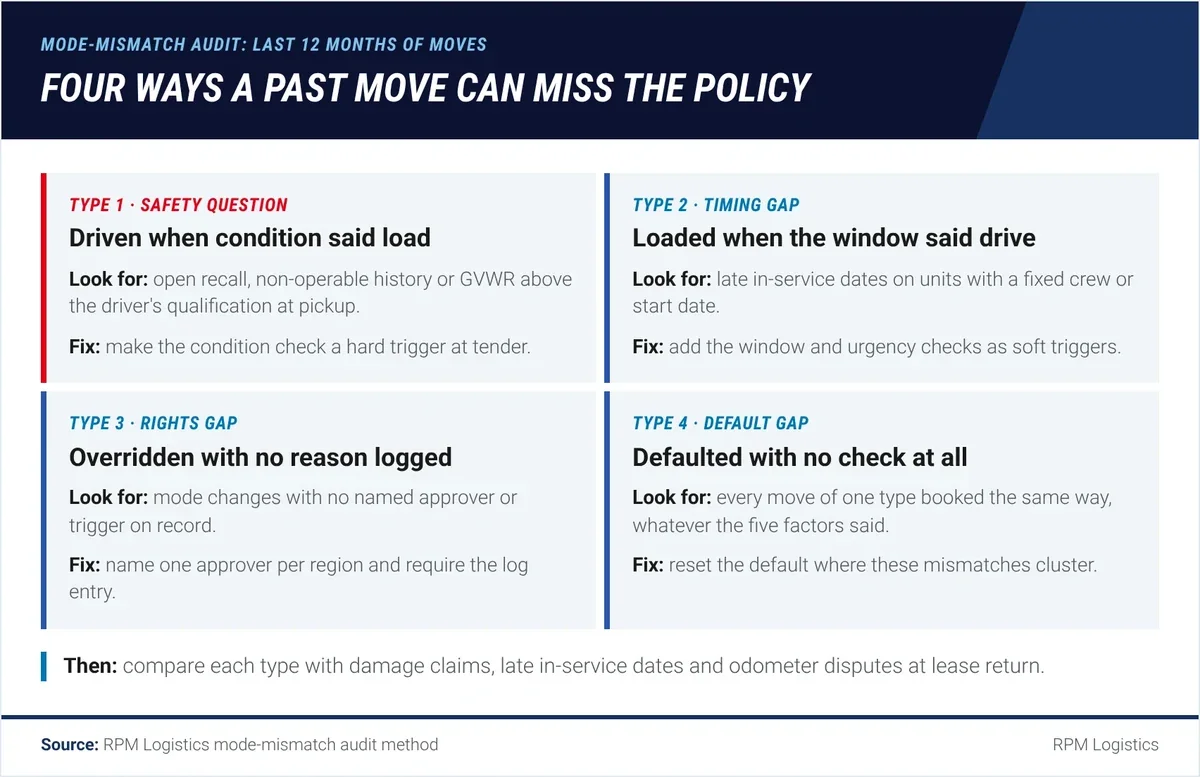
Only the first type is a safety question. The other three are policy gaps, and the log is what exposes them.
The audit takes five steps:
- Pull the move log. One row per VIN per move, with origin, destination, dates and mode used.
- Tag each move with the five factors. Condition at pickup, window, urgency, distance band and business outcome. Recall status by VIN goes here.
- Apply the draft policy. Mark what the default and triggers would have chosen.
- Sort the mismatches into four types. Driven when condition said load. Loaded when the window said drive. Overridden with no reason logged. Defaulted with no check at all.
- Check downstream signals. Look for damage claims, late in-service dates and odometer disputes at lease return. Then see which mismatch type they cluster in.
The downstream signals connect to work other RPM pieces cover in depth. Late in-service dates show up in the gap between delivered and ready for deployment. Odometer and residual effects are the subject of how asset value is protected in driveaway programs.
Where mismatches cluster, change the default for that move type or distance band. Where they scatter, the defaults are probably fine and the triggers need work. Mode mechanics for each side are in how professional driveaway works and the haulaway guide above.
The same audit applies beyond new-unit delivery. Fleets that move units between employees, sites and storage can run it across corporate fleet vehicle relocation services too.
Frequently Asked Questions
What is fleet transport mode selection?
Fleet transport mode selection is the decision, made for each move, on whether a fleet unit is driven to its destination or loaded on a carrier. It should depend on the unit's condition, the timing window, urgency, distance band and the business outcome the move serves. A fleet mode policy sets the default and the triggers for changing it.
Should a fleet have one standard transport mode?
No. A single standing mode removes the per-move decision, and that decision is where condition, deadlines and resale value get weighed. Fleets should set a default per move type and distance band instead. Named override triggers then move individual units off the default when the facts call for it, with the change logged.
Who should decide the transport mode for a fleet move?
The fleet manager should own the policy and its defaults. One named approver per region or program should sign off on overrides. The logistics partner should flag hard triggers, such as a non-operable unit or an open recall, and recommend changes. It should not switch modes on its own without the approver's sign-off.
What should trigger a change from the default transport mode?
Hard triggers force a change: a non-operable unit, an open recall with a "Do Not Drive" warning, or a GVWR the assigned driver cannot legally operate. Soft triggers need an approver: a delivery window the default cannot meet, a customer-facing handover, low EV charge, or a lease return close to its mileage limit.
How do you audit fleet moves for the wrong transport mode?
Pull 12 months of moves by VIN and tag each with the five factors. Apply your draft policy and mark where the mode used differs from what the policy would choose. Sort mismatches into four types, then compare them with damage claims, late in-service dates and odometer disputes. Change defaults where mismatches cluster.
Do heavier fleet vehicles change the transport decision?
Yes. Under 49 CFR 390.5, a vehicle with a GVWR of 10,001 pounds or more is a commercial motor vehicle, so FMCSA driver rules apply when it is driven interstate. A single vehicle at 26,001 pounds or more requires a CDL under 49 CFR 383.91. A mode policy should check GVWR before any driven move is booked.
Put Your Fleet's Mode Decisions on Paper
RPM Logistics arranges driven and carrier-loaded fleet moves in all 50 states and Canada, managing booking, documentation and condition reporting. To see where a standing preference is costing your fleet, Get a Fleet Assessment.