

Quick answer: Fleet insurance transport risk is the exposure a fleet takes on when its vehicles move between sites, upfitters or auctions. Which policy responds depends on the move type: a haulaway carrier's cargo coverage, a driveaway provider's coverage, or the fleet's own auto policy. Losses the fleet's own policy pays show up on its loss runs.
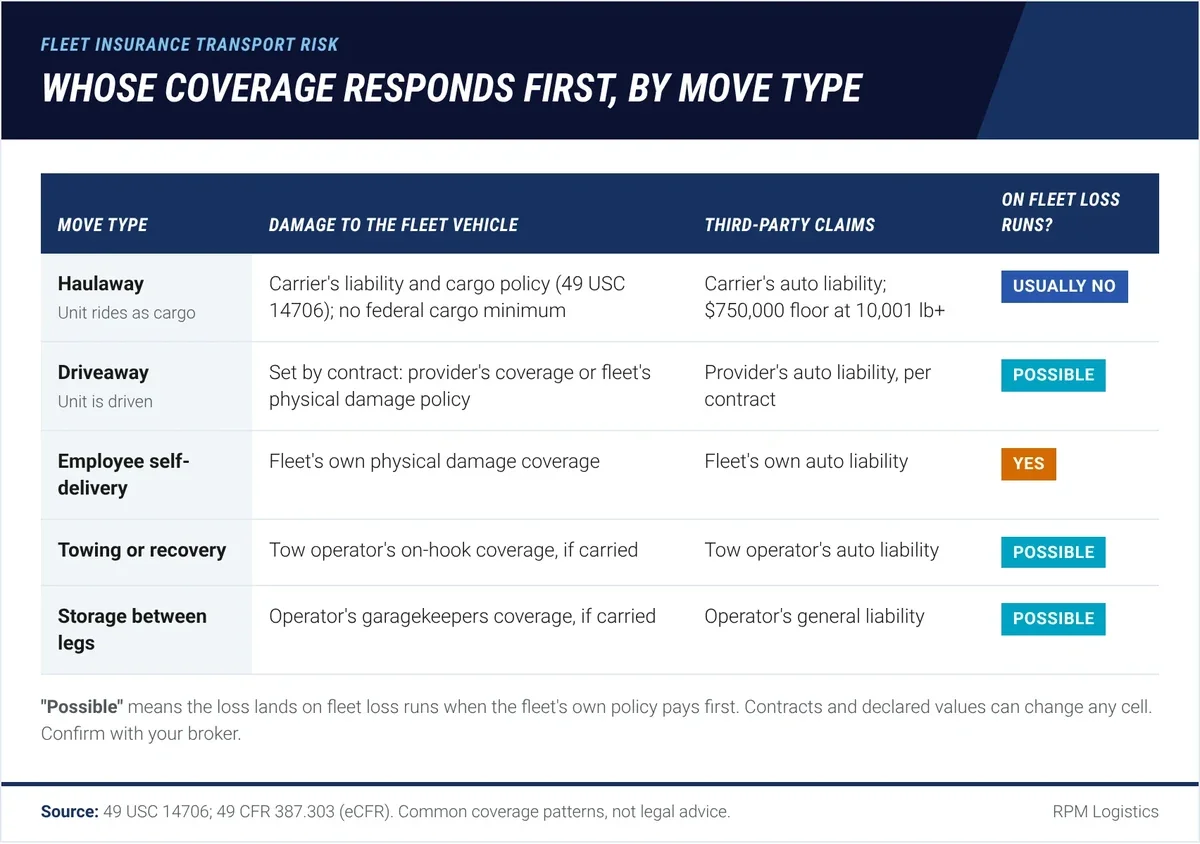
The map shows the usual first responder, not the final payer. Contracts, declared values and subrogation can move the cost after the fact.
Transport risk is the chance of loss while a fleet vehicle is off its assigned route and in someone else's hands. It covers the trip to the upfitter, the transfer between branches and the run to auction. It also covers the days a unit sits in a yard between legs.
Most fleet insurance advice is about drivers on the road. This guide covers the transport leg instead. It explains whose coverage responds by mode, how transit losses reach your loss runs, and which controls you own. It describes how coverage commonly works. It is not legal or insurance advice, so confirm every point with your broker and counsel.
Why the Transport Leg Is a Separate Insurance Question
The transport leg is a separate question because custody changes hands, and coverage often follows custody. On a normal workday, your employee drives your vehicle under your policy. During a move, a carrier, a driveaway provider or a tow operator may hold the unit instead.
That matters because the line your fleet buys is under pressure. AM Best reported a 2024 combined ratio of 113 for commercial auto liability and 88.6 for physical damage (AM Best via Insurance Journal, 2025). A combined ratio above 100 means losses and expenses exceeded the premiums insurers earned.
AM Best also called 2024 the 14th consecutive year of commercial auto underwriting losses, at about $4.9 billion (AM Best, 2025). The segment lost about $1.9 billion in 2025, even as the overall industry posted a combined ratio of 93 (AM Best via Claims Journal, 2026).
The forecasts point the same way. A Triple-I and Milliman outlook from January 2026 named general liability and commercial auto as the only major lines forecast to stay above 100. Underwriters review loss runs at renewal. A transit loss your own policy absorbs becomes part of that record.
Which Policy Responds, by Move Type
The policy that responds first is usually the one held by whoever has custody and control of the vehicle. The table below shows the common pattern by move type. Your contracts can change it, so treat it as a starting map for a broker conversation.
Move type | Who controls the unit | Damage to the fleet vehicle: first look | Third-party injury or property damage | Usually on fleet loss runs? |
|---|---|---|---|---|
Haulaway | Motor carrier | Carrier, under its liability for the cargo and its cargo policy | Carrier's auto liability | No, unless the fleet's own policy pays first |
Driveaway | Driveaway provider's driver | Set by contract; the provider's coverage or the fleet's physical damage policy | Provider's auto liability, per contract | Possible, depending on contract and claim |
Employee self-delivery | Fleet employee | Fleet's own physical damage coverage | Fleet's own auto liability | Yes |
Towing or recovery | Tow operator | Tow operator's on-hook coverage, if carried | Tow operator's auto liability | Possible, if the fleet's policy pays first |
Storage between legs | Yard or storage operator | Operator's garagekeepers coverage, if carried | Operator's general liability | Possible, if the fleet's policy pays first |
Haulaway: the carrier's cargo coverage, with no federal floor
Haulaway means the vehicle rides on a truck as cargo. Under 49 USC 14706, the carrier is liable for the actual loss or injury to the property. That federal rule is known as the Carmack Amendment.
The statute does not set an insurance amount. Carriers pay claims from their own funds or their motor truck cargo policy. Section 14706(c) also lets a carrier limit its liability to a value the shipper declares in writing or agrees to.
Federal rules set no cargo insurance minimum for auto carriers. Under 49 CFR 387.303, the cargo filing requirement applies to household goods carriers only. The well-known $750,000 figure is public liability for for-hire trucks of 10,001 pounds or more. It pays for harm to others, not to your vehicles.
So the cargo limit on a carrier's certificate is a market choice, not a regulation. The gap between that limit and a load of upfitted units is your exposure. Our guide to checking an auto carrier's authority and insurance covers the lookup steps.
Driveaway: the vehicle is the one being driven
Driveaway means a professional driver operates your vehicle on public roads to its destination. Your unit is both the cargo and the vehicle in the crash. That makes the coverage question harder than haulaway.
Federal minimum liability for for-hire carriers depends on vehicle weight. It is $300,000 under 10,001 pounds GVWR and $750,000 at 10,001 pounds or more for nonhazardous property (49 CFR 387.303). How those floors apply to a specific driveaway program is a question for the provider's insurance broker.
Damage to the driven unit itself is usually settled by contract. Some providers carry coverage for vehicles they operate. Other programs leave first-party damage on the fleet's own physical damage policy. Get the answer in writing before the first move. The trade-offs between driveaway and haulaway cover cost and wear; this is the insurance side of that choice.
Driver screening is the other control. Ask how drivers are screened before they get keys, including MVR (motor vehicle record) checks. Corporate programs that need driven moves often use dedicated corporate fleet vehicle relocation services built around screened professional drivers.
Employee self-delivery, towing and storage
Employee self-delivery keeps every part of the risk in-house. The fleet's own policy is primary, and any crash is a fleet claim. It also adds miles to the unit and pulls the employee off the job.
Towing and storage sit in between. A tow operator may carry on-hook coverage for vehicles in tow. A storage yard may carry garagekeepers coverage for vehicles in its care. Neither is assumed, so ask for the certificate. The damaged-vehicle recovery process covers the tow and storage clock.
How Transport Losses Reach Your Loss Runs
A loss run is your insurer's record of claims filed and paid under your policy. Underwriters review it at renewal. A transit loss reaches it whenever your own policy pays first.
A common sequence looks like this. A driver finds damage a week after delivery. Nobody noted it on the delivery receipt. The fastest fix is a claim on the fleet's physical damage coverage, and the unit goes back in service.
Your insurer may then pursue the carrier through subrogation. Subrogation is the insurer's right to recover what it paid from the party that caused the loss. It depends on a file that shows the damage happened in transit.
That proof is a matched pair of condition records, one at pickup and one at delivery. The workflow is covered in our guide to photo condition reports for fleet transport claims. For higher-value units, see what insurance-grade condition reporting adds. How a recovered claim is shown on your loss runs varies by insurer. Ask your broker how transit claims and recoveries are coded.
The carrier side is under the same strain. ATRI found truck liability premiums rose 18.6% to 10.2 cents per mile from 2021 to 2024. Per-mile liability losses rose 33.1% over the same period, per ATRI's May 2026 insurance cost research. Insurance premiums then rose nearly 4% to 10.6 cents per mile in 2025 (ATRI via CCJ, 2026).
Carrier Claim Deadlines Fleets Should Calendar
A carrier claim deadline is the period the law requires a carrier to allow for claims. Missing it can forfeit a recovery your own policy then has to absorb.
The federal rules set two clocks and a response schedule. Carriers may not allow less than 9 months to file a claim. They may not allow less than 2 years to sue after they deny it in writing (49 USC 14706(e)).
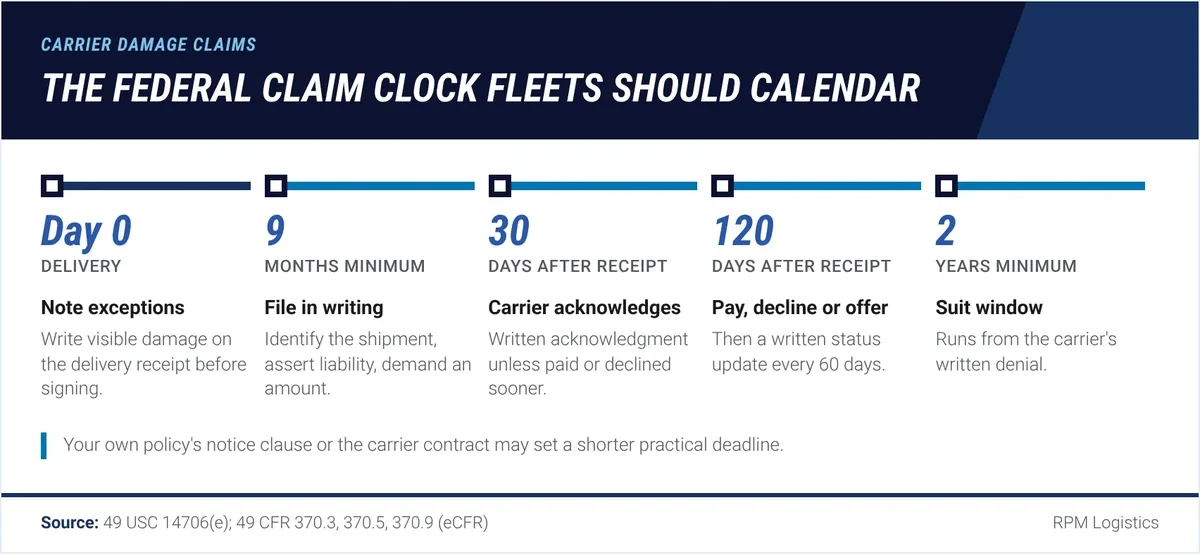
These are federal minimums for carriers. A contract or policy notice clause can set a shorter practical deadline for reporting damage.
49 CFR Part 370 sets the handling rules. A valid claim must meet three tests:
- It is in writing and identifies the shipment.
- It asserts that the carrier is liable for the loss or damage.
- It demands a specified or determinable amount of money.
The carrier must acknowledge the claim within 30 days of receipt. It must pay, decline or make a firm offer within 120 days of receipt. After that, it owes a written status update every 60 days.
Two cautions apply. Part 370 names motor carriers and freight forwarders, not brokers, so a broker's claim role comes from its contract. And your own policy's notice clause may be far shorter than 9 months. Our note on when the cheapest transport rate is the wrong call covers why short practical deadlines matter.
Controls the Fleet Owns Before, During and After a Move
Fleet-owned controls are the steps you can require without changing insurers. Each one maps a transport risk to the coverage that should answer it. The table below sets out six of them.
Control | Risk it addresses | Document that proves it |
|---|---|---|
1. Match the cargo limit to unit value | Load value above the carrier's cargo limit | Certificate of insurance showing the cargo limit |
2. Put declared value in writing | Liability limited under 49 USC 14706(c) | Bill of lading or rate agreement |
3. Settle driven-unit coverage before the first move | Driveaway damage defaulting to the fleet policy | Signed contract clause |
4. Record condition at both ends | Damage that cannot be placed in transit | Pickup and delivery condition reports |
5. Note exceptions at delivery | A clean receipt undercutting a later claim | Delivery receipt with exceptions noted |
6. Calendar the claim clocks | A lapsed policy notice or carrier claim window | Claim log with filing and response dates |
Two points need more detail. On control 1, compare the cargo limit with the value of the full load, not one unit. An upfitted work truck can be worth much more than its base chassis. On control 3, ask whether the provider's coverage or your policy pays first for damage to a driven unit.
The simplest control is the mode choice itself. Every employee self-delivery puts the move on your own policy. Moving that unit by carrier or driveaway shifts first-look responsibility toward a provider, subject to the contract terms in control 3.
Write these into the transport agreement, not a side email. Our guide to protecting asset value in driveaway programs covers mileage caps and screening terms. The RPM claims page outlines how RPM supports claims from filing to resolution.
What Transport Choices Can and Cannot Do for Premiums
Transport choices cannot set your premium, but they can keep avoidable transit losses off your loss runs. Premiums reflect your drivers, vehicles, territory, claims and the wider market. The transport leg is one input among many.
AM Best's figures put the pressure on the liability side. In 2024, commercial auto liability ran at 113 while physical damage ran at 88.6 (AM Best, 2025). AM Best also reported about $2 billion in new reserve deficiencies for commercial auto in 2025 (AM Best via Claims Journal, 2026).
Crash costs are the backdrop. NHTSA put the economic cost of US motor vehicle crashes at $340 billion in 2019, with 23 million vehicles damaged (NHTSA, 2023). Each employee self-delivery puts one of your vehicles into that traffic under your policy.
Our position: do not buy transport on the promise of a premium cut. Buy it to control where losses land. Then show your underwriter the evidence: fewer self-delivered moves, clean condition records and transit claims recovered from carriers. Whether that changes your rate is between you and your insurer.
Frequently Asked Questions
Does my fleet insurance cover vehicles in transport?
It depends on who controls the vehicle. When an employee drives the unit, the fleet's own auto policy is usually primary. When a carrier hauls it on an interstate move, the carrier is liable under federal law and usually pays from its cargo coverage. In driveaway, the contract often decides. Some fleet policies also respond first and then pursue the carrier. Confirm your policy's terms with your broker.
What affects fleet insurance premiums?
Underwriters weigh driver records, vehicle types and values, territory, mileage, claims history and the wider commercial auto market. That market is strained: commercial auto lost about $1.9 billion in 2025, according to AM Best. Transit losses your own policy pays also appear on your loss runs, so the way you move vehicles can feed into the claims history underwriters review.
How much does fleet insurance typically cost per vehicle?
There is no reliable single figure. Cost per vehicle depends on vehicle class, use, territory, driver records, limits, deductibles and claims history. Heavy trucks and light vehicles are rated very differently. For trucking context, ATRI found liability premiums reached 10.2 cents per mile in 2024. Ask your broker for quotes built on your own fleet's exposure and loss history.
Is fleet insurance cheaper than regular insurance?
Not automatically. A fleet policy covers several business vehicles under one contract, which simplifies administration and can change how risk is priced. Whether the per-vehicle cost is lower depends on the fleet's size, vehicle mix, drivers and loss history. Commercial use also carries exposures that personal policies usually exclude. Compare quotes on the same limits and deductibles.
How long do I have to file a damage claim against an auto carrier?
Under 49 USC 14706, a carrier may not allow less than 9 months to file a claim. It may not allow less than 2 years to sue after a written denial. Your carrier contract, bill of lading or own insurance policy may set shorter practical notice deadlines. Note visible damage on the delivery receipt and file in writing promptly.
Who pays if a driveaway driver damages a fleet vehicle?
Usually the contract decides. Some driveaway providers carry coverage for damage to the vehicles they operate. In other programs, the fleet's own physical damage policy responds first, and the insurer may seek recovery from the provider. Third-party injury or property damage typically goes to the provider's auto liability. Get the allocation in writing and review it with your broker.
Get a Fleet Assessment
RPM Logistics arranges fleet vehicle transport across all 50 states and Canada, handling booking, documentation, condition reporting and coordination with carriers screened to RPM onboarding criteria before a load is booked. To map your move types against your coverage, get a fleet assessment.