

Quick answer: A full restoration moves a car through several specialist shops over months or years, which means four or more transport legs, storage between them, and stretches where the vehicle is a rolling shell with its parts in boxes. The hard problems are sequencing around shop queues you do not control, keeping a parts inventory intact across vendors, and knowing who insures the car at each stage.
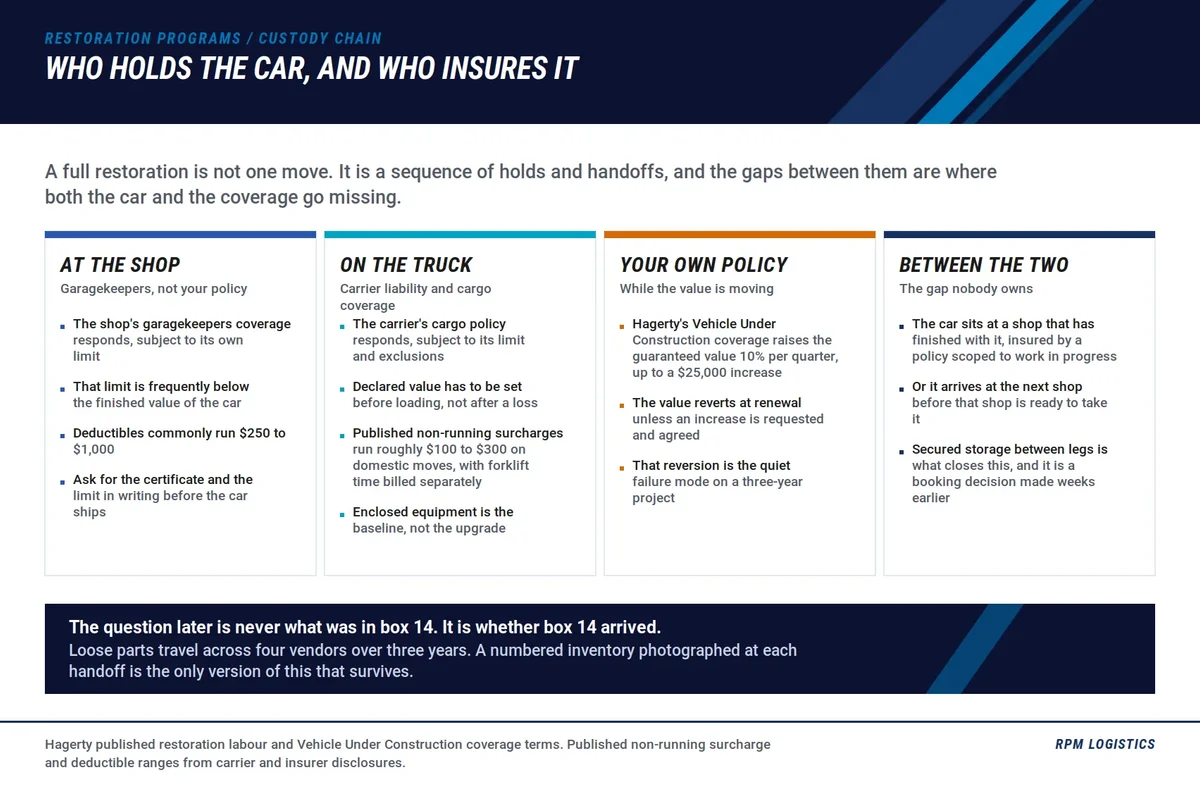
A restoration program has four handoffs and four different answers to who is carrying the risk.
Most classic car transport advice assumes one pickup and one delivery. A restoration is not that. It is a sequence of moves spread across a program that can run years, between vendors who have never spoken to each other, on a vehicle that changes state along the way.
Nothing published treats it as a logistics problem. This does.
What a restoration program actually looks like
The timeline is the first thing that breaks people's assumptions. Coastline Restorations puts a minor or partial restoration at 3 to 6 months, a full restoration at 9 to 18 months, and a frame-off at 12 to 24 months or longer, moving through distinct phases: disassembly and documentation, bodywork and rust repair, engine and drivetrain, electrical, paint prep and refinishing, interior and trim, then final reassembly.
The labour behind that is substantial. Hagerty reports that a concours-level restoration generally takes 4,000 to 5,000 hours, against roughly 1,000 hours for a 1960s muscle car job, at shop rates around $135 an hour, which puts labour well into six figures and sometimes past $500,000 (Hagerty). The same reporting cites a three-year backlog at one well-known restoration house.
Those phases are rarely all under one roof. Bodywork, plating, upholstery, machine work and paint are different trades, and the shops that are genuinely good at each are rarely in the same building. Every boundary between them is a transport leg.
Sequencing around queues you do not control
This is the scheduling problem nobody writes about, and it is the one that costs the most.
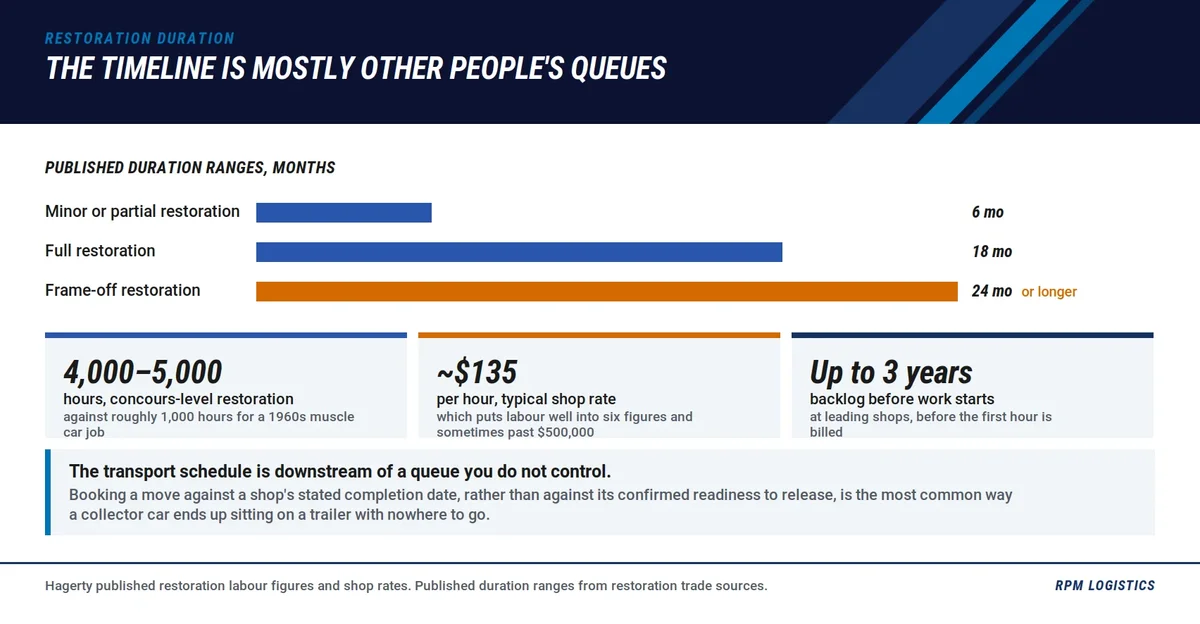
Backlogs at leading shops can run to three years before work starts.
Restoration shops run backlogs. A three-year wait at a top house is not unusual, and specialist vendors run their own cycles: one plating shop publishes 2 to 4 weeks for car parts with longer turnaround in its busy winter season. You are not scheduling transport against your own calendar. You are scheduling it against a chain of queue positions held by businesses with no obligation to coordinate with each other.
Three rules follow.
Book the next shop before the current one finishes. A slot confirmed in advance is the only thing that turns an estimated completion into a transport date. If the next vendor cannot take the car for six weeks, that is a storage decision, not a delay to absorb by leaving the car where it is.
Never transport on an estimated completion date. Restoration estimates slip, and a carrier scheduled against a date that moves becomes a dry run you pay for. Book transport on confirmation that the work is actually done, not on the projection.
Treat the gap between shops as a planned stage. A finished car sitting at a shop that wants the bay back is a problem for both parties. Secured storage between legs is cheaper than a rushed move to a vendor who is not ready. RPM Logistics operates more than 70 storage locations across the United States and Canada for exactly this kind of hold.
Moving a car that is no longer a car
Midway through a restoration the vehicle is not a vehicle in any sense a standard carrier recognises. It may be a bare shell with no glass, no interior, no drivetrain and no brakes. It may be a body separated from its frame. Its parts may be in forty labelled boxes.
That changes the equipment conversation entirely.
Rolling shells and body-off vehicles
A shell that still rolls and steers can be winched, but the technique differs from a non-running complete car. The strap goes to a sturdy cross-member rather than bumper brackets, which may no longer exist. Where the steering is seized, dollies under each wheel allow the crew to position the car laterally. Securement is by soft underbody straps rather than anything that loads a frame rail that has been cut, patched or replaced.
A body separated from its frame does not roll at all, and that is a forklift or crane job rather than a winch job. Expect to be quoted accordingly. Published surcharges for non-running vehicles run roughly $100 to $300 on domestic moves, with forklift time billed separately.
Our guides to barn-find recovery and antique and pre-war handling cover the equipment decision tree and fragile-chassis securement in full. What matters here is telling the carrier the truth about the car's state before they dispatch, because a crew arriving with a winch for something that needs a forklift is a wasted day for everyone.
Loose parts, and the inventory problem
A disassembled car generates hundreds of components that have to arrive where the car arrives, in a condition that lets the next shop identify them.
Restoration practitioners are consistent on the discipline: photograph every component before disassembly, record the origin and detail of each part, and label and store together. The warning that comes with it is blunt, that projects go off the rails when parts are lost or misplaced from the original disassembly.
What nobody has written is how that survives four vendors. A practical protocol:
- Number the boxes against a single master inventory that travels with the program rather than with any one shop. The shop's system ends at the shop's door.
- Photograph the loaded boxes at every handoff, not just their contents at disassembly. The question later is not what was in box 14, it is whether box 14 arrived.
- Keep irreplaceable trim and chrome out of the car. Plated and anodised parts that cannot be remade belong crated and manifested, not loose in a shell that will be winched.
- Manifest what ships with the car and what ships separately, and get both signed. Carriers commonly limit what can ride inside a vehicle by weight and location, so confirm the limit rather than assuming.
- Agree who owns the inventory. If it is the shop, it changes hands four times. If it is the owner, it does not.
Be clear-eyed about one thing: there is no published industry standard for multi-vendor restoration inventory. Every shop runs its own method, and none of them is designed to hand off. The protocol above is ours, offered because the alternative is having none.
Who insures the car at each stage
This is the largest genuine gap in the category, and the answer is that three different policies cover the car at different moments, with seams between them.
While it is at the shop
The shop should carry garagekeepers coverage. Two things about it matter to you as the owner.
First, the form. A direct primary garagekeepers policy pays for damage to a customer vehicle even when the shop is not at fault. A legal liability form pays only when an employee is legally liable, which turns a claim into a dispute about fault. Ask which one the shop carries before the car goes there.
Second, the limit. Garagekeepers limits are typically sized against the most expensive vehicle on the lot multiplied by how many vehicles the lot holds. A shop whose limit was calculated for daily drivers and restorations in the tens of thousands does not have the capacity to cover a six-figure car sitting in the back. Deductibles commonly run $250 to $1,000.
Garagekeepers covers a defined set of perils, generally collision, fire, theft and vandalism. It is not a warranty on workmanship, and it does not follow the car onto a truck.
While it is on a truck
That is the carrier's cargo coverage, and the limit is a number you should see in writing before dispatch. A shell mid-restoration presents a valuation question a finished car does not: what is it worth in its current state, and does the carrier's limit reflect that or the completed value?
Settle the basis before the first leg, not after a claim. Our comparison of agreed value versus actual cash value covers why the valuation basis decides what gets paid.
Your own policy, while the value is moving
Specialist collector insurers write coverage for vehicles actively under restoration. Hagerty's Vehicle Under Construction coverage increases the guaranteed value by 10% per quarter, up to a maximum increase of $25,000, and adds $750 in automotive tools coverage, with the value returning to the original guaranteed value at renewal unless an increase is requested and agreed (Hagerty). Spare parts coverage is available separately.
The quarterly step-up exists because a restoration adds value continuously while a standard collector policy holds a fixed figure. On a two-year frame-off, a policy written at the car's as-found value is badly wrong by the end.
What is not clearly published anywhere is whether that coverage extends while the car sits at a third-party shop or rides on a truck. Do not assume it does. Ask your insurer in writing, specifically about both situations, before the first leg.
Keeping declared value current
One practical habit closes most of the insurance gap: revisit the declared value at every transport leg rather than once at the start.
A restoration adds value continuously, and the moments the car moves are natural checkpoints. A car that left the body shop is worth more than the one that arrived there, and the leg to the upholstery shop should be covered at the new figure, not the old one. Published valuation data for collector vehicles is available through Hagerty's valuation tools, which gives a defensible external reference point rather than an owner's estimate.
Tie it to the transport schedule and it happens. Tie it to an annual renewal and the figure will be a year stale at the moment you need it.
Condition documentation across four handoffs
A single origin-and-destination inspection works when there is one carrier and one journey. It does not survive a program.
The problem is attribution. A mark found at shop four could have come from shop one, shop two, shop three, or any of the three transport legs between them. Without a record at every boundary, the answer is whoever is holding the car when it is noticed, which is neither fair nor recoverable.
What holds up:
- A condition record at every boundary, in both directions. Photographed at release from each shop and at receipt by the next, so each leg has a before and an after.
- The same format throughout. Four vendors using four documentation styles produces a record nobody can compare. Impose one.
- Shoot the state, not the car. A shell needs its floor pans, inner structure and repaired areas documented, not its paint. What matters changes as the restoration progresses.
- One file, owner-held. Each vendor holds its own leg. Only the owner sees the whole sequence, and only the whole sequence proves anything.
Our standards for insurance-grade condition reporting apply at each transport leg. The multi-vendor continuity around them is the owner's to run.
Where these programs go wrong
- Booking transport against an estimated finish date. The most common and most expensive error. Book on confirmation.
- No slot at the next shop. A finished car with nowhere to go becomes a storage problem at a vendor who wants the space back.
- Parts travelling loose in the shell. Chrome and trim that cannot be remade should not be in a vehicle being winched.
- Assuming the shop's insurance is enough. Ask which garagekeepers form and what limit, before the car arrives.
- Never updating the declared value. A car insured at its as-found value two years into a restoration is underinsured by the entire cost of the work.
- Letting each shop keep its own records. The owner needs the continuous file, because no vendor has it.
- Not telling the carrier what state the car is in. "Non-running" and "body off the frame in a crate" require different trucks.
Frequently asked questions
Can you ship a car that has been taken apart?
Yes, but the equipment depends on the state. A rolling shell that steers can be winched with straps to a cross-member and dollies where the steering is seized. A body separated from its frame does not roll and needs forklift or crane handling, which is quoted differently. Tell the carrier the actual state before dispatch.
Who is responsible for my car while it sits at a restoration shop?
The shop's garagekeepers policy, and the form matters. A direct primary form pays for damage to a customer vehicle even when the shop is not at fault; a legal liability form pays only when an employee is legally liable. Limits are typically sized against the most valuable vehicle on the lot, which is why a six-figure car at a shop geared to ordinary restorations can exceed the available coverage.
Does my collector insurance cover a car under restoration?
Specialist collector insurers offer coverage designed for it. Hagerty's Vehicle Under Construction coverage raises the guaranteed value 10% per quarter up to a $25,000 increase, with the value reverting at renewal unless an increase is requested and agreed. Whether such coverage extends to the car while it is at a third-party shop or in transit is not clearly published, so confirm both with your insurer in writing.
Can I ship the engine and drivetrain separately from the body?
Yes, and on a body-off restoration it is often necessary, since the components are at a machine shop while the body is at a paint shop. Manifest what ships with the car and what ships separately, and get both signed at each handoff.
How do you keep a parts inventory straight across several shops?
Number boxes against a single master inventory that the owner holds rather than any one shop, photograph the loaded boxes at every handoff rather than only their contents at disassembly, crate irreplaceable trim and chrome separately, and manifest what travels with the car versus separately. There is no published industry standard for this, so the discipline has to be imposed by the owner.
What happens if the next shop is not ready when the car comes off the trailer?
Plan for it rather than discovering it. Confirm the next slot before booking transport, and treat the gap between shops as a planned storage stage. Secured storage between legs costs less than a rushed move to a vendor who cannot take the car.
How long does a full restoration take?
Published ranges put a minor or partial restoration at 3 to 6 months, a full restoration at 9 to 18 months, and a frame-off at 12 to 24 months or longer. Hagerty reports a concours-level restoration generally takes 4,000 to 5,000 hours of labour, and backlogs at leading shops can run to three years before work starts.
How do you document condition across multiple restoration vendors?
Take a condition record at every boundary in both directions, so each transport leg has a before and an after, use one format across all vendors so records are comparable, document the car's current state rather than its paint, and keep the complete file with the owner. Each vendor only ever sees its own leg.
Running the whole program, not one leg
RPM Logistics moves collector vehicles in enclosed equipment across all 50 states and Canada, with documented custody at each transfer, secured storage between legs, and handling appropriate to non-running and partially disassembled vehicles. If your car is heading into a multi-shop restoration, talk to our team about sequencing it as one program. For the wider picture, start with our complete classic car transport guide.