

Quick Answer
To ship a classic car overseas, clear the title and any lien first, then have the exporter's agent file Electronic Export Information. The car and its documents must reach U.S. Customs and Border Protection at least 72 hours before the vessel sails. Collector cars usually travel enclosed to the port and in a container overseas.
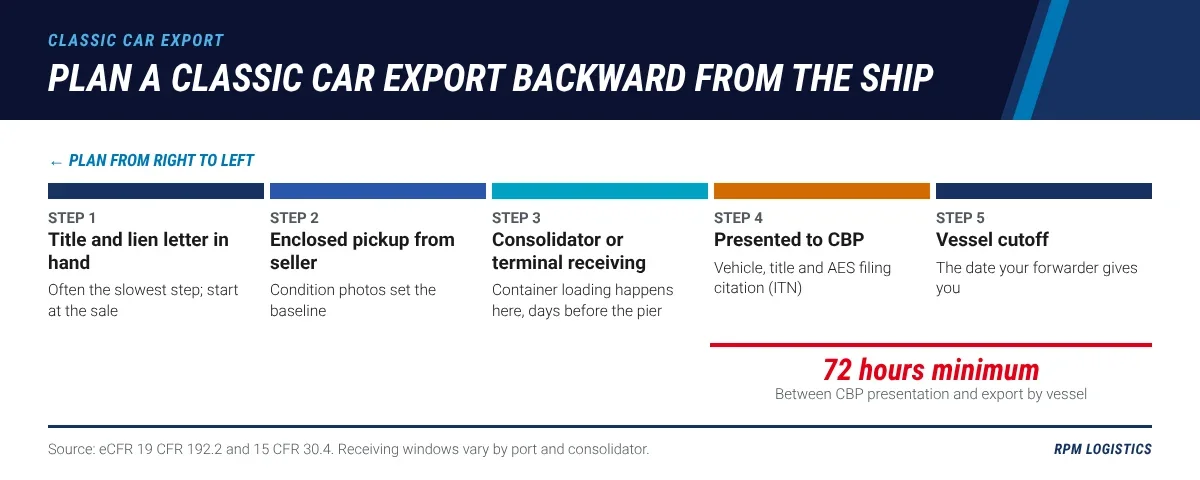
The only fixed number in the chain is the 72-hour rule; the slowest step is usually the title or lien release at the very start.
What does it take to export a classic car from the U.S.?
Exporting a classic car means moving a titled vehicle out of the U.S. to an overseas buyer, under federal export rules for used vehicles. It is different from shipping a car between states. Customs, the Census Bureau's export filing system and the destination country all take part.

Whatever the car, an export starts the same way: a clean title, then a domestic transport leg timed to the port or consolidator receiving window.
Collector cars sell to a global market. Monterey Car Week auctions set a record of $756 million in 2026 sales (Hagerty, 2026), with overseas bidders among the buyers. The U.S. already exports used vehicles at scale. Census trade data counted 989,531 used passenger vehicles exported in 2019, worth $7.72 billion.
A classic export has four parts:
- Clean paperwork: the original title, plus a lien release if there is a loan.
- An export filing: Electronic Export Information filed in the Automated Export System.
- A domestic leg: moving the car from the seller to the port or a consolidator's warehouse.
- An ocean leg: container or roll-on/roll-off shipping, booked through a freight forwarder.
RPM Logistics handles the domestic leg. It moves the car to the port or consolidator in enclosed transport, documents its condition, and times delivery to the forwarder's cutoff. The exporter or its forwarder files the export information and books the ocean freight.
What documents are needed to export a classic car?
Exporting a used vehicle requires the original title and two complete copies, under 19 CFR 192.2. Customs treats almost every classic car as "used," since its title has passed to a retail buyer at some point.
Situation | Required documents |
|---|---|
Titled car, no loan | Original Certificate of Title (or certified copy) plus two complete copies |
Car with a lien or lease | The above, plus a written statement from the lienholder or lessor expressly allowing export |
Never-titled car | Original Manufacturer's Statement of Origin plus two complete copies |
Every used vehicle | The filing citation (ITN) issued when the Automated Export System accepts the export filing |
The lienholder letter is often the slowest document to obtain. Start it as soon as the sale is agreed. If the title is held by a lender, the export cannot proceed until the lender releases it or sends the written approval.
Is an AES export filing required for a classic car?
Yes. Electronic Export Information must be filed for every used self-propelled vehicle, regardless of its value, under 15 CFR 30.2. The usual exemption for shipments worth $2,500 or less does not apply to used vehicles.
The timing is stricter than for ordinary cargo. Most vessel cargo needs its filing only 24 hours before loading. Used vehicles need the filing citation presented to Customs at least 72 hours before export, under 15 CFR 30.4. The Census Bureau has applied that 72-hour rule to used vehicles since April 5, 2014.
The exporter, known as the U.S. Principal Party in Interest, or its authorized agent makes the filing. In practice that is usually the freight forwarder. When the system accepts the filing, it issues an Internal Transaction Number. That number goes to Customs and the ocean carrier.
How far ahead must the car reach the port?
For export by vessel, the car and its documents must be presented to Customs at least 72 hours before export, under 19 CFR 192.2. That is a minimum, not a target. Ports, terminals and consolidators set their own receiving windows on top of it.
Plan backward from the vessel cutoff your forwarder gives you:
- Vessel cutoff. The last moment cargo can be accepted for the sailing.
- Customs presentation. Vehicle, title and filing citation at the port at least 72 hours before export.
- Consolidator or terminal receiving. Container loading usually happens at a warehouse before the car reaches the pier, so this date comes earlier still.
- Domestic pickup. Schedule the enclosed pickup so the car arrives inside the receiving window, with a buffer for weather or traffic.
- Paperwork in hand. Title and any lienholder letter should be ready before the pickup is booked.
Vehicles that entered the U.S. in bond, under a carnet or under a temporary importation bond are exempt from some of these export requirements. Our guide to vehicles moving in bond explains how that works.
Why the domestic leg matters for an export
The domestic leg sets the evidence trail for the whole shipment. The condition report taken at the seller's garage becomes the baseline the overseas buyer, the marine insurer and the destination inspector will all rely on.
- Use enclosed transport. A collector car headed overseas should reach the port as clean as it left. See our enclosed transport to the port service.
- Specify soft-tie securement to protect the suspension and bodywork. Our breakdown of soft-tie securement explains why.
- Document condition in detail. Timestamped photos of every panel, the interior, the underside and the VIN plates. Our guide to an insurance-grade condition report shows what to include.
- Confirm coverage for each leg. Domestic carrier coverage and marine cargo insurance are separate policies. Our explainer on agreed-value coverage covers the valuation question.
Buyers who purchased at auction often need the car moved straight from the sale to the port. Our guide to moving a car out of a major collector auction covers release timing.
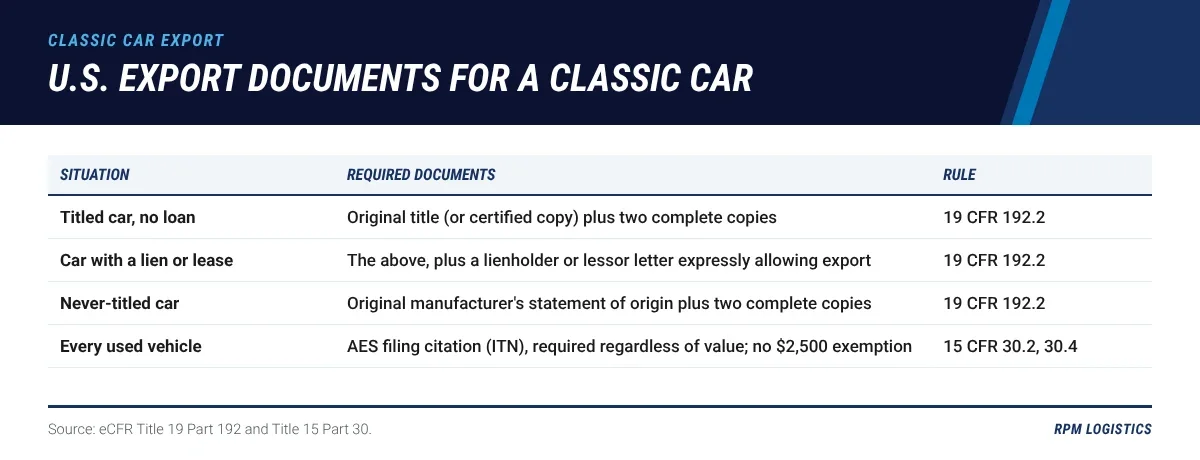
Every document on this list must be in hand before the car is presented to Customs, so it belongs in the plan before the pickup is booked.
Container or RoRo for a collector car?
Most collector cars ship in containers, which keep the car sealed and secured from the U.S. warehouse to the destination port. Roll-on/roll-off (RoRo) ships drive cars aboard like a parking garage and can cost less, but the car is exposed to more handling.
Factor | Container | RoRo |
|---|---|---|
Loading point | Consolidator warehouse, before the port | At the port terminal |
Protection | Sealed, secured in a box | Parked on a vessel deck |
Running condition | Non-running cars can be loaded by winch | Car generally needs to drive aboard |
Best for | High-value, rare and non-running cars | Driver-quality cars on common routes |
Container loading affects the timeline. Because the car is loaded at a warehouse before the port, the domestic delivery date comes earlier than the 72-hour Customs deadline. Ask your forwarder for the warehouse receiving date, not just the vessel date. If the car does not run, see our guide to pre-war and non-running cars.
How to prepare a classic car for export
Prepare the car for both the domestic leg and the ocean voyage before pickup. The Federal Maritime Commission advises draining fuel and disconnecting or removing the battery, and using a licensed and bonded ocean shipping company (Federal Maritime Commission).
- Follow the forwarder's fuel and battery rules for the specific sailing.
- Remove all personal items. Loose items can create customs problems at both ends.
- Record mileage and photograph the car before the domestic pickup.
- Keep provenance documents with you, such as build sheets and restoration records, not in the car.
- Note any leaks or quirks for the driver and the warehouse.
What the buyer's country requires
Import rules at the destination are the buyer's responsibility, but they shape the timeline and the paperwork. Rules vary widely, so the buyer should confirm them with an import agent before the car ships.
- United Kingdom. A vehicle in original state that is at least 30 years old, or no longer in production, may qualify as a collectors' item with an effective 5% import VAT. HMRC advises checking with its Tariff Classification Service before buying.
- Australia. Vehicles built more than 25 years ago can use an older-vehicle pathway. Approval is required before import, is assessed within 30 business days, and does not guarantee registration (Australian Department of Infrastructure).
- European Union. Rules differ by country. Confirm duty, VAT and registration requirements with the buyer's import agent.
Shipping a classic the other way? Our guide to importing a classic car into the U.S. covers the 25-year rule and inbound paperwork.
Choosing a U.S. departure port
The best departure port is usually the one that offers a direct sailing to the buyer's country, not the one closest to the car. A longer domestic leg to a port with a direct route can save weeks of transshipment overseas.
- East Coast ports such as New York/New Jersey, Baltimore and Savannah commonly serve Europe and the Middle East.
- West Coast ports such as Los Angeles/Long Beach and Oakland commonly serve Asia and Oceania.
- Gulf ports such as Houston serve Latin America and some European routes.
Your forwarder will name the port and the consolidator warehouse. Share that address with your domestic carrier early, since some warehouses require delivery appointments and will turn away a truck that arrives without one. A car moving from the Midwest to an East Coast port is a typical one-to-four-day truck move, depending on distance and pickup timing.
Common mistakes that delay a classic car export
Most export delays come from paperwork and timing, not from the ocean voyage itself. These are the mistakes that most often push a car to a later sailing.
- Booking transport before the title is ready. A car that reaches the warehouse without its title or lien release cannot be presented to Customs.
- Planning to the vessel date instead of the warehouse date. Container loading happens days before the ship sails, so the real deadline comes earlier.
- Mismatched VINs or names. The VIN, owner name and description must match across the title, the export filing and the bill of lading.
- Leaving personal items in the car. Extra contents can trigger inspection delays at either end.
- Skipping the condition baseline. Without detailed photos at pickup, a damage claim overseas has no reference point.
- Assuming the buyer's import approval is done. Some countries require approval before the car ships, so confirm it with the buyer first.
A short pre-booking call between the seller, the buyer's agent, the forwarder and the domestic carrier catches most of these problems before they cost a sailing.
Frequently asked questions
Do you need the original title to export a classic car from the U.S.?
Yes. Customs requires the original Certificate of Title, or a certified copy, plus two complete copies. A never-titled car needs its original Manufacturer's Statement of Origin plus two copies.
Can you export a car that still has a loan or lien on it?
Only with a written statement from the lienholder or lessor that expressly allows the vehicle to be exported. Start that request early, since it is often the slowest step.
Is an AES filing required for a low-value used car?
Yes. Electronic Export Information is required for every used self-propelled vehicle regardless of value. The usual $2,500 exemption does not apply.
How far ahead of the ship date does the car need to be at the port?
The car and its documents must be presented to Customs at least 72 hours before export by vessel. Consolidators and terminals often need the car earlier, so ask your forwarder for the receiving date.
Container or RoRo: which is safer for a collector car?
A container is generally safer for a collector car because the car is sealed and secured for the whole voyage. RoRo can cost less but involves more handling, and the car usually needs to run.
Who files the export paperwork for a classic car?
The exporter, or its authorized agent, files the Electronic Export Information. That is usually the freight forwarder. RPM Logistics handles the domestic transport leg and coordinates delivery timing with the forwarder.
Get your classic to the port on time
An export runs on fixed deadlines, and the domestic leg has to hit them. RPM Logistics moves collector cars in enclosed transport from the seller's garage or auction to the port or consolidator, with detailed condition documentation for the buyer and the marine insurer. Request a quote with your vessel cutoff date and the warehouse receiving window, or learn about our high-value vehicle transport.