

Quick Answer
Auto hauler equipment financing is a loan or lease that pays for a car hauler truck or trailer, secured by the equipment itself. Lenders look at credit, time in authority, down payment, insurance and proof of steady revenue. For owner-operators, the fastest path is a credit-neutral prequalification first, then choosing between financing, lease-to-own, renting or buying outright.
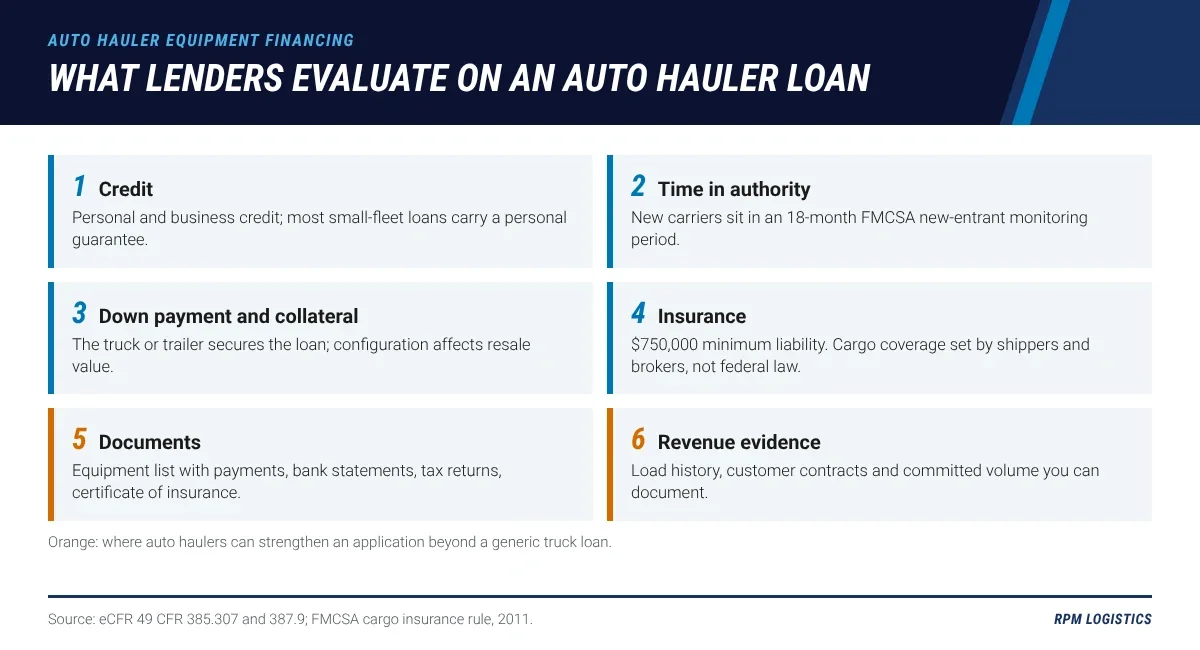
Generic truck-loan guides stop at credit and down payment; the last two boxes are where an auto hauler can strengthen an application.
What is auto hauler equipment financing?
Auto hauler equipment financing is any arrangement that lets a car hauling business acquire a truck or car carrier trailer without paying the full price up front. The equipment serves as collateral, which usually makes it easier to qualify for than an unsecured business loan.
The stakes are high because equipment is one of the largest costs in trucking. The average marginal cost of operating a truck reached $2.336 per mile in 2025, the highest in the history of ATRI's annual report (ATRI, 2026). Truck and trailer lease or purchase payments alone ran 40.4 cents per mile, up from 39 cents the year before (ATRI via FreightWaves, 2026). Getting the financing right decides whether a new rig pays for itself.
Car haulers face extra questions that general owner-operator truck financing guides skip. Trailer configuration affects how many vehicles you can carry per load. Specialized cargo raises insurance costs. Freight that comes from dealer and auction networks can be steady or seasonal. Lenders weigh all of it.
What do lenders look at for owner-operator truck financing?
Lenders look at six things when an auto hauler applies for equipment financing. Strengthening each one before you apply improves both approval odds and terms.
1. Credit history
Personal and business credit both matter, because most small-fleet loans carry a personal guarantee. Equipment-finance approval rates averaged 77.4% industry-wide in July 2026, and 79.7% for small-ticket deals (ELFA CapEx Finance Index, 2026). A clean credit file puts you on the right side of that line.
2. Time in authority
Lenders treat new authorities as higher risk. FMCSA keeps new motor carriers under a safety monitoring period of 18 months under 49 CFR 385.307. A carrier inside that window has a short operating history to show a lender. If your authority is new, expect a larger down payment or a lease-to-own structure.
3. Down payment and collateral
The equipment itself secures the loan, so its type and condition matter. A newer trailer in a common configuration holds resale value better than an older or unusual one. Lenders also look at what you already owe on existing trucks and trailers.
4. Insurance
For-hire carriers must carry at least $750,000 in liability coverage under 49 CFR 387.9. Cargo coverage is different. FMCSA removed the federal cargo insurance requirement for most property carriers in 2011, so your cargo limit is set by what shippers and brokers require. Insurance is also rising fast: it cost 10.6 cents per mile in 2025, up 23.9% since 2021 (ATRI via The Trucker, 2026). Lenders want proof that your coverage is in force and affordable.
5. Documents
A complete file speeds up approval. Lenders commonly ask for:
- A current list of trucks and trailers, with any existing payments
- Business and personal bank statements, usually the last three to six months
- Tax returns for the business and the owner
- A certificate of insurance
- Your operating authority and DOT number
6. Revenue evidence
Documented revenue is one of the strongest parts of an application, and it is where auto haulers can gain an edge. Contracted or recurring freight shows a lender how the new equipment will earn its payment. Bring load history, customer contracts and any committed volume you can document.
How does auto hauler financing work?
Auto hauler financing works in four steps, and the order matters. Prequalify first, so you shop for equipment knowing what you can afford.
- Prequalify without a credit hit. RPM Advantage connects carriers with Equipment Funding Solutions, which matches applicants against a network of 200+ niche transportation and small-business lenders. The digital application has no effect on your credit score, according to the program.
- Choose the equipment and the acquisition route. Decide on truck, trailer configuration, and whether to finance, lease-to-own, rent or buy.
- Submit the full file. Send documents, insurance and revenue evidence to the matched lender.
- Close and put the equipment to work. Line up freight before the first payment is due.
Before you apply, know your numbers. Our guide on how to calculate your cost per mile shows how to check whether a new payment fits your operation.
Finance, lease-to-own, rent or buy outright?
The right way to acquire a car hauler depends on your cash, your credit and how certain your freight is. Each route trades upfront cost against ownership and flexibility.
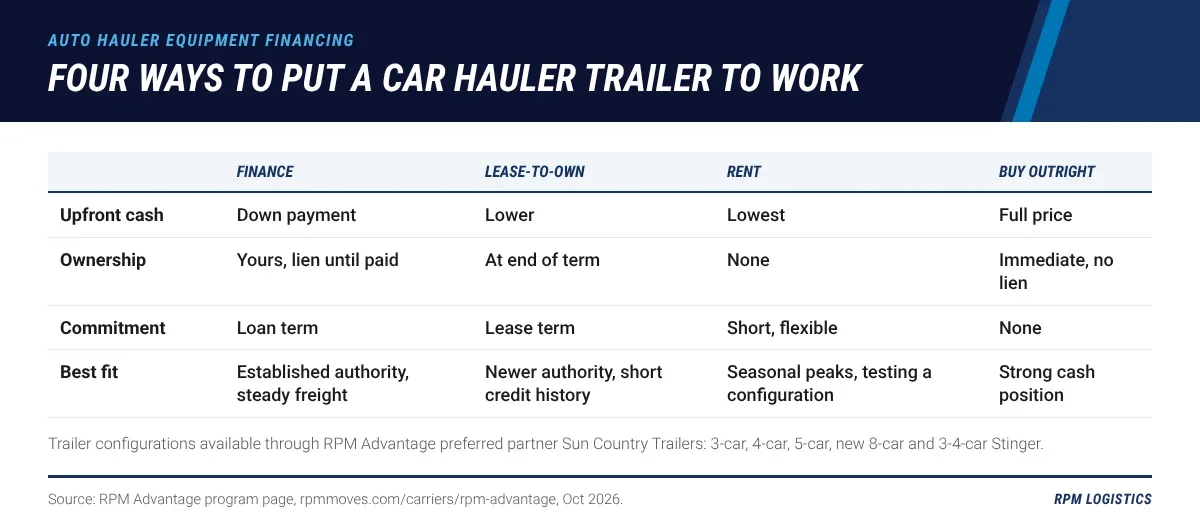
Renting is the only route with no long-term commitment, which makes it the safest way to test a new lane before you finance for it.
Route | Upfront cash | Ownership | Best fit |
|---|---|---|---|
Equipment financing | Down payment | Yours from day one, lien until paid | Established authority, steady freight |
Lease-to-own | Lower | Transfers at the end of the term | Newer authorities, limited credit history |
Rental | Lowest | None | Seasonal peaks, testing a new configuration |
Buy outright | Full price | Immediate, no lien | Strong cash position |
Through RPM Advantage, carriers can work with preferred partner Sun Country Trailers on the industry's first auto-hauler lease-to-own and rental program. Trailers can be leased, rented, purchased outright or financed. Configurations include 3-car, 4-car, 5-car and new 8-car trailers, plus a 3-4-car Stinger.
How trailer configuration affects your financing
Trailer configuration is a revenue decision first and a financing decision second. A larger trailer carries more vehicles per load but costs more, needs a heavier truck and suits different freight.
- 3-car and 4-car trailers pair with lighter trucks, suit dealer trades and short routes, and are the usual entry point for owner-operators.
- 5-car trailers balance capacity and flexibility for regional dealer and auction work.
- 8-car trailers and Stingers serve high-volume lanes such as OEM, auction and rental fleet moves, and require a full commercial setup.
Lenders care about configuration because it affects resale value and revenue per mile. Match the trailer to freight you can already show. Our guide to what it takes to run a car hauling business covers startup costs. Our overview of how car hauling companies get paid explains where the freight comes from.
Why contracted freight strengthens an application
Contracted freight gives a lender a revenue figure to underwrite against, instead of a forecast. A spot-market history shows you can find loads. A contract shows the new equipment already has work.
Demand for finished-vehicle hauling is holding up. Cox Automotive raised its 2026 new-vehicle sales forecast to 16.1 million units in September (Cox Automotive, 2026). Volume is not the same as stability, though, and seasonal swings still hit small carriers hardest. Our piece on peak-season demand for carrier capacity shows how the busy months play out.
The RPM Advantage dedicated carrier program lets carriers sign on to existing or pending contract-awarded business on a daily-revenue model. RPM guarantees daily revenue per piece of equipment by trailer type and assigns shipments by first-in, first-out order and service needs. Carriers can document that revenue when they apply. Ask the lender how it treats contracted freight in underwriting, since practices vary.
How financial planning affects approval
Clean books make you easier to lend to. Lenders read the same financial statements a buyer or investor would, and gaps or late closes slow everything down.
RPM Advantage pairs carriers with Guastella Advisors for financial consultation from an auto-haul CFO. Services include a one-time financial assessment or a full-charge fractional CFO, plus month-end close, cash-flow forecasting, claims support, cost tracking and receivables management. Case results published on the RPM Advantage page for this practice include more than $10 million in capital secured for one high-growth automotive logistics company. That company also saw month-end close run five times faster and monthly receivables fall by more than 85%.
A concentration risk can also hurt an application. In one acquisition review published on the same page, 63% of a hauler's revenue came from just two accounts. Lenders notice that kind of dependence. Spreading revenue across more customers, or locking key accounts under contract, reduces the risk they see.
Can a new authority get car hauler financing?
Yes, a new authority can get car hauler financing, but expect tighter terms. A carrier inside the 18-month new-entrant window has little operating history to show. These steps improve your chances:
- Start with lease-to-own or rental to build a payment history.
- Put more money down to reduce the lender's exposure.
- Keep business and personal finances separate from the first day.
- Document every load and payment so you can show revenue history quickly.
- Stay compliant. Our guide to DOT compliance for automotive carriers covers the basics lenders check.
If you are new to the industry, read our guides on independent car haulers and the financing options open to owner-operators. Then consider joining a carrier network for steady loads.
Mistakes that slow down an equipment loan
Most delays in auto hauler financing come from avoidable gaps in the application, not from the lender. Fixing these before you apply can save weeks.
- Shopping before prequalifying. Falling for a trailer you cannot finance wastes time on both sides. Prequalify first, then shop inside your approved range.
- Mixing business and personal accounts. Lenders need to see business revenue clearly. Commingled statements make that hard and raise questions.
- Letting insurance lapse or change mid-application. A gap in coverage can stop a deal. Keep your policy current and send the certificate early.
- Understating existing debt. Lenders will find every truck and trailer payment on your credit report. List them all up front.
- Buying more trailer than your freight supports. An 8-car rig on 4-car freight carries a payment your loads cannot cover. Match capacity to the work you can show.
- Running late on month-end books. Current financial statements speed underwriting. Statements that are months behind slow it down or stop it.
Each of these is fixable, and most take only a few days. Treat the application like a load you are preparing for a demanding shipper: complete, accurate and on time.
Frequently asked questions
How do I finance a car hauler truck and trailer as an owner-operator?
Prequalify first, then choose your equipment and acquisition route, then submit a full application with documents, insurance and revenue evidence. A lender-matching service can compare offers from several lenders at once.
Does applying for equipment financing hurt my credit score?
Prequalification through the Equipment Funding Solutions application offered by RPM Advantage has no effect on your credit score, according to the program. A full application with a specific lender may involve a credit check, so ask each lender before you submit.
What insurance do I need to finance a car hauler?
You need at least $750,000 in liability coverage for interstate for-hire work. Cargo coverage has no federal minimum for most carriers, but shippers, brokers and lenders usually require it. Lenders also want to see the policy in force.
Is it better to lease-to-own, rent or buy a car hauler trailer?
Buy or finance if your authority is established and your freight is steady. Choose lease-to-own if your credit history is short. Rent to cover seasonal peaks or to test a configuration before committing.
Can a new authority get car hauler financing?
Yes, but expect tighter terms while you have less than 18 months of operating history. A larger down payment, a lease-to-own structure and documented revenue all help.
Does having contracted freight help me get approved?
Contracted freight gives a lender documented revenue to evaluate, which can strengthen an application. How much weight it carries varies by lender, so ask how they treat it.
Grow your fleet with RPM Advantage
Financing is one part of growing a car hauling business. Equipment, financial planning and steady freight matter just as much. RPM Advantage brings equipment financing, preferred trailers, auto-haul CFO consulting and dedicated carrier contracts together in one program for owner-operators and fleets of 5 to 30+ trucks. Talk to the RPM Advantage team about your next truck or trailer.