Fleet logistics is the planning and movement of company, rental, government and commercial vehicles. It covers every handoff between drivers, sites and lifecycle stages. The guides in this section follow each stage a fleet manager runs.
A guide for public-sector fleet managers on the transport, titling, and accountability standards government vehicle programs should require from a logistics partner.
19 Jun 2026
Fleet leaders are moving from fragmented, segment-by-segment transport sourcing to a single integrated partner across OEM, dealer, commercial, corporate, and government fleets to cut empty miles, standardize documentation, and lower per-vehicle cost.
18 Jun 2026
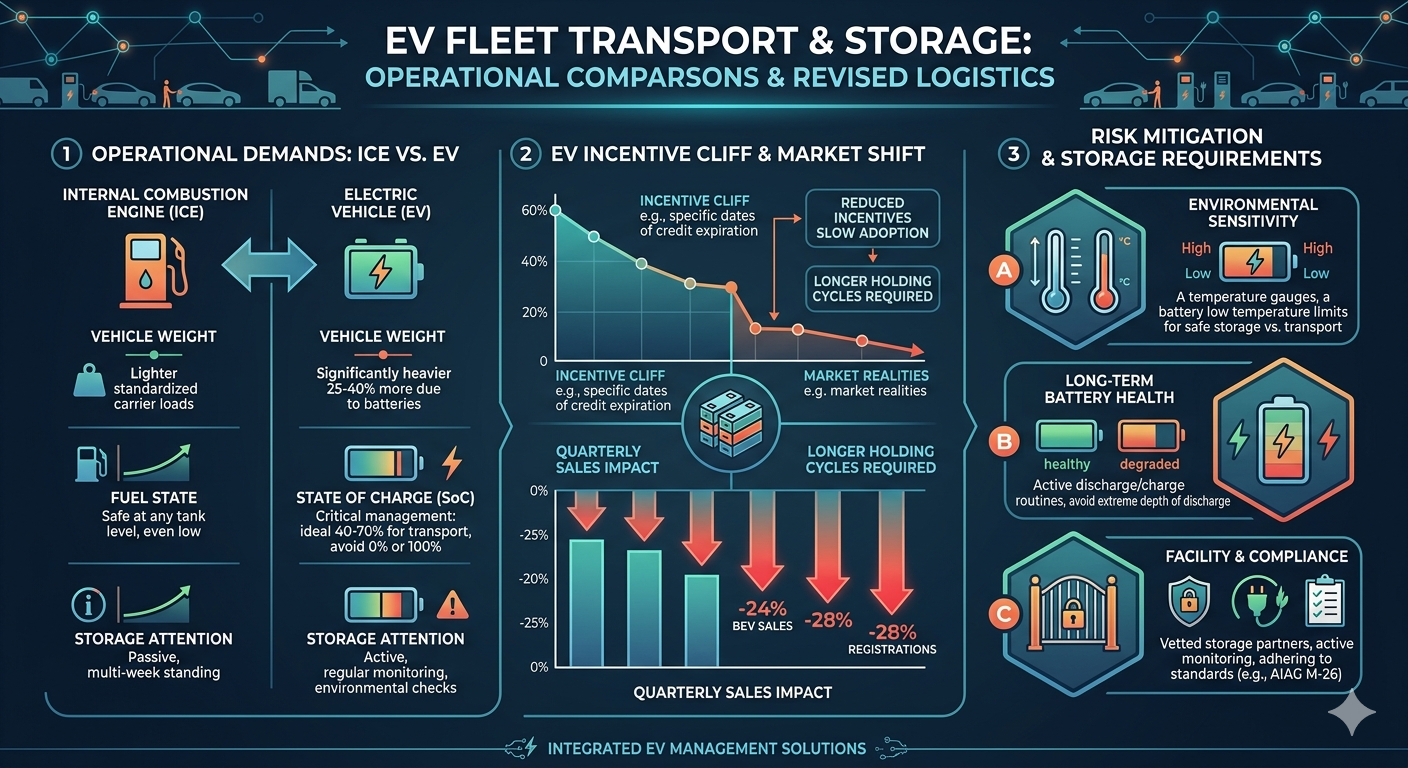
Electric vehicles change fleet logistics through managed state of charge, heavier weight and load planning, and active battery care in storage. A practical playbook for transporting and storing EV fleets.
29 May 2026
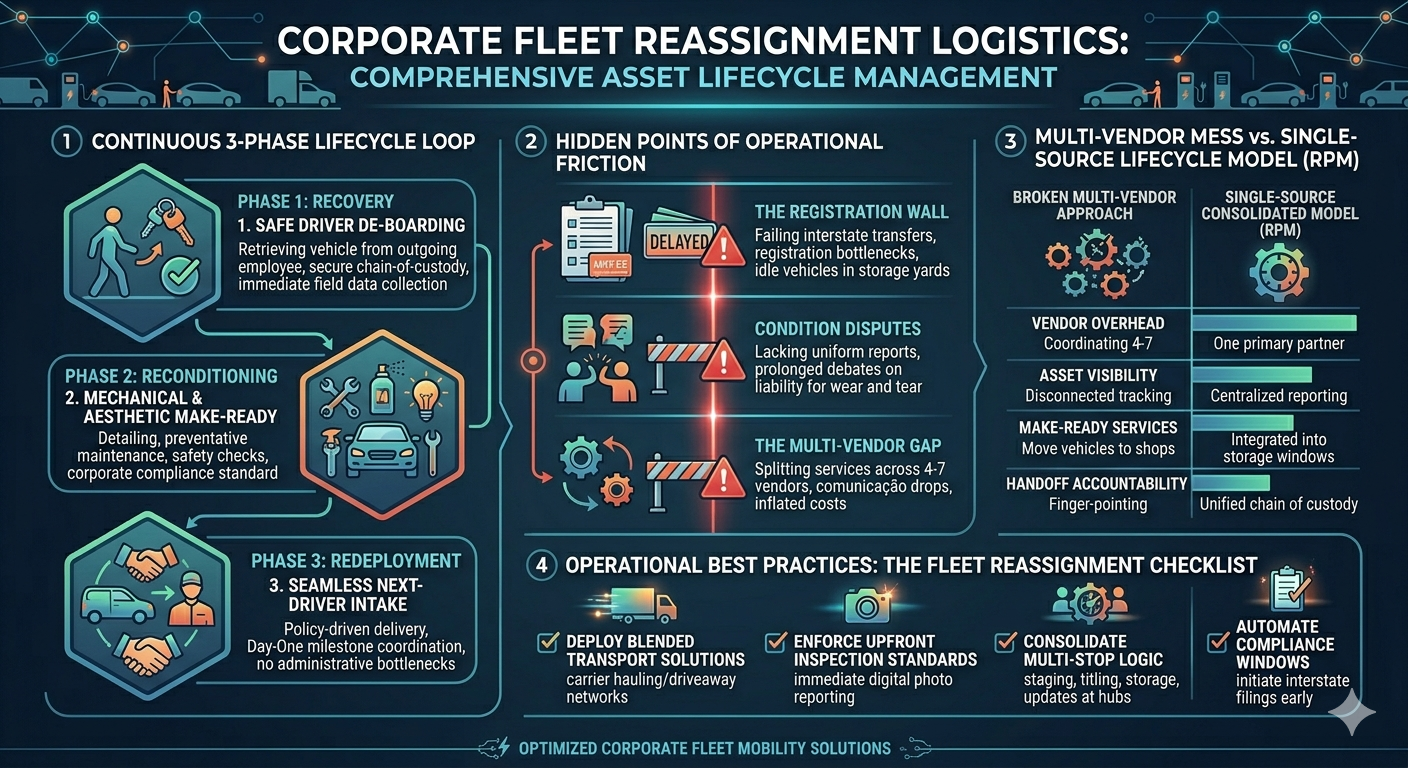
Fleet reassignment logistics covers recovering a vehicle from an outgoing driver, reconditioning it, and redeploying it to the next driver or site. Why it is constant, what it costs, and how to avoid downtime.
28 May 2026
Driveaway moves a vehicle under its own power; haulaway transports it as cargo. A side-by-side comparison of cost, speed, mileage, and asset protection, with a decision framework for fleets.
27 May 2026
Every driveaway mile is a mile off the asset's residual value at remarketing. Fleet transport companies that protect asset value run five operational disciplines: GPS-verified route adherence, contractual mileage caps, elevated driver vetting, intermediate condition reporting, and wear-cost recovery clauses.
26 May 2026
State-level fleet compliance is the headline most providers stop at. County-level emissions inspections, registration sub-rules, classification quirks, and plate-transfer restrictions are where multi-state fleet programs actually get stuck. This guide breaks down the four county-level rule categories and the state-by-state risk matrix.
22 May 2026
Fleet transport damage disputes are decided by documentation, not by what happened to the vehicle. Symmetrical photo condition reports captured at pickup and delivery reduce net claim cost 30 to 50 percent and resolve disputes in 24 to 72 hours instead of 6 to 8 weeks.
21 May 2026
Fleet transport companies reducing per-vehicle costs in 2026 are using four data-driven structural levers: lane-level cost benchmarking, condition-claim pattern analysis, demand forecasting integration, and SLA-tied performance scorecards. The combined effect delivers 4 to 9 percent annual cost reduction.
20 May 2026
Fleet operators consolidating from four-to-seven-vendor programs to a single lifecycle logistics partner typically reduce administrative overhead 40 to 60 percent and damage claim cost 15 to 25 percent. This guide details the economics, the operational case, and when single-partner consolidation does not make sense.
19 May 2026
RPM North America
205 Hamilton Row, Suite 200,
Birmingham, MI 48009
+1 855 585 1910