

Quick Answer
Direct-to-consumer EV logistics is how an electric vehicle brand gets cars from the plant to buyers without franchised dealers. The brand runs its own hubs, inspections, handoffs, trade-ins and returns. With no dealer lot to absorb mistakes, every delivery date, charge level and condition report becomes the brand's responsibility.
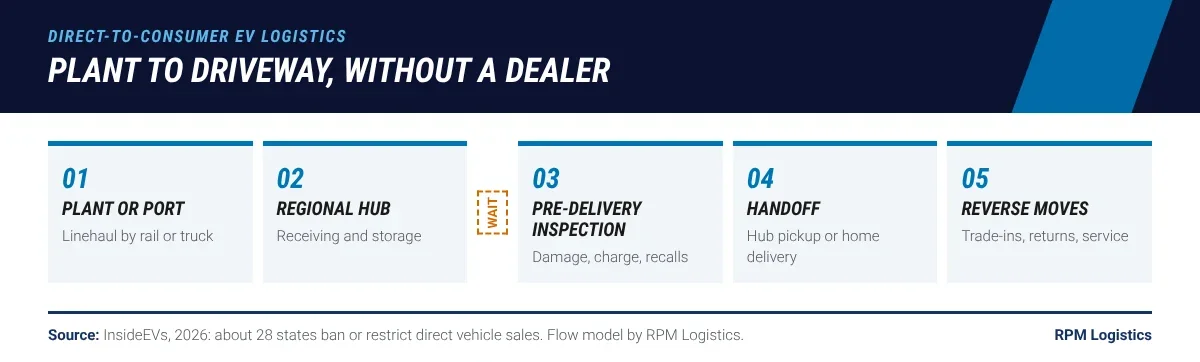
In a dealer model, the lot sits between the plant and the buyer. In a direct model, the brand fills that gap itself.
Who Sells Direct, and Why Logistics Gets Harder
Tesla, Rivian and Lucid sell most of their vehicles directly to consumers. Together they hold about 4% of the U.S. auto market (InsideEVs, 2026). New entrants and EV-only brands tied to legacy automakers are pushing for the same model.
State law shapes how they do it. About 28 states ban or restrict direct vehicle sales (InsideEVs, 2026). In March 2026, Washington passed a law letting Rivian and Lucid sell directly, a right that only Tesla held before (Electrek, 2026). In restricted states, brands often complete the sale out of state and deliver in.
That legal patchwork turns into a logistics problem. A buyer in a restricted state may take delivery from a hub in a neighboring state. Vehicles cross state lines more often, and delivery points sit where the law allows, not always where buyers live.
The vehicles also carry real value. The average new EV sold for $56,220 in October 2026 (Cox Automotive, November 2026). A delivery problem is an expensive problem.
What Dealers Do That a Direct Brand Must Replace
A franchised dealer does more than sell. It receives inventory, inspects it, stores it, preps it, hands it over, takes trade-ins and handles many returns and service visits. A direct brand has to rebuild each of those jobs.
- Receiving. Someone has to take delivery from the carrier and sign the condition report.
- Pre-delivery inspection. Damage from the plant trip has to be caught before the buyer sees it.
- Storage. Built vehicles need a secure place to wait for their buyer.
- Handoff. The buyer expects a clean, charged car and a walk-through.
- Trade-ins. Used vehicles have to be collected and routed to remarketing.
- Returns and service. Vehicles may need to move to a service center hours away.
RPM covers the broader debate on direct car sales and its pros and cons. This article stays on the logistics.
Plant to Hub: The Linehaul Leg
Most direct brands ship from the plant to regional hubs by rail, truck or both. Imported models start at a port. RPM explains that first leg in its guide to port-to-dealer finished vehicle logistics, and the same steps apply when the destination is a brand hub.
EVs bring two linehaul details worth planning for:
- Weight. Large electric SUVs and pickups are heavy. Heavier units can reduce how many vehicles fit on one trailer within weight limits.
- Charge level. Vehicles need enough charge to load, unload and move around the hub. Brands set their own targets for shipping charge.
Production surges and launches add pressure. RPM describes how carriers absorb sudden volume in its overview of OEM production surges.
Hub to Driveway: The Last Mile
The last mile is where a direct brand's reputation is made. Buyers have often waited weeks, and they compare the handoff with what they expected.
Home delivery or hub pickup
Some buyers collect at a hub. Others want the vehicle brought home. Home delivery adds scheduling, parking and access problems. Enclosed or single-vehicle transport may suit higher-trim units and areas where a large car carrier cannot reach.
Pre-delivery inspection
Every vehicle should be inspected after the linehaul and before the buyer sees it. Look for paint damage, glass chips, wheel scuffs and interior marks. RPM's guide to post-delivery quality control covers what to check.
Open recalls
Check each VIN for open recalls before handoff using NHTSA's recall lookup. Many EV fixes arrive as software updates, but some need parts or shop time before delivery.
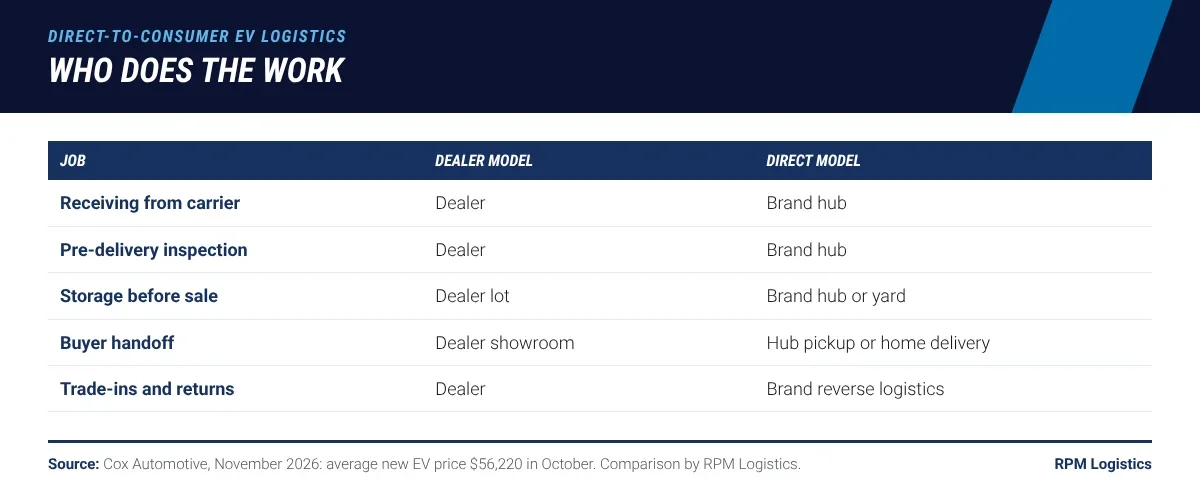
Every job a dealer does by default becomes a process the direct brand must design and staff.
EV Handling Details Carriers Need
EVs load and ride like other cars, with a few exceptions that belong in every transport order:
- Transport or tow mode. Many EVs need a specific mode to roll freely when winched. The brand should supply the steps to every carrier.
- Low ground clearance. Battery packs sit under the floor. Ramp angles and tie-down points matter more than on a pickup.
- Cold weather. Range and charge drop in the cold. A vehicle shipped at a low charge in winter may arrive too low to drive off the trailer. RPM covers this in its guide to electric cars in cold weather.
- Keys and access. Phone-as-key and card keys need a clear handoff plan for drivers and hub staff.
Delivery Dates and Buyer Expectations
A buyer who ordered online often gets a delivery date weeks ahead. That date becomes a promise. Weather, carrier capacity and hub backlogs can all move it.
Brands that handle this well build buffer between hub arrival and the buyer's appointment. They confirm the vehicle is inspected and ready before they confirm the appointment. When a date has to move, they tell the buyer early and give a new one. A late notice hurts more than a late car.
Reverse Moves: Trade-Ins, Returns and Service
Direct brands move vehicles backward as well as forward. These reverse moves are easy to underplan.
- Trade-ins must be collected, inspected and sent to auction or resale. Used EVs have their own handling needs, covered in RPM's guide to used EV transport.
- Returns under a brand's return policy send a nearly new vehicle back to a hub for inspection and resale.
- Service moves carry vehicles to and from service centers that may be far from the owner.
- Battery work may require moving a pack separately. See RPM's guide to EV battery pack transport.
Each of these needs the same condition reporting as an outbound delivery. A return that arrives with new damage starts a dispute with the customer.
Building a Direct-to-Consumer Delivery Network: Core Pieces
- Regional hubs placed where state law allows sales and deliveries.
- A linehaul plan from plant or port to each hub, by rail, truck or both.
- Pre-delivery inspection at every hub.
- Secure storage for vehicles waiting on their buyers.
- Last-mile options for hub pickup and home delivery.
- A reverse flow for trade-ins, returns and service moves.
- One condition report standard across every leg.
Choosing Transport Partners for a Direct Model
A direct brand often needs several kinds of transport: linehaul car carriers, enclosed carriers, single-vehicle delivery and reverse moves. Managing a separate vendor for each adds handoffs.
Questions to ask a partner:
- Can you cover every hub and buyer address, including restricted states?
- How do you handle home deliveries with tight access?
- What does your condition report include at pickup and delivery?
- Can you run reverse moves on the same standard as outbound?
Verify each carrier's operating authority on the FMCSA company snapshot. RPM's guide to evaluating an OEM logistics partner lists more criteria.
RPM Logistics moves finished vehicles for OEMs in all 50 states and Canada, through a network of 15,000+ active carriers. Its OEM vehicle logistics service covers plant, port, hub and last-mile moves.
Frequently Asked Questions
How do direct-to-consumer EV brands deliver cars without dealers?
They ship vehicles from the plant or port to their own regional hubs. There, vehicles are inspected, stored and prepared. Buyers collect at the hub or get home delivery, and the brand also handles trade-ins, returns and service moves.
Which states restrict direct EV sales?
About 28 states ban or restrict direct vehicle sales, according to 2026 reporting from InsideEVs. Rules change often. Washington, for example, allowed Rivian and Lucid to sell directly in March 2026.
How are EVs delivered in states that ban direct sales?
Brands often complete the sale outside the state and deliver the vehicle in. That can mean delivery from a hub in a neighboring state, which adds cross-state transport.
What should be checked before an EV is handed to a buyer?
Inspect for paint, glass, wheel and interior damage from transport. Confirm the charge level, check for open recalls by VIN and make sure the vehicle is clean and ready to drive.
Why do direct EV brands need reverse logistics?
Without dealers, the brand must collect trade-ins, take back returned vehicles and move cars to and from service centers. Each move needs the same care and documentation as a new delivery.