

Quick Answer
Specialty vehicle delivery is moving a finished ambulance, shuttle bus, accessible van or upfit truck from the builder to the dealer or buyer. Most units go by professional driver, which adds miles but fits any height. Tall or high-value units ride on a step deck. Every unit needs an acceptance inspection before it enters service.
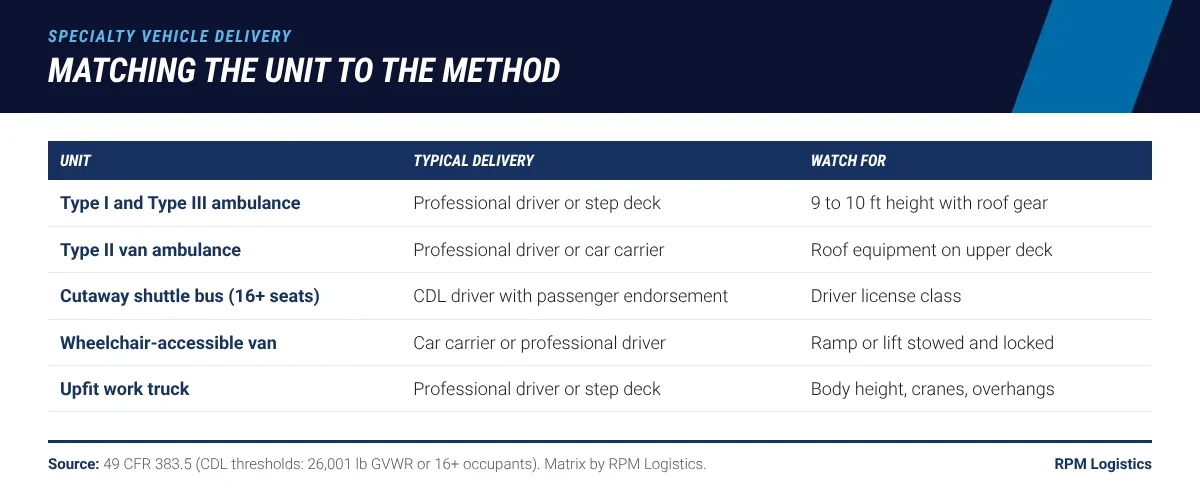
Height, weight and passenger capacity decide how a finished specialty unit can move, and who is allowed to drive it.
What Counts as a Specialty Vehicle
A specialty vehicle starts as a chassis from a major automaker and leaves a second builder as something else. Common examples:
- Ambulances. Type I (truck chassis with a box body), Type II (van-based) and Type III (cutaway van chassis with a box body).
- Shuttle and cutaway buses for hotels, airports, churches, senior living and transit agencies.
- Wheelchair-accessible vans with lowered floors, ramps or lifts.
- Upfit work trucks with service bodies, cranes, dump beds or box bodies.
- Mobile units such as command posts, clinics and food trucks.
These units are taller, heavier and more equipment-dense than the chassis they started from. They also cost far more. A broken light bar or a scraped step can delay a unit's entry into service, which matters most for emergency vehicles.
From Chassis to Finished Unit
Specialty vehicles move at least twice. First, the bare chassis ships from the automaker to the builder. Many automakers run ship-thru programs for this leg. RPM explains how those moves work in its guide to upfitting logistics and ship-thru transport.
Second, the finished unit ships from the builder to a dealer, distributor or end buyer. That second move is the focus here. It carries a finished, inspected, often customized vehicle that the buyer has been waiting for.
The builder that completes the vehicle usually acts as the final-stage manufacturer. Federal rules require a final-stage manufacturer to certify the completed vehicle with a label, under 49 CFR Part 568. Confirm the label is on the unit before it ships. A missing label can stall registration.
Option 1: Professional Driver (Driveaway)
Most finished ambulances and many shuttles reach their buyers under their own power. A professional driver picks up the unit at the builder and drives it to the destination.
Driveaway fits specialty units well because:
- Height is not a constraint, since the unit drives on the road.
- It works for single units going to different buyers.
- The driver can do a basic systems check on the way.
The tradeoffs are miles and driver qualifications. A cross-country delivery adds real mileage to a new vehicle. Some buyers set a mileage limit in the purchase contract.
Who can legally drive the unit
Two thresholds decide whether a CDL is needed. A gross vehicle weight rating of 26,001 pounds or more makes a vehicle a commercial motor vehicle. So does a design to carry 16 or more people including the driver. Both come from the CDL rules in 49 CFR 383.5. Most ambulances fall under 26,001 pounds. Many shuttle buses carry 16 or more passengers. Those need a driver with the right CDL class and a passenger endorsement.
RPM screens professional drivers with motor vehicle record checks and continuous MVR monitoring. For more on how driveaway programs protect vehicle value, see RPM's guide to driveaway programs and asset value.
Option 2: Step Deck or Lowboy Trailer
Trailer transport adds no miles. It suits buyers with strict mileage limits, units that cannot be driven and long cross-country moves.
Height is the main constraint. Type I and Type III ambulances often stand about 9 to 10 feet tall. Many states set a 13 foot 6 inch height limit. A step deck's lower deck sits roughly 3.5 feet off the road, so a 10-foot unit rides close to that limit. Taller units may need a lowboy or a height permit. RPM explains trailer choices in its guide to lowboy trailers and its overview of over-dimensional transport for buses, RVs and chassis.
Securement matters too. Tie-downs must attach to the chassis frame, not to the body, steps or bumpers. Roof equipment, mirrors and light bars must clear any straps.
Option 3: Car Carrier for Smaller Units
Van-based units, including Type II ambulances and many accessible vans, can fit on a car carrier if their height and weight allow. This works well when several units go to one dealer. RPM's guide to haulaway transport explains how multi-unit loads work.
Check the van's height with any roof equipment fitted. A high-roof van with a light bar may not fit the upper deck.
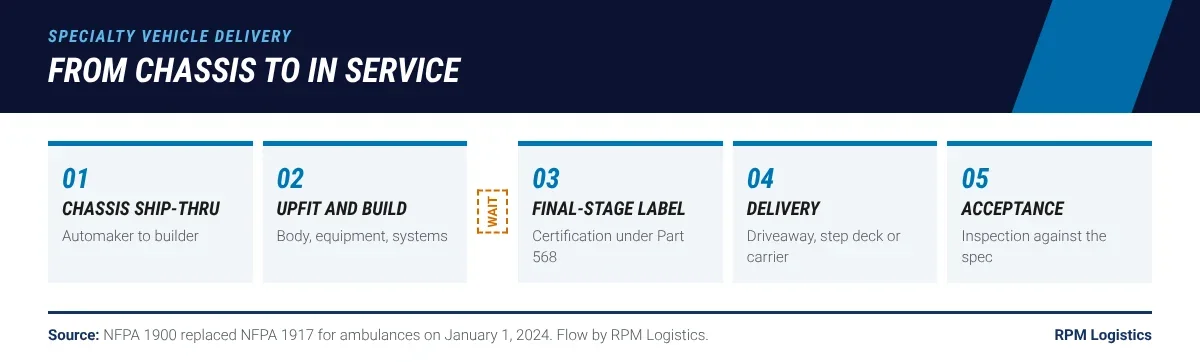
The delivery leg is short compared with the build, but a damaged unit at acceptance sends the whole process back.
Mileage Limits and Delivery Terms
New specialty units often come with a delivery mileage limit written into the purchase contract. A buyer may accept a few hundred delivery miles on a shuttle but expect far fewer on a custom ambulance. Know the limit before choosing a method.
Put these terms in writing with the transport provider:
- Maximum miles allowed on the unit at delivery.
- Fuel level at pickup and at delivery.
- Route restrictions, such as avoiding unpaved roads or tight urban streets.
- Overnight parking rules for driven units, including secure lots for high-value vehicles.
- Who pays for tolls and any permits.
When the route is long and the mileage limit is tight, a trailer is usually the only way to meet both. When the route is short, a professional driver is often faster and simpler.
Shipping a Fleet Order
Large orders change the plan. A county that orders twelve ambulances, or a transit agency that orders twenty shuttles, may want them delivered together for training and in-service dates. Builders rarely finish every unit on the same day.
Two common approaches work. The first is to ship each unit as it is finished and stage them at the buyer's site. The second is to hold finished units at the builder and ship them as a group. Holding adds storage time at the builder, while staging puts finished units on the buyer's lot sooner. Agree the approach before the first unit is done. RPM covers multi-unit planning in its guide to fleet replacement cycle delivery.
What Gets Damaged and How to Prevent It
Specialty units carry equipment that standard vehicles do not. The common damage points are:
- Roof equipment. Light bars, antennas, air conditioning units and vents.
- Rear steps and bumpers. These hang low and can scrape on ramps or curbs.
- Side compartments. Doors can open in transit if latches are not secured.
- Interior equipment. Cots, mounts, cabinets and loose supplies can shift.
- Accessible van ramps and lifts. They must be stowed and locked.
A walkaround with photos at pickup records the unit's condition. RPM explains what a strong report includes in its guide to insurance-grade condition reporting.
Ambulance Standards and Acceptance
Ambulances are built to a recognized standard, which the buyer's specification names. NFPA 1900 took effect on January 1, 2024, replacing NFPA 1917 and three other apparatus standards (NFPA, 2024). Some states still accept the older federal KKK-A-1822 specification or the CAAS Ground Vehicle Standard. Utah, for example, lists all three as approved for new ambulance permits (Utah Bureau of EMS, 2024).
The standard matters to delivery because the buyer will inspect against it. Plan an acceptance inspection at delivery that covers:
- Exterior condition, lights and warning devices.
- Electrical systems, inverters and shore power.
- Oxygen and suction systems.
- Cot mounts, seating and restraints.
- Paperwork: certification label, title documents and warranty registration.
Before acceptance, check the chassis VIN for open recalls on NHTSA's recall lookup. Chassis recalls apply to the finished unit even though a second builder completed it.
Delivering to Public Agencies
Many specialty vehicles go to cities, counties, fire districts and transit agencies. Public buyers often have formal acceptance steps, named receivers and limited delivery hours. They may also hold payment until a unit passes inspection.
Confirm the receiving location, contact and acceptance process before dispatch. A unit that arrives on a weekend with no one to sign for it waits, and so does the invoice. RPM covers public buyers in its guide to public sector fleet vehicle logistics.
Specialty Vehicle Delivery Checklist
- Confirm the unit's height, weight, GVWR and passenger capacity.
- Choose driveaway, step deck or car carrier based on those numbers and any mileage limit.
- Match the driver's license class and endorsements to the unit.
- Confirm the final-stage certification label is on the unit.
- Secure doors, compartments, ramps and loose equipment.
- Photograph the unit, roof equipment and rear steps at pickup.
- Check the chassis VIN for open recalls.
- Book the receiving contact and acceptance inspection at the destination.
Working With a Transport Partner
Builders and dealers often ship specialty units in uneven batches. A fire district order may finish all at once, while single shuttles trickle out to hotels. A partner that offers both professional drivers and trailers can match each unit to the right method.
RPM Logistics moves specialty and upfit vehicles in all 50 states and Canada. Its driveaway service supplies professional drivers for units that can be driven. Its specialized vehicle transport service covers trailered moves for tall, heavy or non-running units. For multi-site programs, see RPM's guide to driveaway program design.
Frequently Asked Questions
How are new ambulances delivered?
Most are driven from the builder to the buyer by professional delivery drivers. Units with strict mileage limits, or very long routes, can ride on a step deck trailer instead. The buyer runs an acceptance inspection on arrival.
Does a driver need a CDL to deliver an ambulance?
Usually not. Most ambulances have a gross vehicle weight rating under 26,001 pounds and carry fewer than 16 people. A CDL is required for vehicles at or above 26,001 pounds or designed to carry 16 or more people including the driver.
Does a driver need a CDL to deliver a shuttle bus?
Often, yes. A bus designed to carry 16 or more people including the driver is a commercial motor vehicle. The delivery driver needs the right CDL class and a passenger endorsement.
Can an ambulance fit on a car carrier?
Some van-based Type II ambulances can. Type I and Type III units are usually too tall and heavy and move by professional driver or on a step deck trailer.
What should be checked when a specialty vehicle is delivered?
Check exterior condition, lights, electrical systems and installed equipment against the purchase specification. Confirm the certification label and title documents, and check the chassis VIN for open recalls.
How tall is a Type I ambulance for transport?
Many Type I and Type III ambulances stand roughly 9 to 10 feet tall with roof equipment. On a step deck, that puts the load close to the 13 foot 6 inch limit common in many states. Measure each unit before booking a trailer.
Who certifies a finished specialty vehicle?
The builder that completes the vehicle usually acts as the final-stage manufacturer. It attaches a certification label under 49 CFR Part 568. That label should be on the unit before it ships.