

Quick Answer
Fleet recall campaign logistics is the work of finding every recalled vehicle in a fleet. Each one then has to reach a repair point and return to service with the least downtime. The recall type decides the move. Software fixes may need no transport. Parts-constrained and do-not-drive recalls need storage, trailers and replacement vehicles planned in advance.
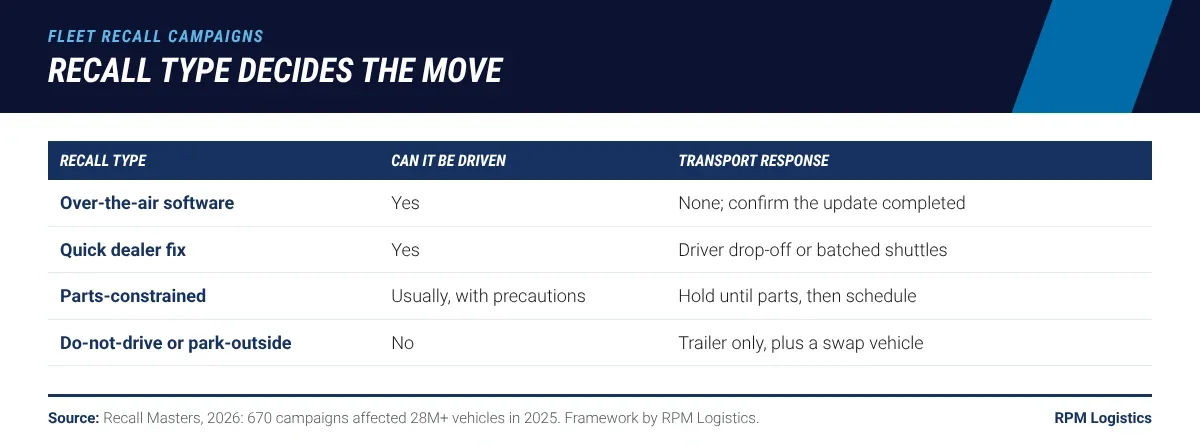
Sort every recall by type first. The type decides whether a vehicle moves, how it moves and how long it is gone.
Why Recalls Are a Fleet Logistics Problem
A recall notice tells a fleet what is wrong. It does not tell the fleet how to get dozens or hundreds of vehicles repaired without stopping work. That part is logistics.
Recall volume is high and rising. In 2025, there were 447 NHTSA-mandated recall campaigns and 223 voluntary manufacturer recalls, affecting more than 28 million vehicles (Recall Masters, 2026). Ford alone issued 152 recalls in 2025, a record for any automaker (Fox Business, 2025). Software defects drove 119 campaigns covering 8.19 million vehicles (Recall Masters, 2026).
Completion is improving but far from total. About 50.3% of vehicles recalled in 2025 had been repaired by February 2026 (Recall Masters, 2026). For a fleet, an unrepaired recall is a safety risk and a liability. NHTSA's 2025 annual recalls report tracks the trend across manufacturers.
Rental fleets face a hard rule. Federal law bars rental companies from renting out vehicles with open safety recalls until they are repaired (Raechel and Jacqueline Houck Safe Rental Car Act, 2015). Corporate and service fleets are not covered by that law, but many apply the same standard in their own policies.
Step 1: Find Every Affected VIN
A fleet can only fix what it can find. Start by checking every VIN against open recalls. Owners usually get recall letters, but fleets with leased, titled-elsewhere or recently reassigned vehicles often miss them.
- Run the full VIN list through NHTSA's recall lookup or the manufacturer's fleet portal.
- Match each affected VIN to its current driver, location and use.
- Flag vehicles that are in storage, between drivers or in transit.
Vehicles between assignments are easy to miss. RPM covers that gap in its guide to fleet vehicle storage between assignments.
Step 2: Triage by Recall Type
Not every recall needs a truck. Sort each campaign into one of four groups:
Over-the-air software
Some fixes install remotely. The vehicle never leaves its driver. The fleet's job is to confirm the update actually completed on each VIN.
Quick dealer fix
Many recalls take an hour or two at a dealer once parts are in stock. Drivers can often take the vehicle in themselves. For remote drivers or busy crews, moving vehicles to the dealer in batches saves time.
Parts-constrained
When parts are short, the manufacturer may announce a recall before the fix is available. Vehicles may be safe to drive with precautions, or they may need to be parked. These campaigns can last months.
Do-not-drive or park-outside
The most serious recalls tell owners to stop driving the vehicle or park it outside. These vehicles cannot move under their own power. They need trailer transport to the repair point and often a replacement vehicle for the driver.
Step 3: Match the Transport Method to the Recall
The recall type decides how a vehicle should move.
- Professional driver. Works for driveable vehicles going to a dealer or repair hub. One driver can move one vehicle door to door. See RPM's guide to driveaway program design for multi-site fleets.
- Car carrier. Works for batches of vehicles from one site to one repair point, and for any vehicle that should not be driven.
- Single-vehicle trailer. Works for a do-not-drive vehicle at a remote driver's home.
Never send a professional driver to drive a vehicle under a do-not-drive notice. Note the recall status on every transport order so the carrier sends the right equipment.
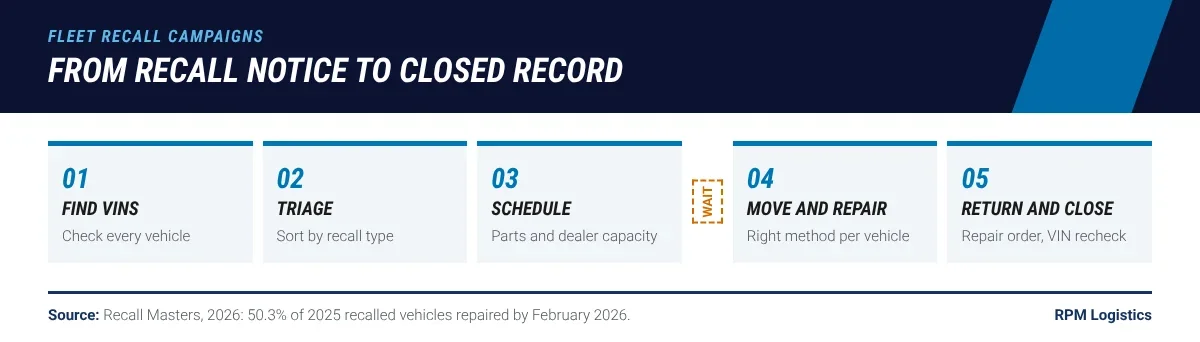
The waits sit at dealer scheduling and parts. Transport is the part a fleet can plan precisely.
Step 4: Schedule Around Dealer Capacity
Dealers have limited service bays. A large recall can fill them for weeks. A fleet that sends 40 vehicles to one dealer on the same day will see most of them wait.
Work with the dealer or manufacturer's fleet team before moving anything:
- Confirm parts are in stock for the number of vehicles you plan to send.
- Agree a daily intake the dealer can handle.
- Spread vehicles across several dealers in the region if one is full.
- Ask whether the dealer can store vehicles waiting on repair.
Some upfitted vehicles, such as service trucks with bodies and racks, may need the repair done at a specific location. RPM explains how upfit moves work in its guide to upfitting logistics and ship-thru transport.
Step 5: Keep Drivers Working
The cost of a recall is mostly downtime. A technician without a van, or a sales rep without a car, stops earning for the business.
Options to keep drivers productive:
- Swap vehicles. Deliver a pool or spare vehicle when the recalled one is collected.
- Repair after hours. Collect vehicles at night or on weekends and return them before the next shift.
- Use mobile service. Some manufacturers send technicians to the fleet's site for simple fixes.
- Rent short term. For long parts delays, a rental may cost less than lost work.
Rental and car-sharing fleets have a sharper problem: an unrepaired recall takes a unit out of rentable inventory. RPM's guide to rental fleet de-fleeting covers how recalls can also hold up vehicles bound for sale.
Step 6: Document Every Handoff
A recall campaign creates many handoffs: driver to carrier, carrier to dealer, dealer back to carrier, carrier to driver. Each one is a chance for damage, lost keys or missing items.
Record condition at each pickup and delivery with photos and odometer readings. RPM explains how to keep a clean chain of custody in its guide to fleet vehicle handoff accountability. Photo condition reports also protect the fleet if a dispute arises. See RPM's guide to damage claims and photo condition reports.
Keep the dealer's repair order for each VIN. It is the proof that the recall was completed.
Step 7: Close the Loop
A recall is not done when the vehicle leaves the dealer. It is done when the fleet's own records show the repair and the vehicle is back with its driver.
- Recheck each VIN after repair to confirm the recall shows as complete.
- Update the vehicle's file with the repair order.
- Track open VINs until every one is closed or explained.
Some vehicles will hit problems: missed appointments, wrong parts, damage in transit. RPM covers how to handle those in its guide to fleet transport exception management.
Putting a Number on Recall Downtime
Recall downtime is easy to underestimate because no invoice shows it. A simple model helps. Multiply the number of affected vehicles by the days each one is out of service. Then multiply by what a day without the vehicle costs the business.
Ownership cost alone is a useful floor. AAA puts ownership cost at $28.50 a day for a half-ton crew-cab pickup, covering insurance, registration, depreciation and finance (AAA, 2025). That cost runs whether the truck works or waits at a dealer.
Take a hypothetical recall covering 60 pickups. If each one is out of service for 5 days, that is 300 vehicle-days, or $8,550 in ownership cost before any lost work. If parts delays stretch the average to 15 days, the same campaign costs $25,650. The lost work of a technician or sales rep is usually far higher than either number.
The levers are clear. Shorter waits at the dealer, faster transport and fewer extra trips cut vehicle-days. Swap vehicles cut lost work.
Communicating With Drivers
Drivers often learn about a recall from a letter, the news or the dashboard. If the fleet has not told them what to do, some will keep driving a do-not-drive vehicle and others will park a safe one.
Send each affected driver a short notice that covers:
- Which vehicle is affected and what the recall is.
- Whether they can keep driving it.
- When and how the vehicle will be collected or repaired.
- What they will drive in the meantime.
One clear message prevents a wave of calls and unsafe guesses.
Fleet Recall Campaign Playbook
- Check every VIN in the fleet against open recalls.
- Sort affected vehicles by recall type: software, quick fix, parts-constrained or do-not-drive.
- Confirm parts and dealer capacity before moving any vehicle.
- Choose the transport method for each vehicle based on recall type.
- Arrange replacement vehicles for drivers who will be without one.
- Record condition at every pickup and delivery.
- Collect the repair order for each VIN.
- Recheck VINs and close the campaign in fleet records.
Recalls on EVs and Battery Packs
EV recalls can involve the high-voltage battery. Some require the pack to be replaced or removed, which turns part of the campaign into a hazmat move. RPM covers that path in its guide to EV battery recall reverse logistics. Do-not-drive or park-outside EV recalls should always move on a trailer, with the carrier told about the recall before pickup.
Working With a Fleet Transport Partner
Fleet managers who run recall campaigns well usually have one transport partner for every move type: professional drivers, car carriers and single-vehicle trailers. That avoids juggling vendors when a large recall hits. Industry groups such as NAFA Fleet Management Association also share recall practices among fleet managers.
RPM Logistics moves fleet vehicles in all 50 states and Canada, by professional driver, car carrier and enclosed trailer. Drivers are screened with motor vehicle record checks and continuous MVR monitoring. Its fleet vehicle transport service supports recall moves, repair shuttles and vehicle swaps.
Frequently Asked Questions
How do fleets manage vehicle recalls?
Fleets check every VIN against open recalls, sort affected vehicles by recall type and schedule repairs around dealer capacity and parts. They move vehicles by the right method, keep drivers working with swaps or after-hours repairs and confirm each repair is recorded.
Can a recalled fleet vehicle be driven to the dealer?
It depends on the recall. Many recalls allow the vehicle to be driven to a dealer. Do-not-drive and park-outside recalls do not, so those vehicles need trailer transport.
Are rental companies allowed to rent recalled vehicles?
No. Federal law bars rental companies from renting out vehicles with open safety recalls until they are repaired. Corporate fleets are not covered by that law, but many follow the same rule in their own policies.
How many vehicles were recalled in 2025?
More than 28 million vehicles were affected by 447 NHTSA-mandated and 223 voluntary recall campaigns in 2025, according to Recall Masters' State of Recalls report.
What is the biggest cost of a fleet recall?
Usually downtime. A driver without a vehicle stops working. Planning swaps, after-hours repairs and batched moves keeps that cost down.
Should a fleet move vehicles before recall parts arrive?
Usually not. Moving vehicles to a dealer before parts are in stock adds storage time and leaves drivers without vehicles. Confirm parts and a repair date first. The exception is a do-not-drive recall, where the vehicle may need to move to secure storage right away.
Who pays for transport during a recall?
The manufacturer pays for the repair itself. Transport to and from the dealer is often the fleet's cost, though some manufacturers offer pickup, mobile service or reimbursement on large campaigns. Ask the manufacturer's fleet team before scheduling moves.