

Quick Answer
Shipping medical device lithium batteries starts with two questions. Is the battery lithium ion or lithium metal? Does it ship alone, packed with a device or installed in it? The answers set the rules under 49 CFR 173.185. Small batteries may be excepted. Larger ones ship as Class 9 hazmat. Ground freight avoids the new 2026 air charge limits.
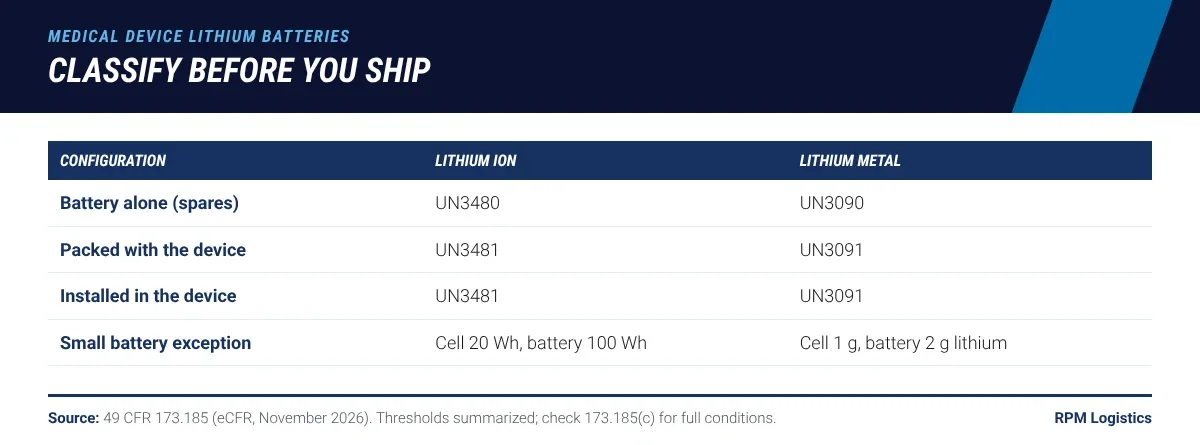
Two questions set the UN number: what chemistry, and where the battery sits relative to the device.
Which Medical Devices Carry Regulated Batteries
Lithium batteries power a wide range of medical equipment. Common examples include infusion pumps, portable patient monitors, automated external defibrillators, portable oxygen concentrators, surgical power tools and wearable monitors.
These products move through the supply chain many times. They ship from the factory to distribution centers, from distributors to hospitals and clinics, and back again for repair or recycling. Each leg is a hazmat shipment unless an exception applies.
Device makers also ship replacement batteries on their own. Hospitals stock spares for critical equipment, and service depots swap batteries during repairs. Battery-only shipments follow different rules from batteries inside a device.
Home health adds another layer. Portable devices increasingly go straight to patients' homes and come back when therapy ends. Each of those trips is a battery shipment too, often handled by staff who do not think of themselves as hazmat shippers. Getting classification right at the start keeps every later leg simpler.
Step 1: Lithium Ion or Lithium Metal
The first question is chemistry. Lithium ion batteries are rechargeable. They power most pumps, monitors and portable devices. Lithium metal batteries are usually not rechargeable. They are common in some defibrillators, implant programmers and long-life backup power.
The chemistry decides the UN number and the thresholds that apply. Check the battery label or the manufacturer's safety data. RPM explains why both types count as hazardous materials in its guide on whether lithium batteries are hazmat.
Step 2: Alone, Packed With or Contained In
The second question is configuration:
- Batteries alone. Spares or replacements with no device in the box. Lithium ion is UN3480. Lithium metal is UN3090.
- Packed with equipment. A device and its battery in the same box, but the battery is not installed. Lithium ion is UN3481. Lithium metal is UN3091.
- Contained in equipment. The battery is installed in the device. Same UN numbers as packed with equipment.
Configuration also affects packaging and air rules. Batteries alone face the strictest limits. Batteries installed in a device face the lightest.
Step 3: Check the Small Battery Exception
Many medical device batteries are small enough to qualify for the exception in 49 CFR 173.185(c). In general, the thresholds are:
- Lithium ion cells up to 20 Wh and batteries up to 100 Wh.
- Lithium metal cells with up to 1 gram of lithium and batteries with up to 2 grams.
Excepted shipments still have conditions. Batteries must be protected against short circuits and damage. Packages usually need the lithium battery mark. They are relieved of many, but not all, of the requirements for fully regulated hazmat. Check the exact conditions in 173.185(c) for your configuration and quantity.
Batteries above these limits ship as fully regulated Class 9 hazardous materials. That means specification packaging, Class 9 lithium battery labels, shipping papers and emergency response information. RPM covers the packaging side in its guide to lithium battery packaging requirements.
Step 4: Confirm UN 38.3 Testing
Every lithium cell and battery design must pass UN 38.3 testing before it ships, excepted or not. The manufacturer must make a test summary available to anyone in the supply chain who asks.
Device makers that buy batteries from a supplier should collect the test summary for every battery design they use. Distributors should be able to get it from the device maker. RPM explains what the document must contain in its guide to UN 38.3 test summary documentation.
Prototype batteries that have not completed testing follow a separate path for low production runs and prototypes. See RPM's guide to shipping prototype lithium batteries under 173.185(e). This often applies to devices in clinical evaluation.
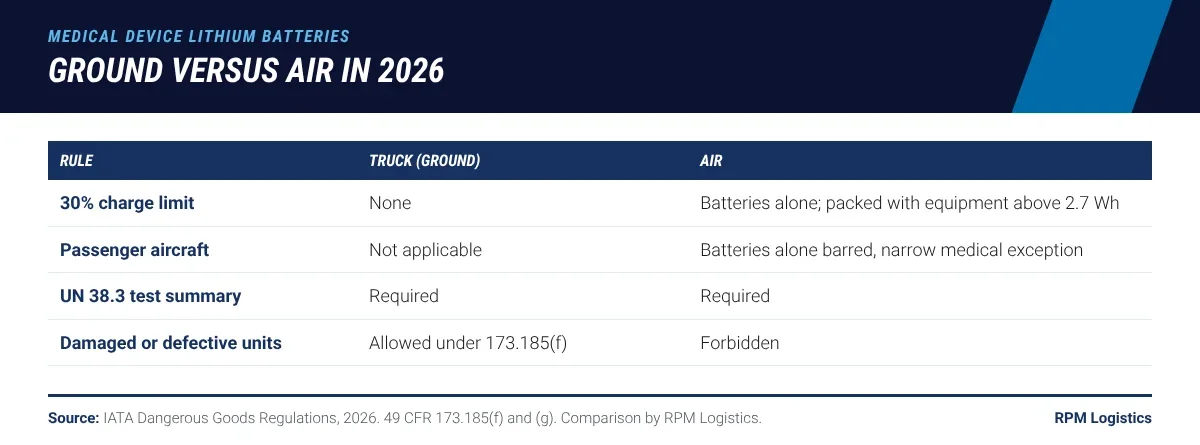
Air rules tightened in 2026. Ground rules did not add a charge limit, which makes truck freight simpler for bulk device moves.
Ground Versus Air: What Changed in 2026
Air rules for lithium batteries are stricter than ground rules, and they tightened again this year.
From January 1, 2026, lithium ion batteries packed with equipment must fly at no more than 30% state of charge. The rule covers batteries rated above 2.7 Wh (IATA Dangerous Goods Regulations, 2026). Batteries shipped alone already faced that limit. IATA still recommends, but does not require, reduced charge for batteries installed in equipment (IATA, 2026).
For medical devices, this creates a readiness problem. A replacement battery shipped at 30% charge has to be charged before it can go into service. That adds a step at the hospital or depot.
Federal rules include a narrow exception. Under 173.185(g), up to two replacement batteries for a medical device can travel as cargo on a passenger aircraft, with approval. The destination must lack daily cargo flights, and the battery must be needed for medical care. Lithium ion medical device batteries may also be excepted from the air charge limit. Each must be individually packed, placed in a rigid outer packaging and protected against short circuits.
Ground freight carries no state of charge limit. For bulk moves between plants, distribution centers and hospitals, truck freight lets batteries arrive ready to use. RPM explains the charge rules by mode in its guide to lithium battery state of charge rules. It summarizes this year's updates in its 2026 lithium battery shipping regulations overview.
Why Ground Freight Suits Bulk Device Moves
Air freight makes sense for urgent single units. For planned volume, truck freight is usually simpler. Four reasons stand out:
- No charge limit. Batteries arrive at the charge they left with, ready for service.
- Fewer quantity limits. Air rules cap how much can go in one package and ban some configurations on passenger aircraft. Ground rules are less restrictive.
- Pallet-level handling. Truckload and LTL freight moves full pallets from plant to distribution center without breaking them into parcels.
- Damaged unit options. Damaged and recalled batteries are hard to fly. Ground freight gives them a compliant path.
The tradeoff is time. A cross-country truck move takes days, not hours. Device makers that plan replacement stock ahead can use ground freight for routine supply and keep air for emergencies.
The Return Leg: Used, Damaged and Recalled Batteries
Medical device batteries do not only move forward. Service programs send used batteries back to depots. Recalls send whole product lines back. End-of-life batteries go to recyclers.
Each return needs a classification decision:
- Used but undamaged batteries going to recycling may follow the disposal and recycling provisions in 173.185(d).
- Damaged, defective or recalled batteries that could overheat follow the stricter rules in 173.185(f). They need special packaging and markings.
- Devices returned for repair with intact installed batteries usually ship as batteries contained in equipment.
The risk is that a damaged battery hides inside a normal return. Train the people who receive returns to check for swelling, leaks, heat or impact damage before repacking. RPM covers the damaged path in its guide to shipping damaged and defective lithium batteries. The recycling path is in its guide to lithium battery recycling and reverse logistics.
Training: Whoever Packs the Box
Federal rules require hazmat training for employees who prepare fully regulated hazardous materials shipments. Training must be repeated at least once every three years under 49 CFR 172.704.
In medical device companies, the person packing a battery shipment may work in a warehouse, a service depot or a customer service team. Training often reaches the shipping department but misses the depot. Map who actually prepares battery shipments, then train those people.
Marking Mistakes That Stop Shipments
Most rejected battery shipments fail on paperwork and marks, not packaging. Common problems include:
- The wrong UN number on the lithium battery mark.
- No lithium battery mark on an excepted package that needs one.
- A Class 9 label used when the shipment qualified for the exception, or the reverse.
- Old marks left on reused boxes.
RPM lists more in its guide to lithium battery marking failures.
Recalls and Field Actions: Planning the Return Wave
A device recall can send thousands of units back in a few weeks. Each one may carry a battery that is, or might be, defective. That turns a routine return program into a hazmat project.
Device makers that handle recalls well plan the logistics before the notice goes out:
- Decide the battery classification first. If the defect involves the battery, returns likely fall under the damaged and defective rules.
- Send compliant return kits. Hospitals and clinics should not have to find their own packaging for a defective battery.
- Consolidate at regional points. Pallet-level truck moves from regional collection points cost less and carry less risk than thousands of single parcels.
- Keep records by serial number. Regulators and quality teams will want to know where each unit went.
Parcel carriers often restrict or refuse damaged lithium batteries. A freight carrier that handles damaged, defective and recalled units by truck gives the recall team another option.
Delivering to Hospitals and Distribution Centers
Hospitals and medical distribution centers have strict receiving rules. Deliveries usually need an appointment, a dock and paperwork that matches the purchase order. A truck that arrives without these may be turned away.
Plan for these details when booking:
- Receiving hours and appointment requirements.
- Dock height, or a liftgate for sites without one.
- Pallet height and weight limits inside the building.
- Where hazmat paperwork must be handed over.
- Storage limits for batteries once they are on site.
Large hospital systems often route deliveries through a central warehouse. That warehouse may also store replacement batteries in bulk, which raises its own fire code questions.
Shipping Checklist for Medical Device Batteries
- Identify each battery as lithium ion or lithium metal.
- Decide whether it ships alone, packed with or contained in the device.
- Assign the UN number and check the small battery exception.
- Collect the UN 38.3 test summary for each battery design.
- Choose packaging, marks and labels for the classification.
- Prepare shipping papers for fully regulated shipments.
- Choose ground or air, and check air charge limits if flying.
- Separate damaged or recalled batteries from normal returns.
- Confirm everyone who packs battery shipments is trained.
Moving Medical Device Freight by Truck
Bulk device shipments, replacement battery stock and recall returns often move best by truck. Ground freight avoids air charge limits and passenger aircraft restrictions. It also fits pallet-level moves between plants, distribution centers and large health systems.
Confirm your carrier accepts Class 9 freight before you tender. The FMCSA's hazmat compliance guide outlines carrier responsibilities. RPM compares shipment sizes in its guide to lithium battery LTL versus truckload.
RPM Logistics moves lithium battery freight in all 50 states and Canada. Its lithium battery transport service handles battery-only, packed-with and contained-in shipments, including damaged and recalled units.
Frequently Asked Questions
Are medical device batteries hazardous materials?
Yes. Lithium ion and lithium metal batteries are Class 9 hazardous materials. Many small medical device batteries qualify for an exception that removes most requirements, but conditions such as short-circuit protection and marking still apply.
What UN number applies to a device with a lithium battery inside?
A lithium ion battery installed in a device ships as UN3481. A lithium metal battery installed in a device ships as UN3091. The same numbers apply when the battery is packed with the device but not installed.
Does the 30% state of charge rule apply to medical device batteries?
By air, it applies to lithium ion batteries shipped alone and, since January 1, 2026, to those packed with equipment above 2.7 Wh. Federal rules allow an exception for medical device batteries packed individually in rigid outer packaging. Ground shipments have no charge limit.
How should recalled medical device batteries be shipped?
Recalled batteries that may be damaged or defective follow the stricter rules in 49 CFR 173.185(f). They need special packaging and markings and should be kept apart from normal returns.
Who needs hazmat training to ship medical device batteries?
Anyone who prepares fully regulated lithium battery shipments, including warehouse and service depot staff. Training must be repeated at least once every three years.
Can medical device batteries ship on passenger aircraft?
Usually not as cargo when shipped alone. Under 49 CFR 173.185(g), up to two replacement batteries for a medical device may fly on a passenger aircraft with approval. The destination must lack daily cargo service, and the battery must be needed for medical care.
Do excepted medical device batteries need shipping papers?
Generally no. Shipments that meet the small battery exception in 49 CFR 173.185(c) are relieved of shipping paper requirements by ground. They still need short-circuit protection, sturdy packaging and, in most cases, the lithium battery mark.
Can medical devices with lithium batteries ship LTL?
Yes, with a carrier that accepts Class 9 freight. LTL suits smaller pallet shipments to distributors and hospitals. Full truckload fits large product launches, recall returns and plant-to-warehouse moves.