

Quick Answer
Shipping prototype lithium batteries in the U.S. relies on 49 CFR 173.185(e). It exempts prototypes shipped for testing, and low production runs of no more than 100 per year, from UN 38.3 testing. In exchange, each battery needs Packing Group I outer packaging and separate cushioned inner packaging. The shipping paper must carry a set notation. Passenger aircraft are banned.
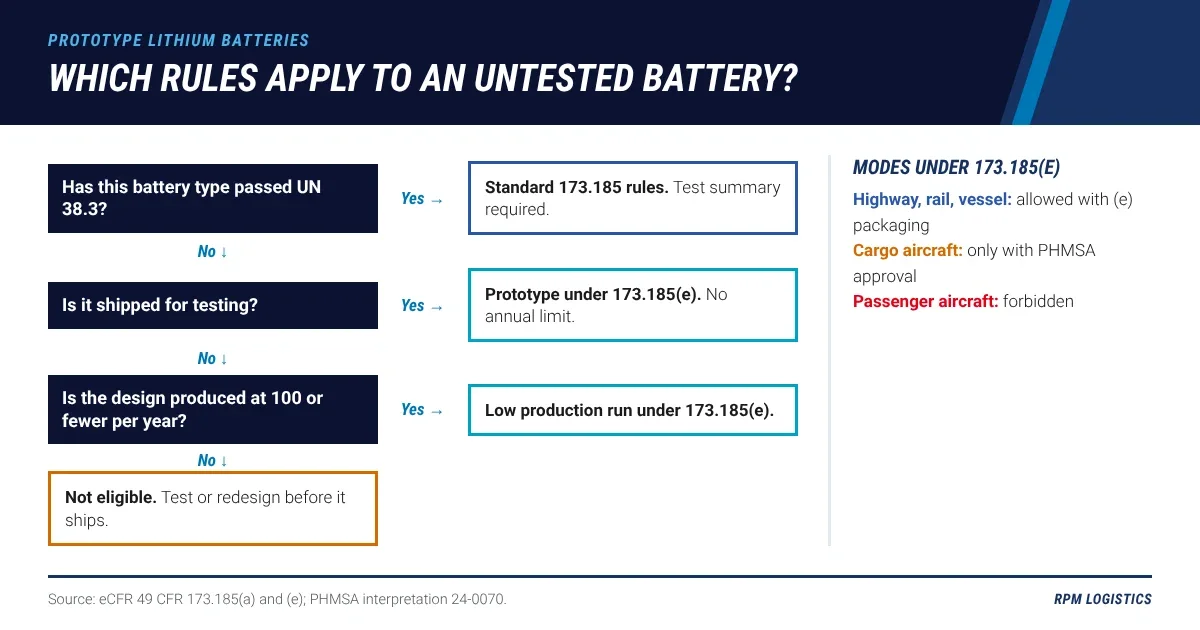
Prototype and low production are separate tests: the 100-unit cap applies only to production runs, and a prototype qualifies only when it is shipped for testing.
What is a prototype or low production lithium battery?
A prototype lithium battery is a cell or battery shipped for testing before its design has passed UN 38.3. A low production run is a design made in quantities of no more than 100 cells or batteries a year. Both are defined in 49 CFR 173.185(e).
Normally every lithium cell and battery type must pass UN 38.3 testing before it ships, under 173.185(a)(1). Manufacturers must keep the test record for as long as the design is offered for transport, plus one year. Cells and batteries made on or after January 1, 2008, also need a test summary. Our guide to UN 38.3 test summary documentation covers those records.
That rule creates a problem for R&D teams. A new design has to travel to a test lab before it can pass the test. Section 173.185(e) solves it by excepting prototypes and low production runs from the testing and recordkeeping requirements of paragraph (a), as long as stricter packaging and handling conditions are met.
Prototype vs. low production run: two separate tests
Prototype and low production are two separate categories with different limits, and confusing them is a common mistake. PHMSA confirmed the distinction in a 2024 interpretation (PHMSA interpretation 24-0070).
Question | Prototype | Low production run |
|---|---|---|
Definition | Cells or batteries shipped for the purpose of testing | No more than 100 cells or batteries of a design produced per year |
Annual limit | None, if shipped for testing | 100 is a production limit, not a shipment limit |
Purpose limit | Testing only | Any purpose |
Fails if | Shipped for a demo, trade show or customer use | Production exceeds 100 a year |
Two points from PHMSA's letter matter most. First, the 100-unit figure limits production, not the number of shipments by air or any other mode. Second, a prototype shipped for any reason other than testing does not qualify for the exception. A prototype pack sent to a trade show, for example, falls outside 173.185(e).
Packaging requirements under 173.185(e)
Prototype and low production batteries need stronger packaging than tested batteries, because the design has not proven itself. Section 173.185(e) sets the following conditions.
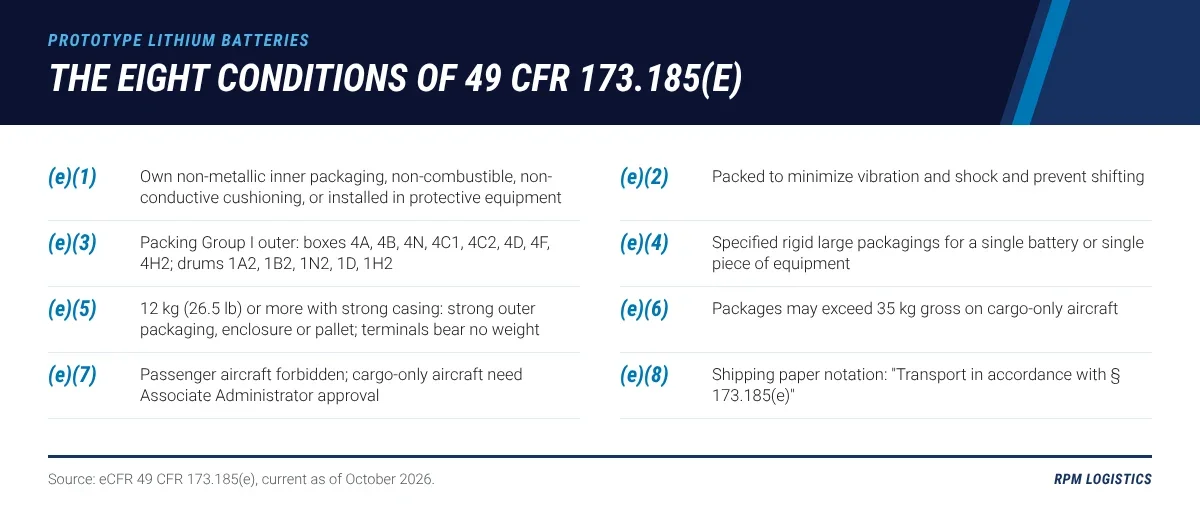
Packing Group I is the strictest performance level in the hazmat rules, which is the trade a shipper makes for skipping UN 38.3.
- Inner packaging (e)(1). Each cell or battery goes in its own non-metallic inner packaging, surrounded by non-combustible, non-conductive cushioning. Alternatively, it can be installed in equipment that protects against accidental operation.
- No movement (e)(2). Packaging must minimize vibration and shock and keep the contents from shifting.
- Packing Group I outer packaging (e)(3). Use a metal (4A, 4B, 4N), wooden (4C1, 4C2, 4D, 4F) or solid plastic (4H2) box. A metal (1A2, 1B2, 1N2), plywood (1D) or plastic (1H2) drum also works.
- Large packagings (e)(4). A single battery or single piece of equipment may use specified rigid large packagings.
- Large batteries (e)(5). Batteries of 12 kg (26.5 lb) or more with a strong, impact-resistant casing may ship in strong outer packagings, protective enclosures or on pallets. They must be secured against shifting, and the terminals cannot bear the weight of other items.
Inner packaging and cushioning are where most errors start. Our guide to inner packaging and cushioning requirements covers materials and layouts.
Can prototype lithium batteries fly?
Prototype and low production lithium batteries cannot fly on passenger aircraft, and cargo aircraft require prior approval. Section 173.185(e)(7) forbids passenger aircraft and allows cargo-only aircraft only with approval from PHMSA's Associate Administrator. Under (e)(6), packages may exceed 35 kg gross on cargo-only aircraft.
That makes ground the practical mode for most domestic prototype moves. A truck can carry 173.185(e) shipments without an aircraft approval. Our guide to choosing air, rail or ground for battery freight compares the modes. For international legs by sea, PHMSA has said a vessel shipment may use the IMDG Code's Special Provision 310 under 49 CFR Part 171, Subpart C (PHMSA interpretation 14-0017).
Does Special Provision 310 apply to U.S. ground shipments?
No. Special Provision 310 comes from the UN Model Regulations and the IMDG Code, and it does not appear in the U.S. special provisions at 49 CFR 172.102. For domestic highway shipments, the U.S. rule is 173.185(e).
This matters because many guides written for international shippers cite SP 310 as if it applied everywhere. A U.S. truck shipment should reference 173.185(e) on the shipping paper, not SP 310. Our guide to IMDG and IATA rules for international legs explains where SP 310 does apply.
What goes on the shipping paper?
The shipping paper for a 173.185(e) shipment must include the notation "Transport in accordance with § 173.185(e)," under 173.185(e)(8). That line tells the carrier and any inspector which exception the shipper is using.
Section 173.185(e) excepts these batteries only from the testing and recordkeeping requirements of paragraph (a). It does not state an exception from the other hazardous materials requirements. Plan for the standard Class 9 shipping paper, marking, labeling and training rules unless your compliance team confirms otherwise. Our guides to marking errors that get loads rejected and DOT hazmat classes and placarding cover those rules.
Training applies to everyone who prepares the shipment. Hazmat employees must be trained within 90 days of hire and at least every three years after that, under 49 CFR 172.704. The stakes are real. Civil penalties for hazardous materials violations can reach $102,348 per violation, or $238,809 when a violation causes death, serious injury or major property damage (49 CFR 107.329).
How a prototype's status changes over its life
A prototype battery does not keep the same regulatory status from the bench to production. Its shipping rules change as it moves through testing, and each stage needs a different plan.
- Before testing. The battery ships as a prototype under 173.185(e), with Packing Group I packaging and the shipping paper notation.
- After it passes UN 38.3. The design becomes a tested battery type. It ships under the standard 173.185 rules and needs a test summary.
- If it fails or is damaged in testing. The battery is now damaged or defective. It falls under 173.185(f), which allows highway, rail or vessel only, with specific packaging and marking. See our guide to shipping damaged and defective lithium batteries.
- If it moves into low production. The 100-per-year limit applies to production, so track output, not shipments.
The return trip from the test lab is where teams most often get caught. A battery that went out as a prototype may come back as a damaged or defective battery, with different rules. Plan the return leg before the outbound one leaves.
Smaller tested batteries have their own exceptions, but untested prototypes cannot use them. The ground-only limits of 60 Wh per cell and 300 Wh per battery in 173.185(c) still require UN 38.3 testing. Untested prototypes must use 173.185(e).
Shipping large prototype packs on pallets
Large prototype packs, such as pre-production vehicle or energy storage batteries, usually ship under the 12 kg alternative in 173.185(e)(5). That path allows strong outer packagings, protective enclosures or pallets instead of a Packing Group I box, but it adds handling demands of its own.
- Protect the terminals. The rule bars stacking that puts weight on terminals, so cap them and keep other freight off the pack.
- Secure the load against shifting. Band or strap the pack to the pallet, then secure the pallet in the trailer.
- Plan loading equipment at both ends. Confirm a forklift or dock at the test lab, since many labs lack a loading dock.
- Share dimensions and weight early. Heavy packs can change the trailer type and the number of pallet positions you need.
Charge level is worth settling with the test lab before pickup. Our guide to state-of-charge rules by mode explains where limits apply.
A pre-shipment checklist for 173.185(e)
Run this checklist before every prototype or low production shipment leaves the building.
- Confirm the battery has not passed UN 38.3 and qualifies as a prototype shipped for testing or a low production run.
- Document the purpose of the shipment, such as the test lab and test plan.
- Pack each cell or battery in its own non-metallic inner packaging with non-conductive cushioning.
- Use an authorized Packing Group I outer packaging, or the 12 kg alternative for large batteries.
- Apply the Class 9 marking and labeling your compliance team has confirmed.
- Add the notation "Transport in accordance with § 173.185(e)" to the shipping paper.
- Confirm every person preparing the shipment has current hazmat training.
- Book the return leg and plan for a damaged or defective return.
Keeping a signed copy of this checklist with each shipment record gives your team a simple audit trail if a carrier or inspector asks how the shipment qualified. Review the checklist whenever the design, the test lab or the packaging supplier changes, since any of those can change how the shipment qualifies.
Choosing a carrier for prototype battery freight
Not every carrier will accept prototype lithium batteries, and parcel networks often refuse them. Look for a ground carrier that handles Class 9 freight and understands the exception you are using.
- Share the exception up front. Tell the carrier the shipment moves under 173.185(e) before pickup.
- Send packaging details. Include the outer packaging code and gross weight.
- Confirm the return leg in the same booking, especially if the battery may come back damaged.
- Keep the paperwork with the load, including emergency response information.
Our guide to carriers that ship when parcel networks won't explains the options. For the full regulatory framework, start with our lithium battery transport compliance guide and the road transport requirements under 49 CFR 173.185.
Frequently asked questions
What is a low production run under 49 CFR 173.185(e)?
A low production run is a battery or cell design produced in quantities of no more than 100 a year. PHMSA has said the 100 figure limits production, not the number of shipments.
Is there a limit on how many prototype batteries I can ship for testing?
No annual limit applies to prototypes shipped for testing. The 100-per-year limit applies only to low production runs. A prototype shipped for any purpose other than testing does not qualify.
Can untested lithium batteries ship by truck?
Yes, if they qualify as prototypes shipped for testing or as a low production run, and they meet the packaging and paperwork conditions of 173.185(e). Otherwise, untested batteries generally cannot be transported.
Can prototype lithium batteries fly?
Not on passenger aircraft. Cargo-only aircraft require prior approval from PHMSA's Associate Administrator. Ground transport is the practical option for most domestic shipments.
What packaging do prototype lithium batteries need?
Each battery needs its own non-metallic inner packaging with non-combustible, non-conductive cushioning, inside Packing Group I outer packaging. Batteries of 12 kg or more with a strong casing can use alternative packaging or pallets.
Does Special Provision 310 apply to U.S. ground shipments?
No. SP 310 comes from the UN Model Regulations and the IMDG Code. U.S. highway shipments of prototypes use 49 CFR 173.185(e).
How do I ship a prototype back after it fails testing?
A battery that fails or is damaged in testing becomes a damaged or defective battery under 173.185(f). It can move by highway, rail or vessel only, with specific packaging and marking.
Move prototype batteries with a carrier that knows the rules
Prototype batteries are often the most valuable cargo in an R&D program, and the rules leave little room for error. RPM Logistics moves Class 9 lithium battery freight by ground across all 50 states and Canada. Request a quote with your packaging details, test lab address and return-leg plan.