

Quick Answer
Porsche transport is shipping a Porsche by truck, usually in an enclosed trailer with soft wheel straps. The details change by model. GT cars need low-angle ramps and the front lift raised. A Taycan weighs more than 4,600 pounds and needs charge. Air-cooled classics and race cars need their own loading plan.
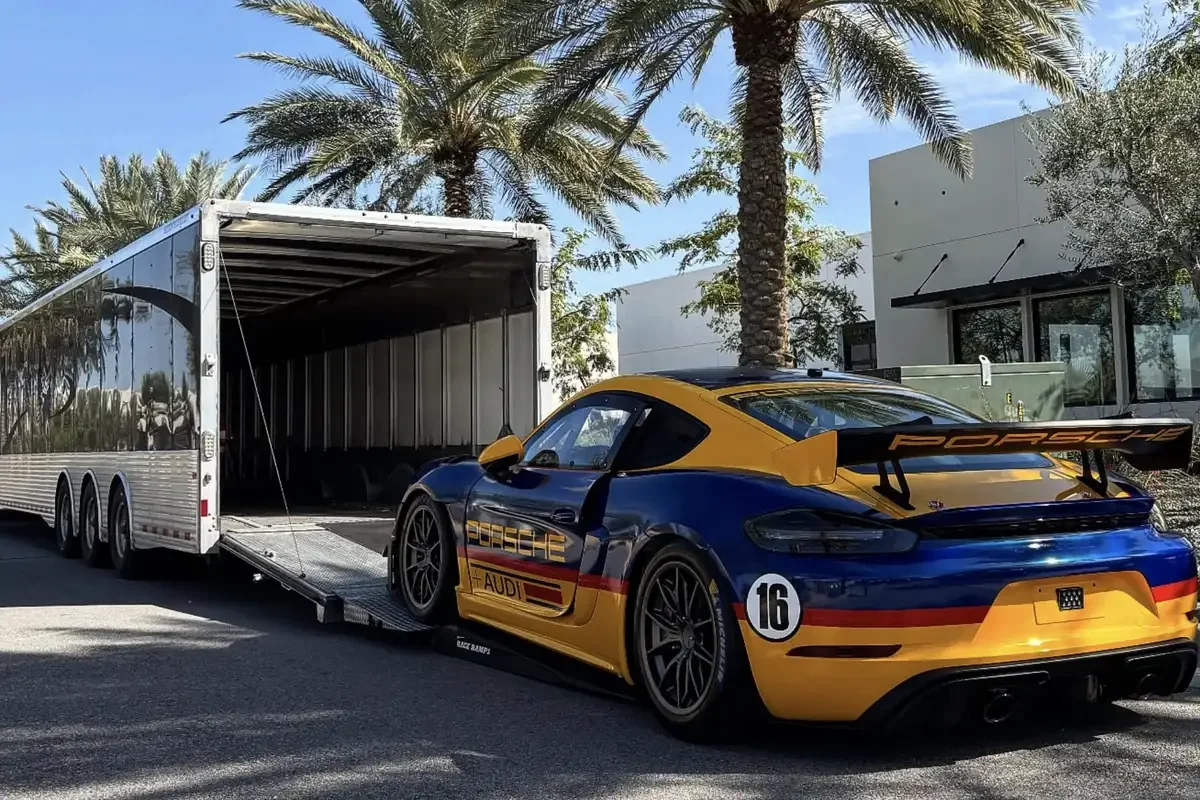
A low ramp angle and an enclosed trailer protect the splitter, the paint and the aero on a track-focused Porsche.
Why Porsches Need a Model-Specific Plan
A Porsche is not one kind of car. The lineup runs from air-cooled 911s built decades ago to the electric Taycan, track-focused GT cars and dedicated race cars. Each one fails in transport in a different way.
A carrier that treats every Porsche the same will get some of them wrong. The safest approach starts with the exact model, year and options, then picks the trailer, ramps and straps to match.
RPM's broader guide to what a luxury vehicle's value demands from a shipping provider covers the general standard. This guide covers what is specific to Porsche.
911 Carrera and Targa
The 911's long front overhang is the main loading risk. On a steep ramp, the front lip touches before the front wheels climb. Many newer 911s offer a front axle lift. On recent Carrera models, the electro-hydraulic system raises the front by about 40 mm, or 1.5 inches (Flatsixes, 2024).
If the car has a lift, the driver should raise it before the ramp. If it does not, the carrier needs ramp extensions or a lift-gate trailer that keeps the approach angle low.
GT3, GT3 RS and Other GT Cars
GT cars sit lower and wear larger splitters and aero. The GT3 and GT3 RS front lift raises the nose about 30 mm, or 1.1 inches, less than the newer Carrera system (Flatsixes, 2024). That gap matters at a trailer ramp.
Other GT details to plan for:
- Center-lock wheels. Straps must not touch the center-lock nut or the brake calipers.
- Carbon ceramic brakes. Keep straps and hooks away from the rotors and calipers.
- Carbon aero. Wings, splitters and canards crack under point pressure. Nothing should rest on them.
- Clubsport cages and harnesses. The driver needs space to get in and out without stepping on trim.
Soft straps over the tires are the right choice for these cars. RPM explains the difference in its comparison of soft-tie and hard-tie securement.
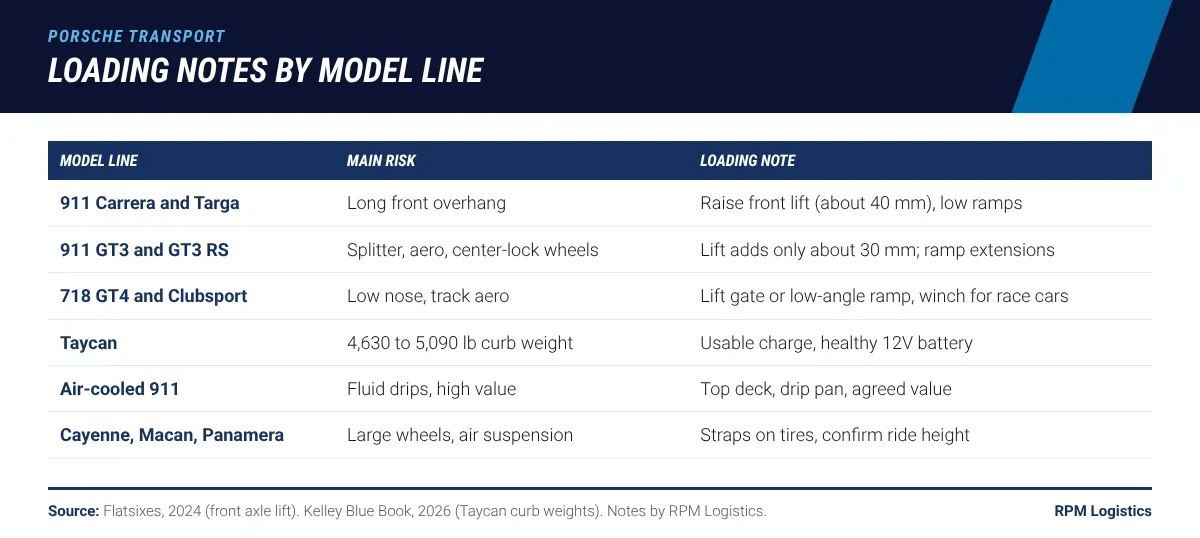
Each model line has its own weak point. Name the model and options when you book.
Taycan and Electric Porsches
The Taycan is heavy for a sedan. A 2026 Taycan weighs between 4,630 and 5,090 pounds, depending on the trim (Kelley Blue Book, 2026). The Taycan Sport Turismo GTS weighs 5,146 pounds (Kelley Blue Book, 2026). The carrier needs to know the trim so it can plan weight per trailer position.
Electric Porsches also need:
- Enough charge to load, unload and move around the destination.
- A healthy 12-volt battery. If it dies, doors and the charge port may not open.
- The owner's instructions for putting the car in neutral for winching, if needed.
Cold weather lowers range and charge. RPM covers this in its guide to electric cars in cold weather, and covers general EV shipping in its hybrid and electric vehicle shipping guide.
Air-Cooled 911s and Classics
Air-cooled 911s, built through the 1998 model year, are collector cars first. Their transport needs are different:
- Fluid drips. Older cars may weep oil. A drip pan or mat protects the car below on a two-level trailer.
- Value. Many have appreciated sharply. Get a current value before you buy coverage. Hagerty's valuation tools are a common reference.
- Top position. Ask for the upper deck of an enclosed trailer so nothing can leak onto the car.
RPM's guide to exotic and collector car transport explains how specialist carriers handle these cars.
Race Cars and Track Cars
Cup and Clubsport cars are built for the track. Most are not registered for the road, so they cannot be driven onto a public street to meet a truck. They ride very low and may have no conventional keys or neutral on a lever.
For race cars, plan for:
- A trailer with a low-angle ramp or a lift gate.
- A winch and a team member who knows how to roll the car.
- Spare wheels, tires and parts shipped with the car and listed on the condition report.
- Pickup and delivery inside a paddock or shop, not at the curb.
Event schedules leave little slack. Book early in a race season, especially for cars moving between tracks.
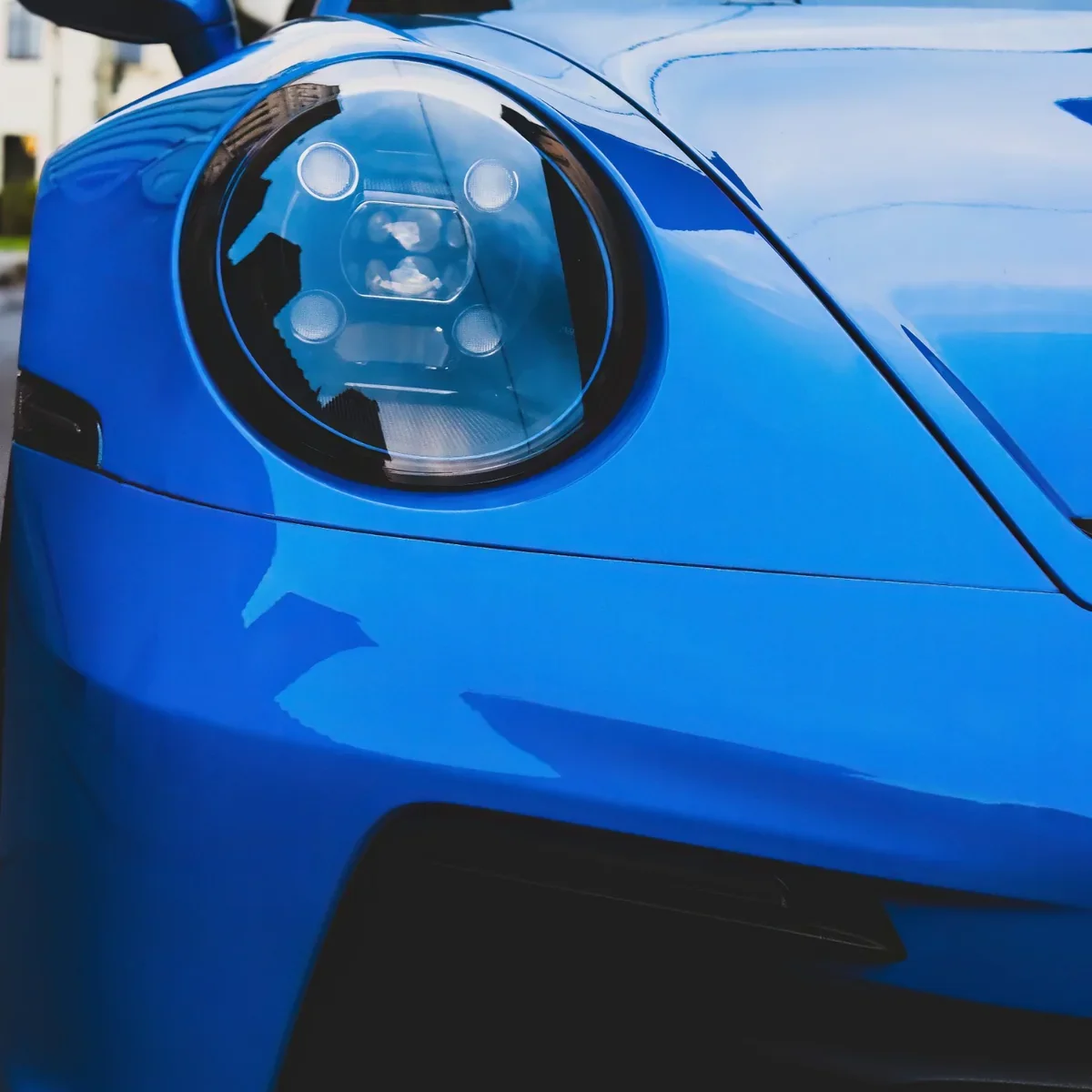
The low front bumper and intakes are the first parts at risk on a ramp. Photograph them at pickup.
Cayenne, Macan and Panamera
Porsche's SUVs and the Panamera are easier to load. They sit higher, have shorter front overhangs relative to their clearance and fit standard ramps. The risks are the ones any luxury vehicle carries: paint, wheels and interior.
Two details still matter. First, large wheels with low-profile tires scuff easily, so straps should sit on the tire, not the rim. Second, air suspension can change ride height when the car is turned off or put in a transport setting. Ask the owner how the car is set before loading.
These models often ship on open carriers for dealer moves and daily drivers. Enclosed transport is worth it for new deliveries, high-trim models and winter routes through snow and road salt. RPM explains when it makes sense in its guide to enclosed transport for luxury SUVs.
Picking Up After a Porsche Delivery Program
Some buyers take delivery at a Porsche Experience Center or the factory, then ship the car home. Others buy from a dealer out of state. In each case, set the pickup details before the delivery date:
- Confirm who will release the car and sign the condition report.
- Agree whether the car will be driven before pickup, and how many miles.
- Ask the delivery team to show the driver the front lift and any transport mode.
RPM's luxury car owner's checklist for interstate shipping covers the paperwork and photos to prepare.
Porsche Transport Checklist
- Give the carrier the exact model, year, trim and options.
- Note the front lift, center-lock wheels and carbon ceramic brakes if fitted.
- Book enclosed transport with soft wheel straps.
- Ask for low-angle ramps or a lift gate for GT cars and race cars.
- Leave a Taycan with usable charge and a healthy 12-volt battery.
- Check for open recalls on the VIN with NHTSA's recall lookup.
- Confirm the carrier's operating authority on the FMCSA company snapshot.
- Photograph the front lip, wheels and aero at pickup and delivery.
A photo record at both ends protects the owner and the carrier. RPM explains what a strong record includes in its guide to insurance-grade condition reporting. After delivery, a short inspection catches anything missed. See RPM's guide to post-delivery quality control.
Shipping a Porsche With RPM
RPM Logistics ships Porsches for owners, collectors, dealers and race teams in all 50 states and Canada, in enclosed trailers with soft-tie securement. Its luxury and exotic car transport service covers street cars, GT cars, classics and race cars. For enclosed options in general, see RPM's enclosed vehicle transport service.
Frequently Asked Questions
Should a Porsche be shipped enclosed?
Enclosed transport is the safer choice for most Porsches, and the standard for GT cars, classics and race cars. It protects paint, carbon aero and low front ends from weather and road debris. A daily-driven Macan or Cayenne can ship open if the owner accepts that exposure.
How do you load a low Porsche onto a trailer?
Use low-angle ramps, ramp extensions or a lift-gate trailer. Raise the front axle lift if the car has one. A spotter at the nose watches the front lip while the driver loads slowly.
How much does a Porsche Taycan weigh for shipping?
A 2026 Taycan weighs between 4,630 and 5,090 pounds depending on trim, according to Kelley Blue Book. Sport Turismo models can weigh more. The carrier should know the trim to plan trailer weight.
Can a Porsche race car be shipped on a car carrier?
Yes, but it needs a low-angle ramp or lift gate, a winch and someone who knows how to roll the car. Most race cars are not road registered, so pickup and delivery usually happen at a shop or paddock.
What should be checked before shipping a Porsche?
Note the model and options, the front lift and the wheels and brakes. Leave a Taycan charged. Check for open recalls, confirm the carrier's authority and photograph the front lip, wheels and aero.
Does shipping add miles to a Porsche?
Only a few. The car is driven on and off the trailer and around the pickup and delivery sites. Record the odometer at both ends so the owner can see the difference. For race cars and non-runners, the car is winched and adds no miles.
Is open transport ever fine for a Porsche?
Yes, for some cars. Daily-driven SUVs, dealer trades and older cars with modest values often ship open. GT cars, new deliveries, classics and anything with exposed carbon aero should go enclosed.