

Quick Answer
Replacement-cycle delivery is the one-for-one swap of an aging fleet vehicle for a new one at the site where it already works. Done well, the new unit arrives, equipment and cards move over, and the old unit leaves on the same visit. The driver never loses a workday, and the retired vehicle heads straight to remarketing.
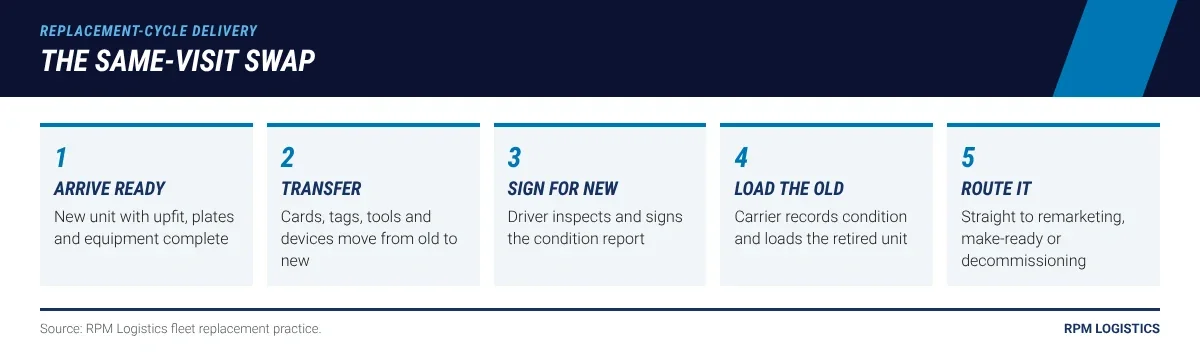
The swap only saves downtime if steps two and four happen on the same visit; split them and the site runs short a vehicle, or pays for two.
What is replacement-cycle delivery?
Replacement-cycle delivery is the logistics of replacing fleet vehicles on schedule at the locations where they already operate. Unlike a new site launch, the site, driver and job stay the same. Only the vehicle changes.
Every fleet replaces vehicles on a cycle set by age, mileage, cost or a mix of the three. When the cycle comes due, each retiring unit needs a matching new unit delivered to the same place. The logistics challenge is doing both moves without a gap in service.
The volume is steady. U.S. fleet sales reached 2,227,876 vehicles in 2025, including 781,986 commercial units, 239,177 government units and 1,206,713 rental units (Bobit Business Media, 2026). Rental rose 16.4% from 2024, while commercial fell 4% and government fell 12.8%. Most of those deliveries replaced a vehicle already in service somewhere.
Replacement-cycle work touches several teams:
- Fleet management sets the cycle and orders new units.
- Site managers and drivers schedule the swap around operations.
- Upfitters build new units to match the old ones.
- Transport providers deliver the new unit and remove the old one.
- Remarketing teams sell the retired unit.
How do fleets decide when a vehicle is due for replacement?
Fleets decide when a vehicle is due for replacement with a policy that sets triggers in advance. The policy turns replacement from a case-by-case argument into a schedule that logistics can plan around.
Common triggers include:
- Age, such as a set number of years in service.
- Mileage, such as a cap tied to warranty or resale value.
- Operating cost, when maintenance and repair spending rises past a threshold.
- Downtime, when a unit spends too many days out of service.
- Program changes, such as a new upfit standard or an electrification target.
Most fleets combine triggers, replacing a unit at whichever limit it reaches first. The logistics team needs that list months ahead. A replacement schedule that arrives with two weeks' notice forces rush deliveries and missed swap dates.
Why do replacement swaps cause downtime?
Replacement swaps cause downtime when the new unit and the old unit move on different days. Either the driver gives up the old vehicle before the new one is ready, or the new one sits while the old one keeps working.
Common causes include:
- Separate bookings for delivery and pickup, often with different providers.
- Unready new units, missing upfit, plates or equipment on arrival.
- Equipment left behind in the old unit, such as tools, tags or devices.
- Driver unavailability on the delivery day.
- No plan for the old unit, so it sits at the site after the swap.
Each of these turns a one-hour swap into days of disruption. Our article on why delivered isn't the same as ready explains how these gaps add up across a fleet.
How does a same-visit swap work?
A same-visit swap delivers the new unit and removes the old one in a single appointment. The driver keeps working before and after, and nothing waits at the site.
- Confirm the new unit is ready. Upfit, plates, registration and equipment are complete before it leaves for the site.
- Book one appointment. The same carrier or team delivers the new unit and loads the old one.
- Transfer what moves. Equipment, cards and devices go from old to new while the carrier is on site.
- Inspect both units. The driver signs a condition report for the new unit, and the carrier records the old unit's condition.
- Route the old unit. It goes directly to remarketing, make-ready for reassignment or decommissioning.
Schedule the swap at the start or end of the driver's shift, when the vehicle would be parked anyway. Haulaway trucks make same-visit swaps efficient for multi-unit sites. A truck can deliver several new units and load the matching old ones on the return. Driveaway works well for single swaps, with one driver delivering the new unit and driving the old one out.
What needs to move from the old vehicle to the new one?
Many items need to move from the old vehicle to the new one, and missing any of them can stop the driver on day one. A written transfer checklist, signed at the swap, prevents most problems.
Category | Items to transfer | Who confirms |
|---|---|---|
Access and payment | Fuel card, toll tag, parking permits, keys and fobs | Driver and fleet |
Equipment | Tools, removable racks and bins, safety kits, chargers | Driver |
Devices | Company phones, scanners, dash cameras, tracking devices if used | Fleet or IT |
Documents | Registration, insurance card, inspection records | Fleet |
Branding | Decals or magnetic signs, if not pre-installed | Fleet or upfitter |
Tolls deserve special attention. A toll tag left in the old unit keeps charging the fleet after the vehicle is sold. Fuel cards tied to the old VIN may also stop working once the unit is retired.
How should you time replacement against remarketing?
Replacement should be timed so the old unit reaches the market while its value is still strong. Every month a retired vehicle sits waiting adds depreciation, storage and insurance cost.
Wholesale prices shift through the year. The Manheim Used Vehicle Value Index stood at 205.9 in September 2026, down 0.6% from a year earlier (Cox Automotive, 2026). Cox also said depreciation accelerated during the third quarter. Soft markets make speed to sale more valuable, not less.
Practical timing rules:
- Move the old unit within days of the swap, not weeks.
- Pick the sale channel before the swap, so the carrier knows where to take it.
- Batch retired units by region to fill haulaway trucks to the auction.
- Avoid model-year changeover peaks when carrier capacity is tight.
Our article on auction lane strategy for fleet remarketers covers how to choose the sale location. For the capacity crunch during model-year turnover, see our guide to model-year changeover logistics.
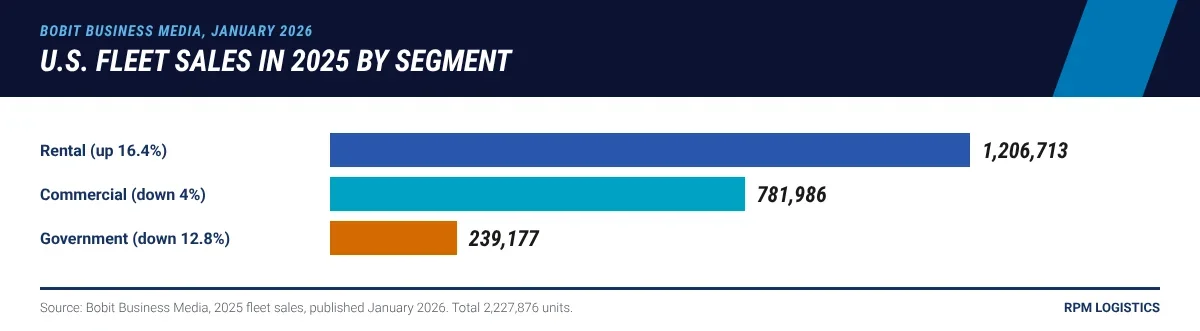
Rental fleets accounted for more than half of 2025 fleet sales, while commercial and government purchases both fell from 2024.
What if the new vehicle is a different type than the old one?
When the new vehicle is a different type, the swap needs more planning. A move from gas to electric, from a pickup to a van, or to a different upfit changes what the driver and site need.
Check these before the swap:
- Charging or fueling at the site and on the driver's routes, for EV replacements.
- Driver training on the new vehicle's controls, capacity or charging.
- Equipment fit, since racks, bins and tools from the old unit may not fit the new one.
- Licensing, if the new unit is heavier and crosses a weight threshold.
Electrified replacements follow a longer timeline. Our guide to fleet electrification at scale explains how to sequence charging, transport and remarketing.
Where does the retired vehicle go after the swap?
The retired vehicle goes to one of three places after the swap, and the choice should be made before the carrier arrives. Deciding on the spot leaves units parked at sites or bouncing between yards.
- Remarketing. Most retired units go to wholesale auction or another sale channel. Our remarketing logistics guide covers how to recover maximum value.
- Reassignment. Some units still have life left and move to another driver or site. They go through make-ready first, as covered in our fleet reassignment playbook.
- Decommissioning. Units at the end of their useful life, or with major damage, go through retirement steps covered in our guide to fleet decommissioning logistics.
Before a retired unit is sold, check for open safety recalls by VIN through NHTSA's recall lookup.
How do you plan a replacement wave across many sites?
A replacement wave across many sites works best as a regional schedule, not a series of one-off swaps. Grouping swaps by region lets haulaway trucks run full both ways and keeps upfit, delivery and remarketing moving together.
- Map retiring units by site and region, with target swap dates.
- Align new-unit orders and upfit slots to the regional schedule.
- Book carriers by region, pairing each delivery with the matching pickup.
- Stage new units nearby when sites cannot accept delivery on a single date.
- Track every unit from order to swap to sale on one list.
Ordering lead times matter here. New-vehicle supply and pricing shift by segment and season, and Cox Automotive forecast about 15.8 million U.S. new-vehicle sales for 2026 (Cox Automotive, 2025). Fleet orders compete with retail demand for the same production slots.
Handoffs between teams are where waves stall. Our article on the fleet handoff problem covers how to assign ownership at each step.
What records close out a replacement swap?
A replacement swap is closed out when four records are on file. Without them, questions about damage, tolls or title can surface months later with no evidence to answer them.
- New-unit condition report, signed by the driver at delivery.
- Retired-unit condition report, with photos and odometer reading at pickup.
- Transfer checklist, confirming cards, tags, devices and equipment moved.
- Delivery receipt for the retired unit at auction, make-ready or decommissioning.
Store these records against both VINs. They also feed fleet KPIs, such as days from swap to sale and damage found at pickup. Our guide to photo condition reports for fleet claims shows what each report should capture.
How RPM supports fleet replacement cycles
RPM Logistics coordinates new-unit delivery, old-unit pickup and remarketing moves for corporate, rental, government and commercial fleets across all 50 states and Canada.
- Paired delivery and pickup on the same visit, by driveaway or haulaway.
- Photo condition reports on both the new and the retired unit at the swap.
- 70+ storage locations in the U.S. and Canada for staging new units or holding retired ones.
- Driver screening through motor vehicle record checks at onboarding, with continuous monitoring after that.
Carriers in the network recorded 3.5 accidents per million miles in 2026 year to date, measured as accident frequency (RPM Logistics, 2026). For program details, see our fleet vehicle logistics services.
Frequently asked questions
What is a fleet replacement cycle?
A fleet replacement cycle is the schedule a fleet uses to retire and replace vehicles. It is usually based on age, mileage, operating cost or a mix of these.
How do you replace fleet vehicles without downtime?
Use a same-visit swap. The new unit arrives ready, equipment and cards transfer on site, and the old unit leaves in the same appointment.
What should transfer from an old fleet vehicle to a new one?
Fuel cards, toll tags, keys, tools, removable equipment, company devices and documents. A signed transfer checklist at the swap keeps anything from being left behind.
Should retired fleet vehicles go straight to auction?
Most should, once the sale channel is chosen. Units with life left may go to make-ready for reassignment instead, and end-of-life units go to decommissioning.
Is driveaway or haulaway better for fleet vehicle swaps?
Driveaway works well for single swaps. Haulaway fits multi-unit sites, where one truck can deliver new units and load the matching old ones.
How many fleet vehicles were sold in the U.S. in 2025?
Bobit Business Media reported 2,227,876 U.S. fleet sales in 2025, including 781,986 commercial, 239,177 government and 1,206,713 rental units.
Keep every site running through the swap
Replacement day should look like any other workday for your drivers. RPM Logistics pairs delivery and pickup so new units arrive ready and retired units leave the same visit. Talk to our fleet team about your next replacement cycle.