

Quick answer: Fleet winterization logistics is the planning of where fleet vehicles sit, move and wait before the first freeze. Start 8 to 10 weeks before your region's median first-freeze date. Sort units into run, reposition or store, book transport, secure storage with charging for EVs, and finish snowbelt moves before chain-law and salt season.
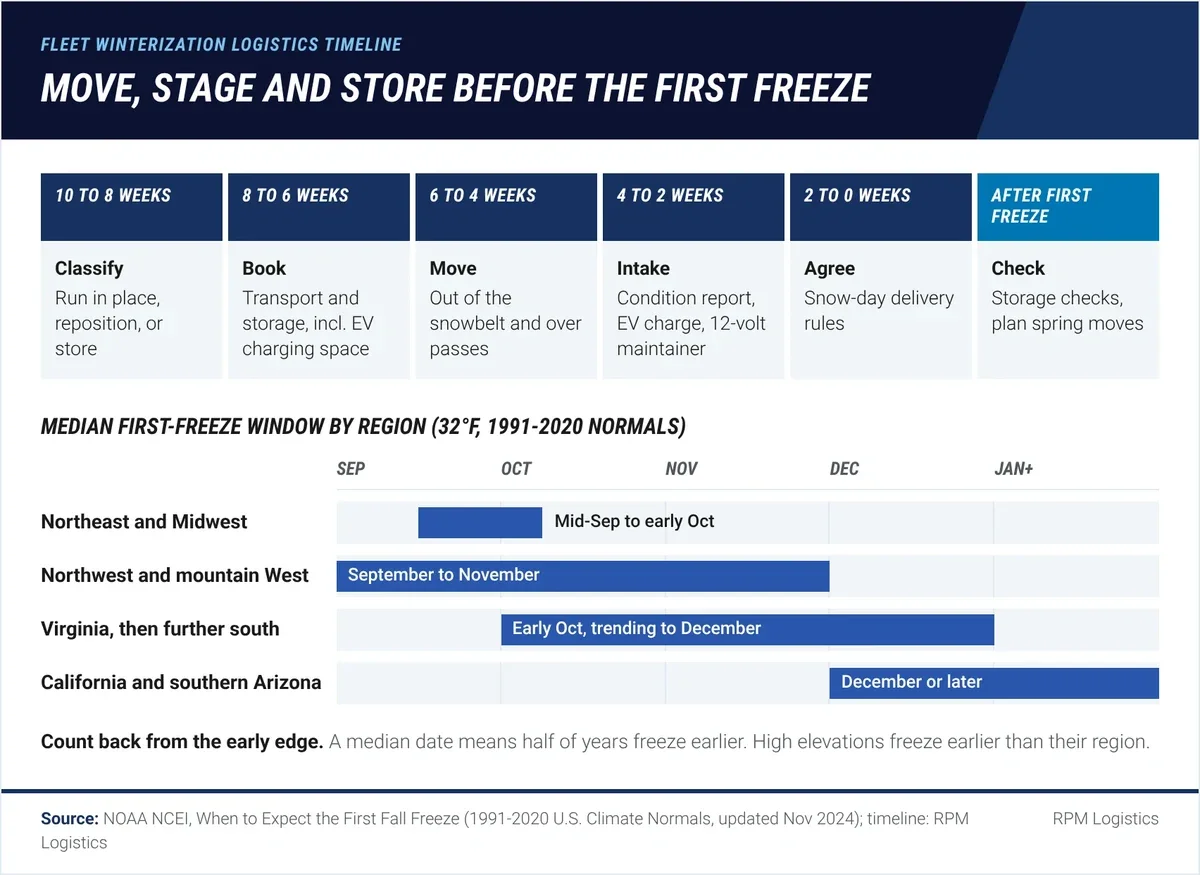
A median freeze date means half of years freeze earlier, so anchor the timeline to the early edge of your region's window.
Fleet winterization is the work of preparing vehicles and operations for cold weather. Most guides treat it as a shop job: batteries, coolant, tires and fuel. That work matters, but it assumes each vehicle is already in the right place for winter.
This guide covers the layer before the shop. It explains when to move units, where to stage them, how to store EVs in the cold, and how winter changes the transport mode you pick. It is written for fleet managers who control dozens or thousands of units across regions.
Fleet Winterization Starts With Location, Not Maintenance
Fleet winterization logistics is the set of decisions on location, timing and transport mode that come before any maintenance. A pickup parked in Minneapolis in December needs a different plan from one repositioned to Phoenix. The shop checklist cannot tell you which plan applies.
Exposure is wide. More than 70% of US roads sit in snowy regions with over five inches of average annual snowfall, per the FHWA Road Weather Management Program. Nearly 70% of the US population lives in those regions. Most national fleets have units there.
Winter also slows the moves themselves. FHWA reports that average arterial speeds fall 30 to 40% on snowy or slushy pavement. A transfer that takes two days in October can take longer in January. Moves made before the first storm cost less schedule risk.
Build the Timeline From Your Region's First Freeze
The right start date is your region's median first-freeze date, minus 8 to 10 weeks. Median first freeze is the date by which half of past years recorded 32°F or colder.
The NOAA NCEI first fall freeze map uses 1991-2020 climate normals. It places the Northeast and Midwest first freeze in mid-September to early October (NOAA NCEI, 2024). The Northwest and the mountain states of Colorado, Utah, Nevada, New Mexico and northern Arizona fall between September and November.
Further south, freeze dates start in early October in Virginia and trickle into December. California and southern Arizona generally do not freeze until at least December outside high elevations. Parts of Florida see no annual freeze.
Two conclusions follow for late September. Northern-tier fleets are already at or past the median, so their window is closing. Mid-Atlantic, Southern, California and desert Southwest fleets still have time to run the full plan.
The table below sets the logistics actions against weeks remaining before a region's median first freeze.
Weeks before first freeze | Logistics action | Why it happens at this point |
|---|---|---|
10 to 8 weeks | Classify every unit: run in place, reposition, or store | Assignment calendars for December to March are firm enough to plan from |
8 to 6 weeks | Book transport and reserve storage, including charger-equipped space for EVs | Southbound snowbird lanes peak in October and November |
6 to 4 weeks | Run moves out of the snowbelt and over mountain passes | Colorado's commercial chain carry rule starts Sept. 1; Washington's starts Nov. 1 |
4 to 2 weeks | Intake stored units: condition report, EV charge set to OEM storage guidance, 12-volt maintainers | Condition is easiest to document before snow and salt film arrive |
2 to 0 weeks | Agree snow-day delivery rules with carriers and receivers | Rules written before the first storm avoid ad hoc calls during it |
After first freeze | Run storage checks and plan spring moves for after the thaw | Stored batteries drain, and spring demand returns fast |
Decide Which Units Move, Stay or Go Into Storage
Winter staging is placing a vehicle where it will be needed before conditions make moving it slow or risky. Every unit should leave the 10-week review with one of three labels.
- Run in place. Units with a snowbelt assignment stay. Stage them close to the work, under cover where possible.
- Reposition. Units needed in sunbelt markets move south before the freeze. Rental operators can follow the cycle in our guide to seasonal fleet repositioning for rental peak demand.
- Store. Units with no winter assignment go into storage. Use the cost test in our post on fleet vehicle storage between assignments before you commit to a long hold.
Some units belong to people, not pools. When an employee relocates mid-season, the vehicle moves with them. Route those through corporate fleet vehicle relocation services rather than a seasonal batch.
Where you stage matters as much as when. The table below compares northern and sunbelt staging for a unit that will sit for most of the winter.
Factor | Northern staging | Sunbelt staging |
|---|---|---|
Road salt exposure | High on any move in or out after the first storm | Low once the unit arrives |
EV battery temperature | Cold soak cuts range and slows charging; indoor or plugged-in storage reduces the effect | Closer to the 55 to 60°F range where the Joint Office found electric buses perform best |
Chain-law exposure on the move | Applies on mountain routes in several western states | Applies only if the route crosses passes |
Return trip | None, the unit is already near its spring assignment | A northbound move is needed in spring |
Best fit | Units with a snowbelt spring assignment | Units needed in southern markets, or EVs without indoor or plugged-in storage up north |
EV Fleets Need a Cold-Weather Staging Plan
Cold weather cuts EV range and slows charging, so EV staging must plan for both. The figures are large enough to change routing and dwell time.
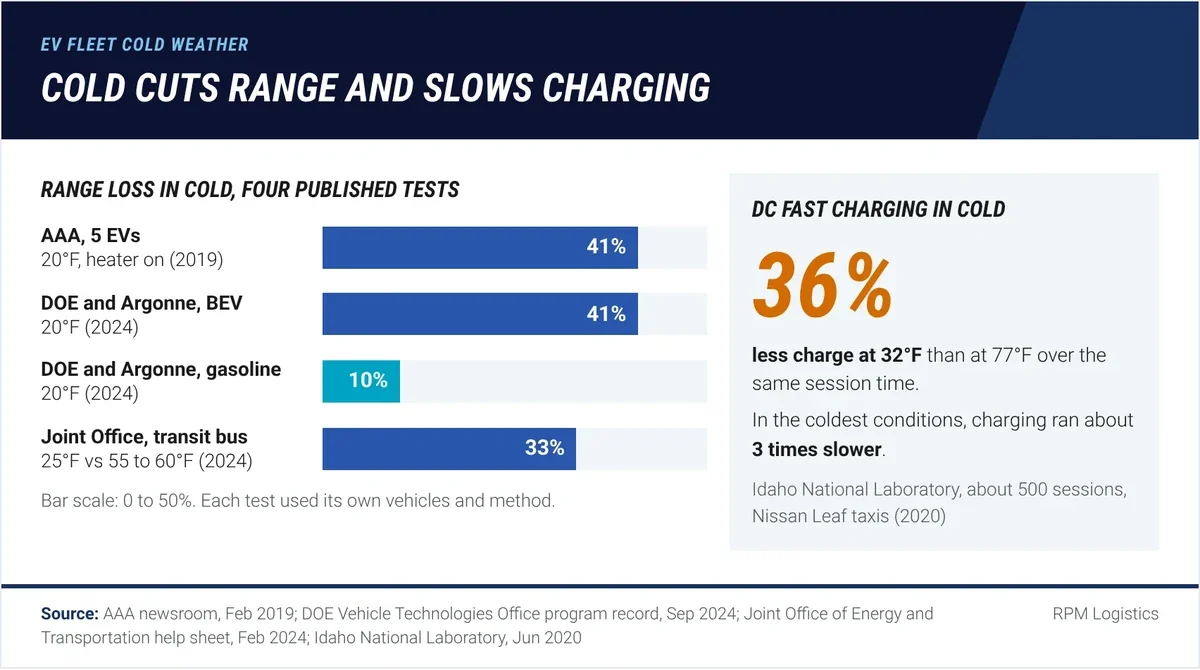
The four studies used different vehicles and test methods, so read them side by side, not as one combined figure.
In a 2019 AAA test of five EVs, average range fell 41% at 20°F with the heater running (AAA, 2019). Heat at 20°F also added almost $25 per 1,000 miles versus 75°F driving.
A Department of Energy and Argonne analysis found the same 41% BEV range loss at 20°F, against 10% for a gasoline vehicle (DOE Vehicle Technologies Office, 2024). It found heat pumps 3 to 4 times more efficient than resistive cabin heat.
Charging slows too. An Idaho National Laboratory study of about 500 fast-charge sessions found 36% less charge at 32°F than at 77°F over the same time (INL, 2020). In the coldest conditions, charging ran about three times slower. The test fleet was Nissan Leaf taxis, so treat the result as directional for newer packs.
Heavier EVs follow the pattern. The Joint Office of Energy and Transportation reports electric transit bus range fell 33% at 25°F, against an ideal of 55 to 60°F (Joint Office, 2024). It advises indoor overnight parking and preconditioning while plugged in.
Those figures translate into four staging rules:
- Deliver EVs only to energized chargers. A cold EV with no charger is a stranded asset. Gate delivery on charger readiness, as covered in our guide to fleet electrification sequencing.
- Build a cold buffer into driven EV legs. Plan winter driveaway legs on reduced range, and add charging dwell at each stop.
- Store EVs indoors or plugged in. A plugged-in EV can warm its pack from the grid instead of the battery.
- Set storage charge per the OEM manual. Our post on EV fleet transport and storage covers state-of-charge handling in detail.
Choose the Winter Transport Mode for Salt, Chains and Schedule
In winter, transport mode decides how much salt, weather and route risk a vehicle absorbs on the way. The three common modes carry very different exposure.
Salt is the slow cost of a winter move. AAA estimates rust damage from road de-icers costs US drivers more than $3 billion a year, at an average of $490 per repair (AAA de-icer fact sheet, 2017). AAA advises washing the whole vehicle, undercarriage included.
Chain laws apply to driven units more than to the carrier hauling them. Rules from three state DOTs show the range:
- Colorado. CDOT requires commercial vehicles over 16,000 pounds to carry chains from Sept. 1 to May 31 on more than 1,400 miles of highway, including I-70. The fine is $500 for not carrying chains and up to $1,000 for blocking the road.
- Colorado passenger traction law. When in force, passenger vehicles need 4WD or AWD with 3/16-inch tread winter or all-weather tires, or chains. Noncompliance costs $100 plus a surcharge, or $500 if it blocks a lane.
- Washington. WSDOT requires vehicles over 10,000 pounds gross vehicle weight to carry chains from Nov. 1 to April 1 on listed routes, including I-90.
- California. Caltrans R-1 to R-3 controls escalate to chains on all vehicles, with no exceptions, at R-3.
A driven Class 3 work truck crossing Snoqualmie Pass in November needs chains aboard. The same truck on a carrier does not.
The table below compares the three modes for winter moves.
Mode | Salt and spray exposure | Chain-law exposure | Added mileage | Best winter use |
|---|---|---|---|---|
Open carrier | Body exposed to road spray; tires off the road surface | Carrier's obligation, not the unit's | None | Standard fleet units, multi-unit moves |
Enclosed carrier | Shielded from spray | Carrier's obligation | None | Executive, high-value or show units that must arrive clean |
Driveaway | Full undercarriage exposure on treated roads | Unit and driver must comply, including chains for heavier trucks | Every route mile | Single urgent units and units that do not load, ideally before chain season |
Our explainer on how driveaway works covers when a driven move still beats a carrier. In winter, the answer more often favors the carrier.
Document Condition Before Snow Hides the Damage
Winter condition reports fail when snow, ice and salt film cover the panels an inspector needs to see. A damage claim depends on a clean record at each handoff.
- At pickup, clear snow before photos. If panels cannot be seen, record that on the report.
- At storage intake, photograph the undercarriage and note existing rust or chips. A spring dispute is hard to settle without that baseline.
- At delivery, inspect in light. Note visibility limits on the delivery receipt rather than signing it clean.
- After salt exposure, wash before final inspection so new and old marks can be told apart.
Delivery is not the end of the job. Our guide to getting delivered fleet vehicles into service covers the arrival steps that follow.
Set Snow-Day Delivery Rules Before the First Storm
A snow-day rule is a pre-agreed plan for what happens when weather stops a delivery. Without one, every storm becomes a string of phone calls.
The risk is real for both drivers and vehicles. FHWA reports that 24% of weather-related crashes occur on snowy, slushy or icy pavement. More than 1,300 people die in those crashes each year.
A workable rule set answers five questions:
- Who can call off a pickup or delivery for weather?
- How fast must the move be rescheduled once roads clear?
- Where does a loaded carrier wait if the receiver is closed?
- Are unattended after-hours drops allowed in snow? Most fleets should say no.
- Which non-urgent deliveries can wait at a holding lot until after the storm?
For broader freight contingency planning, see our winter logistics checklist.
Where Maintenance Fits in the Plan
Maintenance winterization is the shop side: batteries, fluids, tires and fuel. It runs in parallel with the logistics timeline, not in place of it.
For running units, the shop checklist is well covered elsewhere, including our seven steps to winterizing a truck. For stored units, the key overlap is the 12-volt battery. Connect a maintainer or schedule periodic starts at intake, so the unit can leave storage on time.
Frequently Asked Questions
What does fleet winterization include?
Fleet winterization includes maintenance and logistics. Maintenance covers batteries, coolant, tires, fuel and wipers. Logistics covers which units run, move or go into storage, when transport is booked, where EVs can charge in the cold, and how deliveries change in snow. Most checklists cover only maintenance, but both should start 8 to 10 weeks before the region's median first freeze.
How do you winterize a fleet vehicle for storage?
Move the vehicle to storage before the first freeze, ideally indoors. Record a full condition report at intake, including the undercarriage. Connect a 12-volt battery maintainer or schedule periodic starts, and for EVs, set the state of charge the OEM manual specifies and keep the unit plugged in where possible. Schedule periodic checks through the winter.
How long can a fleet vehicle sit unused in winter?
There is no single safe number, because it depends on battery condition, temperature and whether the vehicle is plugged in or on a maintainer. An EV left unplugged slowly loses charge, and cold adds strain. Follow the OEM storage guidance for each model. Set a check interval at intake and log every check.
When should fleet winterization start?
Start 8 to 10 weeks before your region's median first freeze. NOAA places that median in mid-September to early October for the Northeast and Midwest. Virginia sees it in early October, and areas further south as late as December. Because half of years freeze earlier than the median, plan to the early edge of the window.
Is open transport safe for fleet vehicles in winter?
Open transport works for most fleet vehicles in winter. The tires stay off treated roads, but the body is still exposed to road spray, so wash vehicles after delivery. Enclosed transport shields the whole vehicle and suits executive, high-value or show units. Driveaway carries the most salt and chain-law exposure.
How much range do electric fleet vehicles lose in cold weather?
AAA measured a 41% average range loss at 20°F with the heater on. A 2024 DOE analysis found the same 41% for battery-electric vehicles, against 10% for gasoline vehicles. Charging also slows: Idaho National Laboratory found 36% less charge at 32°F over the same time. Heat pumps and preconditioning while plugged in reduce the loss.
Plan Your Winter Fleet Moves With RPM Logistics
RPM Logistics arranges fleet vehicle transport across all 50 states and Canada and coordinates storage through 70+ storage locations across the US and Canada (as of September 2026). Get a Fleet Assessment to map your winter moves before the freeze.