
Quick Answer
Lemon law buyback vehicle transport is the logistics of moving a reacquired vehicle from the consumer or dealer back into the manufacturer's control. The move usually runs through inspection, storage, title branding and resale. Each step needs a condition record and a clear hold or release, because the car is evidence in a warranty dispute.
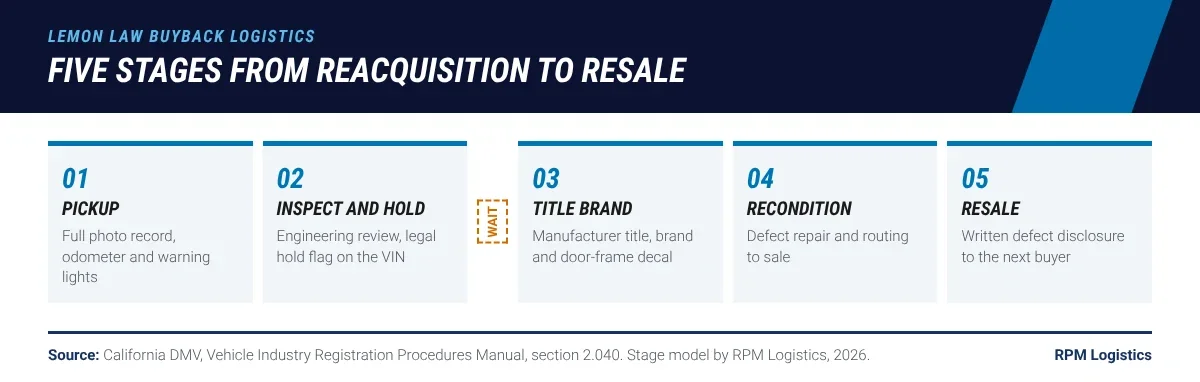
Transport touches every stage. The first move out of the consumer's hands sets the condition record that the rest of the chain relies on.
What a Lemon Law Buyback Vehicle Is
A lemon law buyback vehicle is a car or truck the manufacturer repurchased because it could not be repaired to meet its warranty. Every state has a lemon law, and the federal Magnuson-Moss Warranty Act adds a national layer. Some manufacturers also call these units reacquired vehicles or warranty returns.
California's rule shows how specific the process gets. Its Civil Code requires a manufacturer to replace a new vehicle or make restitution after a reasonable number of failed repair attempts. Vehicles reacquired on or after January 1, 1996 carry a "Lemon Law Buyback" title brand (California DMV, Vehicle Industry Registration Procedures Manual).
Why Buyback Logistics Differ From a Normal Remarketing Move
A normal off-lease or trade-in move has one goal: get the car to its sale point quickly. A buyback has three goals that pull against each other. The manufacturer wants the car moved, preserved as evidence, and resold legally.
Speed still matters. Wholesale values move every month. The Manheim Used Vehicle Value Index stood at 206.8 in October 2026, up 2% from a year earlier (Cox Automotive, November 2026). Unadjusted wholesale prices fell 2.3% from September to October in the same report. A buyback held too long gives up value it never gets back.
But a buyback cannot simply be rushed to auction. Legal teams may need it held. Title work has to finish before resale. And many states require the next buyer to be told about the defect in writing.
Stage 1: The Reacquisition Pickup
The first move happens when the consumer hands the vehicle back. That might be at a dealership, a residence or a repair facility. This pickup creates the condition record that every later stage will rely on.
A standard bill of lading inspection is not enough here. The record should show:
- Exterior and interior photos from fixed angles, including any damage unrelated to the claimed defect.
- Odometer reading with a dash photo, ignition on.
- Warning lights present at pickup, since they may relate to the defect.
- Keys, manuals and accessories received, by count.
- Running condition: whether the vehicle starts, drives and shifts.
Our guide to insurance-grade condition reporting sets out the full photo standard. The older basics are in our explainer on why the vehicle condition report matters.
Transfers of title also carry federal odometer disclosure rules. The manufacturer's title team handles the paperwork under 49 CFR Part 580. A clear dash photo at pickup gives that team a record to match against.
Pickups From Homes, Shops and Non-Running Vehicles
Buyback pickups are less predictable than dealer moves. The vehicle may sit at a consumer's home, a dealer service lane or an independent repair shop. Each location brings its own access issues.
- Residential pickups: narrow streets, HOA rules and gated communities can block a full-size car hauler. A smaller truck or a meeting point may be needed.
- Repair facilities: the shop may hold keys or release paperwork, so confirm hours and contacts in advance.
- Non-running vehicles: some defects leave the vehicle unable to start or shift. The carrier needs a winch and should know before dispatch.
- Electric vehicles: a battery-related defect may require special handling. Share the defect details with the carrier at booking.
Telling the carrier what kind of pickup it is avoids a wasted trip. A failed pickup also delays the whole chain, since inspection and title work wait on the vehicle's arrival.
Stage 2: Inspection, Engineering Review and Holds
Many reacquired vehicles go first to an inspection site or engineering center. The manufacturer wants to see the defect for itself. Some units stay on a legal hold while a dispute or a pattern review is open.
A legal hold changes the transport plan. The vehicle cannot move until someone with authority releases it. That means the storage site needs:
- A hold flag on the VIN in the yard system.
- A named contact who can release the hold.
- Secure storage, since the car is now evidence.
- No reconditioning or repair until release.
Holds are where buyback programs lose the most time. A car can sit for weeks because nobody owns the release. Our article on yard and compound management covers how storage decisions affect transit time across a program.
Stage 3: Title Branding and Disclosure
Before resale, the title has to be branded in most states. California's handbook sets out what that involves for a manufacturer:
- Title and register the vehicle in the manufacturer's name, marked "Lemon Law Buyback."
- Affix a decal stating the title brand, on the left door frame for most vehicles.
- Notify the next buyer of the warranty defect in writing.
Other states use different wording, such as "manufacturer buyback" or "reacquired." Some brand the title and some only require a disclosure form. The shipping plan should not assume the destination state's rules match the origin state's rules.
That matters because buybacks often cross state lines. In one year, Texas recorded 359 out-of-state reacquired vehicles entering the state after repair of their defects (Texas DMV Lemon Law Annual Report, FY 2018). Each one carried a brand or disclosure from somewhere else.
Stage 4: Reconditioning and Routing to Sale
Once the hold is released and the title is branded, the vehicle moves toward resale. That usually means repair of the defect, reconditioning, then routing to a closed or open auction.
The routing decision is about value and compliance. Some manufacturers sell buybacks only through dealer-only or closed sales, so disclosure travels with the car. Our guides to auction vehicle transport and remarketing logistics cover the lane and timing choices in more detail.
A vehicle that goes to auction should arrive with the decal still in place, the branded title in process and the condition record attached. A missing decal at the sale lane can stop the sale.
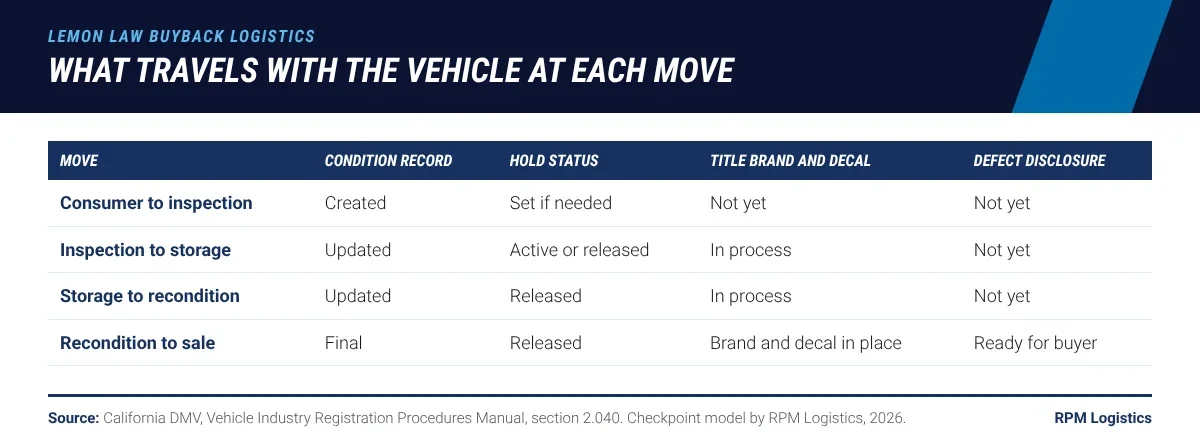
The documents grow at each stage. A carrier moving the car late in the chain should receive everything the earlier stages produced.
Recalls and Buybacks Are Not the Same Move
Recall work and buybacks often share yards and carriers, but they are different programs. A recall moves a car to repair and back to its owner. A buyback moves the car away from its owner for good.
Recall volume is large. About 28 million vehicles were affected by U.S. recalls in 2025 (Recall Masters State of Recalls report, 2026). Buyback volume is far smaller, but each unit carries more paperwork. Check any reacquired vehicle against NHTSA's recall lookup before resale routing, so open recalls are remedied first.
What a Manufacturer Should Ask a Transport Partner
Buyback programs need a carrier that handles evidence, not just freight. Before awarding the work, ask:
- Can you capture a full photo condition record at pickup, including the dash with ignition on?
- Can your storage sites flag a VIN as held and stop movement until release?
- Who on your side tracks hold releases, and how do you report them?
- Can you collect pickups from consumer homes as well as dealers?
- Can you move non-running units, since some defects leave the car undrivable?
- How do you hand off documents to the next stage?
RPM handles finished vehicle moves for manufacturers in all 50 states and Canada through its OEM vehicle logistics service. Remarketing moves run through retail and remarketing transport. For a broader view of partner selection, see our OEM logistics partner scorecard.
Common Mistakes in Buyback Transport
- Thin pickup records: a dispute later has no baseline.
- Holds without owners: vehicles sit and lose value while nobody releases them.
- Reconditioning before release: repair work can disturb evidence.
- Assuming one state's rules: the destination state may brand titles differently.
- Losing the decal: a car arriving at sale without it may be pulled from the lane.
Frequently Asked Questions
Who pays to transport a lemon law buyback vehicle?
The manufacturer usually arranges and pays for transport after reacquisition. The exact terms depend on the settlement or state program. The consumer's role normally ends at the vehicle handoff.
Can a buyback vehicle be moved while a legal hold is in place?
Only if the person with release authority approves the move. Otherwise it should stay in secure storage with a hold flag on the VIN. Moving or repairing a held vehicle can affect the evidence.
What does a Lemon Law Buyback title brand mean?
It tells later buyers the manufacturer reacquired the vehicle for a warranty defect. In California, it applies to vehicles reacquired on or after January 1, 1996, and comes with a door-frame decal.
Do all states brand buyback titles the same way?
No. Wording and requirements vary. Some states brand the title and some require only a disclosure form. Check the rules in the state where the vehicle will be titled and sold.
Can a non-running buyback vehicle be shipped?
Yes. Non-running units need a carrier with a winch or other loading equipment. Tell the carrier at booking so the right truck is sent.
Why does the pickup condition report matter so much?
It is the first record of the vehicle after it leaves the consumer. Every later inspection, repair and sale relies on it. A weak record makes any later dispute harder to settle.