

Quick Answer
Yes, you can usually move to another state with a leased car. Check your lease for a relocation clause, then tell the leasing company before you move. Register the car in your new state by its deadline, using title paperwork the lessor sends. Update your insurance, and expect tax and inspection rules to change with your new address.
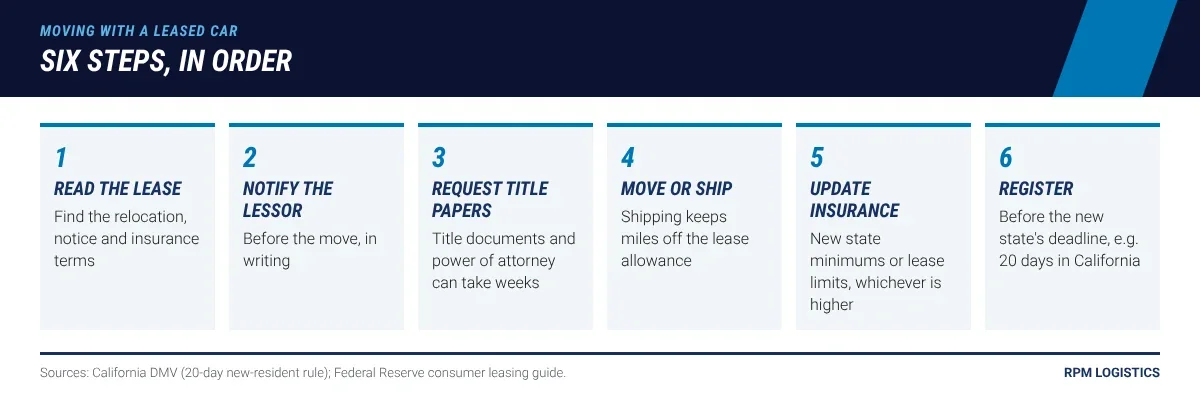
Step three is the slow one: the leasing company holds the title, so start that request before the moving truck is booked.
Can you move to another state with a leased car?
You can usually move to another state with a leased car, as long as your lease allows it and you notify the leasing company. Many lessors, including the finance arms of major automakers, allow permanent moves within the U.S. Some regional lessors do not. The lease itself is the first thing to check.
The Federal Reserve's consumer guide to vehicle leasing notes that some lessors, particularly regional ones, prohibit lessees from permanently moving the car out of state. Others allow it with notice or approval. A lease that is silent on the subject still usually requires you to keep your address current with the lessor.
Leasing is common, so this question comes up often. Leasing made up 25.35% of new-vehicle financing in the second quarter of 2024. That figure comes from Experian's State of the Automotive Finance Market report. Around 8.2 million people moved between states in 2022, according to the U.S. Census Bureau's American Community Survey. Many of them were mid-lease.
What does your lease say about moving out of state?
Your lease usually covers moving in a section on use, location or registration of the vehicle. Read that section before you plan anything else, because it decides whether you need permission or only need to give notice.
Look for these terms:
- Relocation or garaging clause: whether the car may be kept permanently in another state.
- Notice requirement: how many days in advance you must tell the lessor about a new address.
- Registration terms: who registers the car and who pays registration and taxes.
- Insurance minimums: the coverage limits the lessor requires, which may be higher than your new state's minimums.
- Mileage allowance: the annual miles included before overage charges apply.
- Country limits: most leases bar taking the car outside the U.S. without written approval.
If anything is unclear, call the leasing company and ask for its relocation steps in writing. Lessors handle moves every day and usually have a set process.
How do you register a leased car in another state?
To register a leased car in another state, you need paperwork from the leasing company, because it owns the car and holds the title. You then take that paperwork to the new state's motor vehicle agency, along with proof of residency, insurance and any required inspection.
Step 1: Ask the lessor for title paperwork
The lessor holds the title, so it has to provide the documents your new state needs. That is often the original title or a copy, plus a power of attorney that lets you or the new state act for the lessor. Request it as soon as you know your move date, since it can take weeks to arrive.
Step 2: Check your new state's deadline
Every state sets its own deadline for new residents. California, for example, gives new residents 20 days to register a vehicle, according to the California DMV. The clock starts when you become a resident or take a job in the state. Other states use different windows, so check your new state's motor vehicle agency for the exact rule.
Step 3: Complete inspections
Some states require a safety inspection, an emissions test or a VIN verification before registration. California, for instance, requires a smog check for many vehicles coming in from another state.
Step 4: Register and title
Submit the lessor's documents, your proof of insurance and residency, and the inspection results. The new title is issued with the leasing company as owner. You receive new plates and a registration in your name as lessee.
The process for fleets moving many leased vehicles across state lines works the same way at scale. Our guide to title and registration across state lines covers the bulk version.
Who pays registration, tax and title fees when you move a leased car?
You usually pay registration, title and tax costs when you move a leased car, either directly or through the lessor. The lease decides which, and the new state decides how much.
Expect some or all of these costs:
- Title and registration fees in the new state.
- Sales or use tax changes. Many states tax lease payments, so your monthly payment can change with the new tax rate. Some states tax the vehicle when it is first registered there.
- Inspection fees for safety, emissions or VIN checks.
- Lessor processing fees for sending title documents or updating the account.
Ask the lessor how it will bill the new state's taxes. Some add them to your monthly payment, and others bill them once. Knowing the answer early avoids a surprise on your first statement after the move.
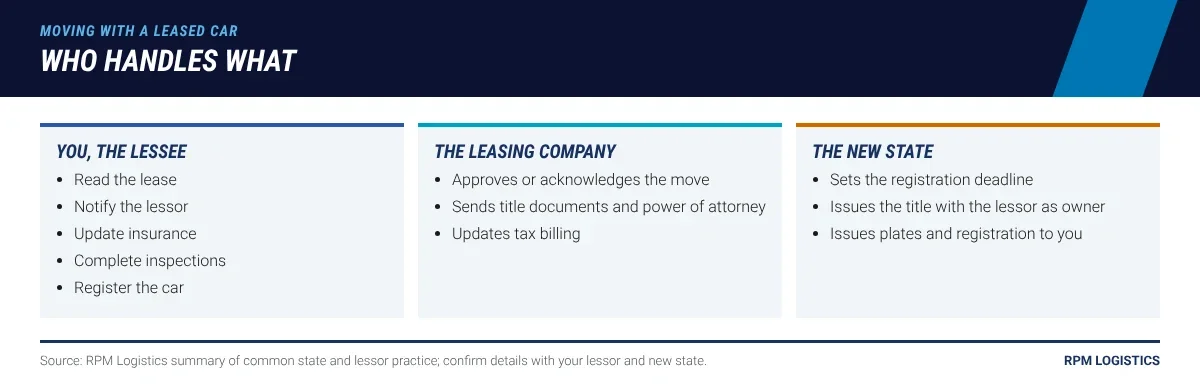
Most delays come from the middle column: nothing at the new state's office can start until the lessor's paperwork arrives.
Do you need new insurance when you move with a leased car?
You need to update your insurance when you move with a leased car, and you may need a new policy. Insurance rules and rates are set by state, and your insurer needs your new garaging address.
Keep two sets of requirements in mind:
- Your new state's minimums, which set the floor for liability coverage.
- Your lease's requirements, which often call for higher limits plus collision and comprehensive coverage.
Whichever is higher applies. Many lessors also require gap coverage, either built into the lease or bought separately. Send the lessor proof of your updated policy, since lapses can be a lease default.
Should you drive or ship a leased car to your new state?
Whether you drive or ship a leased car depends mostly on distance and your mileage allowance. Every mile you drive counts against the lease. Shipping keeps those miles off the odometer and the car off the road during a busy move.
Consider a long cross-country drive. Most leases include a fixed annual allowance, often 10,000 to 15,000 miles. A coast-to-coast trip can use a large share of one year's allowance in a few days. If you are already near your limit, overage charges at lease end can cost more than shipping.
Shipping also helps when:
- You are moving more than one car and cannot drive both.
- You are flying to your new home.
- The car is high-value and you want it protected from weather and road debris.
- You need the car on arrival without a long drive after a long move.
You generally do not need the lessor's permission to ship the car within the U.S., but confirm your lease does not restrict it. For premium or luxury leases, enclosed transport protects the finish you will be judged on at turn-in. Our checklist for shipping a luxury car to another state walks through the process, and our guide to cross-country enclosed car shipping covers long moves.
How do you prepare a leased car for transport?
Preparing a leased car for transport is mostly about documentation. At lease end, the leasing company will inspect the car for damage beyond normal wear. A clear record of its condition before and after the move protects you.
- Wash the car so the condition report shows every existing mark.
- Take dated photos of all sides, the wheels, the interior and the odometer.
- Remove personal items and toll tags that belong to your old state.
- Leave about a quarter tank of fuel, or a reasonable charge for an EV.
- Check for open recalls by VIN through NHTSA's recall lookup and book any repair.
- Keep the pickup report from the carrier with your lease records.
Tipping the driver is optional; our guide to tipping car transport drivers covers the norms. At delivery, walk around the car with the driver before signing. Note anything new on the delivery receipt. That record matters at lease turn-in as much as for a transport claim.
Before you book, confirm the transport company's authority through FMCSA registration records or FMCSA's SAFER lookup. Our guide to preventing double brokering explains why that check matters.
Can you return a leased car in a different state?
You can usually return a leased car in a different state from where you leased it. Captive finance companies, the lending arms of automakers, typically accept returns at franchised dealers of their brand nationwide. Independent and regional lessors may have fewer return locations.
Before your lease ends:
- Ask the lessor which dealers or locations in your new state accept returns.
- Schedule the pre-return inspection where the lessor offers one, so you can fix issues first.
- Bring your records, including service history and both sets of keys.
If you plan to buy the car at lease end, ask the lessor how the purchase and title transfer will work in your new state. The new state's sales tax and title rules apply to the buyout.
What if you lease a car in one state and live in another?
If you lease a car in one state and live in another, you generally register it where you live, not where you signed the lease. Dealers can often handle out-of-state leases, but the lessor has to set up taxes and registration for your home state.
The same applies if you move again during the lease. Each permanent move restarts the notice, registration, insurance and tax steps above. Temporary stays, such as a few months for work or a winter away, usually do not require re-registration. Check your lease and both states' residency rules if your stay will run long.
What should you do if you cannot move the car with you?
If you cannot take a leased car with you, you have a few options, each with costs. The right one depends on how much time is left on the lease and what the car is worth.
- Ship it later, once you are settled, if the car can stay with family or in storage briefly.
- Transfer the lease to another person, if the lessor allows lease transfers.
- Buy out the lease and sell the car, if its market value is above the buyout price.
- End the lease early, usually the most expensive option because of early termination charges.
Get each option's cost from the lessor in writing before you decide. A lease transfer or a buyout and sale can cost far less than early termination in a strong used-car market.
Move your leased car with confidence
RPM Logistics ships personal and leased vehicles across all 50 states and Canada through a network of more than 15,000 active carriers. Every move includes photo condition reports at pickup and delivery, the records your lease turn-in may depend on. For high-value leases, see our enclosed car transport and luxury car transport options, or request a quote with your pickup and delivery locations.
Frequently asked questions
Can you move states with a leased car?
Usually, yes. Many lessors allow permanent moves within the U.S. with notice. Some regional lessors prohibit them, so check your lease and tell the leasing company before you move.
How do you register a leased car in another state?
Ask the leasing company for title documents and a power of attorney. Then take them to your new state's motor vehicle agency with proof of residency, insurance and any required inspection, before the state's deadline.
Do you have to tell the leasing company when you move?
Yes. Most leases require you to keep your address current, and the lessor has to send title paperwork for the new registration. Many leases also require notice before a permanent move.
Will my lease payment change if I move to another state?
It can. Many states tax lease payments, so a different tax rate can change your monthly payment. Ask the lessor how it will bill the new state's taxes.
Can I return my leased car in a different state?
Usually, yes. Captive lessors typically accept returns at franchised dealers of their brand nationwide. Confirm accepted return locations with your lessor before the lease ends.
Should I drive or ship my leased car when I move?
Driving adds miles that count against your lease allowance. Shipping keeps miles off the odometer, which can save money if you are close to your limit or moving a long distance.
Can I take a leased car to another country?
Most leases do not allow it without written approval from the leasing company. Ask the lessor before any move outside the U.S.