

Quick Answer
Pharma sales fleet logistics is the work of moving, staging and reassigning the vehicles that pharmaceutical sales reps drive. When a rep leaves, the car must be recovered, cleared of drug samples, reconditioned and delivered to the next rep. Fast turns protect territory coverage. Clean sample handoffs keep the company compliant with federal sample rules.
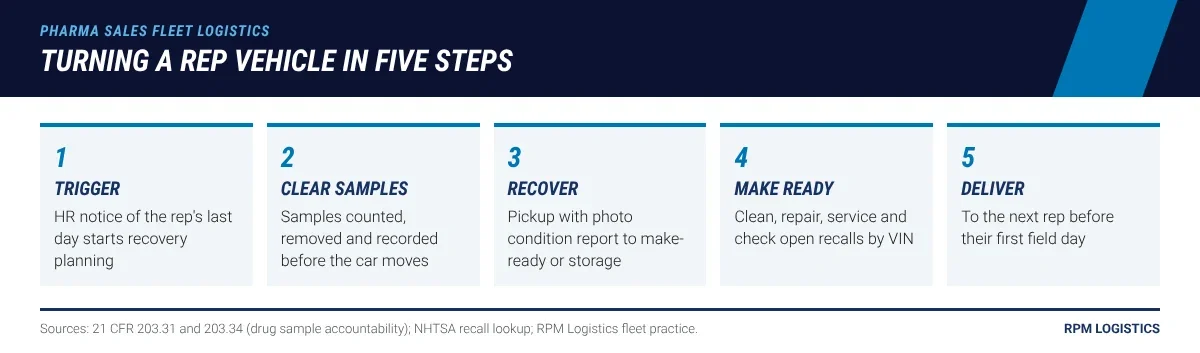
Step two is the one transport teams most often skip: a car should never move with samples still in the trunk.
What is pharma sales fleet logistics?
Pharma sales fleet logistics covers every vehicle move in a pharmaceutical sales fleet, from new-car delivery to final remarketing. In practice, most of the work sits in the middle: turning cars between reps as people join, leave or change territories. Each turn is a short project with a deadline set by the next hire's start date.
These fleets are large. Pharmaceutical Commerce estimated about 300,000 pharma sales fleet vehicles worldwide in 2017, with about 140,000 in North America (Pharmaceutical Commerce, 2017). It put the average company fleet at about 700 vehicles. The 15 largest companies averaged about 5,000 each.
Individual programs can be just as big. Sanofi's careers site describes a car fleet that supports 7,700 sales reps (Sanofi, 2026). At that scale, even a small share of reps changing roles each month creates a steady stream of vehicle moves.
Why do rep vehicle turns cost territory time?
Rep vehicle turns cost territory time because a rep without a car cannot call on prescribers. Every day between a new hire's start date and the car's arrival is a lost field day. A manager may stretch to cover, but calls still drop.
The delay usually comes from small gaps that add up:
- Late notice. Fleet teams hear about a departure after the rep's last day, not before.
- Slow recovery. The car sits at a former rep's home while someone arranges pickup.
- Sample hold-ups. Samples still in the vehicle stop the move until they are counted and removed.
- Make-ready queues. Cleaning, repairs and recall work wait for a shop slot.
- Distance. The available car is in the wrong region for the new hire.
None of these steps is hard alone. Each one usually belongs to a different team: HR, compliance, fleet, a shop and a carrier. The cost comes from running them in sequence, one after another, instead of in parallel. A good program starts recovery planning when the departure is announced, not when the keys come back. HR notice of a rep's last day is the trigger that should start the whole sequence.
How should drug samples be handled when a rep vehicle changes hands?
Drug samples should be removed, counted and documented before a rep vehicle is picked up for transport. The vehicle moves as a car, not as a sample storage site. That keeps the sample records clean and keeps the transport provider out of the sample chain.
The reason is federal sample accountability. Under 21 CFR 203.31, manufacturers and distributors must inventory samples held by their reps at least once a year. Each inventory must be reconciled with the prior one in a written report. That report must account for transfers, returns, destruction and thefts or losses.
The same section requires a list of the sites where reps store samples. For many reps, the car is one of those sites. Under 21 CFR 203.34, companies also need written policies on how reps store samples and on monitoring loss or theft.
For the vehicle turn, that translates into a simple rule set:
- Count and remove samples before the recovery date, under the company's sample policy.
- Record the transfer or return so the next reconciliation ties out.
- Confirm the car is empty of samples, literature and company devices at pickup.
- Note the check on the condition report, so the handoff is documented.
Your compliance team owns the sample process. The fleet and transport plan should simply make sure no car moves until that step is done.
What is the fastest way to turn a rep vehicle?
The fastest way to turn a rep vehicle is to run recovery, make-ready and delivery as one scheduled sequence with a single coordinator. Most delays happen in the handoffs between those stages, not inside them.
Recover the car on a set date
Schedule pickup for the rep's last day or the day after, once samples are cleared. A professional driver or a carrier collects the car with a photo condition report. That report becomes the baseline for any damage questions later, as our guide to photo condition reports for fleet claims explains.
Recondition and check recalls
Send the car to make-ready for cleaning, repairs and maintenance. This is also the moment to check for open safety recalls by VIN through NHTSA's recall lookup. A rep should not receive a car with an unrepaired recall. Our overview of the fleet make-ready and reconditioning pipeline covers the shop stage in detail.
Deliver to the next rep
Deliver the car to the new rep's home or office before their first field day. Driveaway works well for single cars over moderate distances. Haulaway fits when several cars move to one region, such as a new team launch.
Fuel cost is part of the decision too. Pharmaceutical Commerce reported that fuel can reach 60% of total operating costs in some sales fleets (Pharmaceutical Commerce, 2017). Moving a car by truck instead of putting miles on it can make sense on long lanes.
Should you stage spare vehicles or ship each car to order?
Staging spare vehicles makes sense when hiring is frequent and predictable in a region. Shipping each car to order makes sense when turns are rare or spread thin. Many fleets use both, based on where their reps are.
Approach | Best for | Trade-off |
|---|---|---|
Ship each car to order | Low-turnover regions and specialty teams | Slower delivery when a hire starts suddenly |
Regional staged pool | Dense territories with frequent turns | Storage cost and idle vehicles |
Redeploy within the region | Teams that are shrinking in one area and growing in another | Needs early notice of territory changes |
A staged pool turns a multi-day move into a short local delivery. The cost is storage and some idle time. Idle cars still depreciate, and depreciation can reach 62% of a pharma fleet's fixed costs (Pharmaceutical Commerce, 2017). Weigh that against lost territory days.
For a framework on holding cars between drivers, see our guide to fleet vehicle storage between assignments.
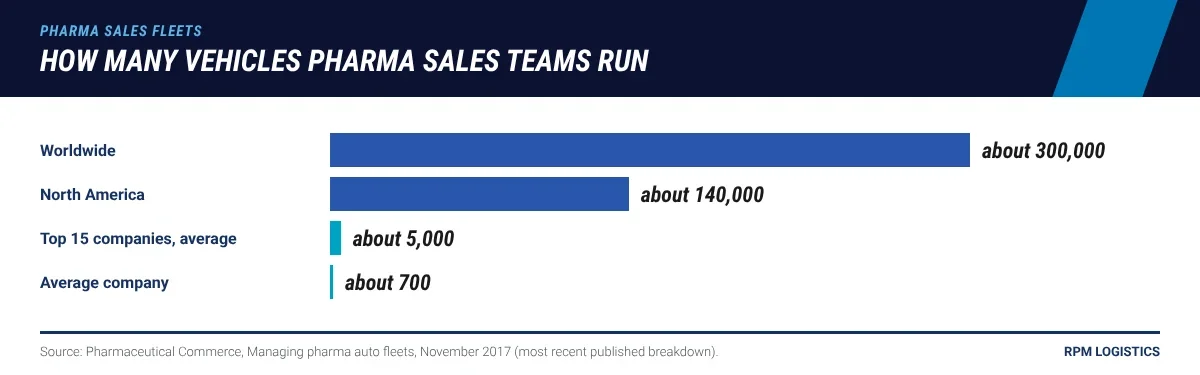
These are 2017 industry estimates, the most recent published breakdown; even at the average fleet size, a few departures a month keep the turn pipeline busy.
How do territory changes affect fleet moves?
Territory changes create the largest fleet moves in pharma, because they shift many reps at once. A product launch, a merger or a restructuring can move dozens of cars across regions in a few weeks.
Plan these waves like a small relocation project, with one owner and a dated schedule:
- Map old and new territories to see which cars can stay and which must move.
- Batch moves by region so haulaway trucks run full.
- Stagger deliveries to match training dates and field start dates.
- Handle registration early for cars changing states, since plates and titles can lag the move.
Registration is easy to underestimate. Our guide to fleet title and registration across state lines covers the paperwork side. For day-to-day reassignments between drivers, see our playbook on fleet reassignment logistics.
What if the departing rep's car is due for replacement?
When a departing rep's car is near the end of its cycle, it may be cheaper to retire it than to recondition it. The turn then splits into two moves: the old car goes to remarketing and a new car goes to the next rep. Deciding early keeps both moves on schedule.
Use a short set of checks at recovery:
- Mileage and age against the fleet's replacement policy.
- Condition from the pickup report, including any damage that would need repair.
- Open recalls or repairs that would delay redeployment.
- Market timing, since used-vehicle values shift by season and segment.
If the car is retired, it can move straight from recovery to auction or a remarketing partner. That avoids paying for make-ready on a car that will not be redeployed. Our guide to remarketing logistics at end of lifecycle covers that path.
The new car then follows the delivery steps above. Upfitted or specialty vehicles may need extra lead time. Plain sedans and SUVs can often be ordered and delivered within the new hire's onboarding window.
What belongs on a rep vehicle turn checklist?
A rep vehicle turn checklist lists every step from departure notice to delivery, with an owner for each. It keeps HR, compliance, fleet and transport working from the same plan.
- Departure or hire date confirmed with HR.
- Sample count and removal scheduled with compliance.
- Fuel card, toll tag and company devices collected.
- Recovery date and address confirmed.
- Photo condition report completed at pickup.
- Make-ready, maintenance and recall check booked.
- Registration updated if the car changes states.
- Delivery date set before the new rep's first field day.
What should pharma fleet managers ask a transport provider?
Pharma fleet managers should ask how a provider handles timing, documentation and driver standards, because those decide territory time and risk. Price per move matters, but missed start dates cost more.
Useful questions include:
- How quickly can you recover a car after a rep's last day?
- Do you confirm the car is empty of samples and company devices at pickup?
- Do you provide photo condition reports at both ends?
- How are drivers screened and monitored?
- Can you stage cars regionally when we need a pool?
- Can you combine recovery, make-ready and delivery under one coordinator?
A single partner across these stages removes most of the handoff delays described above. Our article on using a single logistics partner across the vehicle lifecycle makes that case in detail.
Ask for references from other corporate sales fleets, too. A provider that already turns cars for field sales teams will know the timing pressure and the paperwork that comes with it.
How RPM supports pharmaceutical sales fleets
RPM Logistics runs recovery, storage, make-ready coordination and delivery for corporate sales fleets across all 50 states and Canada. Programs draw on more than 70 storage locations in the U.S. and Canada for regional staging. Drivers are screened through motor vehicle record checks at onboarding and monitored continuously after that.
Safety is tracked, not assumed. Carriers in the network recorded 3.5 accidents per million miles in 2026 year to date, measured as accident frequency (RPM Logistics, 2026). Every move includes photo condition reports at pickup and delivery, so fleet teams can close each turn with a clean record.
For program details, see our fleet vehicle logistics services.
Frequently asked questions
How long should it take to turn a pharma rep's vehicle?
It depends on distance, shop capacity and how early the departure is known. Starting recovery planning when the departure is announced, and running make-ready in parallel, shortens the turn the most.
Can a transport company move a car that still has drug samples inside?
It should not. Samples should be counted, removed and documented under the company's sample policy before pickup. That keeps reconciliation records clean under 21 CFR 203.31.
Should a rep vehicle be checked for recalls before reassignment?
Yes. Check the VIN for open safety recalls through NHTSA's recall lookup during make-ready. Repair any open recall before the next rep receives the car.
Is driveaway or haulaway better for rep vehicles?
Driveaway usually fits single cars over moderate distances. Haulaway fits groups of cars moving to one region or long lanes where added miles would cost more.
How many vehicles are in pharma sales fleets?
Pharmaceutical Commerce estimated about 300,000 worldwide and about 140,000 in North America in 2017. The average company fleet was about 700 vehicles.
When does a staged vehicle pool make sense?
A staged pool makes sense in dense territories with frequent hiring. It trades storage cost and idle time for faster delivery to new reps.
Keep every territory covered
A rep without a car is a territory without coverage. RPM Logistics can recover, stage and deliver sales fleet vehicles on the schedule your hiring plan sets. Talk to our fleet team about your rep vehicle program.