

Quick Answer
Lead-acid batteries are Class 8 corrosive hazardous materials under DOT rules. By truck, spillable batteries (UN2794) can skip most hazmat paperwork under 49 CFR 173.159(e) if five load conditions are met. Non-spillable batteries that pass the tests and carry the NON-SPILLABLE mark are excepted from nearly all other requirements under 173.159a.
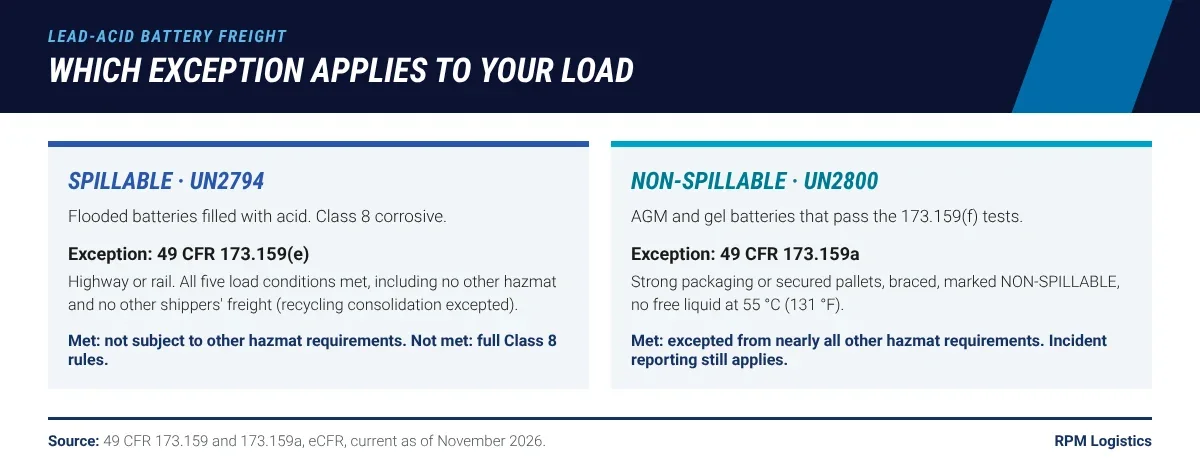
Both exceptions depend on how the truck is loaded, not only on the battery. Break one condition and the full Class 8 rules apply.
Are Lead-Acid Batteries Hazmat?
Yes. A lead-acid battery holds sulfuric acid electrolyte, which makes it a Class 8 corrosive under the Hazardous Materials Regulations. The rules for shipping them sit in 49 CFR 173.159 for wet batteries and 173.159a for non-spillable ones.
The common entries are:
- UN2794: Batteries, wet, filled with acid. Flooded starting and industrial batteries.
- UN2800: Batteries, wet, non-spillable. Most AGM and gel batteries that pass the DOT tests.
- UN2795: Batteries, wet, filled with alkali. Nickel-based industrial cells, not lead-acid, but often shipped by the same customers.
The good news for ground freight is that both main exceptions are written for highway and rail. Most truckload battery shipments can use one of them if the load is planned correctly.
The Base Rules Every Lead-Acid Shipment Follows
Section 173.159(a) applies to every wet battery shipment, exception or not. Batteries may not be packed with other materials, except as the rule allows. Each battery must be prepared to prevent three things:
- Dangerous heat: enough to char, melt or scorch the packaging.
- Short circuits: terminals must not touch other batteries or metal.
- Terminal damage: covers, rigid packaging or recessed terminals protect them.
Batteries can ship in authorized packagings such as fiberboard boxes or plastic drums. They can also be firmly secured to skids or pallets for highway transport. Under 173.159(d), a palletized unit may not stand taller than 1.5 times the width of its pallet.
The Highway Exception for Spillable Batteries: 173.159(e)
Under 173.159(e), wet batteries moving by highway or rail are not subject to any other requirements of the hazmat subchapter if all five conditions are met:
- No other hazardous materials ride in the same vehicle.
- The batteries are loaded or braced to prevent damage and short circuits.
- Any other cargo is blocked, braced or secured so it cannot damage the batteries. Pallets must be stacked so they do not damage other pallets.
- The truck carries no freight from any shipper other than the battery shipper, except when consolidating batteries for recycling.
- Incident reporting under 49 CFR 171.15 still applies.
Condition 1 and condition 4 are the ones that catch shippers. A mixed LTL trailer will often carry other hazmat or other shippers' freight. That load cannot use the exception, so the batteries need full shipping papers, labels and placarding where required. Our guide to DOT hazmat classes and placarding covers those rules. The tradeoff between trailer types is laid out in our LTL vs truckload guide for battery freight, written for lithium but built on the same consolidation logic.
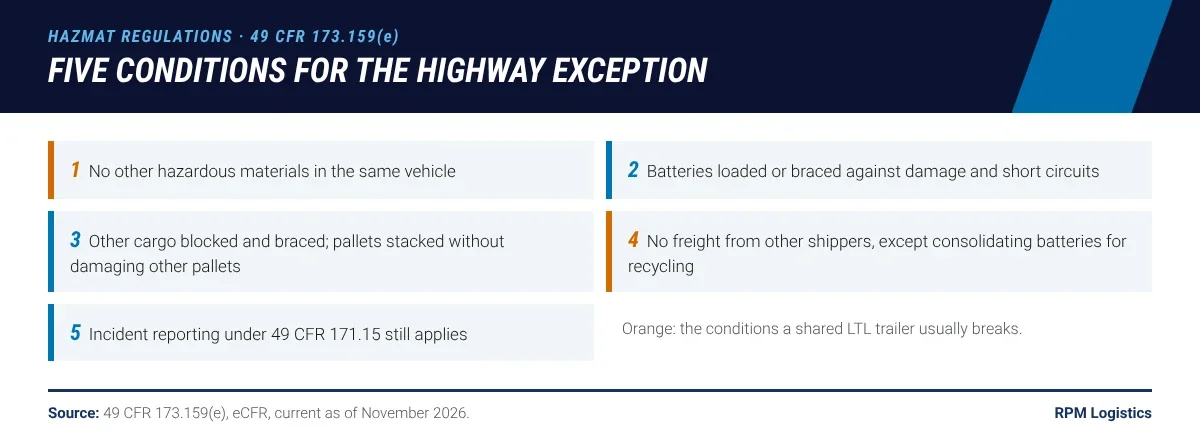
Conditions 1 and 4 decide the trailer type. Dedicated truckload meets them easily. Shared LTL usually does not.
The Non-Spillable Exception: 173.159a
Many AGM and gel batteries are rated non-spillable. To qualify, the battery must pass the vibration and pressure differential tests in 173.159(f). It must then meet the packaging and marking rules in 49 CFR 173.159a:
- Packed in strong outer packaging, or secured to skids or pallets that withstand normal transport.
- Loaded or braced to prevent damage and short circuits.
- Kept from contact with other cargo in the vehicle.
- Marked "NON-SPILLABLE" or "NON-SPILLABLE BATTERY" on the battery and the outer packaging.
A non-spillable battery is excepted from all other hazmat requirements if it also holds no unabsorbed free liquid at 55 °C (131 °F). Its electrolyte must not flow from a ruptured or cracked case. Incident reporting still applies.
The marking is the step most often missed. A pallet of AGM batteries without the NON-SPILLABLE mark on the outer packaging does not qualify, even if every battery inside does.
Used Lead-Acid Batteries for Recycling
Used batteries are the largest lead-acid freight flow. Lead batteries were recycled at a rate of nearly 98%, the highest of any U.S. consumer product (Battery Council International, August 2026). The industry diverts about 160 million batteries from landfills each year (Battery Council International, 2023).
That volume moves by truck from shops, dealers and fleets to collectors and smelters. The 173.159(e) exception has a specific allowance for it. Condition 4 bars freight from other shippers, except when consolidating batteries for recycling. A collector can build one load from many sources and still use the exception.
Used batteries need the same care as new ones. Terminals still need protection, pallets still need bracing, and a cracked case is a spill risk. Our guide to battery recycling reverse logistics covers how lithium recycling flows differ.
Lead-Acid vs Lithium Battery Freight
Factor | Lead-acid | Lithium-ion |
|---|---|---|
Hazard class | Class 8 corrosive | Class 9 miscellaneous |
Main rule | 49 CFR 173.159 and 173.159a | 49 CFR 173.185 |
Main hazard | Acid spill, short circuit | Thermal runaway, fire |
Ground exception | 173.159(e) for dedicated loads | Limited, by size and condition |
Recycling flow | Mature, near-total collection | Growing, condition-dependent |
Lithium shipments follow very different rules. See our 49 CFR 173.185 road guide and the lithium battery compliance guide. Mixed loads of both chemistries raise their own segregation questions, so plan them with your compliance team. Damaged lithium packs are a separate case again, covered in our guide to shipping damaged and defective lithium batteries.
How to Ship Lead-Acid Batteries by Truck
- Identify the battery type: spillable (UN2794) or non-spillable (UN2800).
- Protect terminals with caps, rigid packaging or recessed design.
- Palletize and brace: secure batteries to the pallet and keep unit height within 1.5 times the pallet width.
- Mark non-spillables: NON-SPILLABLE on the battery and outer packaging.
- Choose the trailer: a dedicated truckload makes the 173.159(e) exception easy to meet.
- Confirm the exception with your carrier before pickup, so the driver knows whether papers and placards are needed.
Shippers moving full pallets often book dry van truckload capacity, since a dedicated trailer satisfies conditions 1 and 4. RPM also moves battery freight through its battery transportation service. For the carrier side of hazmat compliance, FMCSA's hazmat compliance guide is the reference.
Frequently Asked Questions
Do lead-acid batteries need hazmat placards on a truck?
Not if the shipment meets all five conditions of 49 CFR 173.159(e). Those batteries are then not subject to other hazmat requirements. If any condition fails, such as other hazmat on the trailer, the full Class 8 rules apply.
What is the UN number for a car battery?
A standard flooded car battery ships as UN2794, Batteries, wet, filled with acid. A qualifying AGM or gel battery ships as UN2800, Batteries, wet, non-spillable.
Can lead-acid batteries ship by LTL?
Yes, but a shared LTL trailer usually breaks the 173.159(e) conditions. Expect full Class 8 shipping papers, labels and marking. A dedicated truckload avoids that.
How do I ship used lead-acid batteries for recycling?
Protect terminals, brace them on pallets and keep the load free of other hazmat. The 173.159(e) exception allows freight from several shippers when the purpose is consolidating batteries for recycling.
Are AGM batteries hazmat?
AGM batteries are wet batteries under DOT rules. Most qualify as non-spillable under 173.159a if they pass the tests and carry the NON-SPILLABLE mark. They are then excepted from nearly all other hazmat requirements.
How tall can a pallet of lead-acid batteries be?
Under 49 CFR 173.159(d), a palletized battery unit may not exceed 1.5 times the width of the pallet. The unit must also withstand normal transport shocks.