

Quick Answer
Aged inventory at a dealership is any unit that has sat past the store's aging cutoff, usually 60 days for used and longer for new. To clear aged units before December 31, work backward from the date. Pick the disposition channel by age band, then book transport early, since holiday weeks cut carrier capacity and auction lanes.
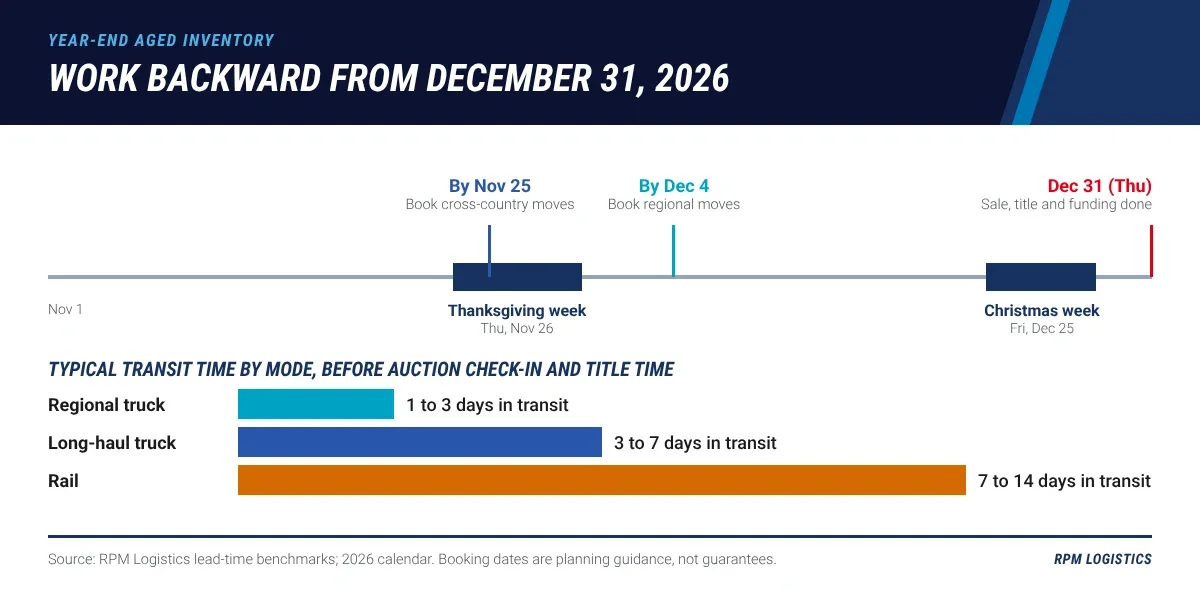
The calendar shrinks faster than it looks: two holiday weeks sit inside the last five, and every channel needs a transport leg before the sale can close.
What counts as aged inventory at a dealership?
Aged inventory is a vehicle that has stayed in stock longer than the dealership's own cutoff for that type of unit. There is no industry-wide number. Many stores flag used units at 60 days and new units later, because used values fall faster and floorplan curtailments start sooner.
The cutoff matters most at year-end because three pressures stack up at once:
- Carrying cost keeps running. Every day on the lot adds floorplan interest. NADA notes that a one-point rise in floorplan rates can raise some dealership costs by millions (NADA, 2017).
- Values soften in the fall. The Manheim Used Vehicle Value Index fell to 205.9 in September 2026, down 1.1% from August. Cox Automotive's Jeremy Robb called it "the weakest season for wholesale valuations" (Cox Automotive, 2026).
- The books close on December 31. Inventory that turns before year-end shows up as cash, not as a carried unit.
Rates still weigh on the business. In Cox Automotive's third-quarter 2026 dealer sentiment survey, 34% of dealers named interest rates as a factor holding their business back. Our analysis of what a transport delay costs in floorplan interest covers the daily math. This guide covers the year-end deadline.
Where dealer inventory stands heading into Q4 2026
Dealers enter the fourth quarter of 2026 with more used supply than a year ago and new-vehicle supply that is tighter but rising. That mix shapes which units become year-end problems.
- Used supply is growing. Used inventory reached 2.21 million units in September 2026, up 3.3% from a year earlier, with 49 days' supply. That was up from 44 days in August (Cox Automotive, 2026).
- New supply climbed in September. New inventory stood at 2.80 million units with 82 days' supply, up from 75 in August but below 87 a year earlier (Cox Automotive, 2026).
- Model-year changeover is behind last year. 2027 models were 22.4% of new inventory at the end of September, against 38.3% for the incoming model year a year earlier.
- Sales are holding. NADA forecast at least 16.0 million new-vehicle sales for 2026 after an August selling rate of 16.8 million (NADA, 2026).
The slower model-year transition means more outgoing 2026 units will still be on lots as 2027 arrivals pick up. Those are the new units most likely to cross an aging cutoff in December.
How to work backward from December 31
To clear aged units by December 31, start at the deadline and subtract every step that has to happen before the sale closes. Transport is usually the step dealers leave for last, and it is the one the holidays squeeze hardest.
The 2026 calendar has fixed constraints:
- Thanksgiving falls on Thursday, November 26. Expect thin driver availability for most of that week.
- Christmas falls on Friday, December 25. Some auctions and receiving stores run reduced schedules that week.
- December 31 is a Thursday. Any unit that needs to sell, title and fund by then has very little room after Christmas.
Transit time comes next. RPM's own lead-time benchmarks put regional truck moves at 1 to 3 days, long-haul truck moves at 3 to 7 days and rail at 7 to 14 days. Our guide to realistic transit lead times by mode breaks those down. Add pickup scheduling, auction check-in, and title and funding time on top.
A practical rule follows. For any aged unit that must leave the store, book transport no later than the first week of December. Units that have to cross the country should be booked before Thanksgiving. Capacity tightens through the fall, as our piece on fall and holiday car-haul capacity explains.
How to choose a disposition channel for aged units
The right channel for an aged unit depends on how old it is and how much time is left before December 31. Each channel trades price recovery against speed and transport dependency.
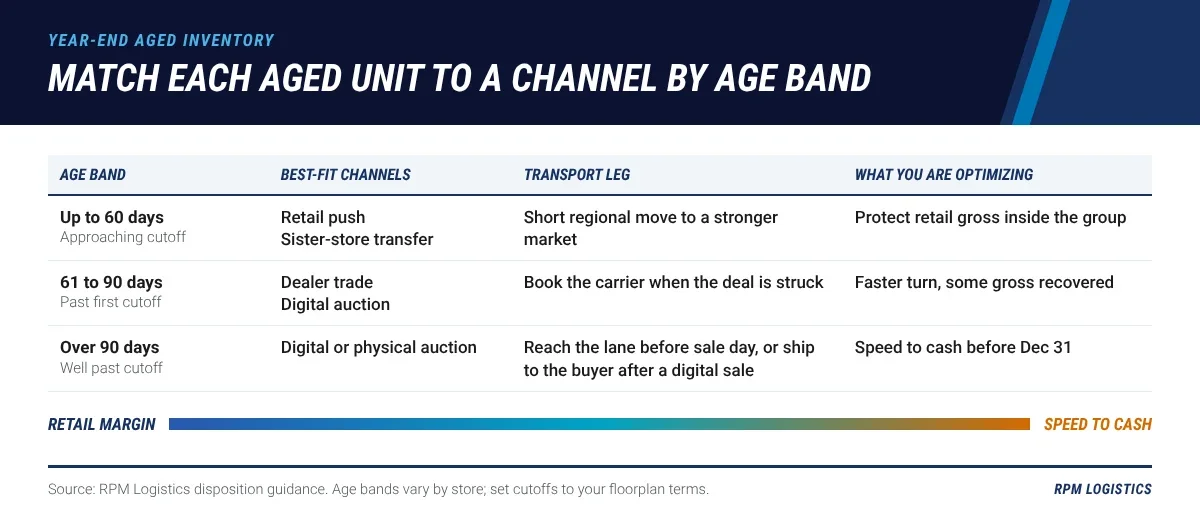
The older the unit, the more the decision turns on speed to cash rather than retail margin, and the more it depends on a truck being available.
Up to 60 days: retail push or sister-store transfer
Units approaching the cutoff still have retail options. A sister store in a market with stronger demand for that model can sell it at retail. A transfer keeps the gross inside the group. The transport leg is short and usually regional. Our guide to balancing inventory across rooftops covers how groups run these moves.
61 to 90 days: dealer trade or digital auction
Units past the first cutoff need faster outcomes. A dealer trade swaps a slow unit for one that fits your market. A digital auction reaches buyers nationwide without a physical lane. Both require a transport leg after the deal, so book the carrier when the deal is struck, not after funding. See our guide to dealer trade transport for what to require from that leg.
Over 90 days: wholesale at auction
Units well past the cutoff are usually candidates for wholesale. A physical lane gives the widest buyer pool but requires the car to reach the auction before its sale date. A digital listing can sell while the car sits on your lot, then ship to the buyer. Our guides to moving trade-ins to auction and choosing the right auction lane explain the trade-offs.
Price pressure sharpens at the low end. Cox Automotive reported that used units under $15,000 had just 29 days' supply in August 2026, and made up 15.1% of inventory against 20.6% a year earlier. Aged units in that price band may still find retail buyers. Higher-priced aged units are the ones most often headed to wholesale.
How model-year changeover changes the year-end plan
Model-year changeover turns year-end into a space problem as well as a cash problem. Incoming 2027 units need lot space, floorplan lines and prep capacity at the same time outgoing units are aging.
Three steps keep the two flows from colliding:
- Identify outgoing-year new units that will cross your aging cutoff by mid-December, and plan their exit now.
- Stage incoming units at off-site storage if your lot fills before aged units leave.
- Sequence transport so outbound wholesale loads leave before inbound allocation arrives.
RPM Logistics coordinates both directions through its dealership transport services, with 70+ storage locations across the U.S. and Canada for staging.
Paperwork that can stall a year-end sale
A unit can move on time and still miss December 31 if its paperwork is not ready. Title, payoff and transfer documents take longer during holiday weeks, when offices run short-staffed.
- Confirm the title is in hand or the payoff is scheduled before the unit ships to auction.
- Send title documents with the right party. Auctions and buying dealers have their own receiving rules.
- Check cross-state moves early. Sister stores and trades across state lines can add registration steps. See our guide to title paperwork across state lines.
- Record condition at pickup. A clear condition report protects arbitration rights if the buyer disputes the unit later.
Which aged units should move first?
The units to move first are the ones losing the most money per day, not simply the oldest ones. A ranking based only on age can leave expensive units sitting while cheap ones ship.
Rank aged units on four factors:
- Daily carrying cost. Higher-priced units cost more floorplan interest each day, so each day saved is worth more.
- Value trend. Models whose wholesale values are falling fastest should exit before the next drop.
- Curtailment date. Units about to hit a floorplan curtailment payment tie up cash the moment they cross it.
- Distance to the buyer. Units that must cross the country need more lead time, so they need an earlier decision.
A unit that scores high on all four belongs at the top of the first transport load. A low-priced unit with a nearby buyer can wait for a later regional load.
Transport choices for year-end volume
Year-end volume calls for batching wherever possible. A full carrier load to one auction or sister store costs less per unit than single-car moves, and it uses one pickup appointment instead of several.
- Batch by destination. Group units headed to the same auction or rooftop into shared loads.
- Use open transport for most units. Open carriers are the standard for dealer inventory and offer the most capacity in December.
- Reserve enclosed transport for high-value units. Exotic or collector units in aged stock may justify the extra protection.
- Consider rail for long, flexible moves. Rail can work for cross-country units that are not on a tight sale date.
- Keep units drivable and ready. Dead batteries, missing keys and flat tires slow loading and can push a unit to the next truck.
Pickup readiness matters as much as the booking. Have keys, title status and any auction paperwork staged before the carrier arrives, so a December load does not leave short.
A year-end aged inventory checklist
Run this checklist in early November and again in early December.
- Pull every unit that will cross its aging cutoff by December 15.
- Sort them into age bands: up to 60, 61 to 90, and over 90 days.
- Assign a disposition channel to each band.
- Set a last safe ship date for each unit based on its destination and mode.
- Book transport before Thanksgiving for long-haul moves.
- Confirm title status and payoff for every unit leaving the store.
- Plan storage for incoming model-year units if lot space runs short.
- Review results the first week of January and adjust cutoffs for next year.
NADA's year-end guidance points the same way. Aged used units hit dealers hardest in December, and higher rates make excess inventory costlier, so the decisions about what to sell or wholesale should come early (NADA, 2025). Our guide on cutting dealer transport spend covers how to keep those moves efficient.
Frequently asked questions
What is considered aged inventory at a car dealership?
Aged inventory is any unit that has stayed in stock past the dealership's own cutoff. Many stores use 60 days for used vehicles and a longer window for new vehicles, but each store sets its own rule based on floorplan terms and market demand.
When should a dealer wholesale an aged used car?
A common approach is to wholesale used units once they pass the store's final aging cutoff, often around 90 days, or sooner if values are falling. At year-end, the last safe ship date to the auction often decides the timing more than the age itself.
Is it better to dealer trade, auction or wholesale aged units?
It depends on the unit's age and how much time is left. Dealer trades and sister-store transfers protect more gross on younger aged units. Auctions convert older units to cash faster. Every option needs a transport leg, so book it early.
When is the last day to ship a vehicle to sell it before December 31?
There is no single date. Work backward from December 31 using transit time, auction or receiving schedules and title time. For long-haul moves, booking before Thanksgiving is safest. For regional moves, book no later than the first week of December.
Should I move aged units to a sister store before year end?
Yes, when the sister store's market has stronger demand for that model. A transfer keeps the gross inside the group and needs only a short regional transport leg.
How does model year changeover affect year-end inventory?
Incoming model-year units compete for lot space and floorplan lines while outgoing units age. In 2026, the changeover is running behind last year, so more outgoing units will still be on lots in December.
Clear aged units before the books close
December 31 does not move, but transport capacity does. RPM Logistics moves dealer trades, sister-store transfers and auction units across all 50 states and Canada through its remarketing logistics and dealership programs. Request a quote with your aged-unit list, and book before the holiday weeks fill.