

Quick answer: Armored vehicle shipping is the transport of an armored civilian car, SUV or truck between an armorer, dealer, owner or protection team. It differs from standard enclosed transport in three ways. Armor adds roughly 500 to 3,500 lbs. Some armored vehicles are export-controlled. Discretion matters as much as damage protection.
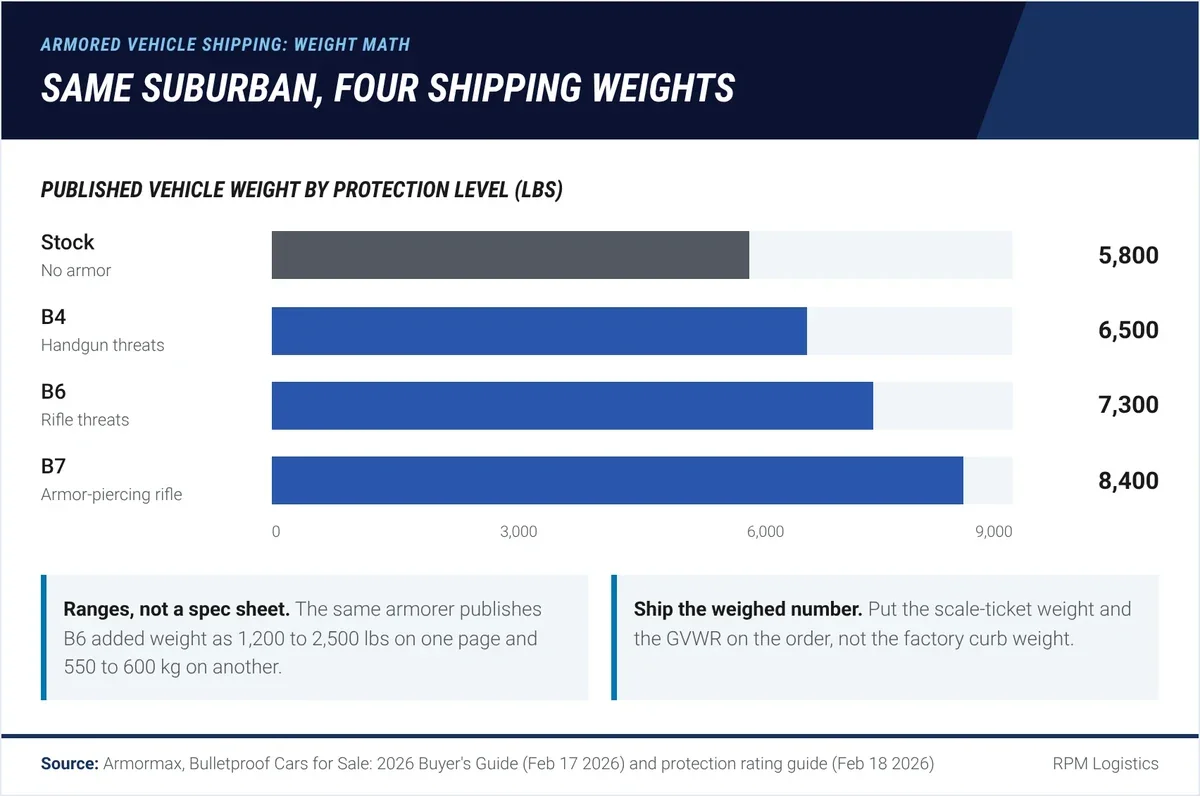
Published figures vary by armorer and by page. The weight that belongs on a transport order comes from a scale ticket.
The phrase "armored vehicle transport" has two meanings. One is cash-in-transit: armored trucks that carry money and valuables for banks and retailers. The other, covered here, is moving the armored vehicle itself. That is usually a civilian armored vehicle, such as an executive SUV built by a commercial armorer.
That second job looks like ordinary enclosed car transport on paper. It is not. The added weight changes what a trailer can carry. The armor can trigger federal export rules. And the vehicle's existence is information someone may want. This guide covers what changes and what a shipper should require.
How Much Weight Does Armoring Add to a Vehicle?
Armoring adds anywhere from about 500 lbs to 3,500 lbs, depending on the protection level. Armorers commonly describe packages on the European CEN scale, B1 through B7, with U.S. NIJ levels and the German VPAM scale also in use. Higher levels need thicker materials. Armormax lists B4 glass at 21 to 22 mm and B6 glass at 38 to 42 mm (Armormax, 2026).
The weight ranges and Suburban example below come from Armormax's 2026 buyer's guide, published February 17, 2026. Threat descriptions follow published level guides from Armormax and Alpine Armoring.
Protection level | Typical threat | Published added weight | Example: Chevrolet Suburban |
|---|---|---|---|
Stock | None | None | 5,800 lbs |
B4 | Handguns, including .44 Magnum | 500 to 1,200 lbs | 6,500 lbs |
B5 | AR-style rifles | 800 to 1,800 lbs | Not published |
B6 | 7.62mm battle rifles | 1,200 to 2,500 lbs | 7,300 lbs |
B7 | Armor-piercing rifle rounds | 2,200 to 3,500 lbs | 8,400 lbs |
Treat those numbers as a starting point, not a spec. The same armorer's protection-rating guide, dated February 18, 2026, puts B6 armor at 550 to 600 kg. That converts to roughly 1,200 to 1,320 lbs, the low end of the other page's range. An older Armormax shipping article put full armor at "up to 1000 lbs." Three pages from one company, three different answers.
The practical fix is simple. Weigh the vehicle before booking and put the scale-ticket weight on the order. Record the gross vehicle weight rating (GVWR) from the door-jamb label too, and ask the armorer whether it changed. The factory curb weight on the original window sticker is the wrong number.
What Armor Weight Changes on an Enclosed Carrier
Armor weight changes three things on an enclosed car hauler: where the vehicle can ride, how it loads, and how many other vehicles share the trailer. None of these show up if the order lists a stock curb weight.
- Deck position. Positions on a multi-car enclosed trailer do not all carry the same rated weight. Ask which position is rated for the scale weight.
- Liftgate capacity. Many enclosed trailers load with a hydraulic liftgate. Ask for the gate's rated capacity in writing and compare it to the scale weight.
- Axle and gross limits. Federal rules cap a truck at 80,000 lbs gross. Single axles max out at 20,000 lbs and tandems at 34,000 lbs, under 23 CFR 658.17. Armor counts against those limits like any other cargo, so heavy units can mean fewer vehicles per load.
- Securement. Heavier vehicles load straps harder. Confirm the method and strap ratings, and read our comparison of soft-tie and hard-tie enclosed securement before you approve either.
An armored sedan or SUV keeps its passenger-car footprint, so the question is usually weight rating, not size. Purpose-built armored trucks and tactical vehicles are a different job. Those can need lowboy equipment and permits, which our guide to over-dimensional vehicle transport explains.
When an Armored Vehicle Needs an Export License
An armored civilian vehicle can be subject to U.S. export controls when it leaves the country, including by road to Canada or Mexico. Whether a license is needed depends on classification and destination. The entry written for armored civilian vehicles is ECCN 0A606.b.1 on the Commerce Control List, in Supplement No. 1 to 15 CFR Part 774. It covers unarmed, civilian-derived vehicles that meet all four of these conditions:
- Ballistic protection equal to or better than level III under NIJ standard 0108.01 (September 1985), or equivalent standards.
- A transmission that drives front and rear wheels at the same time.
- A GVWR greater than 4,500 kg, about 9,921 lbs.
- Designed or modified for off-road use.
The details matter. The test uses GVWR, not curb weight. A vehicle that misses any one condition falls outside 0A606.b.1, which is why the armorer's written classification matters. Notes to the entry exclude civilian vehicles specially designed to carry money or valuables. Vehicles with reactive or electromagnetic armor go to USML Category VII under the State Department's ITAR. Separate armor parts and components can fall under 0A606.b.2.
The table below maps common move types to the rule a shipper should check before the vehicle moves.
Move type | Rule to check | Who usually answers it |
|---|---|---|
Domestic, U.S. to U.S. | No export rule; state titling and registration only | Owner or dealer |
U.S. to Canada or Mexico by road | ECCN 0A606 classification; CBP vehicle export filing | Armorer and exporter of record |
U.S. port for overseas shipment | Same, plus Electronic Export Information | Exporter of record and freight forwarder |
Loose armor panels or glass | 0A606.b.2 parts and components | Armorer |
Reactive or electromagnetic armor | USML Category VII (ITAR) | Manufacturer and export counsel |
Two filing rules apply on top of classification. Under 15 CFR 30.2, Electronic Export Information is required regardless of value for two cases. One is items that need a Commerce license. The other is used self-propelled vehicles. For a used vehicle, CBP also requires the title and two copies at least 72 hours before export, under 19 CFR 192.2.
The receiving side has its own rules. Manitoba, for one, bars owning or driving a fortified vehicle without a provincial permit. The rule sits in its Body Armour and Fortified Vehicle Control Act. Imports into the U.S. raise different questions, covered in our guide to bonded in-transit vehicle moves. Classification belongs to the armorer and the exporter of record. Get it in writing before a carrier is booked. This section is general information, not legal advice.
Why Discretion Is a Transport Requirement
Discretion matters because the shipment record tells a reader what the vehicle is, where it sits and who owns it. For an armored vehicle, that information is a security exposure in its own right. The theft data points to how booking information gets out.
- Verisk CargoNet counted 677 supply chain theft incidents in Q2 2026, down 26% year over year. Estimated losses still rose to $304.6 million (Verisk CargoNet, 2026).
- The average value of thefts with a reported commodity value reached $564,009 that quarter (Verisk CargoNet, 2026).
- Fictitious pickups barely moved, from 165 to 158 events year over year (Verisk CargoNet, 2026).
- Per the Verisk CargoNet Q2 2026 release, business email compromise remained the primary access point for identifying shipments.
Verisk's release headline attributes the jump in losses to high-value metals and technology heists. Consider an email thread that says "armored Range Rover, B6, delivering to a residence." That detail belongs inside a named group. For the wider threat picture and controls, see our cargo theft prevention framework.
A Chain-of-Custody Protocol for Armored Vehicle Shipping
A chain-of-custody protocol is a written sequence that names who holds the vehicle, and who knows about it, at each step. These six steps cover the points where an armored move can leak information or lose accountability.
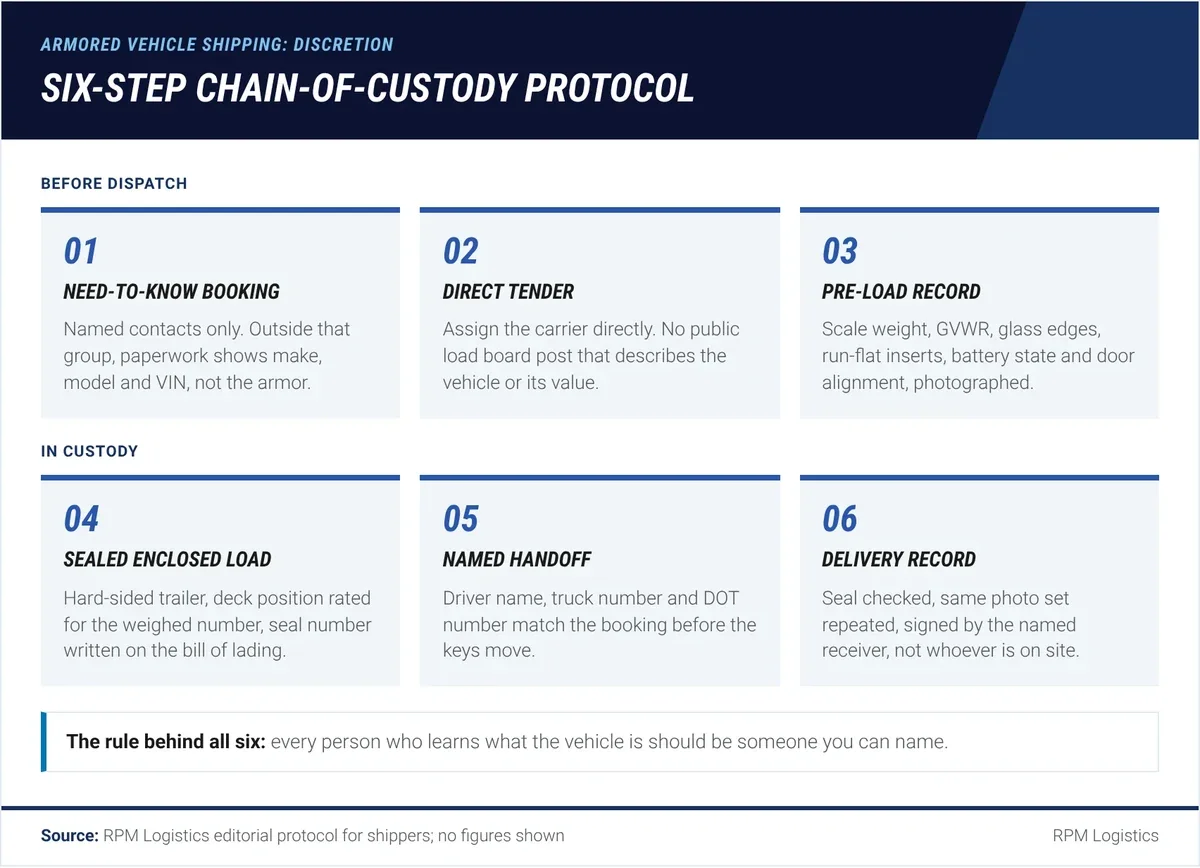
Steps one and two happen before any carrier sees the vehicle, so they decide who learns about it.
- Need-to-know booking. Name the people who know the vehicle is armored. Everyone else sees make, model and VIN.
- Direct tender. Assign the carrier directly. Do not post the vehicle or its value on a public load board.
- Pre-load record. Capture scale weight, GVWR, glass, run-flats, battery state and door alignment in dated photos.
- Sealed enclosed load. Use a hard-sided trailer and a rated deck position. Write the seal number on the bill of lading.
- Named handoff. Match driver name, truck number and DOT number to the booking before releasing keys.
- Delivery record. Check the seal, repeat the photo set and get a signature from the named receiver.
A fictitious pickup works only when someone releases a vehicle to the wrong truck. Step five is the check that stops that release.
What to Photograph on an Armored Vehicle Before Loading
An armored vehicle needs a condition record that covers its armor-specific parts, not just paint and body panels. A standard inspection form does not prompt for armor components.
- Ballistic glass. Photograph every edge and corner. Look for delamination, bubbles or clouding at the edges, and record what you find.
- Door alignment. Armored doors are heavy. Note gaps, hinge condition and how each door closes.
- Run-flat inserts. Record tire condition and any run-flat system the armorer fitted.
- Battery and electrical. Sirens, intercoms and other add-ons can drain a battery in storage. Note voltage and any disconnect instructions.
- Underbody. Photograph floor armor and fuel tank protection where visible.
Use date-stamped photos and signatures at both ends. Our guide to insurance-grade condition reporting explains the standard a claim adjuster expects.
What to Require From an Armored Vehicle Transport Provider
A shipper should require written answers on weight, equipment, value coverage and information handling before tender. Armoring cost drives the value at risk. Armormax's February 18, 2026 rating guide puts B4 at $45,000 to $75,000, B6 at $120,000 to $180,000 and B7 above $250,000.
Add the base vehicle, and many armored vehicles land above the $100,000 line commonly used to define high-value freight. For context, Verisk CargoNet put the average 2025 cargo theft loss at $273,990 (Verisk CargoNet, 2026). The checklist below covers the core asks.
Requirement | Why it matters | What to ask for |
|---|---|---|
Weight-rated position | Positions carry different rated weights | Deck position and liftgate rating in writing |
Cargo coverage at declared value | No federal cargo minimum exists for auto haulers | Certificate showing cargo limit above vehicle plus armor value |
Enclosed, hard-sided trailer | Hides the vehicle and protects glass | Trailer type and seal practice |
Need-to-know handling | Email was the main access point in Q2 2026 | Named contacts and no public posting |
Driver and truck match | Blocks fictitious pickups | Driver name, truck and DOT number before pickup |
Storage plan | A missed window leaves the vehicle somewhere unplanned | Indoor storage location if delivery slips |
The federal $750,000 minimum in 49 CFR 387.9 is public liability, not cargo coverage. Read the cargo certificate itself. For multi-vehicle moves, our playbook on relocating a luxury vehicle collection covers sequencing and agreed-value coverage. Our guide to enclosed transport for luxury SUVs covers trailer equipment.
Frequently Asked Questions
How much does it cost to armor a vehicle?
Armoring cost rises with protection level. Armormax's February 2026 rating guide lists B4 handgun protection at $45,000 to $75,000, B6 rifle protection at $120,000 to $180,000, and B7 at $250,000 or more. Those figures cover armoring, not the base vehicle. The total is the value your transport cargo coverage needs to match.
Does an armored civilian vehicle need an export license?
It can. ECCN 0A606.b.1 controls unarmed civilian-derived vehicles with level III or better ballistic protection, simultaneous front and rear drive, a GVWR above 4,500 kg, and off-road design. Vehicles built to carry money or valuables are excluded. The armorer and exporter of record should confirm classification in writing before the vehicle leaves the U.S.
How much does it cost to ship an armored car?
Price depends on the specific move, so treat any quoted national average with caution. Price follows distance, enclosed trailer availability, the scale weight, the deck position that weight requires, and the cargo coverage limit. Export moves add CBP filing, classification and port handling costs. Request quotes using the weighed number, not curb weight.
Can an armored SUV ship on a standard enclosed car carrier?
Often, yes, if the carrier assigns a deck position and liftgate rated for the weighed vehicle. A B7 Suburban published at 8,400 lbs is much heavier than its 5,800-lb stock version. Purpose-built armored trucks and tactical vehicles usually need heavy-haul equipment and permits instead of a car carrier.
Should the transport order say the vehicle is armored?
The carrier assigned to the move needs to know the true weight and handling needs, so tell that carrier directly. Load board posts, wide email threads and generic paperwork do not need the word "armored." Keep the description to make, model, VIN and weight, and limit armor details to named contacts.
Plan an Armored Vehicle Move With RPM Logistics
RPM arranges enclosed transport across all 50 states and Canada, with condition reporting at pickup and delivery, booking and document coordination, and access to 70+ storage locations (as of September 2026) when a delivery window moves. Share the weighed number and your handoff contacts when you request a quote. Get a Quote