

Quick Answer
Auto haulers usually leave money on the road in five places. They are unmanaged receivables, reactive claims handling, fuel surcharge gaps, slow month-end close and equipment bought without lifecycle cost. Each leak is small on one load and large across a year. Tracking one number for each makes the leaks visible and fixable.
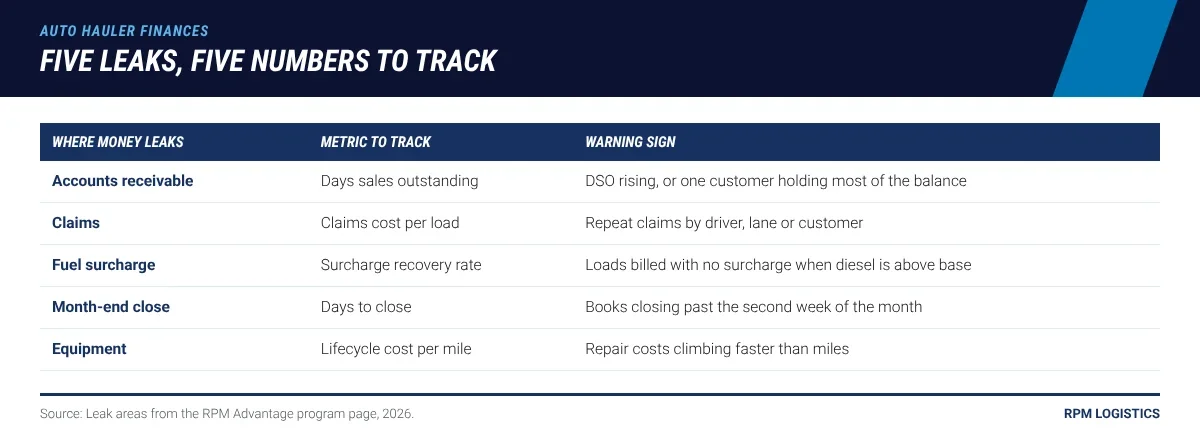
None of these leaks shows up as a single bad load; each one only becomes visible when someone tracks the number on the right.
Where do auto haulers lose money they already earned?
Auto haulers lose money they already earned in the gap between hauling a load and keeping the cash from it. The work gets done, but slow invoices, unpaid claims, missed surcharges and stale numbers eat into what reaches the bank. These are profit leaks, not revenue problems.
The RPM Advantage carrier program page lists five leak areas that show up again and again in auto hauling businesses:
- Equipment decisions made without a full lifecycle cost analysis.
- Unmanaged accounts receivable.
- Reactive claims handling.
- Slow month-end close.
- Fuel surcharge gaps.
The margin for error is thin. The average marginal cost of operating a truck reached $2.336 per mile in 2025, the highest in ATRI's annual report (ATRI, 2026). When costs run that high, a few cents per mile of leakage decides whether a fleet grows or stalls.
This article covers each leak and the number that tracks it. A profitable carrier can still run short of cash. Our companion piece on car haulers who are profitable on paper but broke in the bank explains why.
How does unmanaged accounts receivable drain an auto hauler?
Unmanaged accounts receivable drains an auto hauler by turning finished loads into loans to customers. Every day an invoice goes unpaid, the carrier carries fuel, payroll and equipment payments on its own cash.
Common A/R leaks include:
- Late invoicing, sent days after delivery instead of the same day.
- Missing paperwork, such as a signed delivery receipt or condition report, that gives the customer a reason to hold payment.
- Disputes left open without a follow-up date.
- No aging review, so 60- and 90-day balances go unnoticed.
- Concentration risk, where one slow customer controls most of the cash.
The number to track: days sales outstanding (DSO). DSO is your accounts receivable divided by average daily revenue. A rising DSO means customers are paying more slowly, even if revenue looks fine.
The results of fixing A/R can be large. One established auto transport company reduced its outstanding A/R by more than 60% after restructuring collections, according to case results on the RPM Advantage page. A faster-growing operation cut monthly A/R by more than 85%.
Why does reactive claims handling cost so much?
Reactive claims handling costs so much because the carrier starts gathering evidence only after a customer files. By then, the photos, notes and driver memory that could settle the claim are hard to find. Without them, many claims get paid in full.
Federal rules set the timeline. Under 49 CFR Part 370, a carrier must acknowledge a written cargo claim within 30 days. It must pay, decline or make a firm settlement offer within 120 days. A carrier without records spends those days guessing.
A proactive claims process looks like this:
- Photo condition reports at every pickup and delivery, with timestamps.
- Exceptions noted on the spot, before the customer signs.
- Claims logged the day they arrive, with a response date.
- Root cause tracked by driver, equipment and customer.
- Coverage reviewed so cargo limits match the vehicles you haul. Check federal minimums on the FMCSA insurance requirements page and the $750,000 liability floor in 49 CFR 387.9.
The number to track: claims cost per load, or per hundred loads. It shows whether claims are a few bad days or a steady drain.
Claims are often the biggest controllable cost. A high-growth automotive logistics company lowered its monthly claims cost by more than 95%, according to case results published on the RPM Advantage page. Our guide to photo condition reports that end claim disputes shows what the documentation should include.
What is a fuel surcharge, and where do haulers lose it?
A fuel surcharge is an added charge that adjusts a freight rate for changes in diesel prices. It lets the carrier recover fuel costs above an agreed base price. The line-haul rate then does not need renegotiating every time diesel moves.
Most fuel surcharge programs share three parts:
- An index, commonly the weekly U.S. on-highway diesel price published by the U.S. Energy Information Administration.
- A base or peg price, the diesel price already built into the rate.
- A per-mile formula, usually the difference between the index and the base, divided by an assumed miles-per-gallon figure.
Here is a hypothetical example, not a market rate. Suppose the base is $4.00 a gallon, the index is $4.60 and the agreed fuel economy is 6 miles per gallon. The surcharge is $0.60 divided by 6, or $0.10 per mile.
Haulers lose surcharge money in a few common ways:
- No surcharge clause in spot or direct customer agreements.
- Stale base prices that no longer match current rates.
- Infrequent updates, so the surcharge lags rising fuel prices.
- Billing errors, where the surcharge is calculated but never invoiced.
The number to track: fuel surcharge recovery rate, the share of excess fuel cost actually billed and collected.
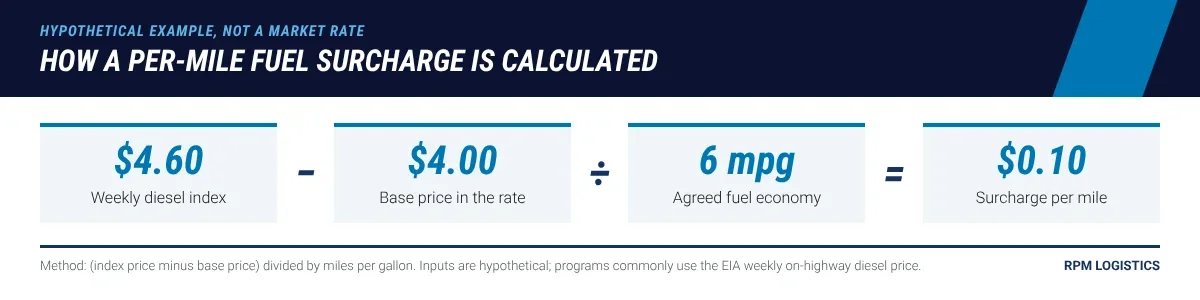
The inputs are hypothetical; the leak is usually not the formula but a base price nobody updated or a surcharge nobody invoiced.
Why does a slow month-end close cost auto haulers money?
A slow month-end close costs auto haulers money because owners end up making decisions with old numbers. Pricing, hiring and equipment choices depend on knowing which lanes, customers and trucks are profitable right now.
Slow books can leave owners working from data that is 45 days old, according to the RPM Advantage page. By then, a losing lane has run for six more weeks, and a slow customer has added another month of unpaid invoices.
A faster close usually comes from a few changes:
- Same-day invoicing, so revenue is booked when it is earned.
- Weekly reconciliation of bank, fuel card and settlement accounts.
- A standard close checklist with owners and due dates.
- Profit by truck and lane, not just for the whole company.
The number to track: days to close, from month-end to final books. One high-growth operation made its month-end close five times faster after building a finance function, per the RPM Advantage case results.
How do equipment decisions leak money over time?
Equipment decisions leak money over time when a truck or trailer is chosen on price or payment alone. The real cost includes maintenance, downtime, fuel, insurance and resale value across the years you run it.
Equipment is one of the biggest lines in any hauler's budget. Truck and trailer lease or purchase payments ran 40.4 cents per mile in 2025, up from 39 cents a year earlier (ATRI, 2026). A cheaper unit with higher repair costs or poor resale can cost more per mile than a pricier one.
Before you buy or lease, compare:
- Payment and term, including how much is paid off at trade time.
- Expected maintenance by age and mileage.
- Downtime risk and access to parts and service.
- Load capacity, such as how many cars each trailer configuration carries.
- Resale value at the end of your planned ownership.
The number to track: lifecycle cost per mile, all-in cost divided by expected miles. Our guides to auto hauler equipment financing and lease-to-own, rent or buy for car hauler trailers cover the acquisition side.
What does a monthly leak review look like?
A monthly leak review is a short meeting where the owner checks the five numbers against last month and against targets. It takes under an hour once the numbers are reported the same way each month.
Leak | Metric | What to look for |
|---|---|---|
Accounts receivable | Days sales outstanding | Rising DSO, or one customer driving most of the balance |
Claims | Claims cost per load | Repeat claims by the same driver, lane or customer |
Fuel surcharge | Surcharge recovery rate | Loads with no surcharge billed when diesel is above base |
Month-end close | Days to close | Close slipping past the second week of the month |
Equipment | Lifecycle cost per mile | Units whose repair costs are climbing faster than miles |
Share the numbers with whoever can act on them, such as dispatchers for claims and office staff for A/R. Pick one leak to fix each quarter rather than all five at once. A single improvement that sticks is worth more than five that fade.
Which leak should an auto hauler fix first?
An auto hauler should usually fix the leak that ties up the most cash first. For most small fleets, that is accounts receivable or claims, because both hold money that has already been earned.
A simple way to rank them:
- Add up the dollars at stake for each leak over the last quarter: overdue A/R, claims paid, surcharge not billed.
- Estimate the effort to fix each one, from a billing change to a new process.
- Start with the largest dollars for the least effort.
Fuel surcharge gaps are often the quickest win. Adding a surcharge clause to new agreements and checking that it is invoiced can recover money within weeks. Month-end close and equipment lifecycle costing take longer, but they improve every decision after them.
Whatever you fix first, write down the baseline number before you start. Without it, you cannot tell whether the change worked.
How RPM Advantage helps haulers close the leaks
RPM Advantage is RPM's program for owner-operators and fleets of 5 to 30 or more trucks. Its financial consultation pillar, through Guastella Advisors, covers the leaks above, from a one-time financial assessment to full-charge CFO support. That support includes month-end close, claims support, cash-flow predictability, cost tracking, A/R management and rolling forecasts.
The program also covers equipment financing through Equipment Funding Solutions and preferred equipment through Sun Country Trailers. A dedicated carrier program adds daily revenue per piece of equipment. Small carriers can fold within 90 days of a cash crunch, the program page notes. Closing leaks early is cheaper than recovering from one.
Learn more on the RPM Advantage page, or see our carrier financing overview.
Frequently asked questions
What is a good profit margin for a car hauling business?
Margins vary widely by lane, equipment and customer mix, so there is no single good number. Track profit by truck and lane each month to see which parts of the business earn the most.
How is a trucking fuel surcharge calculated?
A common method subtracts an agreed base diesel price from a weekly index price, then divides by an assumed miles per gallon. The result is a per-mile surcharge added to the line-haul rate.
What is days sales outstanding for a trucking company?
Days sales outstanding is accounts receivable divided by average daily revenue. It shows how many days, on average, customers take to pay.
How long does a carrier have to respond to a cargo claim?
Under 49 CFR Part 370, a carrier must acknowledge a written claim within 30 days. It must pay, decline or make a firm settlement offer within 120 days.
Why does a slow month-end close matter for auto haulers?
A slow close means decisions are made on old numbers. The RPM Advantage page notes that slow books can leave owners working from data that is 45 days old.
Who provides financial consulting through RPM Advantage?
Financial consulting comes through a preferred-advisor partnership with Guastella Advisors. Services range from a financial assessment to full-charge CFO support.
Keep more of what you haul
Every leak above is fixable once it is measured. RPM Advantage pairs financial guidance, equipment and dedicated freight for auto haulers ready to tighten up. Explore RPM Advantage or talk to our carrier team.